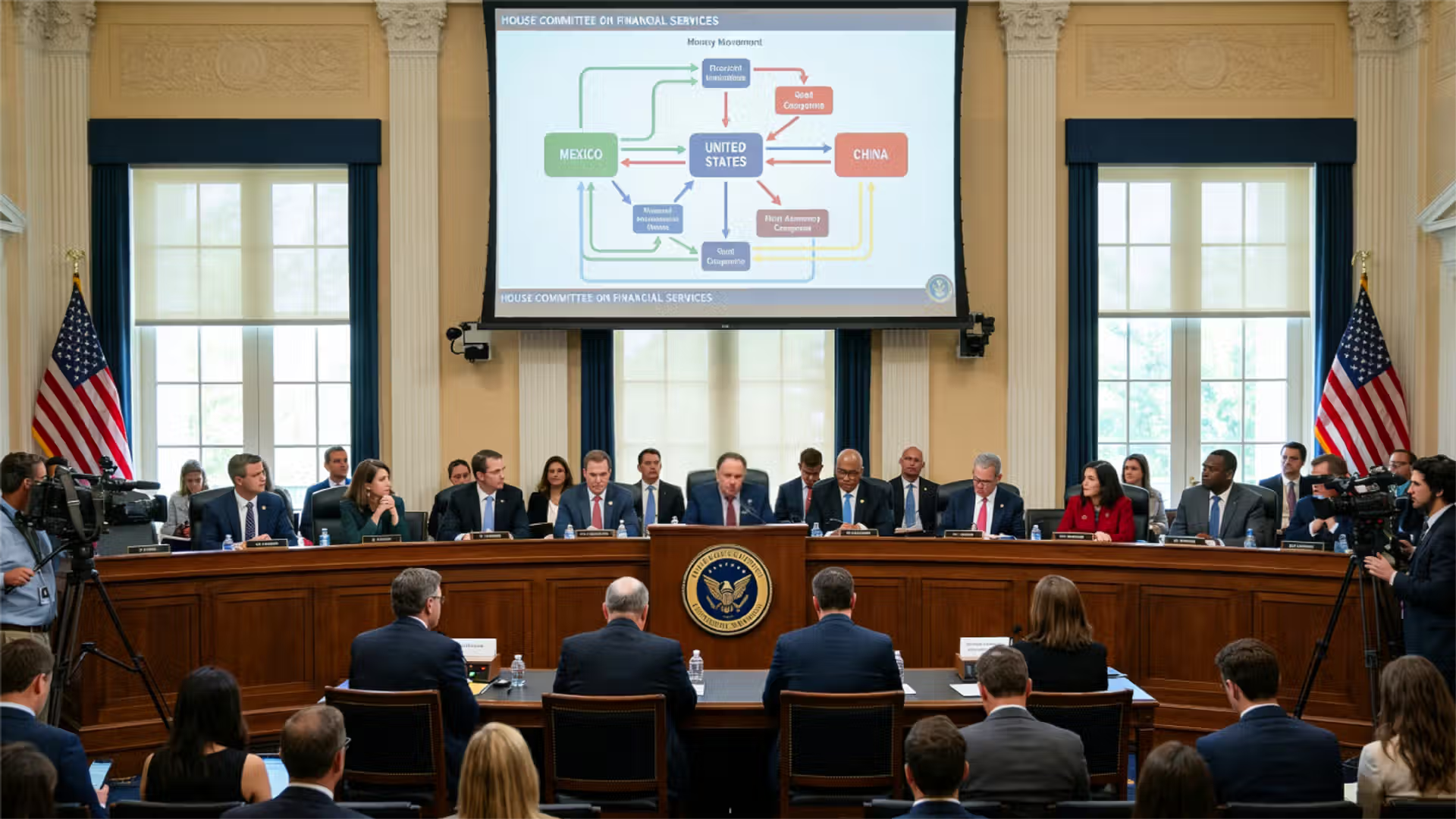
An expansive economic investigation spearheaded by the Lodi Public Prosecutor’s Office and executed by the Economic and Financial Police Unit of the Guardia di Finanza in Italy has exposed a massive Chinese money laundering network responsible for processing more than 200 million euros in illicit capital using sophisticated Chinese underground banking systems. The comprehensive enforcement action resulted in judicial orders targeting forty-four individuals and the execution of personal precautionary measures against eight key suspects implicated in self-laundering, corporate malfeasance, and systemic tax fraud. Law enforcement officials successfully executed a preventive seizure order totaling 31 million euros, recovering extensive physical and digital assets linked directly to the fraudulent operations. This cross-border enforcement operation highlights the growing complexity of parallel banking structures that deliberately bypass established European regulatory frameworks to facilitate international capital flight and conceal criminal proceeds. The judicial decree authorized immediate preventive seizures of extensive corporate bank accounts, luxury properties, and hidden physical currency across multiple regions to ensure full asset recovery.
Table of Contents



Fictitious Corporate Networks Exploit Chinese Underground Banking Channels
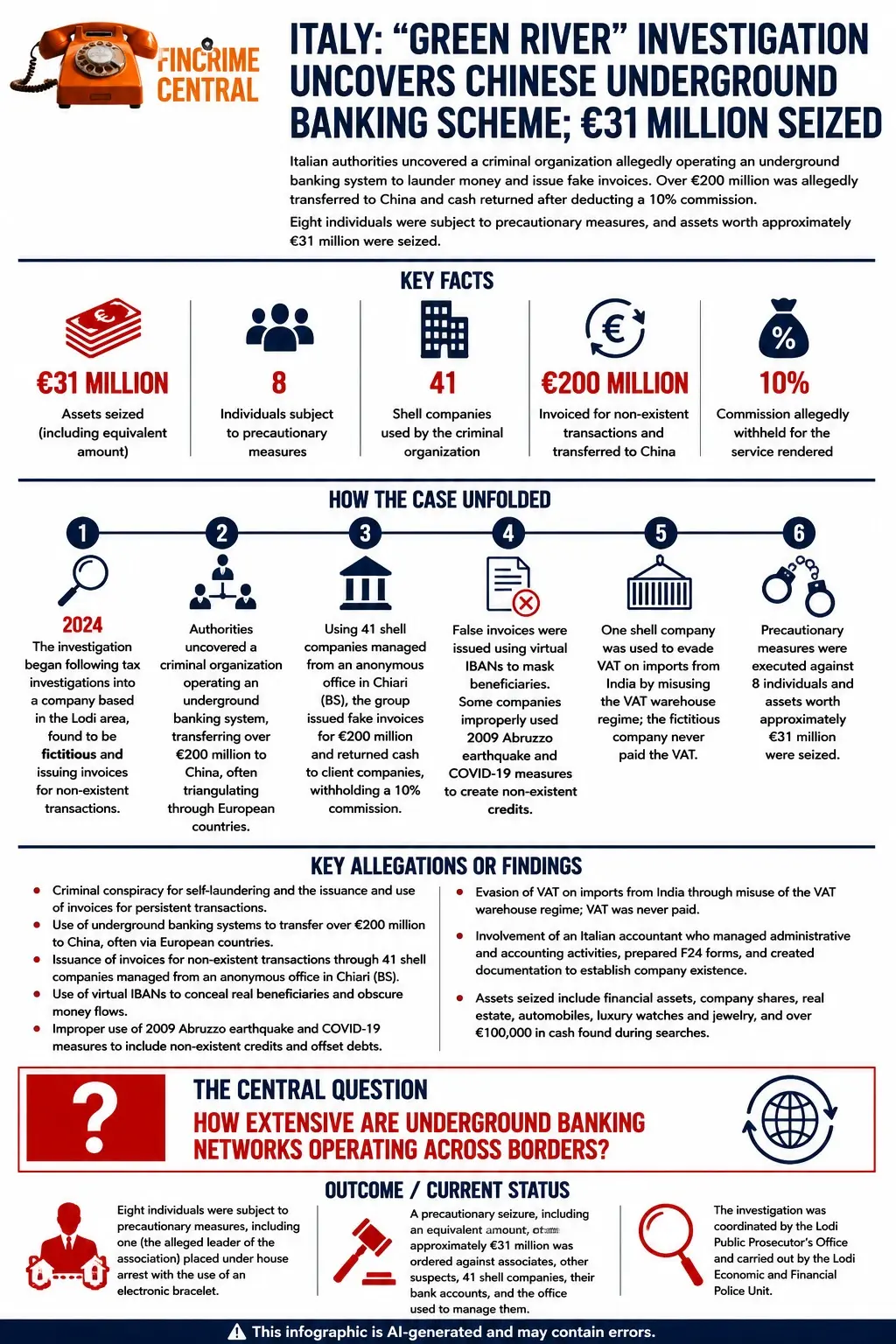
The illicit financial operations managed by the Chinese money laundering network relied heavily on a highly complex mechanism known as Chinese underground banking, operating completely outside the supervision of traditional financial regulators. This unauthorized banking system allowed the criminal syndicate to move massive volumes of capital across international borders without triggering mandatory anti-money laundering alerts or reporting requirements. To facilitate these unmonitored financial flows, the organization integrated virtual international bank account numbers into its transaction routines, creating a sophisticated redirection layer that baffled automated compliance systems. These virtual identifiers effectively masked the ultimate destinations of the funds by consolidating thousands of unique commercial transfers into centralized master accounts. By routing more than 200 million euros through these untraceable channels, the CMLN provided a highly secure laundering pipeline for multiple criminal enterprises, successfully absorbing capital derived from corporate bankruptcy, drug trafficking networks, organized crime syndicates, and widespread tax evasion. This parallel financial architecture effectively allowed foreign economic actors to repatriate immense volumes of unmonitored wealth directly back to Asia while completely circumventing European compliance mandates and capital flight restrictions.




Clandestine Administrative Office Managed 41 Paper Mills
At the absolute center of this multi-layered corporate fraud scheme engineered by the CMLN was a network of forty-one shell companies that existed exclusively on paper to generate fake business records. The administrative, logistical, and accounting operations for these paper mills were secretly handled through a hidden corporate office situated in Chiari, inside the province of Brescia. This hidden hub orchestrated the issuance of thousands of fabricated commercial invoices for non-existent transactions, totaling approximately 200 million euros, which were distributed to numerous domestic client companies. These client corporations executed electronic bank transfers to the paper mills to create a formal appearance of legitimate commercial trade, thereby reducing their overall national tax liabilities. Once the funds arrived in the accounts of the shell firms, the criminal organization moved the capital through international financial nodes before returning the cleaned money back to the original clients in physical cash. For managing this circular financial architecture and facilitating cash repatriation, the criminal syndicate retained a fixed ten percent commission on every transaction, accumulating massive profits while stripping tax revenues from the public treasury.


Exploitation of State Relief Programs and International Trade Systems
Beyond the generation of fictitious corporate expenses, the Chinese money laundering network deliberately targeted state emergency relief frameworks and public financial assistance programs to secure illicit advantages. Auditors established that several shell companies entered entirely fabricated receivables into their formal accounting ledgers, improperly claiming tax credits originally designed by the government to support economic recovery following the 2009 Abruzzo earthquake and the recent global pandemic. The organization used these non-existent tax credits illegally to offset extensive corporate liabilities, including mandatory social security contributions, national insurance premiums, and direct tax obligations. Concurrently, the network utilized its corporate infrastructure to orchestrate large-scale value-added tax fraud schemes tied to the importation of commercial goods from India. By exploiting the specialized value-added tax warehousing regime, which allows qualified operators to work under a tax suspension arrangement, an intermediate front company systematically deferred tax payments indefinitely, ensuring the final buyers received the goods while the tax liabilities remained entirely unpaid. This aggressive manipulation of regulatory relief systems demonstrates how the CMLN adapted its tactics to exploit niche legislative vulnerabilities.
Financial Fraud Indicator Typologies in Complex Commercial Invoicing Networks
Anti-money laundering professionals should maintain high awareness regarding specific operational anomalies and behavioral patterns that indicate the presence of underground financial structures, fictitious invoicing schemes, and parallel banking networks.
- Fictitious Corporate Structures: Business entities that display no physical infrastructure, possess no verifiable operational staff, and share centralized management locations with multiple unrelated firms while generating high volumes of financial transactions.
- Virtual Redirection Accounts: Extensive reliance on virtual international bank account numbers that automatically route diverse incoming corporate transfers to centralized master accounts without clear commercial justification.
- Structured Cash Repatriation: Frequent and large-scale transfers of corporate funds to foreign jurisdictions followed by rapid, unexplained cash withdrawals or the systematic return of physical currency to the original domestic entities.
- Abnormal Emergency Credit Offsets: Corporate tax filings that consistently utilize historical disaster relief credits, pandemic subsidies, or unexpected tax incentives to entirely offset social security, insurance, and national tax liabilities.
- Suspicious Customs Warehousing Schemes; Import transactions utilizing specialized tax suspension warehouses where intermediate corporate entities act as buyers but fail to settle final value-added tax obligations before disappearing from commercial registers.
Key Points
- Operation Green River dismantled a criminal network that laundered over 200 million euros using unauthorized Chinese underground banking channels and virtual bank accounts.
- The Guardia di Finanza executed a preventive asset seizure of 31 million euros comprising real estate, vehicles, luxury items, and concealed cash discovered by canine units.
- The illicit infrastructure utilized forty-one paper mills coordinated from a secret office in Brescia to issue false invoices and return cash for a ten percent fee.
- The syndicate exploited emergency tax credits from the Abruzzo earthquake and pandemic relief alongside international value-added tax warehousing fraud schemes.
- A professional Italian accountant acted as an enabler by managing corporate books, fabricating compliance records, and processing fraudulent tax offset documentation.
Related Links
- Guardia di Finanza Media Portal
- Ministero dell’Economia e delle Finanze
- Financial Action Task Force Underground Banking Reports
- Financial Intelligence Unit for Italy Institutional Actions
- Procura della Repubblica presso il Tribunale di Lodi
Other FinCrime Central Articles About CMLNs
- US House Committee Hearing Examines Chinese Money Laundering Networks
- Chinese Syndicate Members Indicted for Cartel Money Laundering Under CMLN
- Italian Guardia di Finanza Dismantles €5 Billion Chinese Money Laundering-as-a-Service Network
Source: Guardia di Finanza
Some of FinCrime Central’s articles may have been enriched or edited with the help of AI tools. It may contain unintentional errors.
Want to promote your brand, or need some help selecting the right solution or the right advisory firm? Email us at info@fincrimecentral.com; we probably have the right contact for you.