The federal indictment unsealed in the Eastern District of Virginia exposes a complex financial web designed to obscure the origins of immense narcotics profits generated by notorious international cartels. Federal authorities have charged two individuals who allegedly orchestrated these multi-jurisdictional systems to move illicit cash across borders without triggering detection from traditional banking institutions. The case underscores the critical vulnerability of global trade and alternative remittance systems to exploitation by sophisticated criminal entities operating across multiple continents. By integrating various underground banking techniques, the network managed to maintain a continuous flow of capital that sustained the operations of violent drug trafficking organizations. Investigators rely on cross-border coordination to dismantle these networks, which fundamentally depend on specialized financial facilitators who remain physically distant from the primary street-level drug distribution sites. This specific prosecution highlights the strategic pivot by law enforcement toward targeting the economic infrastructure of transnational crime under CMLN frameworks.
Table of Contents



Chinese Underground Banking Networks Drive Global Cartel Money Laundering
The sophisticated mechanism established by the defendants highlights the crucial role played by specialized brokers in executing illicit financial transfers for major narcotics cartels. According to official allegations, the operations stretched from November 2016 through April 2025, creating a resilient pipeline for cleaning cash generated from the sale of fentanyl and cocaine within American borders. The facilitators utilized a method known as mirror transfers, where funds are deposited in one jurisdiction, and an equivalent amount is released in another without the capital ever physically crossing an international border. This system effectively bypasses the conventional clearinghouses and reporting requirements established by federal regulatory frameworks. By operating this parallel financial structure, the syndicate offered a layer of absolute anonymity to the criminal organizations, shielding the identities of both the depositors and the ultimate beneficiaries of the transactions.
The structural design of these operations relied heavily on a global network of facilitators positioned in strategic financial hubs, including the United States, Mexico, Latin America, and China. Money laundering organizations frequently exploit the massive volume of legitimate commercial trade between these regions to mask their illicit transfers. The defendants allegedly embedded their financial transactions within legitimate business invoices, a practice that severely complicates detection by compliance officers who monitor standard corporate banking activities. This integration of illicit cash into the global supply chain makes it difficult to separate criminal proceeds from legitimate commercial revenue. The long duration of the conspiracy demonstrates the resilience of these underground networks and emphasizes the need for financial institutions to maintain dynamic monitoring systems capable of identifying anomalies that span multiple years and jurisdictions.
Furthermore, the operational security maintained by the network depended on strict protocols designed to prevent law enforcement interception. Participants utilized encrypted communications applications to coordinate the movement of cash and to transmit instructions regarding bank accounts and delivery locations. This digital insulation allowed the coordinators to direct field runners who collected bulk cash from domestic drug distribution operations. The reliance on specialized financial cells ensures that even if a courier is intercepted by authorities, the broader infrastructure remains intact and the central leadership remains insulated from direct criminal liability. This structural separation between the physical narcotics distribution and the financial processing represents a major challenge for traditional law enforcement strategies, necessitating highly specialized financial investigations.




Clandestine Verification Protocols Safeguard Transnational Laundering Channels
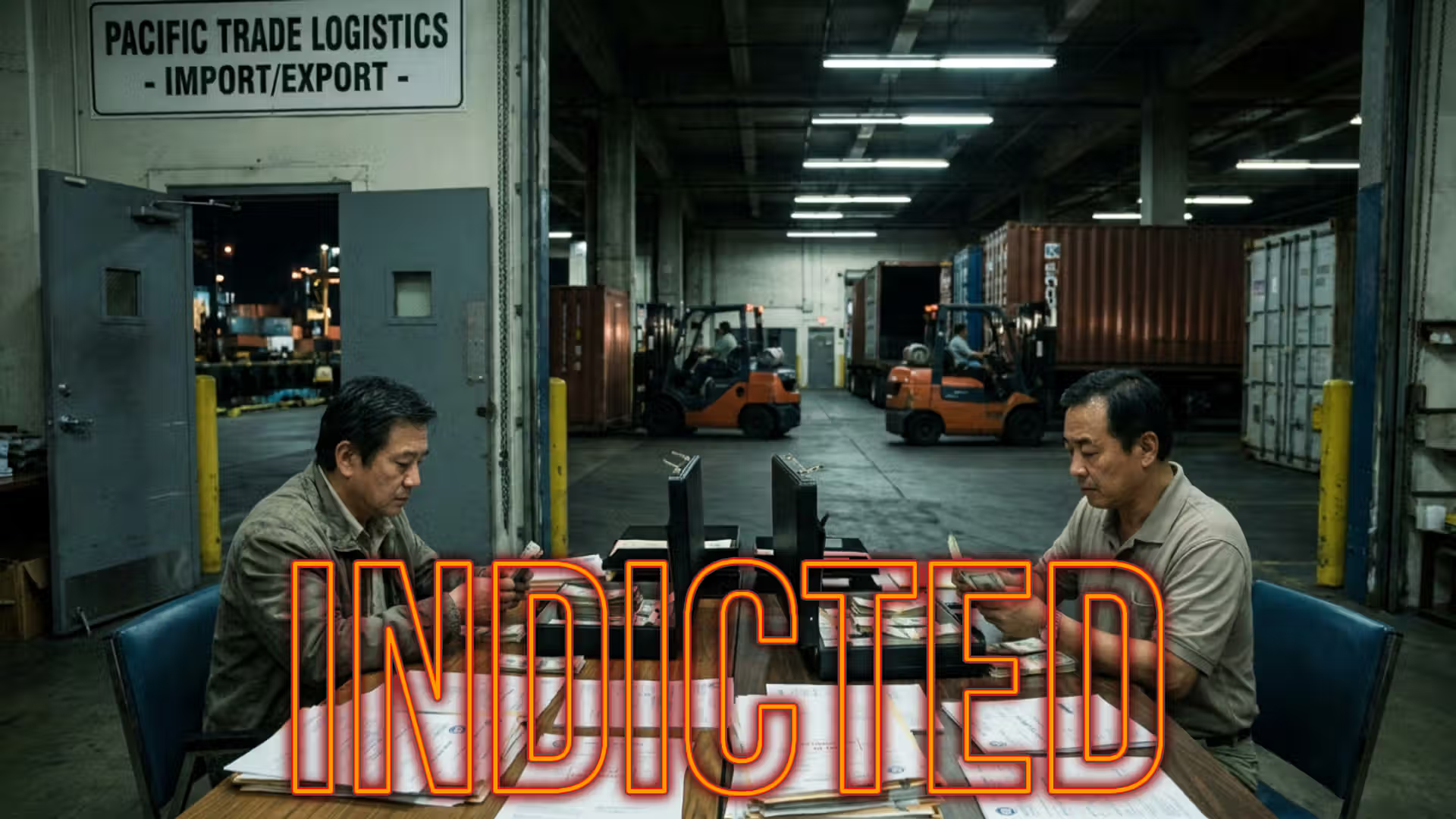
A defining characteristic of the criminal conspiracy was the implementation of a highly structured serial-number verification system used to authenticate large cash transactions. When bulk cash changed hands between couriers and the laundering network, the participants utilized the unique serial numbers on specific paper currency notes as a form of digital token or receipt. This process ensured that funds were only transferred to verified members of the organization, preventing theft and minimizing the risk of law enforcement infiltration. The use of such meticulous verification protocols demonstrates the institutional nature of modern transnational money laundering organizations, which operate with a level of administrative discipline that mirrors legitimate financial clearing houses. This systemic approach reduces reliance on mutual trust among criminals, replacing it with a rigid, verifiable validation process.
In addition to these physical authentication methods, the syndicate exploited foreign bank accounts to layer the illicit funds across multiple legal systems. By routing money through financial institutions located in jurisdictions with varying levels of regulatory oversight or bank secrecy laws, the organization effectively severed the audit trail. Layering involves moving funds through a rapid succession of transactions and accounts, creating a dizzying array of financial movements that exhaust investigative resources. The involvement of entities based in China and Latin America meant that investigators had to piece together fragmented financial records from disparate global banking systems. This international dispersion ensures that no single regulatory authority has a complete view of the illicit financial flow, allowing the network to exploit the operational gaps between national jurisdictions.
The integration phase of the laundering cycle was further facilitated by trade-based money laundering strategies. In this phase, the proceeds of the criminal are used to purchase commercial goods, which are then shipped to another country and sold to generate clean, legitimate currency. This technique allows the organization to convert narcotics cash into commercial inventory, effectively legitimizing the funds under the guise of international import and export activities. Compliance frameworks often struggle to detect trade-based laundering because the transactions involve physical merchandise and standard shipping documentation, which appear entirely legitimate on the surface. The blend of mirror transfers, foreign accounts, and trade-based manipulation created a multi-layered shield that protected the cartel’s wealth for nearly a decade.


Federal Enforcement Mobilizes Global Resources via Operation Take Back America
The indictment of the fugitives represents a coordinated effort by federal law enforcement to dismantle the financial scaffolding that supports international drug cartels. Spearheaded by the Drug Enforcement Administration and the Money Laundering, Narcotics, and Forfeiture Section of the Department of Justice, the investigation required the integration of intelligence from numerous domestic and international field offices. This wide-ranging collaboration underscores the reality that modern financial crime cannot be combated by a single localized agency. By tracking the movement of funds from domestic distribution points back to international financial gatekeepers, the task force aimed to disrupt the profitability that drives transnational cartel operations. The strategic focus of Operation Take Back America prioritizes the total elimination of these networks by targeting the financial facilitators who enable cartels to enjoy the profits of their domestic criminal activities.
The legal strategy employed in this prosecution focuses heavily on conspiracy charges, which allow prosecutors to hold financial facilitators liable for the broader criminal enterprise even if they never personally handled the physical narcotics. Under federal law, individuals who conspire to launder monetary instruments face severe statutory penalties, including a maximum of twenty years in prison for each count. This aggressive approach serves as a deterrent to professional gatekeepers, accountants, and underground bankers who might otherwise view the financial rewards of cartel facilitation as outweighing the legal risks. The pursuit of asset recovery and criminal forfeiture is designed to strip these organizations of their operational capital, rendering them unable to fund future trafficking operations or maintain their complex global logistical networks.
Despite the comprehensive nature of the indictment, the defendants remain at large, illustrating the persistent challenge of apprehending high-level financial facilitators who operate from international safe havens. Transnational money laundering rings frequently leverage their wealth to secure refuge in jurisdictions where extradition is legally complex or politically difficult. This reality emphasizes the ongoing importance of international cooperation and the utilization of global alerts to restrict the movement and financial access of indicted individuals. The federal grand jury in Alexandria, Virginia, has established a formal framework for prosecution, ensuring that whenever these individuals enter a cooperative jurisdiction, they will face immediate arrest and extradition to answer for their decades-long involvement in systemic financial subversion.
Typologies for Anti-Money Laundering Professionals
Financial institutions and compliance officers must remain vigilant against specific behavioral patterns and operational methodologies identified in large-scale cartel laundering networks. Recognizing these indicators during routine transaction monitoring can assist in identifying accounts that may be serving as conduits for transnational criminal organizations.
- Utilizing specific currency serial numbers as unique transaction tokens: Couriers verify the legitimacy of a counterparty by presenting a specific banknote before executing bulk cash handovers.
- Rapid succession of cross-border transfers involving unrelated third parties: Funds move through multiple foreign bank accounts in a short period without a clear economic justification.
- Frequent discrepancies between commercial trade documentation and account activity: Businesses display transaction volumes or geographic patterns that do not align with their industry norms.
- Heavy reliance on encrypted communication platforms for corporate coordination: Corporate entities or account holders avoid standard communication channels for high-value financial arrangements.
- Integration of commercial trade entities in non-traditional financial jurisdictions: Companies route payments through secondary regions that are disconnected from the actual origin of the goods.
Key Points
- Federal grand jury indicts international financial facilitators operating under CMLN frameworks for laundering narcotics proceeds.
- Syndicate utilized mirror transfers and foreign bank accounts to move cartel cash across global borders securely.
- Investigation exposes a highly structured verification protocol using currency serial numbers to validate illicit cash drops.
- Enforcement initiative coordinates multiple domestic and foreign law enforcement units to target cartel financial infrastructure.
- Defendants face a maximum penalty of twenty years in prison per count if apprehended and convicted.
Related Links
- United States Department of Justice Official Press Releases
- Drug Enforcement Administration Enforcement Actions
- Financial Action Task Force Red Flag Indicators
- Financial Crimes Enforcement Network Advisory Page
Other FinCrime Central Articles About CMLNs
- EPPO Seizes 1.2 Million Euros in Chinese Organized Crime Probe
- Italian Guardia di Finanza Dismantles €5 Billion Chinese Money Laundering-as-a-Service Network
- Chainalysis Data on 16.1 Bn$ Chinese Money Laundering Networks
Source: US DOJ
Some of FinCrime Central’s articles may have been enriched or edited with the help of AI tools. It may contain unintentional errors.
Want to promote your brand, or need some help selecting the right solution or the right advisory firm? Email us at info@fincrimecentral.com; we probably have the right contact for you.