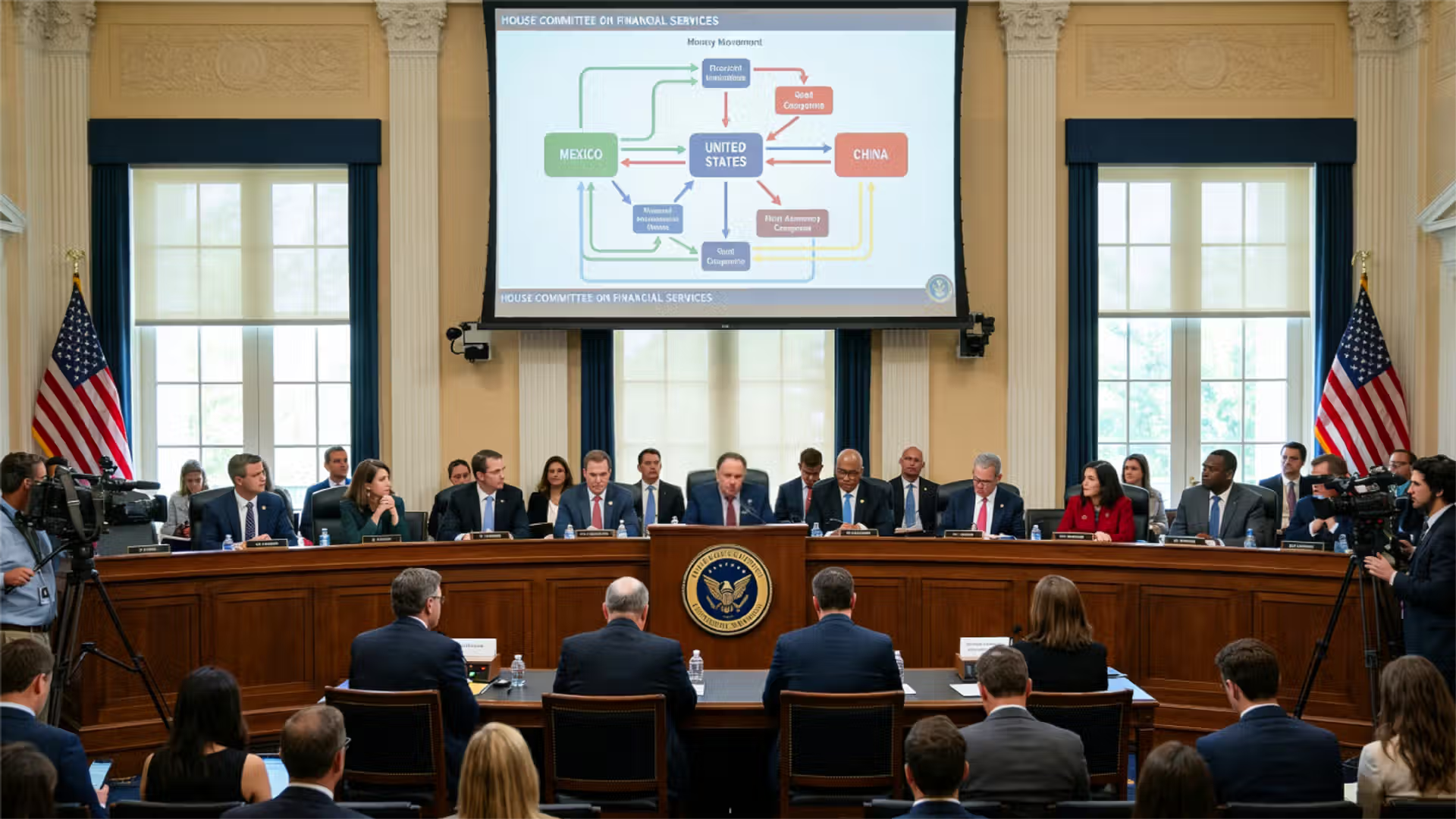
Chinese money laundering networks facilitating cartel financing within the United States financial system were the focus of a June 2026 hearing before the U.S. House Financial Services Committee. The hearing examined how sophisticated laundering organizations have become critical service providers for transnational criminal groups seeking to move and disguise illicit proceeds. Witnesses discussed the growing convergence between narcotics trafficking organizations and professional money laundering actors operating across multiple jurisdictions. Particular attention was given to the role of underground financial systems, trade-based schemes, and cross-border cash movement techniques that continue to challenge law enforcement and financial institutions. The discussion highlighted the increasing complexity of financial crime and the need for stronger detection and disruption capabilities.
Table of Contents


Chinese Money Laundering Networks and Cartel Financing
The June 2026 congressional hearing focused on a threat that has become increasingly prominent in financial crime investigations, namely the collaboration between Mexican drug cartels and Chinese money laundering organizations. Witnesses described how criminal groups have evolved beyond traditional cash smuggling methods and now rely on specialized laundering service providers capable of moving funds internationally while reducing exposure to enforcement actions.
According to testimony presented during the hearing, these networks function as financial intermediaries connecting criminal proceeds generated in the United States with individuals and entities seeking access to U.S. dollars abroad. Rather than physically transporting large quantities of cash across borders, laundering organizations often leverage informal value transfer mechanisms and commercial transactions that obscure the source and destination of funds.
A key concern raised during the hearing involved the efficiency and adaptability of these networks. Criminal organizations increasingly outsource financial operations to professional facilitators who possess expertise in international payments, currency exchanges, trade structures, and underground banking arrangements. This specialization enables narcotics traffickers to concentrate on drug distribution while relying on external actors to manage the financial component of the criminal enterprise.
The hearing also underscored the importance of understanding money laundering as a service industry. Rather than operating independently, laundering networks often support multiple criminal organizations simultaneously. This model creates resilience because disrupting a single trafficking organization may not eliminate the broader financial infrastructure that enables illicit proceeds to circulate through the global economy.




Financial Infrastructure Behind Transnational Crime
Witnesses described how modern laundering schemes exploit globalization, digital communications, international commerce, and fragmented regulatory environments. Criminal organizations increasingly seek jurisdictions, industries, and payment channels that provide opportunities to conceal ownership, disguise transactions, and move value with limited transparency.
Trade-based money laundering remains a significant concern in this context. Criminal actors may manipulate invoices, misrepresent goods, or structure commercial transactions in ways that transfer value while appearing legitimate. Such activity complicates detection because the movement of money is linked to seemingly lawful business activity rather than overt criminal transactions.
Another issue highlighted during the hearing was the role of underground banking systems. These networks can facilitate transfers without relying entirely on traditional banking channels. By matching counterparties across jurisdictions, value can be transferred through offsetting transactions while minimizing visible cross-border fund movements. Such structures create significant challenges for investigators attempting to reconstruct the complete financial trail.
Witnesses further emphasized that criminal organizations frequently adapt to enforcement pressure. When authorities disrupt one methodology, alternative mechanisms often emerge. This continuous evolution requires financial institutions, regulators, and law enforcement agencies to maintain dynamic risk assessment frameworks rather than relying exclusively on historical typologies.
The hearing also examined the broader national security implications associated with transnational criminal finance. Large-scale laundering operations can undermine sanctions effectiveness, facilitate corruption, strengthen organized crime groups, and create vulnerabilities within legitimate financial systems. As criminal networks become more interconnected internationally, the distinction between narcotics trafficking, financial crime, and other illicit activities becomes increasingly blurred.


Regulatory and Investigative Challenges
A central theme throughout the hearing involved the difficulty of identifying and dismantling highly sophisticated laundering ecosystems. Traditional investigative approaches often focus on individual transactions or specific criminal organizations. However, witnesses suggested that authorities must increasingly target the financial facilitators who connect multiple criminal enterprises.
Financial institutions face particular challenges when transactions appear commercially reasonable on the surface. Professional laundering organizations frequently design structures intended to mimic legitimate business activity. This makes it difficult to distinguish illicit transactions from ordinary commercial conduct without robust monitoring capabilities and contextual analysis.
The hearing also highlighted the importance of information sharing. Effective disruption of transnational laundering schemes requires coordination among domestic agencies, foreign counterparts, financial institutions, and intelligence organizations. Criminal actors frequently exploit jurisdictional boundaries and regulatory differences to fragment investigative visibility.
Beneficial ownership transparency was identified as another important consideration. Complex corporate structures can obscure the individuals ultimately controlling assets and accounts. Where ownership information is incomplete or difficult to verify, criminal actors may find opportunities to conceal their involvement in financial transactions.
The discussion reinforced the need for continuous modernization of anti-money laundering frameworks. Emerging threats increasingly involve networks operating across multiple countries, industries, and financial channels. Effective responses therefore require not only enforcement actions but also improvements in data analysis, international cooperation, and financial intelligence capabilities.
Typologies Associated With Chinese Money Laundering Networks
AML professionals should understand that professional laundering organizations often operate as service providers supporting multiple criminal enterprises simultaneously. Cases involving cartel proceeds and international laundering facilitators frequently display recurring transactional and behavioral indicators.
- Underground banking arrangements; Value is transferred through offsetting transactions and informal settlement mechanisms that reduce visible cross-border fund flows.
- Trade-based value transfer: Commercial invoices, import-export activity, or goods transactions are manipulated to move value while disguising the criminal origin of funds.
- Third-party account usage; Funds move through accounts controlled by intermediaries rather than the apparent originators or beneficiaries.
- Rapid movement of funds; Criminal proceeds are dispersed quickly through multiple accounts, entities, or jurisdictions to complicate tracing efforts.
- Cash-to-wire conversion schemes; Large volumes of cash generated from criminal activity are converted into electronic transfers through intermediary networks.
- Layered commercial transactions; Multiple business entities participate in transactions designed primarily to obscure ownership and the source of funds.
- Cross-border currency arbitrage; Criminal organizations exploit demand for foreign currency and international payment services to facilitate laundering activity.
- Complex beneficial ownership structures; Shell companies and nominee arrangements conceal the individuals controlling assets and transactions.
Key Points
- The June 2026 congressional hearing examined links between Chinese money laundering organizations and cartel financing.
- Witnesses described professional laundering networks that provide services to multiple criminal groups.
- Underground banking systems and trade-based mechanisms remain significant laundering concerns.
- Financial facilitators increasingly represent critical targets for AML investigations.
- International cooperation and enhanced financial intelligence remain essential for disruption efforts.
Related Links
- FinCEN Bank Secrecy Act Resources
- FATF Professional Money Laundering Report
- U.S. Department of Justice Money Laundering and Asset Recovery Section
- FinCEN Beneficial Ownership Information Reporting Rule Fact Sheet
Other FinCrime Central Articles About Cartels and CMLNs
- Chinese Syndicate Members Indicted for Cartel Money Laundering Under CMLN
- Billions In Cartel Proceeds Moved Through Chinese Networks Says FinCEN
- Chainalysis Data on 16.1 Bn$ Chinese Money Laundering Networks
Source: US Committee on Financial Services (video)
Some of FinCrime Central’s articles may have been enriched or edited with the help of AI tools. It may contain unintentional errors.
Want to promote your brand, or need some help selecting the right solution or the right advisory firm? Email us at info@fincrimecentral.com; we probably have the right contact for you.