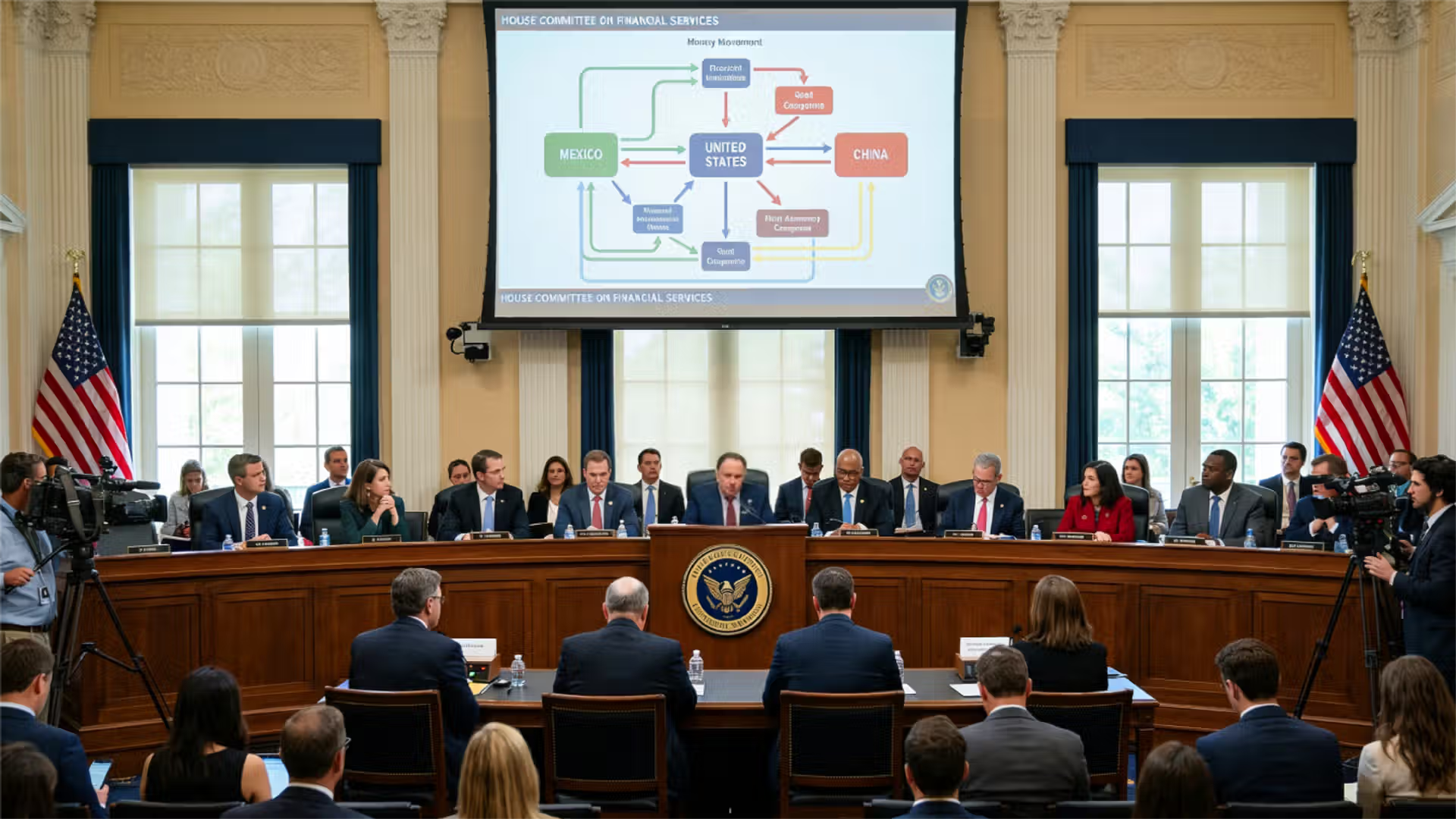
The Bank Policy Institute (BPI) and The Clearing House Association, serving as prominent financial bodies, submitted comprehensive joint comment letters on June 9, 2026, addressing new federal anti-money laundering and countering the financing of terrorism frameworks that do not impose any fines or financial penalties. These sweeping advocacy submissions provide an exhaustive critique of interconnected rulemakings put forward by the Financial Crimes Enforcement Network, the Office of the Comptroller of the Currency (OCC), the Federal Deposit Insurance Corporation (FDIC), the National Credit Union Administration (NCUA), and the Office of Foreign Assets Control. The dual letters represent a monumental effort by the traditional banking sector to influence the biggest structural modernization of the Bank Secrecy Act in modern history, following the mandates established under Section 6101 of the Anti-Money Laundering Act of 2020 and the recently enacted Guiding and Establishing National Innovation for United States Stablecoins Act. By responding concurrently to separate but deeply interrelated regulatory proposals, the two major trade associations have mapped out a strategic blueprint aimed at preventing fragmented oversight, reducing low-value regulatory compliance exercises, and encouraging technological innovation. The core of their argument hinges on giving financial entities the structural flexibility to allocate their finite resources toward genuinely high-risk threats rather than facing rigid, checklist-driven examiner oversight that hampers systemic effectiveness and stifles modern technological tools.
Table of Contents



Federal Regulatory Modernization of Financial Bodies Compliance Frameworks
The joint letters focus extensively on the notice of proposed rulemaking aimed at fundamentally transforming how domestic financial institutions structure their defensive programs against illicit finance. Under the traditional framework, financial firms have frequently been forced to treat compliance as a formalistic checklist exercise, dedicating vast amounts of human capital and technological resources to auditing lower-risk customers and routine transactions. This traditional approach frequently results in a severe dilution of analytical capability, leaving compliance officers buried under mountain ranges of low-value alerts while sophisticated money laundering networks exploit subtle gaps in the broader financial infrastructure. The trade organizations strongly endorse the stated objective of the federal regulators to transition toward an effectiveness-based regime that prioritizes high-value law enforcement outcomes and national security protections over mere technical boxes. This shift represents the operational fulfillment of congressional intent within the comprehensive anti-money laundering statutory updates passed in recent years, which explicitly directed agencies to design a more coherent, threat-informed regulatory structure. However, the groups argue that the current text of the proposed rule fails to fully codify the flexible, risk-based assurances contained in the agency preambles, leaving a dangerous disconnect that could allow rigid examination practices to persist unchanged.
To bridge this operational disconnect, the associations urge federal authorities to formally embed an explicit presumption of reasonableness within the binding regulatory text itself. Because financial organizations possess an incomparably deeper understanding of their unique customer portfolios, localized business lines, and specific risk exposures than external regulatory bodies, they must be afforded the structural latitude to calibrate their internal controls accordingly. A truly risk-based framework requires an explicit acknowledgement from examiners that the meaningful prioritization of high-risk operational areas inherently necessitates a corresponding reduction in the resources allocated to lower-risk activities. Without explicit safe harbors in the rule text, individual bank examiners may continue to second-guess the good-faith tactical decisions of compliance departments, effectively punishing institutions for shifting administrative focus away from historically over-monitored, low-risk segments. Furthermore, the banking groups emphasize that this flexible allocation strategy must apply uniformly across every component of an anti-money laundering architecture, from initial customer onboarding and ongoing transaction monitoring to the formal risk assessment mechanisms utilized to track institutional exposure over time.




Technological Adaptation and Digital Asset Regulatory Gaps
The second major pillar of the industry response addresses the complex regulatory regime being constructed to govern permitted payment stablecoin issuers under the newly minted federal stablecoin legislation. This highly anticipated statutory framework represents the first unified federal attempt to oversee the rapidly expanding digital asset ecosystem, introducing strict compliance guidelines for entities seeking to issue dollar-pegged payment instruments. The trade groups acknowledge that the emergence of stablecoins presents profound policy questions regarding the long-term stability and integrity of the domestic payment infrastructure. While the proposed regulations focus heavily on primary-market transactions, such as the direct issuance and redemption of tokens between issuers and authorized counterparties, the associations point out a massive regulatory vulnerability within the broader secondary market. Comprehensive empirical data compiled by financial intelligence units demonstrates conclusively that the vast majority of illicit stablecoin activity, including sanction evasion, terrorist financing, and proliferation finance, occurs after the initial issuance during peer-to-peer transfers on secondary platforms.
The current regulatory landscape creates a dangerous asymmetry by placing heavy administrative burdens on federally regulated issuers while leaving secondary-market actors, such as state-licensed money transmitters, decentralized finance protocols, digital asset service providers, and unhosted wallets, subject to vastly inferior compliance standards. Many digital asset exchanges operate without the rigorous customer identification programs required of commercial banks, establishing a structural vulnerability that criminal syndicates actively exploit to launder illicit proceeds. The associations argue that forcing stablecoin issuers to monitor or police uncontrollable secondary-market transactions without clear, standardized guidelines is operationally unworkable and legally unfair. They recommend that the Treasury Department utilize its existing statutory authorities to implement a comprehensive, uniform oversight framework for all secondary-market participants, thereby eliminating regulatory arbitrage opportunities and elevating the defensive posture of the entire digital asset environment to match the standards maintained by the traditional banking industry.


Systemic Harmonization and Coordinated Administrative Implementation
Achieving a durable, effective modernization of the financial system requires absolute consistency across all overlapping regulatory initiatives, a goal that the trade associations argue is threatened by fragmented agency timelines. The concurrent rollout of the broad program rule and the specific stablecoin regulations has created a highly complex, interdependent matrix of rulemakings that cannot be safely evaluated in isolation. The banking groups express serious concern over the compressed and staggered deadlines imposed by the various writing authorities, which limit the ability of industry participants to provide holistic feedback on how these massive frameworks will interact in practice. For instance, stablecoin subsidiaries owned by well-capitalized insured depository institutions should not be subjected to arbitrarily harsher compliance metrics or more aggressive supervisory scrutiny than independent, non-bank stablecoin firms. A fragmented approach risks driving innovation completely out of the regulated banking sector and into more opaque, less supervised shadow networks, ultimately undermining the primary national security goals of the underlying anti-money laundering legislation.
To ensure an orderly transition that avoids systemic operational disruption, the joint submissions outline a detailed implementation timeline that decouples the formal effective date of the final rules from the actual compliance enforcement date. The trade organizations request that the official effective date be set six months after publication, allowing institutions to legally begin reallocating compliance assets toward higher-risk threats immediately. Conversely, the mandatory compliance deadline should be extended to at least twelve months after the regulators collectively finalize a coordinated implementation package. This essential administrative package must include comprehensive, updated revisions to the Federal Financial Institutions Examination Council examination manual, extensive training programs for field examiners to align their supervisory habits with the new risk-based methodology, and a robust library of clear advisory guidance to resolve operational ambiguities. Furthermore, the groups emphasize the urgent need to modernize ancient transaction reporting thresholds, specifically for suspicious activity reports and currency transaction reports, which have remained completely unadjusted for decades despite massive inflation and shifting economic realities, forcing banks to waste finite analytical power processing millions of low-value forms.
Safeguarding Sovereign Financial Integrity Through Collaborative Governance
The ultimate success of this historic regulatory overhaul depends entirely on the creation of a collaborative, transparent governance structure that fosters trust and communication between private financial institutions and federal enforcement agencies. The trade groups advocate for the establishment of an enhanced consultation mechanism within the Financial Crimes Enforcement Network to inject structural fairness and analytical rigor into the administrative oversight process. Under this proposed mechanism, banks would be granted a formal, transparent opportunity to demonstrate the underlying effectiveness of their tailored compliance programs before any negative supervisory or enforcement actions are advanced. Federal authorities would be legally required to provide detailed, written documentation of their analytical conclusions, including a rigorous assessment of the actual illicit finance risks driving the agency action, to prevent duplicative, overlapping penalties from being levied by multiple agencies for a single technical infraction.
In an era defined by the unprecedented velocity of technological change, where sophisticated criminal organizations routinely deploy generative artificial intelligence and automated systems to bypass traditional financial controls, defensive compliance frameworks must be agile enough to evolve in real time. The rigid application of legacy model risk management guidance has historically acted as a massive institutional barrier to innovation, discouraging banks from developing, testing, and deploying advanced automated solutions due to the fear of regulatory second-guessing during lengthy approval cycles. By formally embedding a pro-innovation philosophy into the core evaluation metrics used by examiners, federal regulators can empower financial institutions to collaborate actively with law enforcement, pool critical financial intelligence, and construct a highly responsive, data-driven defense of the sovereign financial system that successfully protects national security while supporting legitimate economic expansion.
Key Points
- Traditional compliance frameworks are transitioning from rigid checklist monitoring to an effectiveness-based model that prioritizes high-value national security outcomes.
- Regulatory agencies must codify a formal presumption of reasonableness within binding rule texts to protect financial institutions from arbitrary examiner second-guessing.
- A massive compliance gap exists between heavily regulated stablecoin issuers and secondary-market participants who face significantly lower identification requirements.
- Complete harmonization across distinct stablecoin and program rulemakings is essential to eliminate regulatory arbitrage and protect well-capitalized depository institutions.
- A structured 12-month compliance window, contingent upon updated examination manuals and extensive supervisor training, is necessary to prevent severe systemic disruption.
Related Links
- Financial Crimes Enforcement Network Official Regulatory Actions
- Federal Deposit Insurance Corporation Financial Institution Letters
- Office of the Comptroller of the Currency Bank Secrecy Act Guidance
- Office of Foreign Assets Control Sanctions Compliance Programs
- Financial Action Task Force Guidance on Digital Assets and Crypto
Other FinCrime Central Articles About AML Modernization
- The Price of Doing Nothing on AML Modernization
- FinCEN modernization of BSA and SARs drives Hurley’s ACAMS keynote
- FinCEN’s 2025 Agenda Blends BSA Modernization, Beneficial Ownership and Digital Assets
Source: The Banking Policy Institute
Some of FinCrime Central’s articles may have been enriched or edited with the help of AI tools. It may contain unintentional errors.
Want to promote your brand, or need some help selecting the right solution or the right advisory firm? Email us at info@fincrimecentral.com; we probably have the right contact for you.