An exclusive article by Fred Kahn
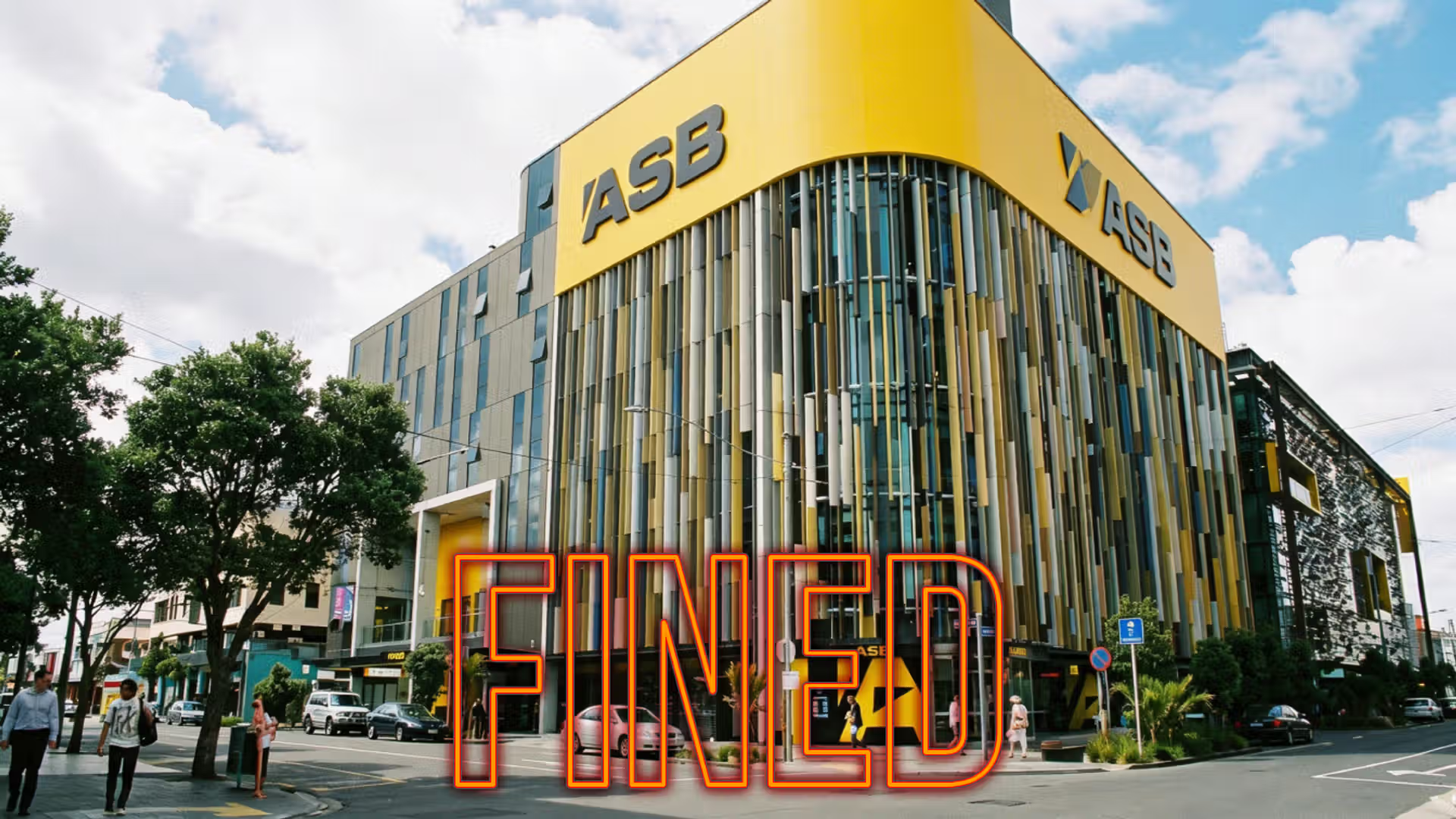
The global financial system remains profoundly exposed to systemic trad-based money laundering, a reality highlighted by recent multi-million dollar penalties against major institutions for systemic tracking failures. Despite extensive guidance from the Financial Action Task Force and domestic regulators, international merchandise shipping channels have emerged as the least controlled pathway for illicit financial flows. Compliance programs across the banking sector struggle with structural visibility gaps, as the cross-border movement of commercial cargo occurs almost entirely outside the monitoring infrastructure used to track digital capital. This systemic disconnect between commercial paperwork and banking ledger entries allows criminal organizations to move billions of dollars annually with minimal risk of detection.
Table of Contents



Trade-Based Money Laundering Disconnects
The underlying mechanics of this illicit channel rely on a structural separation between the physical movement of cargo and the financial transactions that fund it. Financial institutions operate in a data ecosystem restricted to payment messages, letters of credit, and documentary collection forms. They do not possess the mechanisms to physically inspect shipping containers at international ports, verify the actual market value of industrial machinery, or confirm that a cargo ship contains raw materials instead of scrap plastic. This profound lack of real-time visibility into the physical supply chain leaves banks heavily dependent on paper documents or electronic data files submitted by corporate clients.
This operational vulnerability is further compounded by the separate operational universes inhabited by customs authorities and financial compliance departments. Customs agencies focus on physical border security, tariff collection, and commodity classification, utilizing logistics databases that do not interface with the transaction monitoring software used by commercial banks. Financial intelligence units and banking compliance teams monitor global wire networks and account ledgers but lack automated access to real-time bills of lading or customs declarations. Because these two critical oversight sectors do not share data dynamically, illicit syndicates can exploit the information gap by presenting conflicting information to each entity without triggering automated alerts.




Compliance Operational Boundaries
The scale of international trade misinvoicing and sophisticated sanctions evasion schemes suggests that many corporate compliance programs have reached a point of functional resignation regarding commercial financial crime. Standard transaction monitoring models are calibrated to detect anomalies in retail banking or simple cash deposits, making them ineffective against complex commercial arrangements. A single international trade transaction can involve dozens of third parties, including freight forwarders, shipping lines, customs brokers, shell companies, and nested correspondent banks. Reviewing these relationships manually requires specialized maritime trade knowledge that traditional compliance staff rarely possess, leading to an environment where complex trade documents are often processed with only superficial screening.
The ongoing expansion of the global shadow fleet, used to circumvent international trade restrictions and energy price caps, underscores the limits of existing financial crime controls. Entities engaged in sanctions evasion frequently utilize front companies registered in loose regulatory jurisdictions, altering shipping manifests and overstating invoice values to justify large cross-border capital transfers. When financial institutions process payments for these transactions, their automated screening systems check the immediate transacting entities against sanctions lists but routinely fail to detect that the underlying commodities are mispriced or destined for prohibited destinations. The reliance on static, periodic look-backs rather than dynamic, data-integrated trade screening ensures that the vast majority of these illicit commercial maneuvers proceed completely uninterrupted.


Regulatory Realities and Systemic Gaps
The global regulatory framework established by international standard-setting bodies places an explicit obligation on countries to identify, assess, and understand their trade-related financial crime risks. However, recent mutual evaluation reports demonstrate widespread deficiencies in how jurisdictions supervise the commercial finance sector. A significant percentage of nations do not update their national risk assessments regularly or suffer from severe inter-agency coordination challenges. These structural weaknesses allow transnational criminal networks to exploit regulatory arbitrage, moving their operations to jurisdictions with weaker trade enforcement and less stringent customer due diligence requirements for import-export firms.
To bridge these systemic vulnerabilities, the international financial community must transition toward an integrated model that combines corporate banking data with global maritime logistics intelligence. Relying exclusively on corporate self-declaration forms and unverified invoices is no longer a viable defense against sophisticated financial syndicates. Until financial institutions integrate automated vessel tracking data, global commodity price indexes, and electronic customs verification networks into their core transaction monitoring systems, the commercial banking infrastructure will continue to serve as a primary mechanism for legitimizing the proceeds of transnational crime.
Trade-Based Money Laundering Typologies
The identification of illicit commercial activity requires a deep understanding of the specific methods used to manipulate trade transactions for capital concealment. Compliance professionals must look for distinct behavioral patterns and documentary anomalies that indicate a high probability of structural financial manipulation.
- Significant Commodity Misinvoicing: The systematic overvaluation or undervaluation of listed cargo on official invoices to justify the transfer of disproportionate sums of capital across borders.
- Carousel Shipping Structures: The repetitive routing of an identical batch of physical commodities through multiple jurisdictions to generate a high volume of complex financial transactions without any legitimate underlying commercial purpose.
- Phantom Cargo Documentation: The fabrication of complete sets of shipping documents, including bills of lading and certificates of origin, for entirely non-existent shipments to facilitate illicit wire transfers.
- Dual-Use Commodity Obfuscation: The deliberate mislabeling of restricted, military-grade, or high-technology equipment as standard consumer merchandise to bypass international export controls and trade restrictions.
- Obscure Third-Party Capital Settlement: The regular payment for commercial merchandise by independent, unrelated foreign entities that have no logical connection to the specific import-export transaction.
Key Points
- International merchandise trade channels represent a highly resilient pathway for global illicit financial flows due to structural visibility limitations.
- The fundamental disconnect between physical customs inspection data and banking transaction monitoring software prevents the automated detection of trade misinvoicing.
- Standard banking compliance infrastructure remains poorly equipped to verify the true market value or physical existence of cross-border cargo.
- Advanced sanctions evasion networks regularly exploit corporate registration loopholes and maritime shadow fleets to move capital through commercial banking networks.
- Global regulatory evaluations continue to document significant gaps in inter-agency data sharing and specialized trade-based financial crime supervision.
Related Links
- Wolfsberg Group Standards and Trade Finance Principles for Financial Crime Compliance
- United Kingdom Financial Conduct Authority Thematic Review on Trade Finance Controls
- Financial Action Task Force Methods and Trends in Global Proliferation Financing
- United Nations Convention Against Corruption, Transparency, and International Standards
- Egmont Group of Financial Intelligence Units Operational Guidance and Communiques
Other FinCrime Central Articles About Trade-Based Money Laundering
- Pakistan Faces IMF Pressure Over Unchecked Trade-Based Money Laundering
- The Invisible Crisis of Global Trade-Based Money Laundering
- How Supply Chains Are Used to Launder Funds in the Food and Retail Sector
Some of FinCrime Central’s articles may have been enriched or edited with the help of AI tools. It may contain unintentional errors.
Want to promote your brand, or need some help selecting the right solution or the right advisory firm? Email us at info@fincrimecentral.com; we probably have the right contact for you.