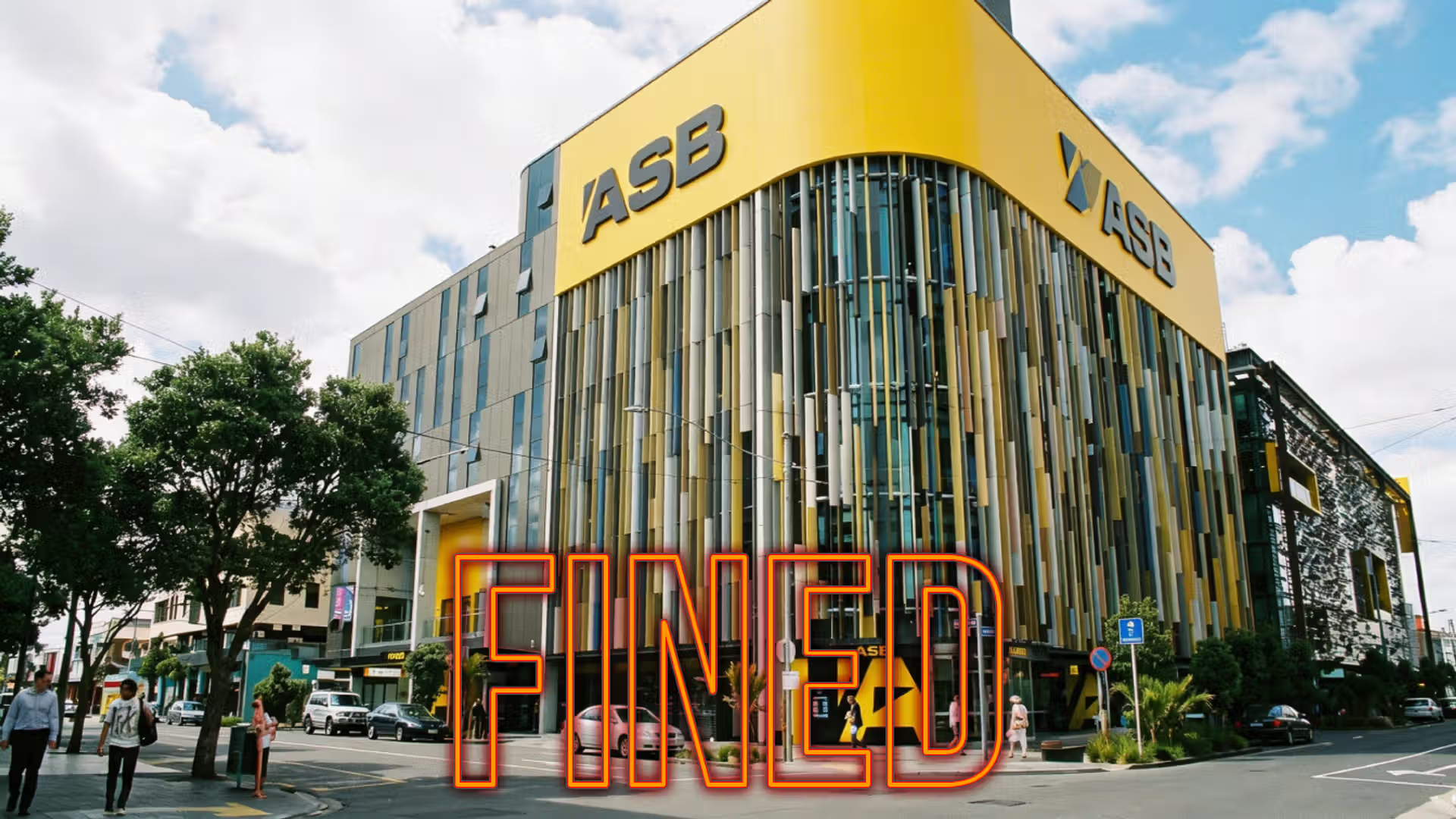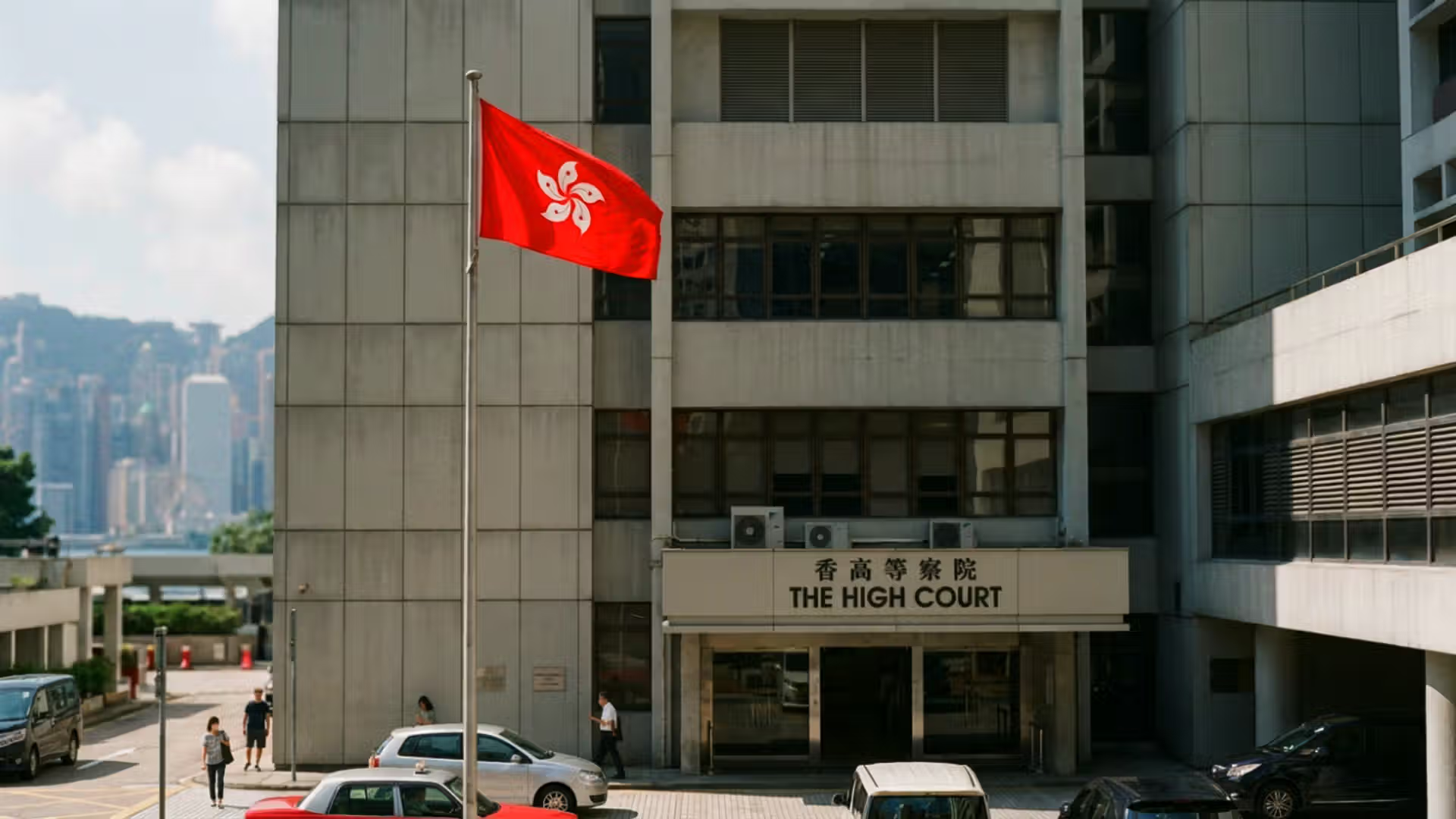
A Hong Kong court has upheld enforcement of an arbitral award exceeding €30 million despite arguments that payment could expose a Canadian bank and its employees to potential sanctions-related criminal liability. The decision provides an important examination of how courts balance international sanctions concerns against the strong policy favoring the enforcement of arbitral awards.
Table of Contents



Arbitration Enforcement and Sanctions Exposure
The dispute arose from three bank guarantees issued by a Canadian bank in connection with a 2021 contract involving engineering services, goods supply, and works at a Russian metallurgical facility. Following termination of the underlying contract and demands under the guarantees, the bank refused payment, arguing that Canadian sanctions legislation prohibited the transfer of funds.
The arbitration tribunal ultimately awarded the Russian claimant more than EUR 30 million plus interest after rejecting the bank’s sanctions-based defense. The tribunal concluded that the bank had not established that the claimant fell within the scope of the relevant Canadian sanctions provisions and therefore remained obligated to honor the guarantees.
A central issue concerned the ownership and control of the claimant. One of its principal beneficial owners, who also served as chief executive, president, and chairman, had been designated under Canadian sanctions measures introduced following Russia’s invasion of Ukraine. The bank argued that payment under the guarantees would constitute dealings with property controlled by a sanctioned person and could therefore amount to a criminal offense under Canadian law.




Conflicting Views on Sanctions Control
The case highlighted a recurring challenge for compliance professionals, namely the interpretation of beneficial ownership and control concepts within sanctions frameworks.
Canadian authorities later informed the bank that they considered the Russian claimant to be deemed owned by a sanctioned individual because that individual’s leadership position allegedly gave him the ability to direct the company’s activities. The Canadian regulator also refused a permit that would have authorized payment and reminded the bank that sanctions violations could attract criminal penalties.
However, the arbitral tribunal had previously reached a different conclusion. It found that the bank had not proven that the claimant fell within the relevant sanctions restrictions and further determined that any alleged illegality under Canadian law did not provide a contractual defense under the governing law of the guarantees.
This divergence created a situation increasingly familiar to global financial institutions. An organization may obtain one legal interpretation from an arbitral tribunal while regulators responsible for sanctions enforcement adopt a different view. Such conflicts create significant compliance uncertainty, particularly where criminal liability may arise.


The Court’s Analysis of Criminal Risk
The Canadian bank argued before the Hong Kong court that enforcing the award would place it and its personnel in an impossible position. Compliance with the award could allegedly expose them to prosecution, while refusal to comply could result in enforcement action.
The court accepted that the sanctions issue was genuine but emphasized that the question was not whether Canadian authorities disagreed with the tribunal. Instead, the court focused on whether enforcement would create a real and practical risk of prosecution sufficient to engage Hong Kong public policy concerns.
After reviewing the evidence, the court concluded that such a risk had not been established. Several factors influenced that assessment.
First, the tribunal had already considered extensive expert evidence regarding Canadian sanctions law and determined that the alleged illegality had not been proven. The enforcement court emphasized that it was not entitled to revisit the merits of those findings.
Second, the court observed that alternative enforcement mechanisms might exist. It specifically noted that enforcement through garnishee proceedings against Hong Kong assets could potentially occur without active participation by the bank itself, thereby reducing the prospect of sanctions liability.
Third, the court attached weight to the bank’s efforts to comply with sanctions requirements. The bank had sought guidance from Canadian authorities, requested permits, and attempted to obtain regulatory clarification before payment. Those actions demonstrated good-faith compliance efforts that could reasonably be expected to influence any prosecutorial decision.
Why Public Policy Did Not Prevent Enforcement
The court then addressed whether sanctions concerns justified the refusal of enforcement on public policy grounds.
Hong Kong follows a strongly pro-enforcement approach under the New York Convention. The court emphasized that public policy exceptions are interpreted narrowly and apply only where enforcement would violate fundamental notions of justice or morality.
The bank argued that international comity required respect for Canada’s sanctions objectives. The court rejected that position and stressed that the relevant public policy is Hong Kong public policy, not the public policy of another jurisdiction.
Particularly important was the court’s recognition of the commercial realities faced by multinational financial institutions. Banks operating across jurisdictions routinely encounter overlapping and sometimes contradictory legal obligations. According to the court, the existence of conflicting legal requirements does not automatically justify refusing enforcement of a valid arbitral award.
The judgment therefore reinforces a principle increasingly visible across international arbitration decisions. Courts generally remain reluctant to transform foreign sanctions concerns into a broad defense against enforcement unless a clear and compelling public policy violation is established.
Typologies AML Professionals Should Monitor
This case demonstrates several typologies relevant to sanctions compliance, ownership analysis, and cross-border financial crime controls.
- Control Through Executive Authority: A sanctioned individual may exercise effective control through management positions rather than majority ownership, creating uncertainty around deemed ownership assessments.
- Ownership Aggregation Risk: Multiple influential shareholders may collectively exert control even where individual ownership percentages fall below traditional thresholds.
- Cross-Border Sanctions Conflict: Legal obligations in one jurisdiction may directly conflict with contractual or judicial obligations in another jurisdiction.
- Guarantee Payment Exposure: Financial institutions issuing guarantees may face sanctions risks years after issuance if geopolitical circumstances change significantly.
- Regulatory Interpretation Divergence: Arbitration tribunals, regulators, and courts may reach different conclusions regarding sanctions applicability, creating elevated compliance risk.
- Permit Denial Escalation: Refusal of sanctions licenses or permits can materially increase regulatory scrutiny and enforcement exposure.
- Indirect Facilitation Concerns: Employees authorizing, processing, or facilitating transactions may become part of sanctions risk assessments even where funds move through overseas branches.
Key Points
- Hong Kong enforced an arbitral award exceeding EUR 30 million despite sanctions-related objections.
- Canadian authorities considered the claimant to be controlled by a sanctioned individual and denied a payment permit.
- The arbitration tribunal reached a different conclusion regarding sanctions applicability.
- The court found that a real risk of criminal prosecution had not been sufficiently established.
- Hong Kong public policy favored enforcement of the award under the New York Convention framework.
Related Links
- Special Economic Measures Act Canada
- Hong Kong Monetary Authority Guidance on Sanctions Compliance
- Hong Kong Department of Justice Arbitration Ordinance Cap. 609
- Hong Kong Judiciary Practice on Enforcement of Arbitral Awards
- Hong Kong Monetary Authority Guideline on Anti-Money Laundering and Counter-Financing of Terrorism (Authorized Institutions)
Other FinCrime Central Articles About Hong Kong
- DBS Hong Kong Enhances SME Compliance via AI Verification Technology
- Mainland China Hong Kong and Macao Improve Fight Against Dirty Money
- Hong Kong Regulators Introduce a HK$5 Million Fine for Unlicensed Virtual Asset Dealing
Source: HKU Law
Some of FinCrime Central’s articles may have been enriched or edited with the help of AI tools. It may contain unintentional errors.
Want to promote your brand, or need some help selecting the right solution or the right advisory firm? Email us at info@fincrimecentral.com; we probably have the right contact for you.