An exclusive article by Carlos Eduardo da Silva
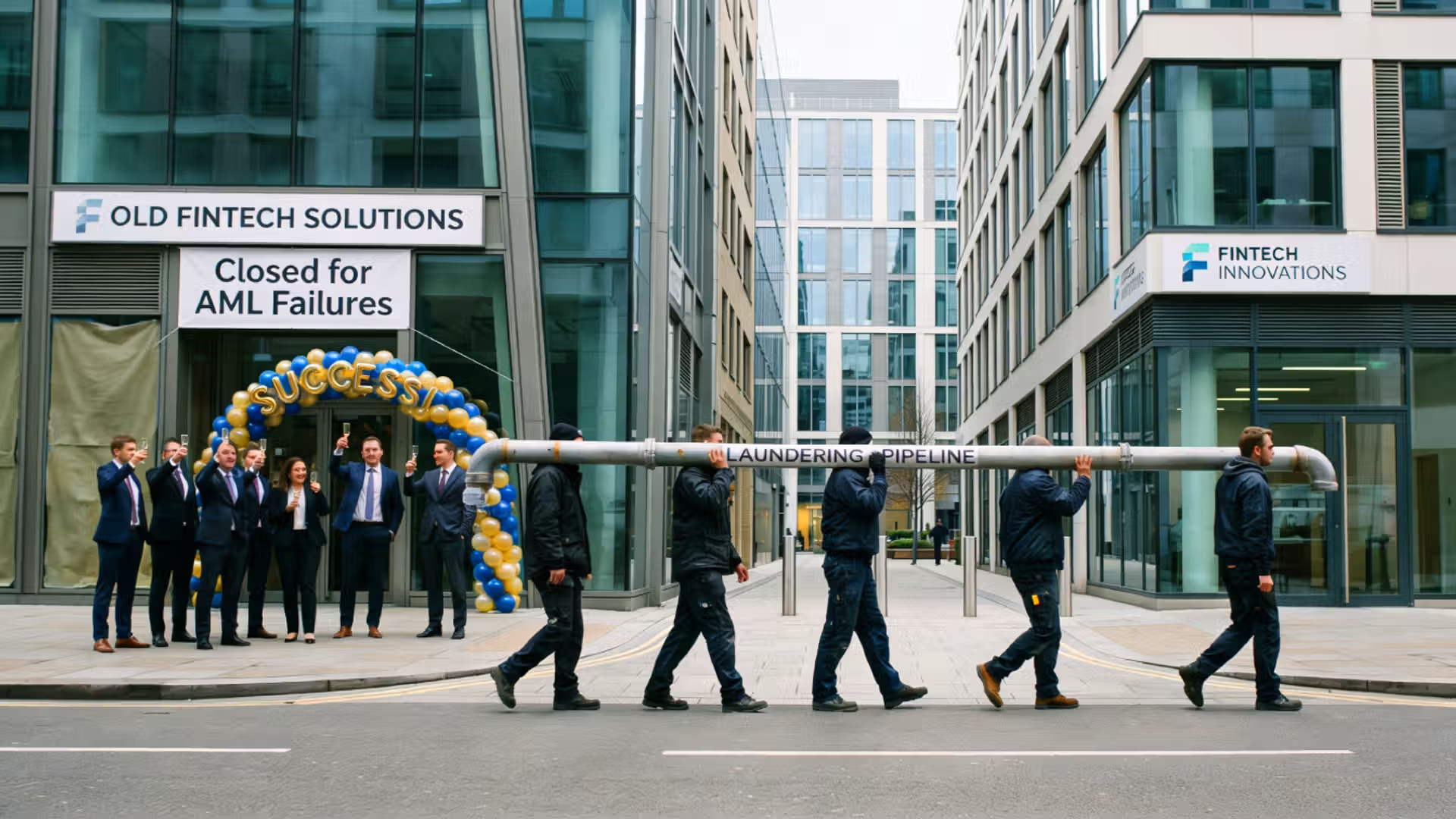
Enforcement against money laundering has rarely been better at finding the money, yet it has not become correspondingly better at stopping it. Investigators increasingly locate the funds, freeze the accounts, and charge the operators, only to watch the same money move again through new infrastructure within months. The pattern is structural, and it is visible with unusual clarity in Brazil, where authorities have spent the past year dismantling one financial network after another tied to the country’s largest criminal organization, the Primeiro Comando da Capital (PCC). What those cases expose is not unique to Brazil. A laundering system can be built to lose channels without losing the two things that sustain it: technical knowledge and pooled capital. For compliance professionals, the question is no longer whether a laundering channel can be found and closed, but whether closing it changes anything.
Table of Contents



The Channel Is Not the System
A laundering channel is a specific, observable thing: an investment fund, a payment institution, a front company, a money broker, a cluster of accounts. It can be identified, frozen, indicted, and reported as an enforcement success, and increasingly it is. The capability behind it is harder to reach. It is the know-how to carry illicit value through placement, layering, and integration, the relationships with cooperative or negligent intermediaries, and the capital itself, held in forms that survive the loss of any single channel. Conventional anti-money laundering frameworks are built to find and close channels; they are far less equipped to tell whether the machinery behind them has been touched at all. Based on more than two decades of investigating organized crime and its financial structures within specialized units of the São Paulo Civil Police, including DEIC (Criminal Investigations) and DENARC (Narcotics), this gap between the channel and the machinery is the most consistent feature of how these organizations operate financially. A channel is a cost of doing business; the capability is the business. The channel is what enforcement reaches. The capability is what it rarely touches.
That machinery is never static. Its history is a sequence of migrations, each one a response to the closure of the previous channel. As a former senior São Paulo prosecutor has publicly described, the organization’s financial methods evolved from cash-intensive local commerce and the city’s transport businesses, through the traditional money brokers who moved value informally across borders, toward the far more sophisticated structures required to sustain an international drug supply chain. From there, the trajectory continued: out of informal cash channels and into the real economy, notably fuel distribution; out of the fuel sector and into investment funds; and most recently out of funds and into payment institutions and fintechs. Each step was a reaction to the enforcement closing the rail before it. What is striking is not that the channels changed, but that the technique survived every transition. The operators who understood how to layer and integrate illicit proceeds rebuilt the same logic on whatever infrastructure remained available. The wrapper changed; the knowledge migrated.




Money Pools and Regulatory Arbitrage
The most recent stage of that migration surfaced in May 2026, when the Brazilian Federal Revenue Service and the São Paulo Public Prosecutor’s Office, through its organized-crime unit (GAECO), reported that six payment institutions had operated as a “parallel bank” for the PCC, moving more than R$26 billion (approximately US$5 billion) between 2022 and 2025. According to the Revenue Service, the scheme relied on pooled “omnibus” accounts, locally called contas bolsão, that gathered funds from many sources and dispersed them, and on internally-ledger accounts where the true owner’s identity was recorded only inside the institution’s own systems, never on the regulated rails visible to the Central Bank. The same agency reported that one institution alone received more than R$1 billion (approximately US$190 million) in physical cash, an amount incompatible with the nature of a payment institution. Funds were then layered across other payment institutions, adding a second concealment layer that severed the money’s origin from its destination, and prosecutors traced at least R$365 million (approximately US$70 million) in crypto-asset transfers linking the network to other laundering operations. In the canonical terms of the field, the cash deposits are placement, the pooled and internal-ledger accounts are layering, and the reinvestment into funds and the fuel economy is integration. Because ownership existed only inside private ledgers, the regulated system could watch the money move without ever seeing who owned it. The design is what matters. These structures are the money pools that let capital outlive any single account: when one entity is seized, the funds and the operators who manage them are already elsewhere. A seizure removes a container, not the contents, because the contents were never concentrated in the container to begin with.
The compliance failure here is structural, not incidental. Several of the targeted institutions had simply not reported activity they were obliged to report, a duty that became mandatory only after an earlier phase of the same investigation exposed the gap. Brazil’s revenue authority attributes the vulnerability to a regulatory vacuum that let payment institutions operate for years without the transparency obligations imposed on banks for two decades. The laundering did not defeat a mature compliance regime; it selected the rail where compliance was weakest. This is the move most often underestimated: sophisticated launderers do not merely evade controls, they perform regulatory arbitrage, migrating value toward whichever institution type, jurisdiction, or product carries the lightest supervisory burden, and moving again the moment that burden increases. Pooled and internal-ledger accounts work precisely because they defeat name-screening and transaction monitoring that assume each account has one visible owner. When the controls assume a transparency the structure is designed to deny, a quiet account is not a clean one. It is a blind spot. The lesson generalizes well beyond one country: any system that supervises institutions unevenly invites the laundering to find the gap.


What Survives an Operation
When authorities dismantle a channel, what is lost is recoverable: some accounts, some capital in transit, a few operators arrested. The technique has already been shown to migrate, and the capital to pool beyond any single account; what an operation rarely reaches is the people who run them. Operators are largely fungible. An arrested money broker or fintech executive is replaced, and the function continues without interruption. This is why enforcement metrics built around channels, such as accounts frozen or volumes identified, can climb steadily while the actual capacity to move illicit money remains essentially undisturbed. The numbers describe activity, not attrition. Motion is mistaken for progress.
For a compliance team, the lesson translates into concrete warning signs, most of them visible before any single transaction looks criminal. The recurring ones are pooled or omnibus accounts that aggregate funds from many sources and redistribute them, obscuring who owns what; internal-ledger structures where beneficial ownership is recorded only inside a provider’s own system, off the regulated rails; cash-in volumes incompatible with the institution’s stated business, especially at payment institutions and fintechs; opaque or rapidly changing beneficial owners behind otherwise routine corporate counterparties; accelerated migration of flows toward newer, less-supervised providers, particularly after enforcement hits an adjacent sector; and repeated transfers between unrelated payment institutions with no apparent economic rationale. None of these proves wrongdoing on its own. Each marks the moment a laundering operation is reorganizing, which is precisely when conventional monitoring, calibrated to steady-state behavior, is least likely to fire.
A Borderless Problem and the Future of AML
None of this stays inside one jurisdiction. The organization may be Brazilian, but the rails it uses are not: correspondent banking, international trade, and virtual assets carry value across borders by design, and the same migratory logic operates wherever supervision is uneven. An institution in another country can sit several steps removed from the original crime and still process its proceeds, simply because it is the next, least-watched node in the chain. For banks and payment providers outside Brazil, the relevant exposure is rarely the obvious one. It is the indirect link, the counterparty of a counterparty, that arrives already layered and clean on its surface. A single correspondent relationship can import another market’s blind spot directly onto a compliant institution’s books. Treating this as a distant, foreign problem is itself a vulnerability.
This resilience is not a failure of enforcement effort. Brazilian authorities have been aggressive and increasingly effective at finding the money. It is a failure of the assumption that closing a channel is the same as reducing the threat. An organization that treats every lost channel as a routine cost, while preserving its technique and its capital, can absorb a remarkable volume of enforcement without strategic damage. The implication for anti-money laundering is direct: the discipline can no longer be measured by how many channels it closes, but by how fast it sees the next one forming. For banks, fintechs, payment institutions, and multinational corporations, the real risk is not only processing illicit funds, but failing to recognize that the laundering architecture has already migrated before their internal controls adapt. The launderers reorganize in real time, and compliance has to learn to watch them do it. Money laundering is no longer defined by where illicit funds are hidden, but by how quickly they can migrate before compliance catches up.
Key Points
- Brazilian authorities repeatedly dismantled laundering channels linked to the PCC, yet the underlying laundering capability continued to migrate to new financial infrastructure.
- Payment institutions allegedly operated pooled and internal-ledger account structures that obscured beneficial ownership and reduced transparency.
- More than R$26 billion reportedly moved through six payment institutions between 2022 and 2025 using mechanisms resembling a parallel banking network.
- Laundering networks increasingly exploit regulatory arbitrage by migrating toward institution types and products subject to lighter supervision.
- The primary AML challenge is no longer identifying existing channels but detecting new channels before criminal networks reorganize.
Related Links
- Financial Action Task Force (FATF) Guidance on Beneficial Ownership and Transparency
- Financial Action Task Force (FATF) Risk-Based Approach Guidance for Virtual Assets and VASPs
- Banco Central do Brasil Payment Institutions Regulatory Framework
- Receita Federal do Brasil Official Communications and Enforcement Announcements
Other FinCrime Central Articles About Cross-Border Laundering
- AUSTRAC CEO Pushes For Enhanced Cross-Border Anti-Money Laundering Action
- FinCEN’s Guidance on Cross-Border Sharing Strengthens Money Laundering Defenses
- Cross-Border Payments AML Challenges In A Rapidly Evolving Financial World
Some of FinCrime Central’s articles may have been enriched or edited with the help of AI tools. It may contain unintentional errors.
Want to promote your brand, or need some help selecting the right solution or the right advisory firm? Email us at info@fincrimecentral.com; we probably have the right contact for you.