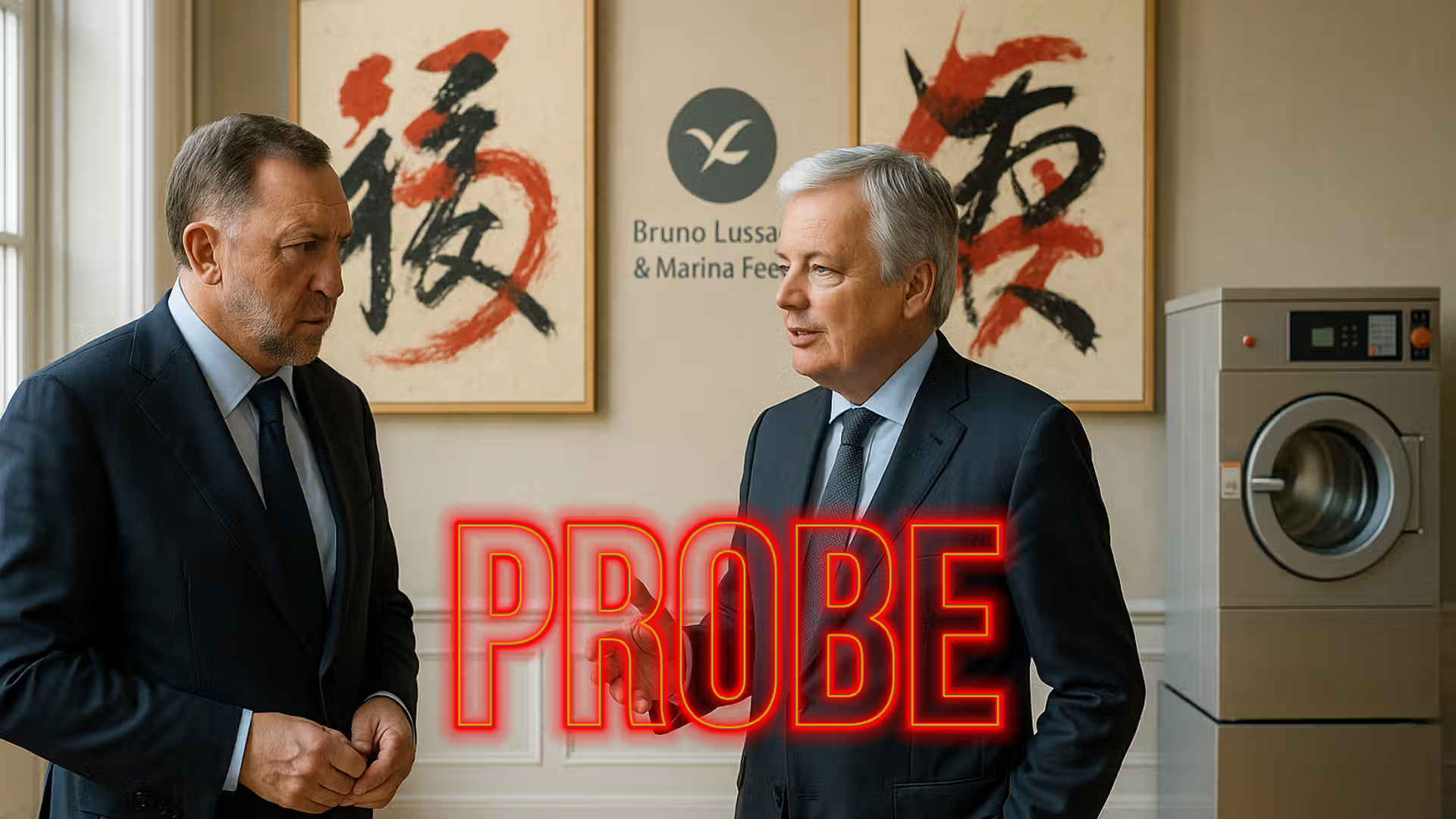
A Belgian nonprofit meant to promote Japanese art is now the epicenter of a revived financial crime investigation tying Russian oligarch Oleg Deripaska to former European Commissioner Didier Reynders. Behind the curtains of culture and philanthropy, prosecutors suspect a cross-border laundering network where political protection may have helped illicit funds quietly move through Belgium’s financial system. The Deripaska Reynders link is now under formal re-examination by the Brussels prosecutor’s office, years after the original case was dismissed.
Table of Contents


Deripaska Reynders link raises questions about collusion and cover-up
The initial probe into the Uccle-based nonprofit began in 2014, when Belgium’s financial intelligence unit flagged irregular incoming funds traced back to secrecy jurisdictions like Liechtenstein. These funds, lacking transparency and legitimate origin, were funneled into the Belgian association with little resistance. Investigators at the time suspected the nonprofit served as a vehicle to launder money tied to organized crime, benefiting from its status as a cultural entity.
Yet the investigation was shelved in 2016, citing lack of prosecutable evidence. What prosecutors did not act on back then is now being re-evaluated — primarily due to revelations about Didier Reynders’ direct and sustained involvement with the same nonprofit.
Reynders, a dominant figure in Belgian politics and later an EU Commissioner for Justice, reportedly attended numerous receptions hosted by the nonprofit. Beyond appearances, one of his former advisors, Constantin Chariot, was installed as the director of the association after serving Reynders from 2003 to 2008 in the domains of culture, scientific policy, and tax shelter legislation.
This is not circumstantial. Chariot was not merely a cultural operator; he had insider access to Belgium’s fiscal policy strategies and, during his tenure with Reynders, also managed links to sectors frequently exploited in money laundering schemes, including the art market and real estate.
Sources close to the investigation suggest that Reynders helped facilitate Chariot’s transition into the nonprofit world, possibly aware of the opaque financial infrastructure being put in place. This creates a scenario where a senior policymaker may have, intentionally or not, enabled the laundering of foreign capital under the guise of cross-cultural exchange.
While Reynders has denied wrongdoing, the Deripaska Reynders link is under renewed judicial scrutiny. The Brussels prosecutor’s reopening of the case suggests a growing body of evidence pointing to complicity, or at the very least, negligence by a political figure who should have enforced — not ignored — AML standards.
How the money laundering case involving Deripaska unfolded
The Brussels-based nonprofit “Association Bruno Lussato et Marina Fédier,” founded ostensibly to promote Japanese art, is the central node in this money laundering case. According to findings initially made by Belgium’s financial intelligence unit, the nonprofit received millions in funds routed through secrecy jurisdictions like Liechtenstein. Investigators now suspect these funds were tied to organized crime and funneled into Belgium via a seemingly benign cultural vehicle.
This entity was registered in Uccle, a wealthy suburb of Brussels, where it maintained a quiet presence. But behind its polished facade, authorities believe it served as a front to whitewash illicit capital. The nonprofit was allegedly used to pay for events, host receptions, and purchase assets, including real estate, without generating any legitimate revenue. The source of these incoming funds was traced back to offshore shell structures that are standard in sophisticated laundering schemes.
Deripaska’s wealth, built on his control of the world’s largest aluminium company and his central role in Russia’s oligarchic inner circle, has long drawn suspicion from Western regulators. Despite this, his philanthropic endeavors in Europe largely escaped scrutiny until the 2014 investigation by Belgium’s financial crime authorities. The initial investigation appeared promising, but the case was shelved in 2016 due to the absence of irrefutable evidence tying the funds to criminal activities.
The latest developments suggest that prosecutors may now have access to new data, cooperation from foreign authorities, or intersecting findings from the Reynders case that reignite interest in Deripaska’s financial footprint in Belgium. This resurgence reflects a larger trend across European jurisdictions to revisit shelved cases involving sanctioned or politically exposed individuals, especially when prior decisions to close cases may have been premature or politically sensitive.
The Russian oligarch’s laundering network through Belgian assets
Deripaska’s alleged money laundering network demonstrates the enduring appeal of Belgium as a laundering hub due to its favorable nonprofit laws, elite diplomatic presence, and discrete financial services sector. The case presents a textbook example of how high-net-worth individuals, especially those under sanctions or informal watchlists, create plausible deniability through cultural associations, shell companies, and intermediaries.
One aspect that stands out in this case is the nonprofit’s complete reliance on funds from secrecy jurisdictions. There was no local fundraising, no ticketed events, and no active cultural partnerships. The opaque financial architecture around the “Association Bruno Lussato et Marina Fédier” suggests that it served primarily as a holding and disbursement vehicle, potentially mixing criminal proceeds with legitimate philanthropy to obfuscate traceability.
Further red flags appeared when investigators identified transactions involving real estate purchases in Belgium under the nonprofit’s name. The practice of using cultural entities to purchase high-value property without the usual due diligence attached to corporate or individual buyers is a common money laundering typology. When properties are later sold or rented, the resulting income appears clean, and the paper trail is laundered through institutional legitimacy.
The reopening of the case points to potentially new findings regarding these real estate operations. These may include:
- Properties bought under market value and sold above market in short timeframes
- Use of shell structures connected to low-tax jurisdictions
- Lack of formal board oversight over major financial decisions
- Ties between nonprofit leadership and Deripaska’s known associates
If confirmed, these elements would support the thesis that the nonprofit was not just a passive vehicle but an active part of a wider laundering strategy.
A politically entangled financial crime
A key twist in this revived money laundering case is its overlap with the investigation into Didier Reynders, Belgium’s former Deputy Prime Minister and former EU Commissioner. According to multiple sources, Reynders had close professional and personal links to individuals associated with the nonprofit. Notably, Constantin Chariot, the Belgian director of the nonprofit, was Reynders’ cultural and tax shelter advisor between 2003 and 2008. He later took the helm of the association allegedly involved in laundering Deripaska’s funds.
This convergence of political and financial interests raises serious concerns for AML professionals and regulators alike. It adds complexity to what may have initially appeared to be a conventional case of foreign money entering a European jurisdiction. With Reynders now under investigation for his own alleged involvement in money laundering, prosecutors are likely to explore whether there were reciprocal benefits, willful blindness, or even direct involvement in Deripaska’s financial maneuvers.
It is also noteworthy that Reynders reportedly attended multiple events hosted by the nonprofit and belonged to its informal “circle of friends.” These associations, while not evidence of wrongdoing, significantly raise the risk level of the case and may trigger new levels of cooperation between Belgian prosecutors, OLAF, and other European financial intelligence units.
The connection between a senior EU official and a suspected laundering vehicle tied to a Russian oligarch adds geopolitical stakes to the case. It may prompt both the European Commission and the European Anti-Fraud Office to reexamine how politically exposed persons are screened, monitored, and flagged across institutions and Member States.
For compliance officers, this illustrates the urgent need to revisit screening thresholds for third-party nonprofits, especially when tied to high-risk individuals. Many institutions exclude such entities from enhanced due diligence on the assumption that cultural organizations are low-risk. This case shatters that assumption.
What AML professionals should take away from this scandal
While the headlines may focus on Deripaska’s billions or Reynders’ political career, the core lesson for AML professionals is structural. High-risk clients do not operate alone. They embed themselves in networks, including cultural and political circles, that offer layers of legitimacy. The case underscores the need to monitor not just formal relationships, but the informal spheres where influence, money, and discretion converge.
For compliance departments, several red flags now seem glaring in hindsight:
- A nonprofit with offshore-only funding and no revenue-generating activity
- Connections between nonprofit leadership and active political figures
- Use of property transactions with no clear business rationale
- Cultural positioning that discourages scrutiny
The Deripaska Reynders link is not a deviation from the norm — it is an extreme version of a pattern seen repeatedly in AML failures involving PEPs. This case should prompt financial institutions to revisit their screening procedures for nonprofits, especially those with elite political connections or opaque funding structures.
As Belgian prosecutors dig deeper, the hope across the AML community is that this will not remain just another case of postponed justice. It must become a turning point in how Europe treats laundering risks tied to both oligarchs and their political enablers.
Related Links
- Belgian Financial Intelligence Processing Unit (CTIF-CFI)
- EU Sanctions Map
- European Public Prosecutor’s Office
- European Commission – Anti-Money Laundering
- FATF Guidance on NPO Risk
Other FinCrime Central Articles About Collusions Between Art, Politics, and Money Laundering
- UK Art Dealer Charged in Historic Terrorist Financing Case
- 50 UK Art Businesses Face Hefty Fines for Money Laundering Compliance Failures
- ING Investigation of Former EU Commissioner Reynders Reveals Suspicious Funds Activity
Source: Le Soir
Some of FinCrime Central’s articles may have been enriched or edited with the help of AI tools. It may contain unintentional errors.
Want to promote your brand, or need some help selecting the right solution or the right advisory firm? Email us at info@fincrimecentral.com; we probably have the right contact for you.