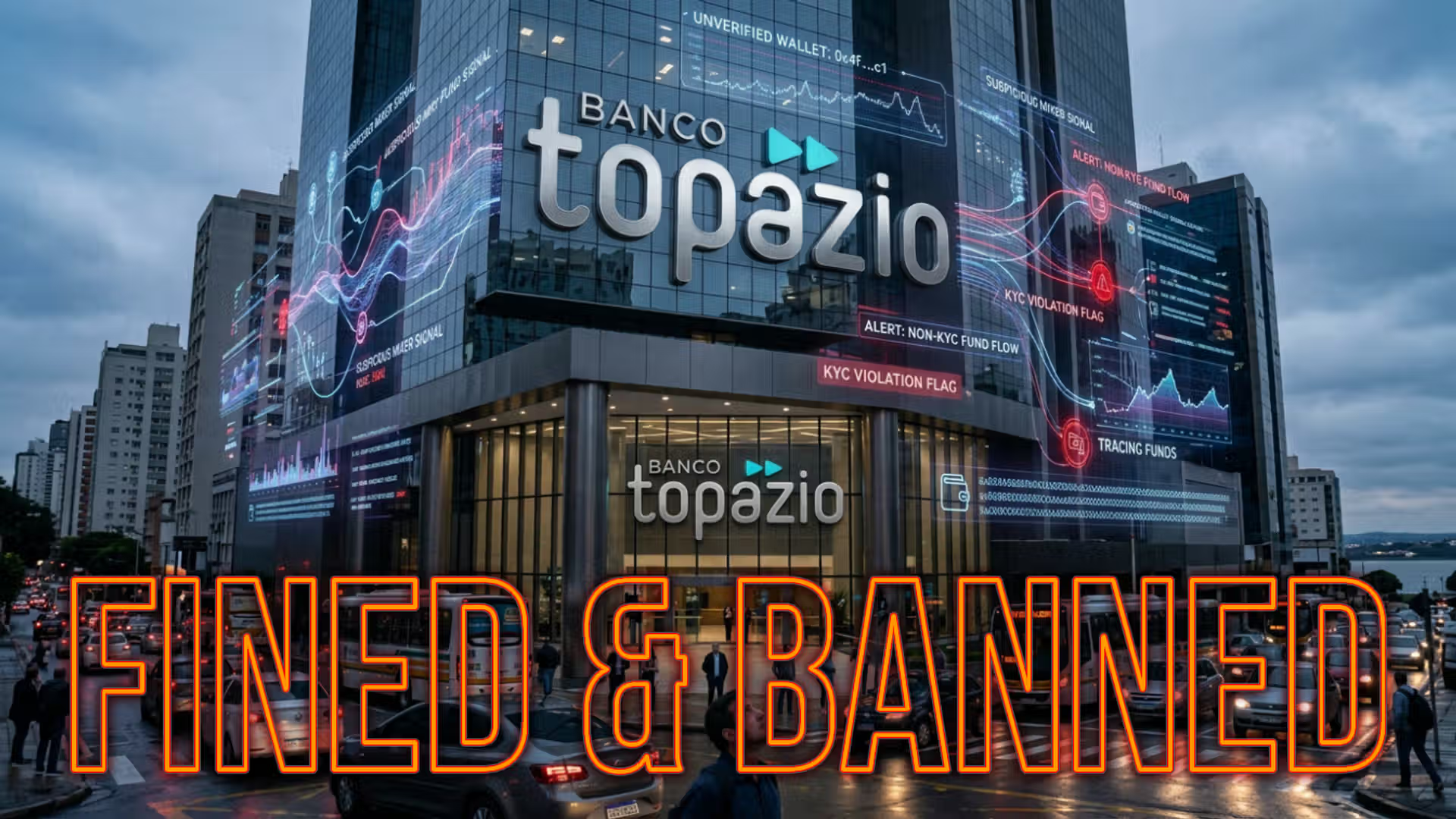
The Administrative Sanctioning Process Decision Committee of the Central Bank of Brazil has officially imposed a fine of R$ 16.280 million on Banco Topazio due to critical systemic failures within its anti-money laundering architecture. The comprehensive enforcement action includes a strict two-year prohibition from executing foreign exchange operations related to cryptocurrency trading in the over-the-counter market. According to the supervisory authority, the financial institution processed astronomical volumes of international capital transfers without establishing the mandatory risk controls required to verify the true origin of wealth or the eligibility of the third-party beneficiaries. This landmark administrative enforcement action highlights the heightened scrutiny applied by the national regulatory body on structural gaps that permit illicit wealth placement within the corporate banking infrastructure. The Central Bank of Brazil confirmed that identical preventive measures will be deployed aggressively across the national financial network to combat institutional negligence and dismantle unmonitored pathways used for illicit international capital flight.
Table of Contents



Crypto Assets Compliance Failures
The extensive administrative investigation conducted during the forty seventh formal session of the regulatory panel exposed profound structural compliance vulnerabilities within the primary market operational framework of the financial institution. Between October 2020 and September 2021, the organization facilitated massive foreign exchange transactions totaling US$ 1.7 billion linked directly to the acquisition of virtual holdings. These extensive financial transfers were systematically executed on behalf of 15 corporate entities without the application of appropriate customer due diligence protocols, comprehensive background checks, or verified customer qualification tracking. The total volume of these unverified digital asset transactions represented a staggering 63% of all foreign exchange transfer contracts executed by the bank for outbound international transfers during that calendar period, proving an extreme level of institutional exposure to unmitigated legal risks. Furthermore, these specific virtual asset transactions accounted for 47% of the total primary market activities conducted by the organization during the same window of time, defining the primary market segment where an institution negotiates directly with end customers before routing funds to the interbank network.
The supervisor determined that operating at such an elevated scale without adequate transaction monitoring tools created an immediate, existential threat to the safety and soundness of the national banking system. This high concentration of unverified corporate accounts processing cross-border flows without proper economic justification allowed immense amounts of fiat currency to enter the global virtual ecosystem undetected. The regulatory authorities emphasized that the sheer volume of capital moving through these specific channels required the highest tier of anti-money laundering oversight, which the entity completely failed to maintain. By allowing corporate entities to move hundreds of millions of dollars without verifying their underlying financial capacity or the true origin of their wealth, the bank essentially functioned as a high-speed gateway for unmonitored capital flight. The structural failure to perform basic corporate verification allowed these entities to route massive flows into the over-the-counter virtual marketplace, bypassing traditional safety mechanisms designed to block illicit wealth distribution networks.




Brazilian Financial System Regulations
The regulatory panel categorized the persistent compliance gaps as an exceptionally grave institutional infraction under the strict provisions of Article 4, Clause IV of Law 13.506. This specific legislation governs illicit behavior capable of causing severe disruption to the continuity, security, and fundamental purpose of the broader national banking architecture, the payment infrastructure, and the consortium ecosystem. The supervisory evaluation determined that the institutional deficiencies spanned three critical operational pillars, specifically the comprehensive assessment of customer economic capacity, the maintenance of accurate registration records, and the execution of mandatory preventive controls against illicit capital manipulation. Beyond the massive institutional fine levied against the financial entity itself, several high-level corporate executives and administrative directors faced direct personal liability and severe financial sanctions for their individual roles in the oversight breakdown within administrative case number 266470.
A retired Central Bank employee turned administrative official received a personal fine of R$ 732,000 alongside a comprehensive five-year ban from occupying any executive or administrative position within any financial institution operating under national supervision. Additionally, two other prominent administrative directors received separate personal penalties of R$ 471,000 and R$ 358,000, respectively for their failure to enforce internal controls. The enforcement body made it absolutely clear that corporate leadership will be held directly accountable when internal systems are intentionally or negligently blinded to satisfy profit margins. The application of personal administrative bans serves as a clear warning to the financial industry that executive responsibility cannot be outsourced or ignored when managing high-risk cross-border corridors. The regulatory framework explicitly demands that financial entities maintain independent, fully funded internal auditing structures capable of overriding commercial interests when high-risk transactions are identified.


National Anti-Money Laundering Architecture
The complete failure of the financial institution to communicate suspicious, unusual, or atypical financial movements to the Council for Financial Activities Control formed a central pillar of the regulatory prosecution. The oversight panel observed that despite the anomalous patterns, rapid velocity, and immense scale of the corporate transactions, the internal monitoring mechanisms failed to trigger mandatory reporting mechanisms. The Director of Supervision explicitly stated that the rapid expansion of the virtual asset marketplace requires aggressive, proactive vigilance from banking supervisors to prevent modern business models from becoming specialized engines for laundering illicit funds. The regulatory stance was significantly reinforced by a comprehensive set of legal updates enacted in late 2025, which legally aligned specific virtual asset transactions with traditional foreign exchange and international capital controls while establishing clear boundary rules for virtual asset service providers.
The supervisory authority warned that the temporary operational ban applied in this instance represents a standard precautionary mechanism that can and will be utilized against any other financial institution exhibiting similar deviant behaviors. This proactive strategy allows the central regulator to suspend dangerous corporate activities immediately without waiting for the lengthy conclusion of a formal administrative sanctioning process. The integration of virtual service providers into the standard regulatory matrix ensures that all entities moving value across borders must operate under identical transparency standards. The enforcement action marks a permanent shift toward real time intervention, where regulators will no longer tolerate financial institutions acting as passive intermediaries for unverified digital wealth generation.
Virtual Assets Money Laundering Typologies
- Unverified Corporate Layering: The utilization of multiple corporate entities to execute massive cross-border transfers for virtual asset purchases without providing documentation regarding the beneficial ownership or economic origin of the fiat currency.
- Atypical Transaction Concentration: A disproportionate volume of institutional foreign exchange activity is being directed into high-risk over-the-counter cryptocurrency markets, effectively dominating the total primary market operations of a financial firm.
- Absence of Mandatory Intelligence Disclosures: The systematic failure to generate and forward suspicious activity reports to the national financial intelligence unit when transaction volumes clearly diverge from the established economic profile of the client.
- Inadequate Financial Capacity Evaluation: Processing multi-million dollar international wire transfers for corporate accounts without verifying whether the registered entities possess the legitimate commercial presence or asset base to justify such cash flows.
Key Points
- The Central Bank of Brazil issued an institutional fine of R$ 16.280 million against Banco Topazio due to systemic anti-money laundering structural deficiencies.
- The enforcement action includes a strict two-year prohibition barring the financial entity from engaging in foreign exchange transactions within the over-the-counter cryptocurrency market.
- The compliance breakdowns involved unverified corporate transactions totaling US$ 1.7 billion, representing more than sixty percent of the bank’s international outbound transfers.
- Executive administrators faced individual penalties, including a five-year professional ban and personal fines reaching up to R$ 732,000.
- The regulatory authority confirmed that these strict precautionary suspensions will be applied broadly across the financial sector to curb deviant institutional behaviors.
Related Links
- Banco Central do Brasil Enforcement Decisions
- Council for Financial Activities Control Suspicious Activity Guidelines
- Law 13.506 Sanctioning Framework Documentation
- Financial Action Task Force Brazil Mutual Evaluation Reports
Other FinCrime Central Articles About Brazil
- Brazil’s Ambitious Push to Close AML Gaps: What BRL 44.2 Million in Fines Reveals
- Police Chief Warns Brazil’s Lawmakers About Influencers Promoting Illegal Gambling Schemes
- Brazil’s Betting Industry Faces Tight Deadline for Anti-Money Laundering Policies
Source: Times Brazil, by Amanda Souza
Some of FinCrime Central’s articles may have been enriched or edited with the help of AI tools. It may contain unintentional errors.
Want to promote your brand, or need some help selecting the right solution or the right advisory firm? Email us at info@fincrimecentral.com; we probably have the right contact for you.