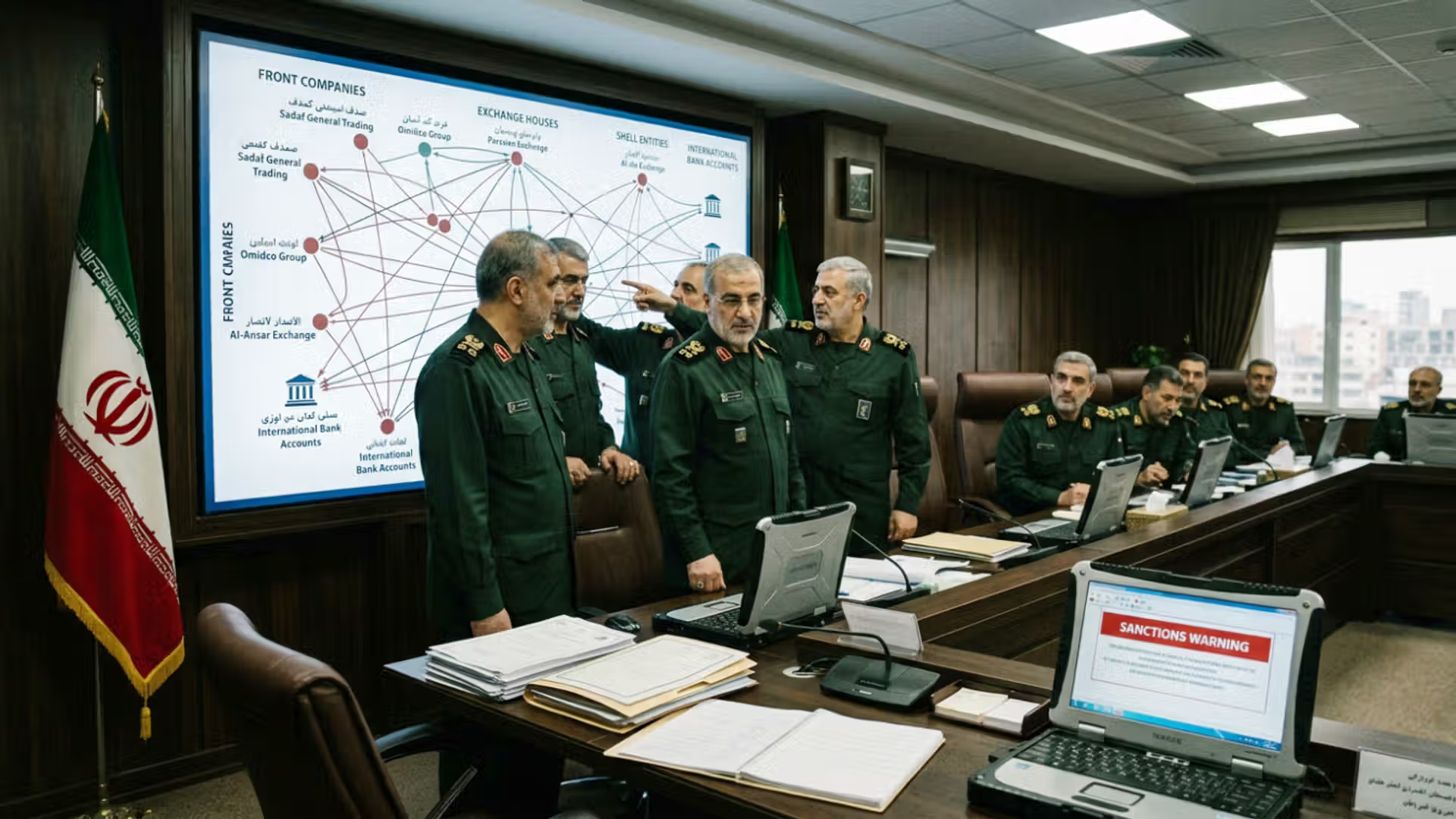
The founding of Nobitex by members of one of the most influential families in Iran has raised significant concerns regarding the intersection of digital asset platforms and sanctioned state actors. This development highlights the complex mechanisms through which domestic financial entities might bypass international restrictions using decentralized technology. Regulatory bodies continue to monitor how these connections facilitate the movement of capital across borders without traditional oversight. The case underscores the critical need for enhanced transparency within the global virtual asset service provider sector. Security experts suggest that the structural ties between private enterprises and state-linked individuals create high-risk environments for illicit financial flows.
Table of Contents



Nobitex Money Laundering Risks
The emergence of large-scale cryptocurrency exchanges in jurisdictions subject to heavy international sanctions presents a unique challenge for global anti-money laundering efforts. When a platform like Nobitex gains a dominant market share while being controlled by individuals with deep ties to state infrastructure, the risk of systemic evasion of financial controls increases exponentially. These entities often operate in a regulatory gray zone where domestic laws may be designed to facilitate rather than prevent the circumvention of foreign sanctions. Money laundering professionals view such configurations as high risk because the traditional separation between private commercial interests and state political objectives is blurred. This lack of distance allows for the creation of sophisticated financial pipelines that can move billions of dollars in digital assets while obscuring the ultimate beneficial ownership of the funds. The Iranian economic landscape has long been characterized by the presence of powerful foundations and family conglomerates that control significant portions of the national economy. When these players enter the crypto space, they bring with them established networks that can be used to layer transactions and integrate illicit proceeds into the legitimate economy. The speed and relative anonymity of blockchain transactions provide a perfect vehicle for these activities, especially when the exchange itself is not compliant with international standards such as those set by the Financial Action Task Force. Consequently, the global financial system faces a persistent threat from platforms that serve as gateways for sanctioned capital to enter the international market through various conversion and mixing techniques.
The specific case of Nobitex involves the Rafsanjani family, a lineage with profound historical and economic influence within the Iranian state apparatus. Investigations have revealed that descendants of this family were instrumental in the inception and growth of the exchange, which has processed tens of billions of dollars in transactions. From a financial crime perspective, the involvement of such politically exposed persons in a high-volume crypto platform is a significant red flag. It suggests that the platform could be leveraged to provide liquidity for state-sponsored activities or to shield the assets of the elite from international seizure. The scale of the operation is particularly concerning, as it allows for the accumulation of vast amounts of digital liquidity that can be used to settle international trade debts outside the SWIFT network. By utilizing a network of domestic users and international liquidity providers, sanctioned entities can effectively neutralize the impact of banking restrictions. This process involves the conversion of local currency into digital assets, which are then moved through a series of intermediate wallets before being liquidated into hard currency in more permissive jurisdictions. The technical infrastructure of the exchange provides the necessary tools for this volume of movement, while the political connections provide the necessary protection from domestic interference or meaningful oversight. Furthermore, the ability of these exchanges to intermingle legitimate retail traffic with suspicious institutional flows makes the task of de-risking almost impossible for foreign banks.
As the digital economy expands, the methods used to layer and integrate funds have become increasingly complex. In the context of the Nobitex case, the high concentration of power within a single family unit facilitates a level of internal coordination that is difficult for external investigators to penetrate. This internal cohesion allows for the creation of multiple layers of shell companies, each serving as a buffer between the exchange and the sanctioned individuals. By rotating the ownership of these shell companies, the true architects of the platform can maintain control while appearing to distance themselves from day-to-day operations. This form of structural obfuscation is a classic hallmark of sophisticated money laundering operations. The vast sums handled by the platform also create a massive pool of liquidity that can be used to influence domestic policy and further entrench the family’s economic dominance. For the global compliance community, this represents a shifting front in the war against illicit finance, where the adversary is not a rogue individual but a well-capitalized, state-aligned dynasty using cutting-edge technology to preserve its status.




Iranian Sanctions Evasion and Digital Assets
The integration of digital asset exchanges into the strategic economic planning of sanctioned nations represents a shift in the global landscape of financial warfare. For a country like Iran, which has been largely disconnected from the global banking system, cryptocurrency offers a vital lifeline for maintaining international commerce. Platforms like Nobitex act as the primary interface between the domestic economy and the global blockchain ecosystem. This interface is not merely a service for individual retail investors but functions as a critical piece of financial infrastructure. The laundering of funds through these channels often involves the use of shell companies and front individuals who mask the state-linked nature of the transactions. By the time these assets reach international exchanges, they have often been tumbled or passed through so many addresses that their origin is difficult to trace without advanced forensic tools. However, the underlying risk remains constant: the platform itself is a sanctioned-adjacent entity that facilitates the movement of value for a regime under strict international embargoes. The persistence of these flows suggests that current monitoring techniques are often insufficient to capture the full scope of the activity.
Monitoring the flow of funds from such exchanges reveals a pattern of interaction with global liquidity hubs, often located in regions with less stringent identity verification requirements. This allows sanctioned actors to exploit the fragmented nature of global crypto regulation. The Iranian government has openly discussed the use of digital assets for imports, further validating the suspicion that these domestic exchanges are instruments of national policy. For compliance officers in the West, any interaction with wallets linked to these domestic Iranian platforms carries an inherent risk of violating secondary sanctions. The difficulty lies in the fact that these platforms often use sophisticated techniques to obfuscate their hot and cold wallet addresses, making it a constant game of cat and mouse for blockchain analytics firms. The involvement of powerful families ensures that these operations have the capital and the political cover to expand their reach, even as international pressure mounts. This dynamic creates a self-sustaining ecosystem where digital assets provide the liquidity needed to bypass the traditional financial blockade, thereby undermining the effectiveness of diplomatic and economic sanctions.
The role of technology in these evasion schemes cannot be overstated. By leveraging privacy coins or decentralized exchanges that lack central authorities, sanctioned entities can further disconnect their activities from any identifiable physical location. When these decentralized tools are combined with the massive centralized liquidity of an exchange like Nobitex, the resulting hybrid model is exceptionally resilient. It allows for the rapid conversion of large blocks of capital into untraceable formats, which can then be reintegrated into the global market through unwitting third parties. This process of digital integration is much faster and more scalable than traditional money laundering through physical cash or commodities. Moreover, the lack of a unified global regulatory response creates safe harbors where these activities can flourish with minimal risk of intervention. The case of the Rafsanjani family’s involvement in Nobitex serves as a primary example of how political capital is being converted into digital capital to survive and thrive under international pressure.


Global AML Implications of State-Linked Crypto
The long-term implications of state-linked cryptocurrency exchanges extend far beyond the borders of any single nation. As more sanctioned regimes observe the perceived success of the Iranian model, they may be encouraged to develop their own domestic digital asset infrastructures to facilitate illicit finance. This trend poses a fundamental threat to the integrity of the global financial system by creating a parallel economy that is immune to traditional regulatory levers. The role of powerful political dynasties in these ventures adds a layer of complexity that traditional due diligence processes are often ill-equipped to handle. Identifying the true beneficial owners of these platforms requires deep investigative work that goes beyond standard corporate registry checks. Furthermore, the use of these platforms for money laundering is often hidden behind the guise of legitimate retail trading activity, making it difficult to distinguish between a common citizen protecting their savings and a state actor moving illicit wealth. This blurring of lines is a deliberate strategy intended to make broad-based sanctions appear as an attack on the general population rather than the ruling elite.
To combat this, international regulators are increasingly focusing on the concept of nested exchanges and the risks associated with high-risk jurisdictions. The goal is to isolate these platforms from the global liquidity pool by blacklisting their known addresses and putting pressure on third-party service providers to cease all interactions. However, the decentralized nature of the technology means that as long as there is a willing counterparty somewhere in the world, the flow of funds can continue. Concluding this analysis, it is clear that the case of the Iranian exchange is a landmark example of how digital assets can be weaponized by state-linked actors to maintain financial relevance in the face of isolation. The battle against money laundering in the crypto age will increasingly be defined by the ability of regulators to identify and neutralize these state-integrated platforms before they become too large to contain. Enhanced international cooperation and the universal adoption of the travel rule are essential components of a strategy to mitigate these risks. Without a unified global response, the digital asset space will continue to provide a sanctuary for sanctioned capital, driven by the interests of powerful political elites who operate with impunity within their own borders.
Furthermore, the emergence of central bank digital currencies in sanctioned nations could provide even more sophisticated avenues for these families to automate their laundering activities. Smart contracts could be programmed to trigger transactions based on specific market conditions, further reducing the need for human intervention and the associated risks of exposure. This technological evolution requires a corresponding evolution in the tools used by law enforcement and financial intelligence units. It is no longer enough to look for individual suspicious transactions; instead, the focus must shift to identifying the underlying networks and the political incentives that drive them. The Nobitex investigation provides a roadmap for how these networks operate, but it also serves as a warning of how deeply embedded these systems have become within the structures of sanctioned states. As digital assets continue to mature, the gap between those who seek to regulate them and those who seek to exploit them will likely widen unless a fundamental change in the approach to global financial oversight is achieved.
Risk Identification and AML Typologies
Compliance professionals must remain vigilant when dealing with transactions that show characteristics of sanctioned state involvement or the participation of high-profile politically exposed persons. The following indicators are essential for identifying potential money laundering and sanctions evasion through digital asset platforms.
- Geographic Nesting: The routing of transactions through virtual asset service providers located in jurisdictions known for weak anti-money laundering controls or active sanctions evasion.
- Political Family Involvement: Direct or indirect ownership of financial technology platforms by relatives of high-ranking government officials in high-risk or sanctioned countries.
- High Volume Round Tripping: Large-scale movements of funds that originate from a sanctioned jurisdiction, move through multiple international wallets, and eventually return to the same region.
- Obfuscated Liquidity Sourcing: The use of decentralized finance protocols or mixers to hide the origin of funds before they are deposited into a domestic exchange in a sanctioned country.
- Frequent Address Rotation: A pattern where an entity or platform constantly changes its deposit and withdrawal addresses to evade detection by blockchain monitoring software.
- Trade-Based Crypto Laundering: The use of digital assets to settle invoices for physical goods in a manner that bypasses the traditional banking oversight and customs reporting.
- Layered Beneficial Ownership: The presence of multiple tiers of holding companies in offshore jurisdictions that ultimately lead back to politically exposed persons in sanctioned nations.
Key Points
- Nobitex was established by individuals connected to the influential Rafsanjani family in Iran.
- The exchange has processed over thirty billion dollars in transactions despite international sanctions.
- State-linked crypto platforms provide a primary mechanism for bypassing the global banking system.
- Political dynasties in sanctioned regimes use digital assets to protect and move elite wealth.
- Global regulators face increasing difficulty in tracking and blocking these sophisticated financial pipelines.
Related Links
- Financial Action Task Force Guidance for a Risk-Based Approach to Virtual Assets
- United States Department of the Treasury Office of Foreign Assets Control Sanctions List
- Financial Crimes Enforcement Network Advisory on Illicit Use of Digital Assets
- European Banking Authority Regulatory Framework for Crypto Assets
- United Nations Office on Drugs and Crime Report on Transnational Organized Crime and Crypto
Other FinCrime Central Articles About Nobitex and its IRGC Links
- Iranian Sanctions Evasion Shattered as Israeli hacking group Predatory Sparrow Hits Nobitex
- UK Authorities Move to Dissolve Crypto Firm Over 1 Billion Dollar IRGC Link
- Escalated Digital Asset Outflows from Iranian Platforms During Conflict
Source: Reuters, by Gavin Finch, Allison Martell, Denise Ajiri, James Pearson and Elizabeth Howcroft
Some of FinCrime Central’s articles may have been enriched or edited with the help of AI tools. It may contain unintentional errors.
Want to promote your brand, or need some help selecting the right solution or the right advisory firm? Email us at info@fincrimecentral.com; we probably have the right contact for you.