
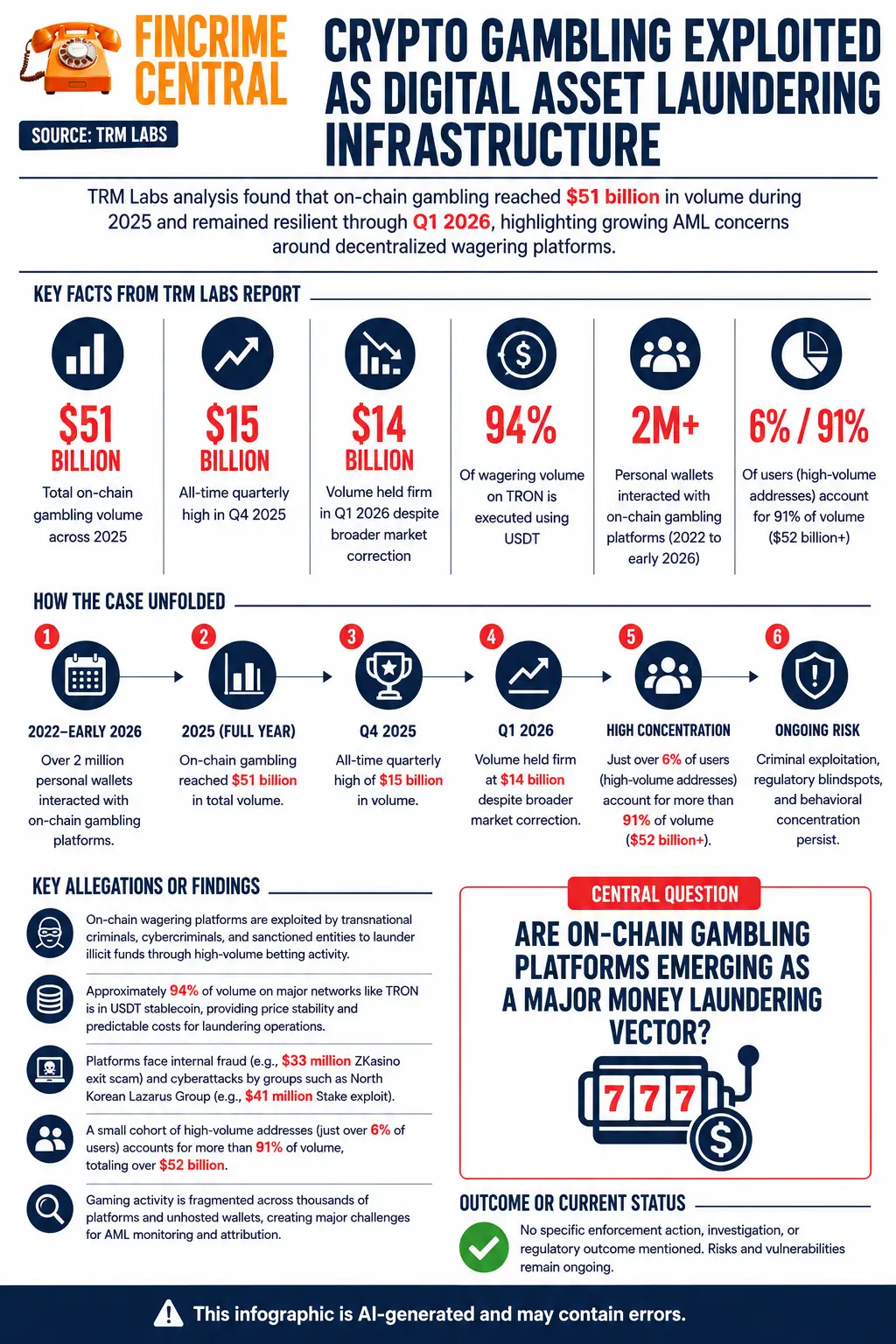
TRM Labs has reported that on-chain casino laundering ecosystems experienced unprecedented growth over the last several years, quietly transforming into a massive, parallel financial ecosystem that presents profound challenges for anti-money laundering professionals. While public attention and regulatory scrutiny focused heavily on prediction markets due to high-profile political events, decentralized gaming and wagering platforms expanded to a staggering 51 billion dollars in total volume across 2025. This explosive trajectory sustained its momentum into the first quarter of 2026, holding firm at 14 billion dollars despite a broader digital asset market correction. This structural resilience, completely uncoupled from traditional crypto price cycles, underscores a deeper systemic reality that compliance officers must confront. These platforms are no longer just recreational outlets for retail participants, but are increasingly functioning as highly efficient, liquid, and automated layered mechanisms used by illicit actors to obfuscate the origins of criminally derived funds.
Table of Contents



Crypto Gambling Exploited as Digital Asset Laundering Infrastructure
The monumental scale of the on-chain wagering sector has made it a primary target for sophisticated transnational criminal syndicates, cybercriminals, and sanctioned entities looking for rapid placement and layering channels. The absolute volume within the ecosystem, which reached an all-time quarterly high of fifteen billion dollars in the final quarter of twenty twenty five, provides an ideal environment for illicit actors to blend their transactions with legitimate retail activity. Traditional financial institutions rely on geographical boundaries and established banking relationships to flag suspicious cross-border movements, but decentralized wagering protocols operate globally with minimal friction. This allows illicit funds to be deposited from anonymous unhosted wallets, commingled with millions of dollars in retail betting volume, and withdrawn as seemingly legitimate gaming winnings. The persistent demand for these platforms through the 2025 and 2026 market correction proves that the flow of funds is driven by utility rather than speculative asset appreciation, making it an incredibly stable infrastructure for layering illicit capital.
The structural composition of the assets moving through these platforms further amplifies the money laundering risks and complicates transactional tracking for anti-money laundering specialists. Approximately 94 percent of the wagering volume on major networks like TRON is executed using the stablecoin USDT, which completely insulates the sector from the volatile price swings that typically characterize the broader cryptocurrency markets. For an illicit organization attempting to wash funds, stability is paramount, as price drops during the layering phase can result in severe capital loss. By utilizing stablecoins within high-volume gambling protocols, money launderers can predict their exact operational costs, moving millions of dollars through automated smart contracts with near-zero slippage. This stablecoin dominance creates a massive, highly predictable liquidity pool that effectively hides the transactional footprints of malicious actors who exploit the quick settlement times and high turnover rates inherent to digital casino operations.
Beyond the exploitation of legitimate platforms for layering purposes, the crypto gambling ecosystem is plagued by severe internal criminal risks, including outright protocols designed as exit scams and platforms targeted by state-sponsored cyber actors. A prominent example of internal fraud occurred with the 33 million dollar ZKasino exit scam, where a platform advertised as a decentralized wagering network abruptly locked user funds, illustrating how easily fraudulent entities can masquerade as legitimate gaming protocols to launder stolen capital. Concurrently, highly sophisticated state-sponsored hacking groups, such as the North Korean Lazarus Group, have actively targeted large-scale crypto casinos, evidenced by their 41 million dollar exploit of the Stake platform. These incidents demonstrate that on-chain gambling sites act as dual threats, serving as highly lucrative targets for cyber theft while simultaneously providing the exact infrastructure needed to launder the proceeds of those identical hacks, creating a self-sustaining loop of decentralized financial crime.




Regulatory Blindspots and Blockchain Complications in On-Chain Casinos
Evaluating the behavioral dynamics within the wagering ecosystem reveals a deeply concentrated risk profile that challenges standard anti-money laundering monitoring frameworks. Blockchain analytics indicate that while more than two million personal wallets interacted with these platforms between twenty twenty two and early twenty twenty six, a tiny minority of users account for nearly the entire financial volume. A specific cohort of high-volume addresses represents just over six percent of the total user base but commands more than 91 percent of all personal wallet wagering volume, accounting for over 52 billion dollars. This extreme concentration of capital means that compliance teams cannot simply rely on aggregate wallet counts to assess risk; they must implement granular behavioral tracking that differentiates casual retail participants from these massive capital allocators. The rapid intensification of these large-scale wallets, whose monthly volume grew from under four hundred million dollars in twenty twenty two to over two billion dollars by March twenty twenty six, signifies an immense concentration of liquidity that is highly susceptible to exploitation by professional money laundering networks.
The decentralized and non-custodial nature of on-chain casinos creates severe regulatory blind spots that traditional anti-money laundering frameworks are ill-equipped to address. Unlike fiat casinos that are subject to strict Bank Secrecy Act requirements, comprehensive identity verification, and geographical restrictions, many decentralized gambling applications run entirely via automated smart contracts without centralized compliance teams. This lack of oversight allows users to interact with the platform directly from unhosted wallets, bypassing standard client screening, politically exposed persons checks, and sanctions filtering. When a platform does not enforce robust customer due diligence, it becomes incredibly easy for criminal actors to utilize automated scripts that split large illicit deposits into thousands of smaller wenders, mimicking the behavior of habitual retail bettors. This behavioral mimicry makes it exceptionally difficult for automated transaction monitoring systems to isolate suspicious activity without generating overwhelming amounts of false positives.
Furthermore, the cross-chain and inter-contract nature of these transactions creates significant hurdles for blockchain forensics investigators trying to trace the path of tainted assets. Illicit funds are frequently routed through complex decentralized finance protocols, wrapped into different token standards, and hopped across multiple blockchain networks before entering a gambling smart contract. Once inside the casino ecosystem, the funds are subjected to rapid-fire wagering cycles where the original input tokens are mixed with the platform’s internal liquidity pools. When the funds are eventually withdrawn to a new, clean, unhosted wallet, the direct cryptographic link to the original theft or exploit is heavily obscured. This fluid movement across smart contracts transforms the gambling platform into a highly effective substitute for traditional cryptocurrency mixers, providing clean on-chain histories for assets that can then be easily off-ramped at centralized exchanges.


Advanced Behavioral Frameworks for Countering On-Chain Wagering Risks
To effectively mitigate the systemic laundering risks proliferating through the digital wagering sector, financial institutions and virtual asset service providers must transition toward advanced behavioral profiling models. Relying solely on basic static indicators, such as checking if an address has interacted with a known gambling smart contract, is no longer sufficient given the complexity of modern layering techniques. Compliance departments must develop sophisticated algorithmic models that categorize incoming wallet traffic into distinct behavioral archetypes based on transactional cadence, velocity, and historical funding sources. By mapping out the specific behavioral baselines of legitimate cohorts, such as occasional sport bettors who activate only during major athletic events, compliance systems can more accurately detect anomalies that signal automated structuring or institutional money laundering. When an address exhibits transaction frequencies and volumes that deviate sharply from standard retail behavior, it should trigger immediate enhanced scrutiny and comprehensive source of wealth investigations.
Proactive risk mitigation also requires deep transaction monitoring at the nexus points where stablecoin flows transition between decentralized gambling applications and centralized exchange infrastructure. Because the vast majority of on-chain wagering utilizes stablecoins like USDT and USDC, centralized exchanges serve as the ultimate gatekeepers where these washed assets are converted into fiat currency or other stable holdings. Virtual asset service providers must deploy real-time blockchain intelligence tools that calculate exposure scores for all incoming stablecoin deposits, tracking the asset’s history back through multiple layers of smart contract interactions. If a deposit reveals a high concentration of funds originating from unhosted wallets that frequently interact with unregulated, non-compliant gambling protocols, the transaction must be flagged for immediate review. Cooperating with stablecoin issuers to freeze assets linked to verified casino exploits and state-sponsored cyber theft remains a critical line of defense in disrupting the financial utility of these illicit networks.
Ultimately, addressing the financial crime risks embedded within the rapidly growing crypto gambling sector requires a coordinated, global regulatory approach that harmonizes compliance expectations for decentralized applications. As long as regulatory arbitrage exists, illicit actors will continue to exploit jurisdictions with weak oversight and protocols that refuse to implement basic compliance controls. International standard-setting bodies must work toward establishing uniform guidelines that hold protocol developers, front-end operators, and governance token holders accountable for integrating anti-money laundering protocols directly into their systems. By mandating decentralized identity solutions and zero-knowledge compliance proofs, the industry can preserve user privacy while ensuring that multi-billion-dollar financial flows are no longer completely shielded from anti-money laundering oversight. Until these comprehensive frameworks are universally adopted, the on-chain wagering sector will remain a highly liquid and deeply problematic vector for global money laundering activities.
Contextual Anti Money Laundering Typologies to Monitor in Crypto Gambling
Anti-money laundering professionals must maintain a comprehensive understanding of specific behavioral anomalies and operational patterns that indicate the exploitation of on-chain wagering platforms for illicit capital flight and asset layering.
- Automated Transaction Structuring via Unhosted Wallets: Deploying specialized software scripts to automatically distribute a large volume of illicit digital assets across dozens of newly generated, unhosted addresses before depositing those fractured amounts into a gambling smart contract to mimic low-stakes retail behavior.
- Rapid Multi Asset Layering and Mixing: Depositing tainted tokens into a decentralized casino, immediately placing low-risk or hedging wagers across opposing outcomes to lock in minimal losses, and subsequently withdrawing the funds to entirely separate addresses to sever the direct cryptographic link to the initial crime.
- Stablecoin Velocity Exploitation on Low Fee Networks: Utilizing high volumes of USDT on low-cost blockchains to execute rapid-fire deposits and withdrawals through gambling applications, exploiting the low transaction fees and massive liquidity pools to obfuscate large-scale fund movements without market slippage.
- Exploitation of Non-Compliant Front-End Interfaces: Accessing decentralized wagering protocols exclusively through geographic jurisdictions or third-party user interfaces that do not enforce customer due diligence, sanctions screening, or wallet risk scoring.
- Internal Smart Contract Exit Scams: Establishing a supposedly legitimate decentralized wagering platform to attract retail liquidity, followed by the abrupt execution of malicious code changes to drain and route user deposits into private, unhosted wallets for layering purposes.
Key Points
- On-chain gambling reached 51 billion dollars in total volume during 2025, surpassing prediction markets until the first quarter of twenty twenty six.
- Transnational criminal networks and state-sponsored groups like the Lazarus Group systematically utilize crypto casinos as primary money laundering infrastructure.
- Approximately 94 percent of the wagering volume on the TRON network utilizes the stablecoin USDT, providing transaction stability for illicit actors.
- High volume addresses representing just six percent of the user base control over 91 percent of the total personal wallet gambling volume.
- Decentralized wagering platforms frequently function as effective alternatives to cryptocurrency mixers due to their lack of identity verification controls.
Related Links
- Financial Action Task Force Guidance on Virtual Assets
- United States Department of the Treasury FinCEN Financial Crimes Enforcement Network
- Office of Foreign Assets Control Sanctions Compliance Guidance
- United Nations Office on Drugs and Crime Global Report on Cybercrime
Other FinCrime Central Articles About Casinos as a Laundering Vector
- Nevada Regulations Force AML Compliance Shift Across Las Vegas Strip Casinos
- Macau Casino Scheme Leads to Indictment and US$1 Billion Penalty in Taiwan
- Philippines Casino Losses of Officials Expose Flood Project Money Laundering Web
Source: TRM Labs
Some of FinCrime Central’s articles may have been enriched or edited with the help of AI tools. It may contain unintentional errors.
Want to promote your brand, or need some help selecting the right solution or the right advisory firm? Email us at info@fincrimecentral.com; we probably have the right contact for you.