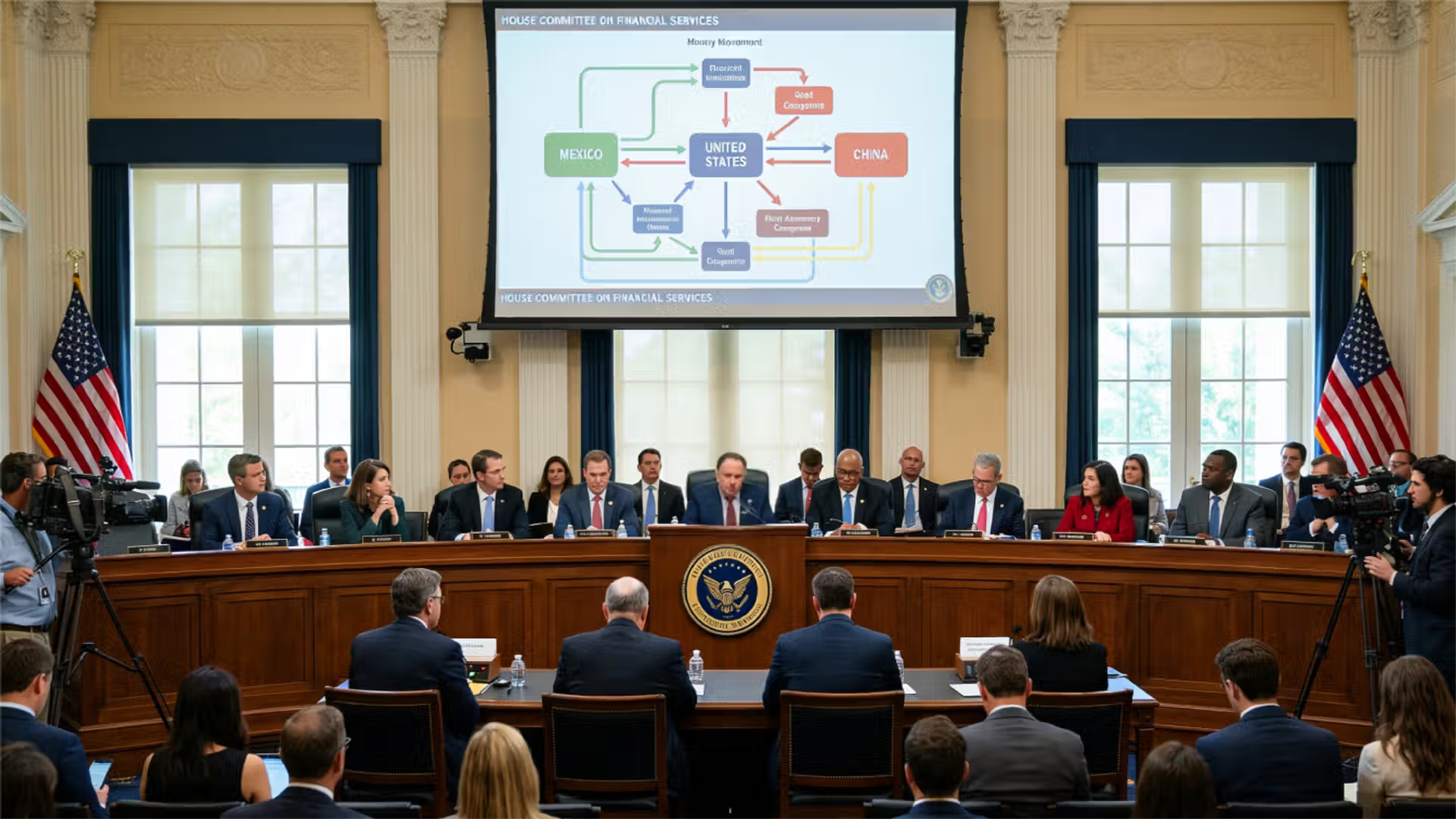
The $4.2 million penalty levied against Wise US by a coalition of state financial regulators has quickly become a reference point for the shifting landscape of money transmitter compliance in the United States. The case illustrates the evolving priorities of state and federal authorities, especially in the context of fintech firms facilitating large-scale cross-border transactions. Wise US, as a subsidiary of the global financial technology company Wise PLC, offers digital remittance and international money transfer services across all 50 states, making it an essential player in the US payments ecosystem.
State regulatory action on Wise US, announced in July 2025, brings into sharp focus the mounting expectations on non-bank financial service providers to maintain robust anti-money laundering (AML) and countering the financing of terrorism (CFT) programs. The settlement agreement requires Wise US not only to pay a substantial monetary penalty but also to overhaul its risk management, enhance internal controls, and engage in ongoing regulatory oversight for a multi-year period.
Table of Contents
Money Transmitter Compliance in the US: A Complex Regulatory Environment
The enforcement action against Wise US underscores the unique challenges that money transmitters face within the fragmented US regulatory environment. Money transmission activities are regulated at both the state and federal levels. States such as New York, California, Massachusetts, Minnesota, Nebraska, and Texas—those directly involved in the Wise US settlement—are among the most active in licensing and supervising money transmitters under local statutes and regulations. New York, for instance, applies its Banking Law and strict AML requirements through the Department of Financial Services (DFS).
At the federal level, money transmitters must comply with the Bank Secrecy Act (BSA) and related rules administered by the Financial Crimes Enforcement Network (FinCEN), a bureau of the US Department of the Treasury. The BSA requires money services businesses (MSBs) to develop risk-based AML programs, file suspicious activity reports (SARs), and conduct customer due diligence. Failure to meet these obligations can result in significant enforcement action, as demonstrated by the Wise US settlement.
Multi-state settlements of this nature reflect a growing tendency for state regulators to coordinate their AML enforcement strategies, ensuring greater consistency and higher standards across the industry. Wise US, operating under a nationwide model, became subject to a joint examination by the Multi-State MSB Examination Taskforce (MMET), which scrutinizes large and high-risk money transmitters.
The Wise US Case: Deficiencies in AML/CFT Controls
The Wise US enforcement action centers on alleged deficiencies in its AML and CFT controls, primarily related to the implementation of the BSA and relevant state regulations. Regulators flagged areas including customer due diligence, transaction monitoring, and suspicious activity reporting. Specifically, authorities identified gaps in the way Wise US risk-assessed customers, monitored international payments, and documented internal control processes.
Wise US’s business model involves facilitating high volumes of cross-border payments for retail and business customers, increasing its exposure to money laundering and terrorism financing risks. The MMET’s examination found that Wise US did not always meet heightened regulatory expectations, particularly in the context of complex or high-risk transactions.
Under the settlement, Wise US must take remedial action, which includes:
- Overhauling and enhancing its AML and CFT policies and procedures
- Retaining an independent third-party consultant to assess and certify corrective actions
- Submitting quarterly progress reports to the coalition of regulators for a two-year period
This regulatory response not only imposes a financial cost but also requires Wise US to demonstrate continuous improvement in compliance standards.
Industry Implications: AML Penalty Sets a New Precedent
The size and structure of the AML penalty for Wise US is notable in several respects. First, it signals a new era of heightened scrutiny for digital financial services providers, especially those handling international funds transfers. Regulators are sending a clear message that payment firms must take a proactive stance on AML and CFT, with no tolerance for process gaps or delays in risk mitigation.
The collaborative approach taken by the six state agencies represents a growing trend among US regulators, who increasingly view money transmitter compliance as a collective responsibility. This is evident in the joint settlements, uniform remediation requirements, and ongoing supervisory obligations now imposed on Wise US. Other fintech and payments companies are likely to see this as a warning to revisit their own risk controls and compliance frameworks.
The regulatory climate is also shaped by the integration of federal guidance, such as FinCEN’s 2020 update to the AML program requirements for MSBs, and by new technological solutions being deployed for transaction monitoring and customer risk profiling. Wise US’s remedial plan will likely include advanced compliance technologies and updated policies that respond to both current threats and anticipated changes in criminal typologies.
The settlement’s terms require Wise US to engage an independent third-party auditor—a measure that is becoming more common as regulators seek external validation of compliance upgrades. Quarterly progress reports further enhance regulatory transparency and allow authorities to track ongoing remediation. For Wise US, this marks a transition from a one-time penalty to a multi-year compliance journey.
Other Recent Regulatory Challenges for Wise US
The $4.2 million penalty is not the first time Wise US has come under regulatory scrutiny. Earlier in 2025, Wise reached a settlement with the Consumer Financial Protection Bureau (CFPB) concerning alleged failures to accurately disclose fees to consumers. That matter, while distinct from AML concerns, reflects a broader regulatory focus on consumer protection and transparency in the fintech sector.
Together, these enforcement actions illustrate the comprehensive nature of financial regulation in the US. Money transmitters must navigate both AML and consumer protection rules, often adapting to new expectations with little advance notice. Wise US’s experience is a reminder that compliance risks are multifaceted and that firms must be prepared for holistic supervisory reviews that encompass everything from financial crime prevention to marketing disclosures.
The Evolving Landscape for AML and CFT in Money Transmission
The Wise US case takes place against the backdrop of rapid change in the global payments sector. Regulators in the US and worldwide are raising the bar for AML and CFT controls as financial crime threats become more sophisticated. The Financial Action Task Force (FATF) regularly updates its recommendations, and the US has made several recent enhancements to its AML regime, such as the Anti-Money Laundering Act of 2020 and the Corporate Transparency Act. These developments set new benchmarks for compliance, risk management, and reporting across the sector.
For non-bank payment firms, the challenge lies in building scalable and effective compliance frameworks that can adapt to changing regulatory guidance. This requires robust governance structures, advanced analytics for transaction monitoring, and regular training for staff on evolving risks. Technology and data science are playing an increasing role, with firms leveraging artificial intelligence to detect suspicious activity and automate compliance checks.
Wise US’s penalty and remediation efforts serve as a cautionary tale for the industry, highlighting the consequences of underestimating regulatory expectations. Firms must invest in proactive compliance strategies, ensure executive-level accountability, and foster a culture of transparency to stay ahead of enforcement trends.
Conclusion: Wise US Penalty as a Catalyst for Industry-Wide Change
The $4.2 million AML penalty imposed on Wise US by state regulators stands as a pivotal development in the US payments landscape. It demonstrates a renewed commitment among regulators to enforce high standards for money transmitter compliance and financial crime prevention. The multi-state collaboration, combined with ongoing remediation and third-party oversight, sets a new benchmark for how fintech companies should approach AML and CFT.
As money transmission continues to evolve, so too will the regulatory environment. Wise US and its peers must adapt rapidly, balancing innovation with robust risk management. The lessons from this settlement will resonate across the payments sector, encouraging companies to prioritize compliance investments and build sustainable, future-ready frameworks for AML and CFT.
Related Links
- New York State Department of Financial Services: Money Transmitter Guidance
- FinCEN – Bank Secrecy Act Regulations
- Consumer Financial Protection Bureau: Enforcement Actions
- Financial Action Task Force: Recommendations
- California Department of Financial Protection and Innovation: Money Transmission
Other FinCrime Central Articles About PSPs
- Wise Faces Scrutiny Over AML Controls: A Closer Look at Regulatory Actions
- AML fines Europe: a costly wake-up call for PSPs and EMis
- Zero Tolerance: Bank of England Imposes £11.9m Penalty on Vocalink for Compliance Failures
Source: PYMNTS
Some of FinCrime Central’s articles may have been enriched or edited with the help of AI tools. It may contain unintentional errors.
Want to promote your brand with us or need some help selecting the right solution or the right advisory firm? Email us at info@fincrimecentral.com; we probably have the right contact for you.