An exclusive article by Fred Kahn
Trade finance AML failures continue to pose serious challenges for global financial stability and operational integrity, as illicit actors exploit gaps in cross-border documentation, fragmented data flows, and weak controls. With mounting regulatory scrutiny and high-value enforcement actions reported across jurisdictions, compliance leaders face mounting pressure to elevate program effectiveness. This article embeds independent research and case illustrations to offer a refined analysis of trade-based money laundering vulnerabilities, regulatory evolution, cutting-edge detection technologies, and holistic compliance enhancements.
In examining systemic weaknesses, regulatory drivers, technological enhancements, and culture-shaping strategies, this article equips AML practitioners with actionable insights to transform trade finance AML defenses into adaptive, resilient mechanisms.
Table of Contents


Persistent Vulnerabilities In Trade Finance AML
Trade finance is inherently complex, with cross-border transactions often encompassing multiple stakeholders—banks, logistics firms, customs, insurers, and trade platforms. Such complexity presents fertile ground for trade-based money laundering (TBML), an illicit practice designated by the Financial Action Task Force as a major threat. Criminals can exploit various techniques including mis-invoicing, over or undervaluing goods, falsely describing quantities or descriptions, or inventing shipments altogether.
Consider mis-pricing: a shipment of precious metals may be invoiced at a fraction of true value, allowing illicit proceeds to move undetected, or vice versa to covertly introduce clean funds. Phantom shipments involve generating trade documentation without actual physical transfers, funneling illicit funds through letters of credit or open-account arrangements. Duplicate invoicing allows criminals to present multiple invoices for the same goods to different banks, increasing laundering capacity.
Such strategies thrive in environments with fragmented oversight. Financial institutions may lack visibility into the physical movement of goods. Customs authorities often operate in isolation from banks, and trade data remains siloed. Beneficial ownership of shipping entities can be obscured through shell companies or complex ownership chains, further complicating detection.
Cross-border dynamics amplify risk. Jurisdictions with weaker AML controls, high volumes of opaque trade, or political instability may serve as hubs for layering illicit value. Sanctioned or high-risk counterparties can be indirectly engaged via third-party intermediaries, further obfuscating the illicit origin of funds.
Enforcement And Regulatory Momentum
In recent years, regulators across regions have taken decisive action, signalling that failures in trade finance AML are no longer tolerated. Enforcement fines in the multiple millions—including cases involving major global banks—highlight failures in due diligence on beneficiary identity, supply-chain opacity, and failure to monitor trade flows for red flags.
The FATF has responded by publishing updated Best Practices on TBML, urging jurisdictions to enhance data collection, improve analytical capacities, and develop typologies specific to high-risk corridors. These recommendations underscore the importance of cross-agency cooperation, integration of trade data with financial intelligence units, and public-private information exchanges.
Simultaneously, FATF’s 40 Recommendations framework was updated in June 2025 to reinforce consistent global standards. These changes reaffirm the requirement for enhanced due diligence in trade, and for risk-based approaches that adapt to emerging TBML methodologies.
In the European Union, the establishment of AMLA—the Authority for Anti-Money Laundering and Countering the Financing of Terrorism—marks a pivotal shift. Camped in Frankfurt and becoming operational by mid-2025, AMLA will have direct supervisory powers over high-risk financial institutions, including trade finance desks in systemic banks and, potentially, burgeoning sectors like crypto firms, art dealers, and sports organisations.
Across the EU, member states continue to adapt through National Supervisory Authorities (NSAs), which now require banks to maintain detailed mapping of trade counterparties, verify end-users across supply chains, and sustain granular audit logs to demonstrate compliance. These requirements are backed by supervisory examinations and remediation directives.
Internationally, trade transparency units—specialised analytics hubs combining customs, financial intelligence units, and law enforcement—have sprung up in jurisdictions like Singapore and Canada. These units monitor trade flows for suspicious patterns—such as sudden spikes in import-export activity with specific corridors or commodity mismatches between declared value and actual price ranges—then feed alerts back to banks.
Moreover, regulatory consistency is gaining traction. FATF regional bodies and multilateral institutions emphasize alignment across borders. Asia-Pacific Group (APG) and the Council of Europe’s MONEYVAL have also issued updated trade finance risk guidance, reinforcing FATF standards and facilitating better cross-jurisdictional coordination.
Technological Advancements In Detecting TBML
To close the visibility gap, financial institutions are embracing advanced technologies tailored for trade finance AML. These encompass artificial intelligence, machine learning, distributed ledger technologies, network analytics, and integrated compliance platforms.
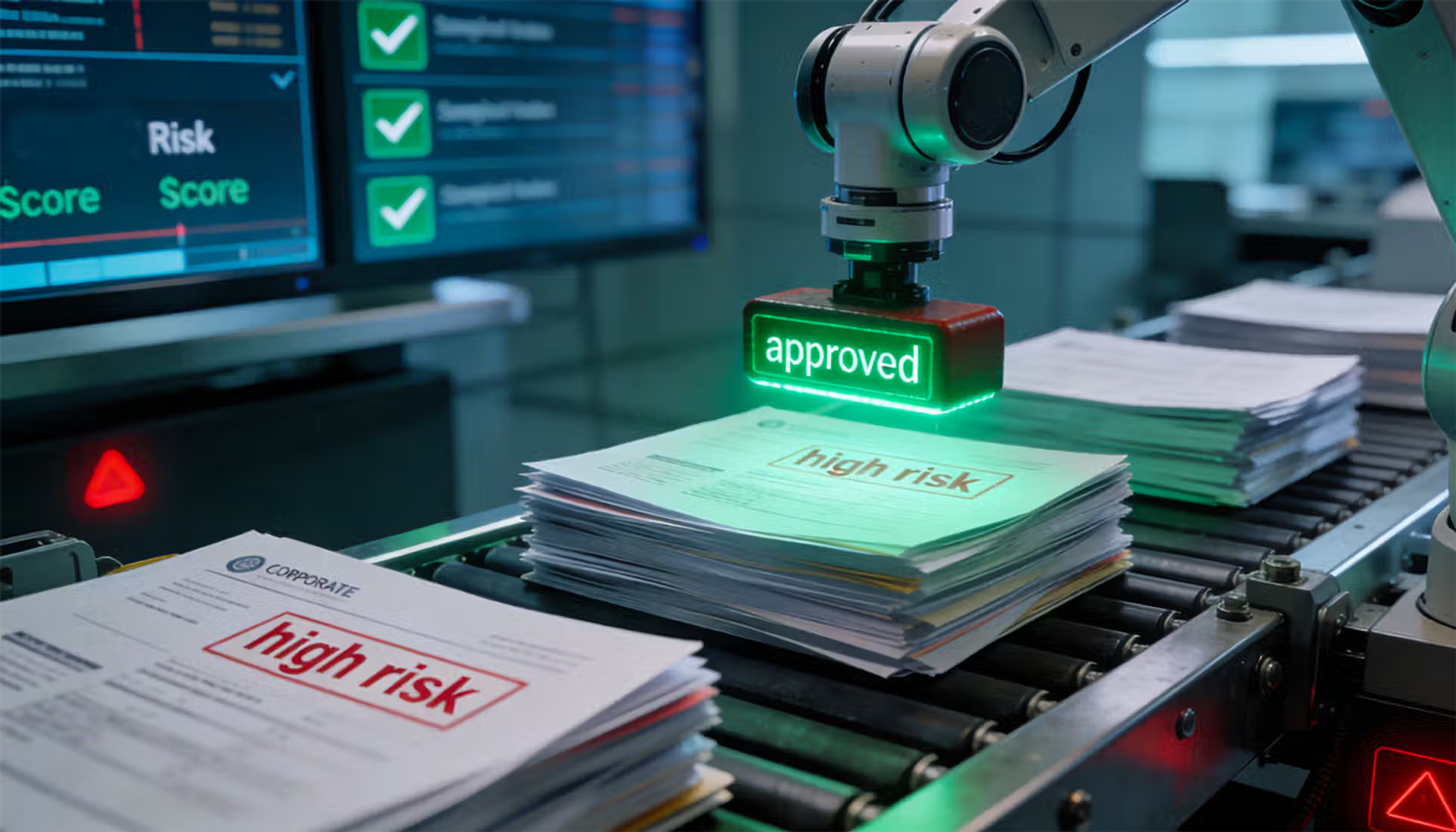
AI-powered analytics now digest vast volumes of trade-related data, including invoices, bills of lading, payment records, shipment manifests, and customs entries. These systems learn normal trade patterns, identifying anomalies like inconsistent pricing against commodity benchmarks, unusual routing schemes, or repeating counterparties across unrelated transactions. They can surface potential mis-invoicing or duplicate shipping chains for human review—crucial in detecting sophisticated TBML.
Distributed ledger technologies allow all stakeholders—banks, shippers, customs, insurers—to record trade events on a shared, tamper-resistant ledger. This real-time visibility enhances authenticity checks across documents like certificates of origin and bills of lading. Shared ledgers can also expose circular trade flows used to layer and integrate illicit proceeds through chains of trade that mask ultimate source.
End-to-end compliance platforms integrate with trade service providers, shipping agents, customs authorities, and data providers. Structured APIs enable auto-escalation of red flags and faster investigations. These platforms let AML teams access consolidated documentation and risk indicators, improving speed and accuracy of decision-making.
Network analysis tools expose hidden relationships among entities. A shell company used to invoice a trade partner may also connect to other high-risk entities in different transactions. By visualising these networks, compliance professionals can scrutinise ownership structures, interlocking directorships, or repeated beneficial ownership components that may indicate laundering.
Continuous monitoring frameworks, backed by dynamic typology libraries, mean institutions update their detection rules based on emerging threats. Red-flag indicators may include rapid increases in trade volume, evolving routing patterns, or usage of newly registered corporate entities with evergreen ownership details.
Strengthening Compliance Programs And Culture
Technology alone is insufficient. Compliance programs must also invest in people, process, and culture to become truly resilient.
Scenario-based training tailored to trade finance AML is foundational. AML professionals need immersive modules reflecting current TBML typologies—such as invoice manipulation, shell-company exploitation, and mismatched commodity valuation—to sharpen investigative instincts and judgment. Scenario libraries should be informed by actual cases and evolving typologies.
Governance and oversight mechanisms are critical. AML committees should include trade-finance officers, audit and risk leads, and senior compliance. Regular internal reviews and testing—such as red-team exercises—can identify weaknesses in transaction monitoring, documentation, and escalation processes.
Robust due diligence procedures must go beyond collecting standard documents. They must include verifying suppliers, ultimate end-users, and beneficial owners with credible local intelligence. Validation efforts may include site visits, reference checks, analysis of publicly-available corporate registries, and use of commercial data providers.
Auditability and documentation are vital. Every red-flag alert, decision, and investigation must be recorded in a comprehensive file that demonstrates the bank’s ability to monitor and respond. This creates transparency for supervisors and strengthens remediation readiness.
Cross-sector collaboration amplifies impact. Public-private partnerships, trade associations, customs authorities, and FIUs can share patterns of abuse. Embedding that intelligence into compliance frameworks enhances detection ability across the industry.
Continuous improvement cycles ensure programs remain up to date. This includes adapting to new legislation, typology shifts, and evolving risk models, with regular policy reviews and system parameter calibration.
Resilient Trade Finance AML That Empowers Institutions
Trade finance AML stands at a crossroads. Where past approaches relied heavily on static rule-sets and manual checks, the future demands dynamic systems, collaborative intelligence, and strategic agility. As regulators tighten expectations, institutions that invest in technological innovation, governance excellence, staff proficiency, and ecosystem engagement will gain the confidence of supervisors and stakeholders.
Making trade finance AML a competitive advantage starts with building adaptive controls, leveraging data intelligently, and cultivating a culture of vigilance. By doing so, institutions can transform a persistent vulnerability into a forceful shield—protecting global trade integrity and reinforcing trust in financial systems.
Related Links
- FATF Recommendations June 2025
- FATF Best Practices on Trade-Based Money Laundering
- Details on Establishment of the EU Authority for Anti-Money Laundering
- EU Official Journal Update on AML Grey-List Status
Other FinCrime Central Articles About AML in Trade Finance
- How Smart Data Linkage Could Break the TBML Game for Good
- Trade-Based Money Laundering Threatens Asia-Pacific Supply Chains
- Why Banks Struggle to Integrate Trade Finance Data into Transaction Monitoring Systems
Some of FinCrime Central’s articles may have been enriched or edited with the help of AI tools. It may contain unintentional errors.
Want to promote your brand, or need some help selecting the right solution or the right advisory firm? Email us at info@fincrimecentral.com; we probably have the right contact for you.