An exclusive article by Fred Kahn
Transaction monitoring has long been presented as a sophisticated safeguard against financial crime. Yet the market increasingly resembles a standardized utility, with vendors promoting similar capabilities and pricing models. Regulatory frameworks across major jurisdictions define what institutions must implement, narrowing the scope for radical differentiation. Enforcement actions continue to highlight operational failures rather than technological gaps. This environment fuels a provocative question: has transaction monitoring become a commodity product rather than a strategic differentiator?
Table of Contents


Transaction Monitoring Commoditization and Regulatory Standardization
Legal obligations establish the functional baseline for every monitoring system. The Bank Secrecy Act in the United States requires financial institutions to maintain programs reasonably designed to detect and report suspicious activity. FinCEN regulations and guidance clarify expectations around ongoing monitoring and suspicious activity reporting. In the European Union, successive Anti Money Laundering Directives and the forthcoming AML Regulation impose comparable duties. The UK Money Laundering Regulations 2017 similarly mandate ongoing monitoring of transactions and customer relationships.
When statutory requirements converge, product design follows. Every credible platform must screen transactions against defined risk indicators, generate alerts, support case management, and facilitate regulatory reporting. These shared capabilities form the core of nearly all commercial offerings. Marketing materials emphasize artificial intelligence and behavioral analytics, yet the structural components often mirror one another.
Supervisory practice reinforces this convergence. Enforcement actions by authorities such as FinCEN, the Federal Reserve, and the UK Financial Conduct Authority frequently cite inadequate alert review processes, poor calibration, and insufficient governance. Rarely do they fault institutions for lacking access to cutting-edge algorithms. Instead, they focus on ineffective implementation of standard monitoring expectations. This pattern suggests that compliance outcomes depend less on novel technology and more on disciplined execution of established controls.
As a result, transaction monitoring increasingly resembles a regulated utility. Institutions must have it, regulators define its minimum performance criteria, and vendors design products to satisfy those common benchmarks. The perception of commoditization stems directly from this regulatory harmonization.



Uniform Features and the Erosion of Distinctiveness
The feature sets of leading monitoring platforms typically include scenario libraries aligned to Financial Action Task Force typologies, configurable thresholds, sanctions screening integration, and investigator workflow tools. Machine learning modules are often layered onto rule-based engines, but they operate within similar governance constraints. Supervisory guidance on model risk management, including Federal Reserve SR 11 7, requires validation, documentation, and explainability.
Explainability requirements narrow differentiation. A system that cannot articulate why an alert was generated will struggle under regulatory review. Consequently, vendors gravitate toward hybrid models that balance statistical scoring with transparent rules. Once explainability becomes non-negotiable, architectural diversity contracts.
Cloud deployment has also become widespread. Regulatory bodies such as the European Banking Authority have issued guidelines on ICT and outsourcing risk, shaping how institutions manage third-party providers. Cloud readiness is no longer a differentiator; it is a baseline expectation for many institutions. As adoption spreads, infrastructure choices cease to distinguish one vendor from another.
Even scenario design tends to converge. The Financial Action Task Force and national authorities publish typology reports on trade-based money laundering, terrorist financing, and emerging risks. Vendors incorporate these typologies into their libraries, producing comparable detection frameworks. When all providers reference the same regulatory sources, the distance between products narrows.
Price Pressure and Procurement Behavior
Commoditization typically leads to pricing compression. Evidence from public financial disclosures of regtech firms and industry surveys indicates increased competition and subscription-based pricing. Procurement teams now compare cost per transaction or cost per account monitored, framing monitoring as an operational expense rather than a strategic investment.
Regulatory expectations reinforce this cost sensitivity. Since minimum standards are defined by law, institutions may assume that most established vendors can satisfy baseline compliance requirements. If performance differences are marginal, price becomes the decisive factor. This dynamic mirrors other mature software categories where feature parity drives competitive bidding.
However, switching costs complicate the picture. Migration from one monitoring platform to another involves data mapping, scenario recalibration, parallel testing, and regulatory validation. Supervisors may scrutinize major system changes during examinations. These frictions slow rapid vendor turnover, even in a commoditized market.
Smaller institutions and fintech firms illustrate the trend more clearly. Many seek turnkey solutions with predictable subscription fees. For them, monitoring is a regulatory obligation rather than a competitive advantage. As new regulatory frameworks such as the EU Markets in Crypto Assets Regulation expand the perimeter of supervision, newly regulated entities often prioritize compliance sufficiency over bespoke innovation.
When a Commodity Still Carries High Stakes
Describing transaction monitoring as a commodity risks underestimating its legal significance. Enforcement actions across the United States and Europe demonstrate that ineffective monitoring can trigger substantial penalties and multi-year remediation programs. Regulators assess not only system presence but operational effectiveness, including alert review timeliness and data integrity.
This creates a paradox. Monitoring may be commoditized in structure, yet failure remains costly. The Bank Secrecy Act and equivalent European legislation impose non-negotiable duties. Institutions cannot treat monitoring as interchangeable in practice, even if vendor brochures appear similar.
Differentiation therefore shifts from algorithmic novelty to operational reliability. Data lineage, governance controls, audit trails, and scenario documentation often determine whether a system withstands supervisory scrutiny. These elements rarely feature prominently in marketing narratives, yet they shape regulatory outcomes.
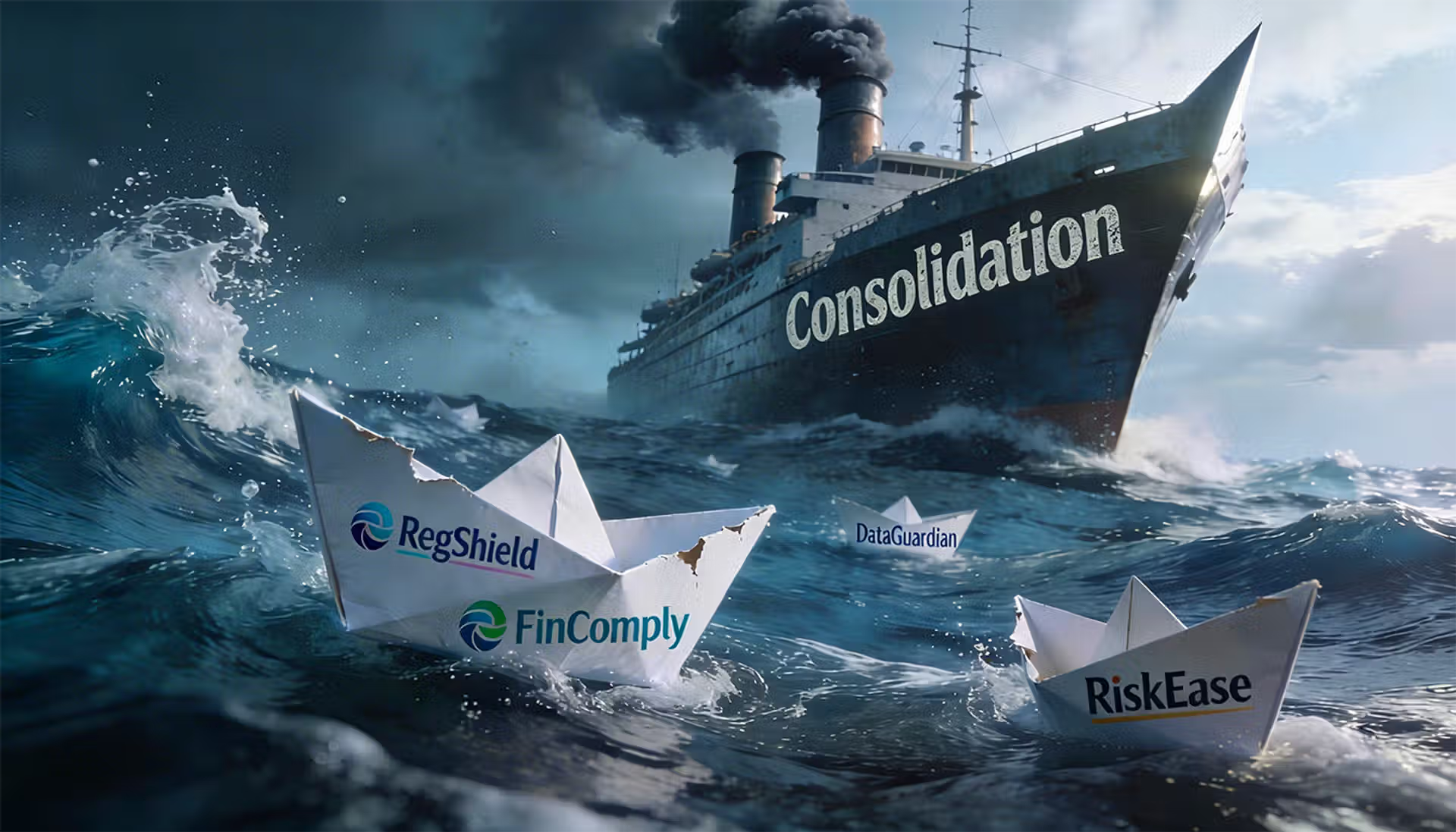
Market consolidation may further entrench commoditization. As larger technology groups acquire specialized AML providers, integrated compliance suites become common. Monitoring becomes one module within a broader risk platform, bundled with sanctions screening and customer due diligence. In such ecosystems, monitoring risks is perceived as a standardized component rather than a distinctive capability.
The decisive question is not whether transaction monitoring is becoming a commodity, but whether institutions are comfortable treating it as one. Regulatory harmonization and shared typologies drive structural similarity. Pricing pressure reinforces the perception of interchangeability. Yet supervisory scrutiny ensures that effectiveness remains paramount. In a tightly regulated environment, commoditization may be inevitable, but accountability is not diluted. Monitoring may look standardized, but its consequences are anything but ordinary.
Key Points
• Global statutes such as the Bank Secrecy Act and EU AML Directives mandate transaction monitoring as a legal requirement
• Regulatory harmonization drives convergence of core monitoring features across vendors
• Explainability and model governance requirements limit extreme technological differentiation
• Pricing pressure increases as institutions perceive baseline compliance capability across providers
• Operational effectiveness, not marketing claims, determines regulatory outcomes
Related Links
- Financial Action Task Force Risk-Based Approach Guidance
- FinCEN Bank Secrecy Act Overview
- UK Money Laundering Regulations 2017
- European Banking Authority Guidelines on ICT and Security Risk Management
- Federal Reserve SR 11 7 Model Risk Management
Other FinCrime Central Articles About Transaction Monitoring
- AI and Analytics Usher in a New Era of Transaction Monitoring in AML
- Why Your Old Transaction Monitoring System Is Bleeding Your Budget Dry
- The Vital Role of Transaction Monitoring in Crypto Compliance
Some of FinCrime Central’s articles may have been enriched or edited with the help of AI tools. It may contain unintentional errors.
Want to promote your brand, or need some help selecting the right solution or the right advisory firm? Email us at info@fincrimecentral.com; we probably have the right contact for you.