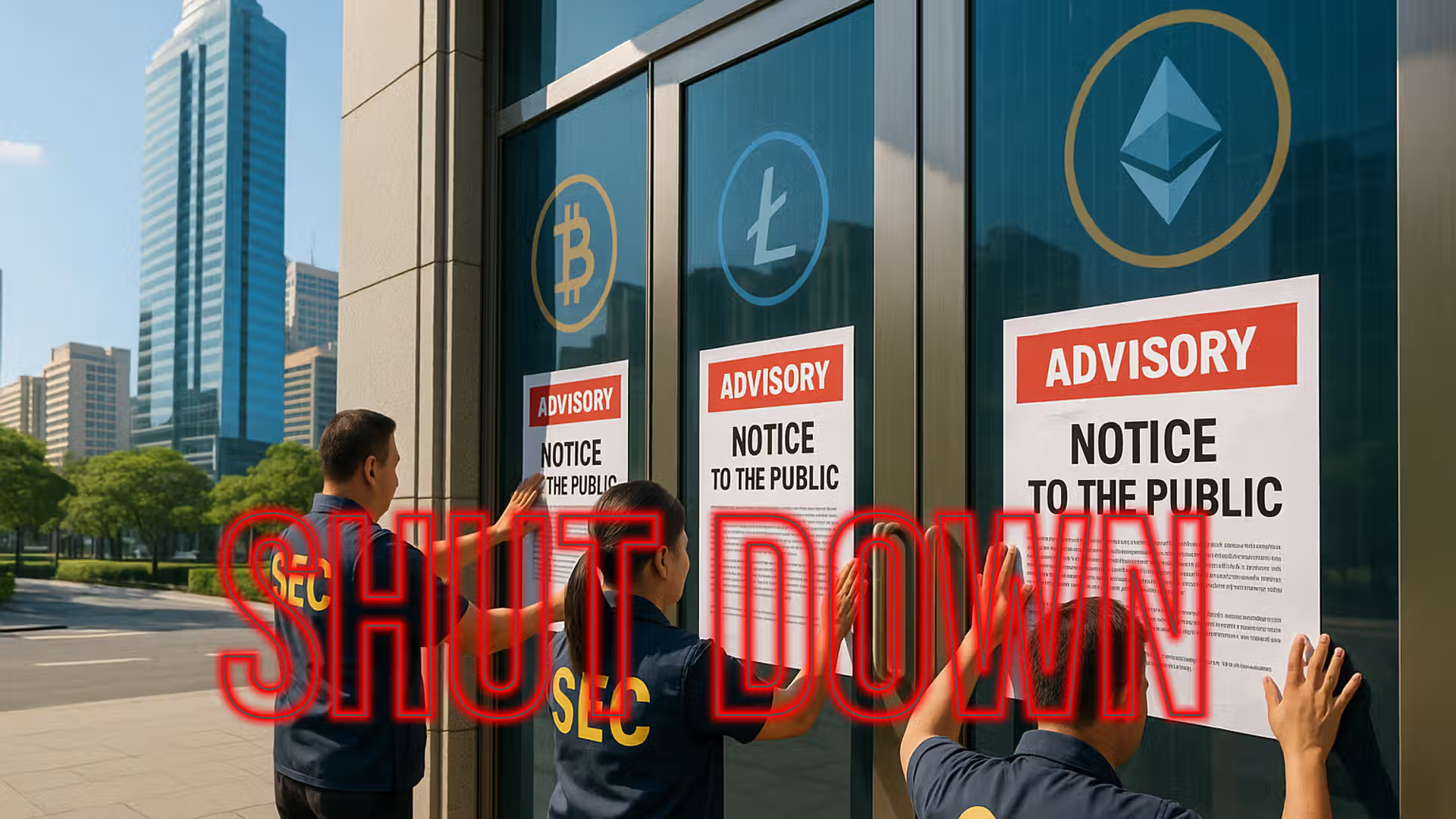
Suspicious digital wallets and high-risk crypto trades are making headlines again, but this time the warning comes straight from the top. The Philippine Securities and Exchange Commission (SEC) has just released an urgent advisory, targeting a surge of unregistered cryptocurrency platforms offering trading and investment products to local users. This warning isn’t just a gentle reminder for investors—it is a direct response to mounting evidence of financial crime risks tied to the crypto sector’s regulatory loopholes.
Table of Contents


Crypto Platform Registration and AML in the Philippines
At the center of this warning lies the requirement for any company soliciting or facilitating investments in the Philippines to be duly registered with the SEC under Republic Act No. 8799, the Securities Regulation Code (SRC). More importantly, these platforms must also comply with anti-money laundering obligations set out under Republic Act No. 9160, the Anti-Money Laundering Act (AMLA), and its 2021 amendments recognizing virtual asset service providers (VASPs) as “covered persons.” The interplay of these laws forms the backbone of the country’s response to emerging risks from digital finance.
Yet, many platforms advertising to Filipinos are operating from offshore jurisdictions, outside the SEC’s supervision, and without any local registration or compliance controls. These platforms typically lack effective customer identification, allow anonymous transactions, and fail to monitor for suspicious activity—making them a magnet for money launderers, fraudsters, and terrorist financiers. The SEC’s 2025 advisory lists dozens of unregistered crypto platforms, a sign that the problem is neither hypothetical nor isolated.
Law enforcement and regulatory data in the Philippines reflect a sharp uptick in the use of crypto for layering illicit funds, with typologies including cash-ins via local agents, P2P trades with unverified counterparties, and rapid asset transfers to overseas exchanges. The lack of regulatory registration not only deprives the government of visibility into these transactions, but also leaves investors with no legal recourse if funds are lost or stolen.
The SEC’s warning is not just a technicality: it is a direct intervention against a rapidly escalating AML and consumer protection risk. Unregistered platforms that facilitate trading or investment in crypto without complying with registration and AML obligations are now squarely in the regulator’s crosshairs.
Money Laundering Threats: How Unregistered Crypto Platforms Become Laundering Tools
Unregistered crypto exchanges have become the weak link in the Philippines’ anti-money laundering (AML) defenses. These platforms, operating beyond the reach of the country’s regulatory and financial intelligence framework, create prime conditions for money laundering, terrorist financing, and fraud. Investigations by the Anti-Money Laundering Council (AMLC) have repeatedly highlighted how unregistered virtual asset service providers enable anonymous, rapid, and cross-border transfers of value.
Typically, these platforms allow users to open accounts with minimal or no identification. Funds can be deposited using cash agents, online wallets, or even prepaid cards. Once crypto assets are purchased, they can be moved instantly—often in small increments, across multiple wallets, or through mixing services that obscure the audit trail. This type of structuring, known as “smurfing,” is designed to break the transaction chain and make detection difficult for authorities.
Several recent cases in the Philippines have demonstrated how proceeds from fraud, investment scams, and even organized criminal activities have been laundered through these offshore exchanges. In one widely reported scam, investors were encouraged to deposit funds into unregistered trading apps, which then routed assets through a web of anonymous wallets, eventually cashing out via overseas platforms beyond Philippine law enforcement’s reach. Such schemes take advantage of the weak onboarding and reporting requirements, bypassing both SEC oversight and AMLC reporting.
The inability to freeze or recover funds held with unregistered entities further complicates law enforcement action. Even when suspicious transactions are identified, cooperation with offshore platforms is limited by jurisdictional issues and lack of regulatory alignment. The end result: illicit actors can exploit these regulatory blind spots with relative impunity, undermining the integrity of both the crypto sector and the broader financial system.
The Legal Framework: SEC Registration, AMLA, and FATF Recommendations
Combatting the risks posed by unregistered crypto platforms requires a robust legal and regulatory infrastructure. In the Philippines, two central statutes form the basis of crypto oversight: the Securities Regulation Code (SRC), and the Anti-Money Laundering Act of 2001 (AMLA), as amended by Republic Act No. 11521 in 2021.
The SRC requires all persons or entities engaged in the offer or sale of securities—including digital assets, utility tokens, or “investment contracts”—to register with the SEC. This requirement ensures that platforms are subject to ongoing supervision, compliance reviews, and sanctions for violations. Entities soliciting investments without registration face criminal liability and administrative penalties, with the SEC empowered to issue cease and desist orders and refer violations for prosecution.
The AMLA and its implementing rules require VASPs to register as “covered persons” with the Bangko Sentral ng Pilipinas (BSP) and comply with stringent anti-money laundering controls. These include customer due diligence (CDD), ongoing monitoring, suspicious transaction reporting, and recordkeeping. In line with FATF Recommendation 15, the Philippines has also introduced “Travel Rule” requirements, mandating that originator and beneficiary information accompany virtual asset transfers.
Despite these measures, enforcement gaps remain. Many unregistered platforms operate offshore, avoiding direct regulation by Philippine authorities. Some exploit technical loopholes, claiming to be mere “technology providers” rather than investment intermediaries. The SEC’s August 2025 advisory is an explicit rejection of these evasive strategies, and a warning that any platform offering crypto products to Filipino investors must comply with local law—regardless of physical location.
The SEC has also taken the step of publishing a list of unregistered platforms, empowering consumers and financial institutions to conduct enhanced due diligence. This approach aligns with FATF best practices, which call for proactive identification and public disclosure of high-risk entities to reduce exposure and limit criminal exploitation.
The Compliance Imperative: How Financial Institutions and Users Can Respond
The SEC’s advisory carries immediate implications for banks, payment processors, remittance companies, and fintech firms operating in the Philippines. Under both AMLA and the BSP’s VASP regulations (BSP Circular No. 1108), financial institutions are required to conduct customer due diligence, monitor for transactions linked to unregistered or high-risk entities, and report suspicious activity to the AMLC.
For compliance teams, this means maintaining updated lists of unregistered crypto platforms and screening all outbound or inbound crypto transactions for connections to these entities. Risk-based approaches must be deployed, with enhanced scrutiny for transactions involving countries or platforms known for lax AML oversight. Transaction monitoring systems should be configured to flag unusual trading patterns, rapid movement of funds, and large-volume transfers inconsistent with customer profiles.
From a user perspective, the risks are even more direct. Engaging with unregistered platforms exposes individuals to asset loss, legal liability, and, in some cases, investigation for facilitating money laundering. Unlike regulated entities, these platforms typically do not offer investor protection mechanisms, recourse for fraud, or transparency in their operations. Users may find themselves entangled in investigations without even realizing that their funds are passing through high-risk channels.
Financial institutions are also under pressure to enhance staff training, update their risk assessments, and report emerging typologies involving virtual assets. The SEC’s action is a clear sign that compliance with local registration and AML laws is no longer optional, but a non-negotiable standard for all participants in the digital finance ecosystem.
Regulatory Momentum: Why the SEC’s Action Matters for AML and Financial Crime Prevention
Philippine authorities are not alone in grappling with the rise of unregistered crypto platforms, but the SEC’s high-profile advisory marks a turning point in the national fight against digital financial crime. By publicly identifying non-compliant platforms, the SEC is raising the bar for both market participants and law enforcement, signaling that regulatory arbitrage will no longer be tolerated.
The timing is crucial. The FATF’s ongoing monitoring of the Philippines’ progress on AML/CFT standards has kept the country under close international scrutiny. The country’s effectiveness in combating financial crime is under periodic review, with virtual asset risks a recurring theme in evaluations. Failure to close loopholes exploited by unregistered platforms could impact the Philippines’ standing with international regulators, investors, and correspondent banks.
For the local market, the message is unambiguous: compliance with SEC registration and AML laws is essential for the legitimacy and sustainability of crypto adoption. Platforms unwilling or unable to meet these requirements will increasingly be isolated from the formal financial sector. Consumers, meanwhile, are urged to steer clear of unregistered platforms and to engage only with licensed, regulated providers.
The SEC’s stance also sends a strong message to regional peers. Neighboring countries in Southeast Asia are confronting similar risks as digital asset markets expand, and coordinated regulatory action is becoming increasingly common. The Philippine example illustrates that proactive identification, public disclosure, and a commitment to enforcement are central pillars of an effective AML/CFT regime in the age of digital finance.
Raising the Bar for Crypto Compliance in the Philippines
Regulatory action against unregistered crypto platforms is more than an administrative step—it is a major escalation in the fight against money laundering, terrorist financing, and investor fraud in the Philippines. The SEC’s August 2025 advisory spotlights the urgent need for market participants to comply with registration, adopt robust AML controls, and prioritize transparency. For financial institutions, compliance teams, and everyday users, the message is clear: cutting corners on crypto compliance is no longer just risky—it is unacceptable.
The future of digital assets in the Philippines will depend on building trust through regulation, collaboration, and vigilance. The SEC’s proactive approach offers a model for closing regulatory gaps and driving bad actors out of the market. As financial crime threats evolve, so too must the tools, strategies, and determination of those charged with protecting the system’s integrity.
Related Links
- Securities and Exchange Commission (Philippines) – Advisories
- Bangko Sentral ng Pilipinas – Virtual Asset Service Provider Guidelines
- Anti-Money Laundering Council (Philippines) – Guidance for Virtual Asset Service Providers
- Financial Action Task Force – Guidance for a Risk-Based Approach to Virtual Assets
- Philippines Securities Regulation Code – Republic Act No. 8799
Other FinCrime Central Articles About Crypto Exchanges Being Shut Down
- Garantex Cryptocurrency Exchange Brought Down: A Major Blow to Money Laundering Networks
- Dutch authorities take down 2 crypto exchanges, seize €7M in money laundering bust
- Germany Shuts Down 47 Crypto Exchanges Over Money Laundering Activities
Source: Philippines SEC (PDF)
Some of FinCrime Central’s articles may have been enriched or edited with the help of AI tools. It may contain unintentional errors.
Want to promote your brand with us or need some help selecting the right solution or the right advisory firm? Email us at info@fincrimecentral.com; we probably have the right contact for you.