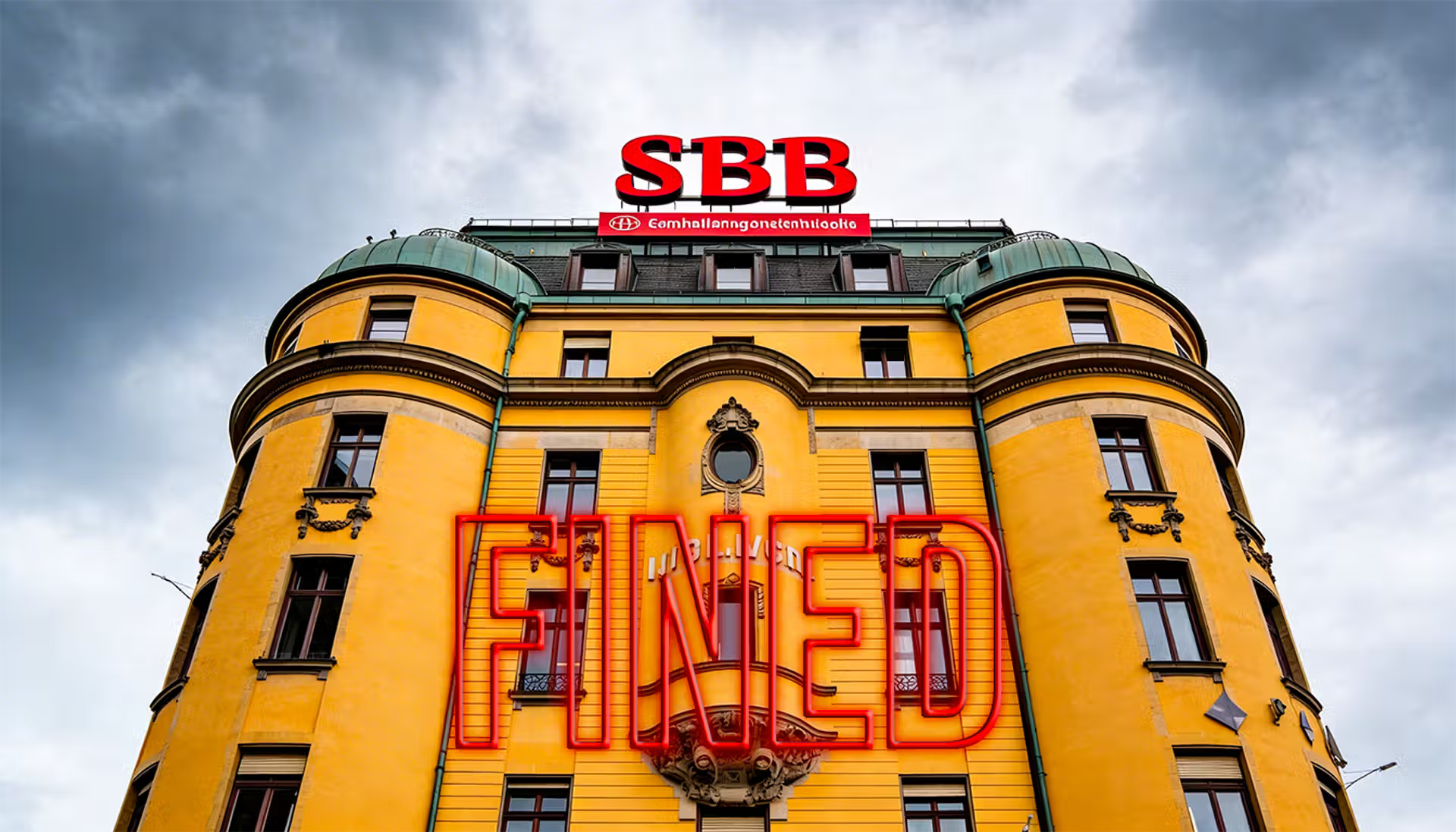
Finansinspektionen issued a caution and an administrative fine of 80 million SEK (7.5M€) to Samhällsbyggnadsbolaget i Norden AB (SBB) due to significant breaches in financial reporting standards. The regulator determined that the firm failed to provide an accurate representation of its consolidated financial statements for the 2021 fiscal year. These discrepancies led to an inflated reported profit and an incorrect statement of financial position, which misled market participants and investors. Such failures in transparency are viewed with extreme gravity by oversight bodies because they undermine the integrity of the capital markets. Accurate reporting remains a cornerstone of preventing the systemic manipulation of financial data and ensuring that capital flows are monitored effectively.
Table of Contents


Financial Integrity and the Role of Corporate Transparency
The maintenance of transparent financial records is a fundamental requirement for preventing the illicit movement of funds and ensuring market stability. When a major entity like Samhällsbyggnadsbolaget i Norden AB fails to adhere to established accounting principles, it creates a vacuum where financial reality and reported data diverge. In this specific instance, the Swedish regulator found that the firm did not report certain properties at their fair value. This failure to accurately value assets can be a precursor to more complex financial discrepancies that mask the true origin or destination of capital. By reporting a consolidated profit before tax that was 3.6 billion SEK higher than the actual figure, the firm presented a facade of financial strength that did not exist. For anti-money laundering specialists, such overstatements are a significant red flag because they can be used to justify large movements of cash or to inflate the value of collateral in complex lending schemes. The integrity of the bond and stock markets relies heavily on the premise that the numbers provided by corporations are verified and truthful. Without this certainty, the mechanisms designed to track large-scale financial flows and identify suspicious patterns become compromised.



Misclassification of Acquisitions as a Regulatory Risk
A critical component of the investigation by Finansinspektionen involved the misclassification of business activities. The regulator discovered that two specific acquisitions were incorrectly reported as asset acquisitions when they should have been documented as business combinations. This distinction is not merely a matter of technical accounting but has deep implications for how money moves through a corporate structure. Business combinations require more rigorous disclosure regarding the nature of the acquired entities and the subsequent financial impact on the parent organization. By bypassing these requirements, a firm may inadvertently or intentionally obscure the underlying financial health or the specific sources of its expanded asset base. The Swedish Board for Financial Reporting Supervision played a key role in identifying these gaps, highlighting the importance of multi-layered oversight in the modern financial ecosystem. When disclosures regarding the character of acquisitions are missing, it becomes significantly harder for auditors and regulators to perform the necessary due diligence required to ensure that the funds used in such transactions are legitimate. This case demonstrates that even established players in the real estate sector must be held to the highest standards of reporting to prevent the creation of opaque financial structures that could be exploited for illicit purposes.
Impact of Asset Valuation on Credit Assessments and Market Trust
The valuation of commercial real estate serves as a bedrock for credit assessments across the European capital market. Properties are frequently used as collateral for substantial loan-based financing, meaning that any deviation from fair value reporting impacts the entire lending chain. If an organization inflates the value of its real estate holdings, it essentially secures financing under false pretenses, which is a form of financial deception that borders on more serious economic crimes. The Director General of the Swedish regulator emphasized that the Swedish market is often viewed as a model of transparency, making this 80 million SEK fine a necessary step to safeguard the national reputation. Incorrect valuations lead to an improper distribution of loan financing among market participants, which can destabilize the financial sector. From a monitoring perspective, when the collateral itself is based on fictitious or exaggerated values, the risk of default increases, and the trail of the money becomes harder to justify. The Executive Director of Markets at the regulator noted that these errors presented a stronger financial position than reality, potentially influencing the decisions of small savers and institutional investors alike. This manipulation of perceived value is a primary concern for those tasked with maintaining the cleanliness of the financial system, as it allows for the artificial generation of wealth.
Strengthening Oversight to Prevent Financial Distortions
The decision to combine a caution with a significant administrative fine reflects the severity with which the Swedish authorities view reporting deficiencies. While this specific action targets accounting violations, it occurs against a backdrop of increasing scrutiny regarding corporate compliance and anti-money laundering frameworks within the Nordic region. In the broader context of financial crime prevention, ensuring that firms subject to the Securities Market Act comply with every reporting rule is essential. The 2021 financial statements from this real estate firm were found to be deficient in multiple aspects, including the total absence of disclosures regarding the impact of certain large-scale transactions. This lack of transparency prevents the detection of irregularities that might otherwise be flagged by automated monitoring systems or manual audits. By enforcing these rules, regulators ensure that the financial system remains a hostile environment for those who would seek to hide the true nature of their fiscal activities through complex accounting maneuvers. The intervention by the regulator serves as a warning to other market participants that the accuracy of a statement of financial position is not optional. It is a mandatory requirement that supports the global effort to keep financial markets transparent and free from the distortions caused by inaccurate reporting. The focus remains on protecting the integrity of the market by ensuring that every krona reported is accounted for through legitimate and accurately documented business practices.
Key Points
- The Swedish regulator Finansinspektionen imposed an 80 million SEK fine on the real estate firm SBB for major financial reporting errors.
- Discrepancies in the 2021 consolidated financial statements resulted in a reported profit that was 3.6 billion SEK higher than the actual value.
- The investigation revealed that properties were not reported at fair value and acquisitions were misclassified to avoid stricter disclosure rules.
- These reporting failures undermined investor protection and created an inaccurate view of the firm’s financial position on the stock and bond markets.
- Regulators emphasized that accurate financial statements are vital for credit assessments and maintaining the integrity of the Swedish capital market.
Related Links
- Finansinspektionen Official Sanctions Database
- European Securities and Markets Authority Enforcement Reports
- Swedish Board for Financial Reporting Supervision Guidelines
- Financial Action Task Force Guidance on Real Estate Transparency
- Swedish Securities Market Act Regulatory Framework
Other FinCrime Central Articles About Recent Actions By the Swedish Regulator
- Police Authorities in Sweden Warn of Severe Penalties for Illicit Money Transfers
- Swedish Watchdog Slams Svea Bank With 15M€ For AML Lapses
- Swedish Regulator Hits FDJ Subsidiary Spooniker with Major AML Penalty
Source: Finansinspektionen
Some of FinCrime Central’s articles may have been enriched or edited with the help of AI tools. It may contain unintentional errors.
Want to promote your brand, or need some help selecting the right solution or the right advisory firm? Email us at info@fincrimecentral.com; we probably have the right contact for you.