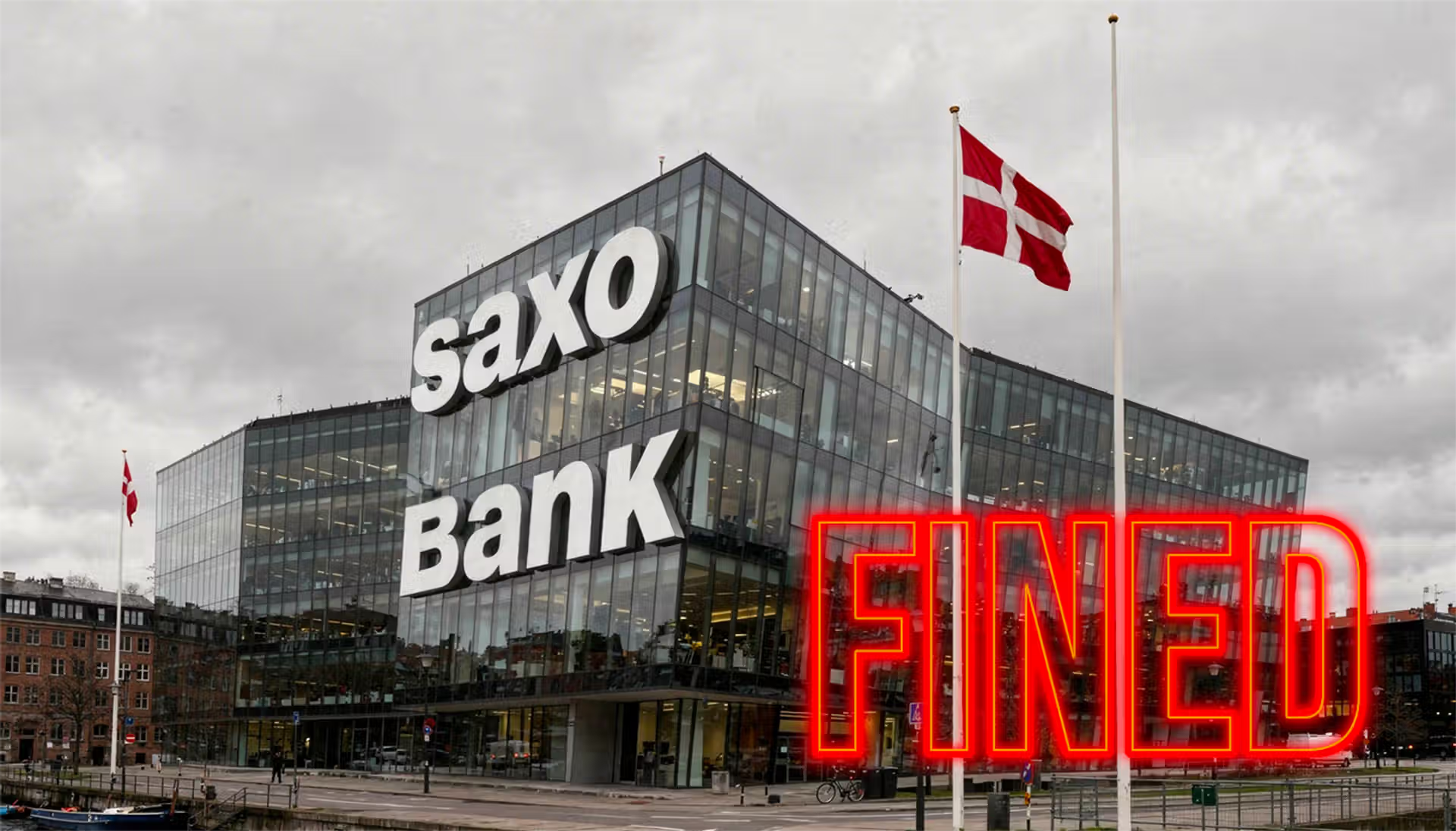
The Danish Financial Supervisory Authority has issued an administrative fine notice of 46,100,000 USD to Saxo Bank for significant violations of the Money Laundering Act. This enforcement action focuses on the company failing to comply with requirements for obtaining information regarding the purpose and intended nature of specific customer relationships. The period of non-compliance spanned from early 2021 through May 2023 and primarily involved the monitoring of white-label clients. While the regulator did not identify specific instances of money laundering, the structural gaps in risk management led to this substantial penalty. The bank has officially adopted the fine, acknowledging the breaches of sections 11(1)(4) and 11(1)(5) of the governing legislation.
Table of Contents


Anti-Money Laundering Compliance Standards
The Danish Financial Supervisory Authority determined that the investment firm failed to maintain adequate customer due diligence procedures during its operations. These failures were specifically linked to the collection of information regarding the intended nature of business relationships and the lack of ongoing monitoring for white-label clients. Within this framework, the bank makes its trading platform available to the customers of these partners, creating a complex oversight environment that requires rigorous internal controls. The regulator found that the bank did not meet the necessary legal thresholds for identifying risk profiles during the multi-year period under review. Under the Money Laundering Act, financial institutions are strictly required to ensure that every layer of their business, including third-party platform usage, is subject to consistent and thorough transaction surveillance.
The administrative fine of 46,100,000 USD reflects the scale of the oversight deficiencies found within the organization. When calculating this amount, the Danish Financial Supervisory Authority applied principles established in the preparatory work of the Money Laundering Act, which ensures that penalties remain proportionate and dissuasive. The authority took into account the financial strength of the institution, which initially suggested a higher potential penalty, but ultimately applied a reduction. This adjustment was granted because the company contributed actively to the investigation and initiated immediate steps to restore compliance. By adopting the administrative fine notice, the bank avoided a lengthy trial while admitting to the regulatory shortcomings.



Mandatory Monitoring of White Label Partnerships
A significant portion of the regulatory scrutiny focused on the bank’s relationship with its white-label clients. These partners utilize the bank’s technological infrastructure to provide trading services to their own end-customers, a model that introduces specific vulnerabilities in the anti-money laundering framework. The investigation revealed that the bank failed to conduct sufficient ongoing monitoring of these relationships between January 2021 and May 2023. The absence of robust data collection meant the bank could not effectively verify the legitimacy of the business activity occurring on its platform. Effective oversight of such intermediaries is a core pillar of Danish financial law, intended to prevent the systemic exploitation of digital trading infrastructures by anonymous or high-risk actors.
The Danish Financial Supervisory Authority utilizes administrative fines as an efficient tool for addressing violations that are clear and immediately detectable. To issue such a notice, the violation must not entail a penalty higher than a fine and must be uncomplicated from an evidentiary perspective. In this instance, the gaps in the bank’s customer due diligence were deemed sufficiently uniform to meet these criteria. The case highlights the increasing pressure on financial service providers to manage the risks associated with delegated business models. Compliance teams are now expected to maintain the same level of transparency for indirect customers as they do for direct account holders to ensure the integrity of the broader financial system.
Financial Adjustments in the Mandatum Share Sale
The imposition of this penalty has triggered a direct financial impact on the pending sale of shares to Mandatum. According to the sales negotiations initiated in March 2025, an indemnity mechanism was established to protect the buyer from potential regulatory liabilities. Mandatum, which holds a 19.83 percent stake in the institution, has confirmed that the purchase price will be adjusted downward to reflect the cost of the fine. This adjustment results in a reduction of approximately 8.7 million USD from the original purchase price. This mechanism ensures that the financial consequences of the anti-money laundering failures are borne proportionately by the stakeholders involved in the divestment process.
Despite the reduction in the total cash received by Mandatum, the company stated that the adjustment would not have a material impact on its overall financial results. The transaction, originally valued at approximately 346 million USD, remains on track for completion in early 2026. This case serves as a clear example of how regulatory non-compliance can influence corporate valuations and the execution of high-level mergers and acquisitions. Investors and acquiring firms are increasingly incorporating specific clauses related to financial crime investigations to mitigate the risks of large-scale administrative penalties. The finalization of the sale remains subject to standard regulatory approvals, as the parties navigate the final stages of the divestment.
Institutional Resilience and Regulatory Cooperation
The conclusion of this enforcement action demonstrates the importance of cooperation between financial institutions and supervisory bodies. The Danish Financial Supervisory Authority noted that the bank’s willingness to assist in the investigation was a primary factor in the final determination of the penalty. By taking proactive steps to rectify the information gaps regarding the purpose of business relationships, the firm showed a commitment to future stability. The reduction of the fine based on the bank’s ability to pay and its remedial actions indicates a balanced approach to regulation that prioritizes system health over purely punitive measures. The institution continues to operate its platform while implementing the necessary upgrades to its monitoring systems.
Moving forward, the bank must demonstrate that its new protocols for white-label clients and general customer due diligence are sufficient to prevent a recurrence of these issues. The case serves as a warning to other institutions operating in the digital brokerage space that technological platform sharing does not absolve the primary provider of its legal obligations. The Danish regulator remains vigilant in its oversight of the money laundering area, emphasizing that procedural failures are treated with high severity even when no illicit funds are detected. Maintaining the trust of both regulators and international partners requires an unwavering focus on the core principles of the Money Laundering Act.
Key Points
- The Danish Financial Supervisory Authority imposed a 46.1 million USD fine on Saxo Bank for failing to meet customer due diligence and monitoring requirements.
- Violations occurred between January 2021 and May 2023, specifically concerning the oversight of white-label clients and their end-users.
- An indemnity agreement caused an 8.7 million USD downward adjustment in the price of Saxo Bank shares sold to Mandatum.
- The bank cooperated with the investigation and took remedial steps to address gaps in business relationship data collection.
Related Links
- Danish Financial Supervisory Authority
- Ministry of Industry, Business and Financial Affairs
- Financial Action Task Force Denmark
- Danish Money Laundering Act Official Text
- Mandatum Investor Relations
Other FinCrime Central Articles About Danish Banks
- Jyske Bank Accepts Fine for not complying to AML rules
- Cover-Up #5: Danske Bank’s Estonian branch, successful whistleblowing, but the wrong people got punished
Source:
Some of FinCrime Central’s articles may have been enriched or edited with the help of AI tools. It may contain unintentional errors.
Want to promote your brand, or need some help selecting the right solution or the right advisory firm? Email us at info@fincrimecentral.com; we probably have the right contact for you.