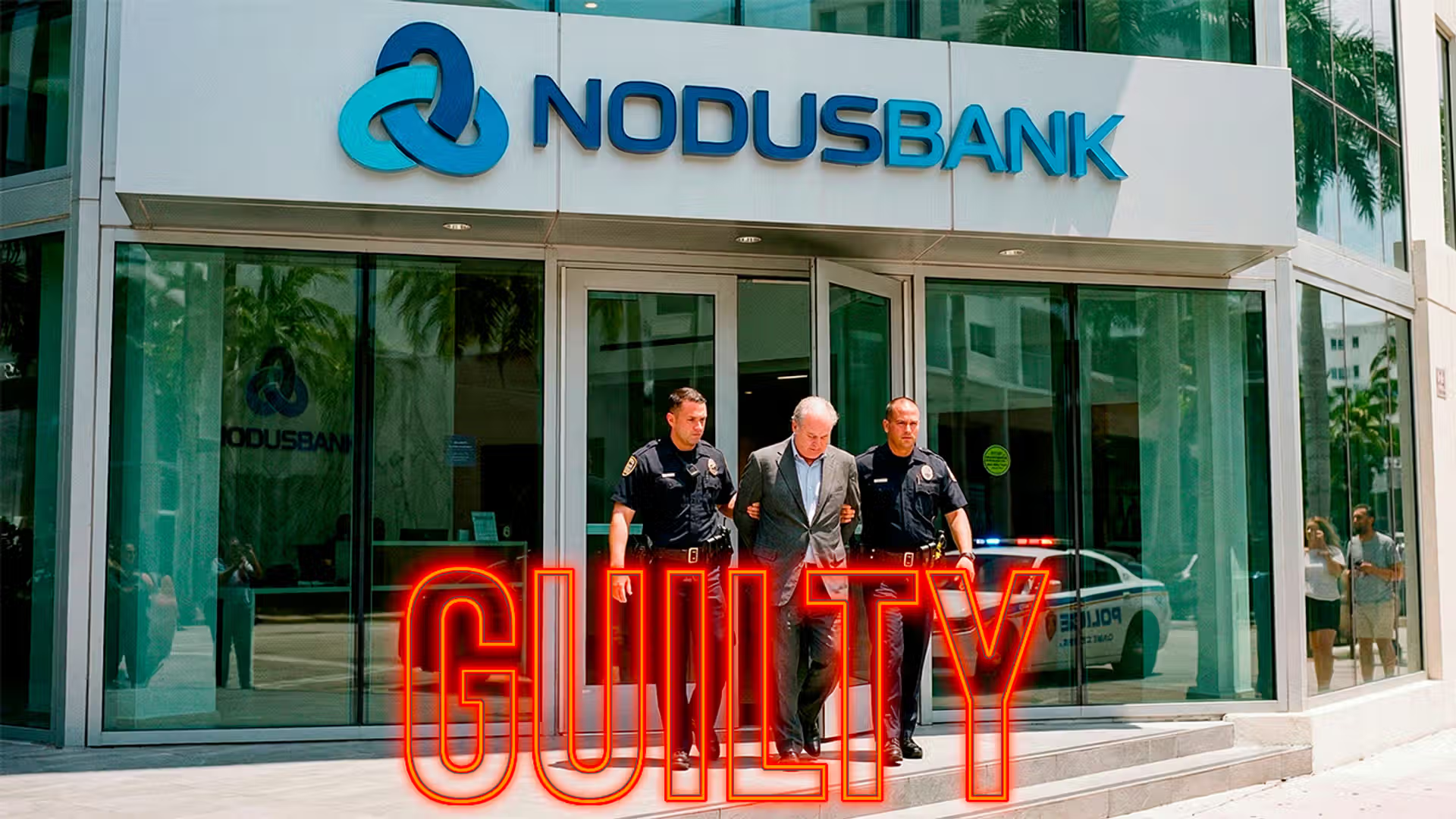
A former bank CEO, Tomas Niembro Concha, recently pleaded guilty to orchestrating a massive financial conspiracy that resulted in the illegal siphoning of at least 24.9 million dollars from Nodus International Bank while simultaneously evading United States sanctions. This complex criminal enterprise involved the former chief executive officer utilizing his leadership position to treat a regulated financial institution as a private source of capital for personal enrichment and prohibited foreign transactions. Federal prosecutors in the Southern District of Florida revealed that the defendant engaged in wire fraud and violated the International Emergency Economic Powers Act through a series of sham investments and illicit real estate deals. The collapse of the Puerto Rican international bank in 2023 serves as a direct consequence of these systemic internal abuses and the intentional circumvention of anti-money laundering controls. As part of the formal plea agreement reached with the Department of Justice, the defendant is now required to forfeit at least 16.9 million dollars representing the direct proceeds of his fraudulent activities.
Table of Contents


Former Bank CEO and Internal Governance Failures
The prosecution of the former Nodus Bank executive highlights the profound vulnerabilities that exist when internal governance fails to prevent executive-level malfeasance and organized money laundering. Central to this case was the deliberate manipulation of the banking infrastructure to move millions of dollars through opaque channels designed to benefit high-ranking insiders. By establishing a Miami-based lender as an intermediary, the conspirators were able to inject 11 million dollars of bank capital into a structure that ultimately funneled those funds back to themselves. This type of self-dealing is a classic red flag for financial investigators as it demonstrates how traditional lending products can be weaponized to facilitate the layering and integration stages of the laundering cycle. The lack of transparency regarding the true beneficial ownership of these loans allowed the illicit activity to persist for years without detection by the board of directors or external auditors.
Regulatory bodies emphasize that the risk of money laundering increases exponentially when senior management bypasses established compliance protocols. In this specific instance, the concealment of conflicts of interest served as the primary mechanism for the underlying fraud. The movement of 25.3 million dollars through 47 promissory notes held by Nodus Finance, an entity privately owned by the CEO and the board chairman, illustrates a sophisticated effort to drain liquidity from the bank. From an anti-money laundering perspective, these transactions represent a failure of the internal control environment where the very individuals responsible for oversight were the ones perpetrating the crimes. The use of promissory notes as a vehicle for transferring wealth is a common tactic in complex financial fraud because it provides a veneer of legitimacy to what are essentially unsecured and non-arm ‘s-length transfers of value.
Furthermore, the integration of these fraudulent proceeds into the legitimate economy requires a level of obfuscation that often involves the creation of shell companies or the use of secondary financial entities. By leveraging their positions of authority, the defendants ensured that the bank’s internal compliance department did not scrutinize the movement of funds toward their private interests. This systemic failure underscores the necessity for robust independent audits and the empowerment of compliance officers to challenge executive decisions. When a chief executive officer treats a bank as a personal automated teller machine, the integrity of the entire financial market is compromised, leading to a loss of public trust and potential economic instability within the jurisdiction.



Sanctions Evasion and International Wire Fraud Schemes
The intersection of domestic financial fraud and international sanctions evasion presents a unique challenge for global law enforcement and anti-money laundering professionals. Beyond the internal theft of bank assets, the defendant engaged in a calculated conspiracy to facilitate transactions for a Specially Designated National associated with the Venezuelan state-owned oil company, Petróleos de Venezuela, S.A. This aspect of the case demonstrates how sanctioned individuals seek out compromised financial institutions to maintain access to the global financial system. The scheme involved a highly irregular real estate transaction in Southampton, New York, where a prohibited private agreement was used to bypass the restrictions imposed by the Office of Foreign Assets Control.
Initially, the conspirators sought and obtained legitimate authorization to foreclose on a property to satisfy a debt, providing a mask of regulatory compliance. However, the subsequent plan to sell the property back to the sanctioned individual through a front company for 4 million dollars constitutes a direct violation of U.S. national security policies. This maneuver is a hallmark of sanctions evasion, where legal processes are used to create a baseline of legitimacy while the actual transfer of value remains hidden. The use of front companies to hide the identity of the true purchaser is a recurring theme in international money laundering cases, particularly those involving high-value real estate in the United States.
Law enforcement agencies increasingly focus on the role of financial facilitators who provide the necessary expertise to navigate complex regulatory environments on behalf of sanctioned entities. The CEO’s willingness to engage in these prohibited transactions suggests a broader culture of non-compliance that extended beyond simple embezzlement. By assisting a designated individual in regaining control of a multimillion-dollar asset, the defendant actively undermined the efficacy of the sanctions regime intended to pressure the Venezuelan government. This behavior reinforces the critical link between financial crime and broader geopolitical risks, making the prosecution of such individuals a high priority for the Department of Justice and the Treasury Department.
Regulatory Oversight and the Impact of Bank Failures
The eventual collapse and liquidation of Nodus International Bank by the Office of the Commissioner of Financial Institutions of Puerto Rico in 2023 was the direct result of the long term siphoning of capital by its leadership. When regulators began to close in on the institution’s insolvency, the defendants attempted to further deceive the board and the comptroller by substituting a questionable loan portfolio for the outstanding debt owed to the bank. This desperate attempt to balance the books through the transfer of low-quality or fraudulent assets is a common final stage in bank fraud cases. It represents an effort to delay the inevitable discovery of the missing funds while continuing to profit from the remaining assets.
The role of the Office of the Commissioner of Financial Institutions was pivotal in identifying the irregularities that led to the criminal investigation. Effective regulatory oversight requires the ability to look past formal reporting and investigate the underlying substance of major transactions. In this case, the discovery of the undisclosed relationships between the bank executives and the entities receiving millions in loans was the catalyst for the subsequent federal charges. The liquidation process serves as a reminder of the tangible harm caused by white-collar crime, as depositors, employees, and the broader financial community bear the brunt of the bank’s failure.
From a policy perspective, this case reinforces the need for stricter reporting requirements for international banking entities operating within U.S. territories. The ability of executives to hide multimillion-dollar conflicts of interest for over five years suggests that current disclosure mechanisms may require enhancement. Furthermore, the coordination between the Internal Revenue Service Criminal Investigation Division and the Department of Justice highlights the multi-agency approach necessary to untangle complex webs of financial deceit. By following the money through various domestic and international accounts, investigators were able to reconstruct the timeline of the fraud and quantify the total loss to the institution.
Global Standards for Combating Financial Facilitation
The prosecution of Tomas Niembro Concha serves as a stern warning to financial professionals who believe their status or location provides immunity from federal law. The charges of conspiracy to commit wire fraud and conspiracy to violate the International Emergency Economic Powers Act carry significant prison sentences, reflecting the gravity of the offenses. The mandatory forfeiture of 16.9 million dollars is designed to strip the defendant of his ill-gotten gains and provide some measure of restitution to the affected parties. This enforcement action aligns with the broader goals of the Homeland Security Task Force to eliminate transnational criminal organizations and those who provide them with financial oxygen.
The global community, through organizations like the Financial Action Task Force, continues to refine standards aimed at preventing the abuse of the financial system by senior officials. This case illustrates the concept of the “prohibited transaction” in its most literal sense, where the very act of engaging with a sanctioned party creates a legal liability regardless of the perceived business justification. For anti-money laundering compliance officers, the takeaway is clear: the most significant risks often originate from within the highest levels of the organization. Establishing a culture of transparency and accountability is the only effective defense against the type of systemic fraud witnessed at Nodus Bank.
As the legal proceedings move toward sentencing in June, the focus remains on the broader implications for the banking sector in Puerto Rico and beyond. The successful investigation of this multimillion-dollar scheme demonstrates the persistence of federal authorities in pursuing high-level financial criminals. By dismantling the networks that allow for the evasion of sanctions and the fraudulent extraction of wealth, law enforcement protects the stability of the global economy. The case stands as a landmark example of the intersection between corporate greed, regulatory failure, and the ongoing battle against international money laundering.
Key Points
- The former CEO of Nodus Bank admitted to a 24.9 million dollar fraud scheme that led to the 2023 failure of the institution.
- The criminal activity involved siphoning bank funds through sham investments and promissory notes for the personal benefit of high-ranking executives.
- Conspiracy to evade U.S. sanctions involved a prohibited real estate deal with a designated individual linked to the Venezuelan state oil company.
- The defendant agreed to forfeit 16.9 million dollars and faces up to 20 years in prison for each count of conspiracy and wire fraud.
- Investigation by the IRS Criminal Investigation Division and the Department of Justice targeted the misuse of banking infrastructure for money laundering.
Related Links
- Office of Foreign Assets Control Sanctions Programs and Information
- Financial Action Task Force Guidance on Criminal Justice Sector Measures
- Department of Justice Money Laundering and Asset Recovery Section
- Internal Revenue Service Criminal Investigation Annual Reports
- Office of the Commissioner of Financial Institutions of Puerto Rico Regulatory Actions
Other FinCrime Central Articles About Unscrupulous CEOs
- Atlanco CEO Carl Zaglin found guilty in Honduras bribery and laundering scandal
- Banca Privada d’Andorra Sees CEO Jailed Seven Years in €70 Million Laundering Case
- Upper Tribunal Affirms FCA’s Ban and £1.1M Fine for Barclays ex-CEO Jes Staley
Source: US DOJ
Some of FinCrime Central’s articles may have been enriched or edited with the help of AI tools. It may contain unintentional errors.
Want to promote your brand, or need some help selecting the right solution or the right advisory firm? Email us at info@fincrimecentral.com; we probably have the right contact for you.