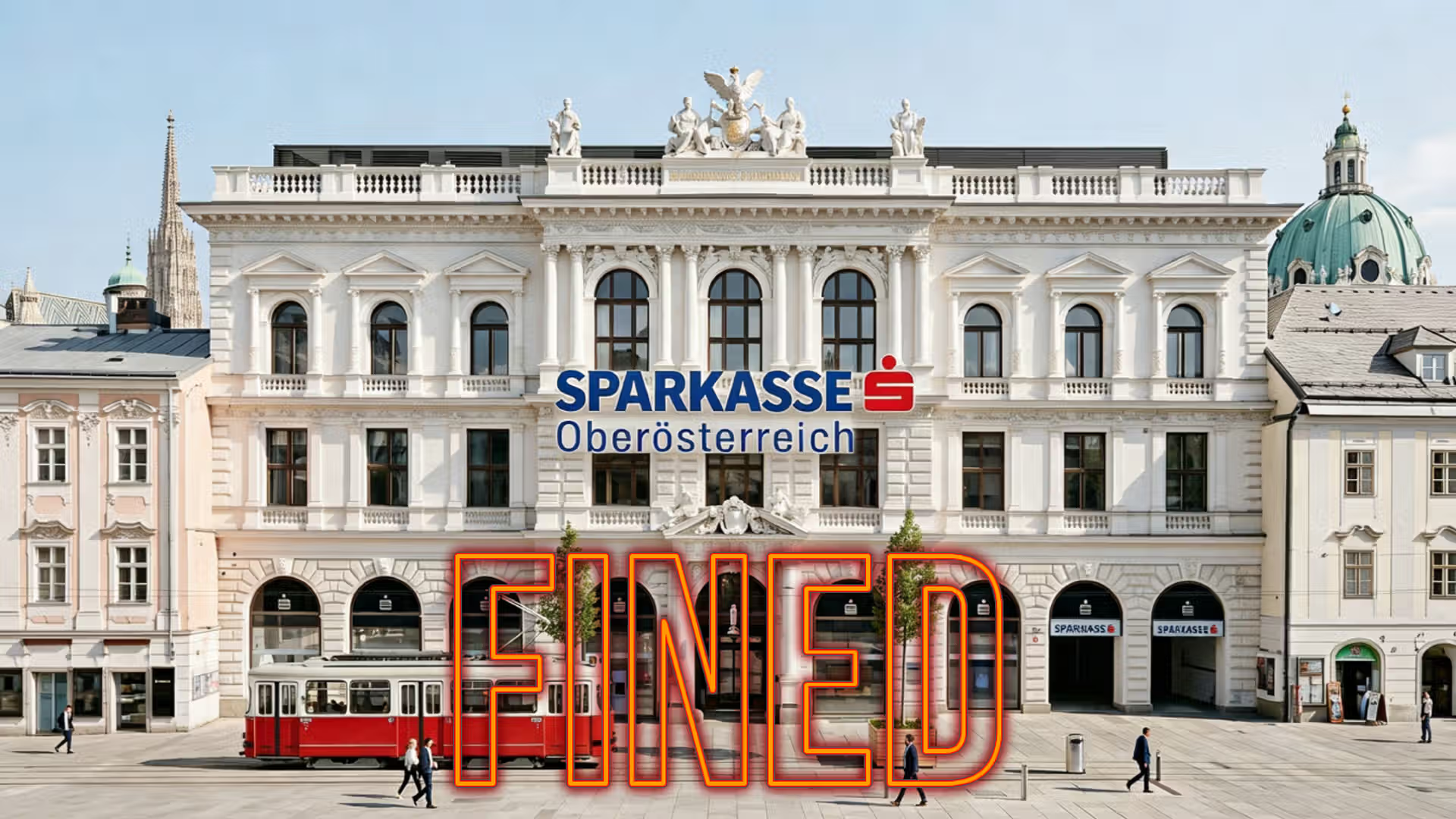
The Financial Market Authority has penalized Sparkasse Oberösterreich Bank AG with a fine of 60,000 euros for significant breaches of anti money laundering due diligence obligations. This regulatory action follows a detailed investigation into the internal controls and procedural frameworks maintained by the institution to prevent financial crimes. The fine was issued through an accelerated proceeding, which indicates a level of cooperation or a streamlined administrative process between the regulator and the bank. It underscores the critical requirement for financial entities to maintain rigorous standards regarding customer information and risk management strategies. The finality of the penal order marks a definitive conclusion to this specific enforcement action by the Austrian supervisor.
Table of Contents



Sparkasse Oberösterreich Compliance Lapses
The Austrian financial landscape requires strict adherence to the Financial Markets Anti-Money Laundering Act to ensure that the integrity of the banking system remains intact. In this specific case, the regulator identified that Sparkasse Oberösterreich Bank AG failed to implement sufficient policies and procedures to accurately identify and understand the ownership and control structures of its clientele. This omission is a fundamental flaw in the risk management cycle because knowing the ultimate beneficial owner is the cornerstone of preventing illicit funds from entering the formal economy. Without a clear map of who actually controls the assets, a bank cannot effectively monitor for suspicious activities or potential sanctions violations. The failure to formalize these strategies in writing further complicated the ability of the institution to demonstrate compliance during regulatory audits.
The nature of the breach extended to the ongoing application of these missing or weak strategies, suggesting that the problem was not merely a clerical error but a systemic oversight in daily operations. Regulatory frameworks demand that every bank not only create a rulebook but also actively live by it through continuous monitoring and verification of client data. When a bank fails to check that its duties to update information are being performed, the risk of money laundering increases exponentially as old profiles become obsolete or misleading. The 60,000 euro fine serves as a formal reprimand for these gaps in the defensive perimeter of the bank. Such administrative penalties are designed to encourage rapid remediation and to signal to the broader market that administrative laxity in the face of financial crime will not be tolerated.
Effective oversight in the Austrian banking sector involves a multi-layered approach where both internal audit functions and external regulators collaborate to find vulnerabilities. The fact that the breaches related specifically to the drawing up of policies and procedures indicates that the foundational elements of the compliance program were deemed inadequate by the authorities. This is particularly concerning in the context of ownership and control structures, as these are the primary mechanisms used by bad actors to hide the origins of criminal proceeds. Complex corporate webs and shell companies are frequently employed to mask the true identity of individuals who are attempting to launder money through legitimate financial institutions. When a bank lacks a robust strategy to pierce these veils, it becomes an unwitting participant in global money laundering schemes.




Systematic Failures in Ownership Transparency
Beyond the initial identification of customers, the ongoing obligation to update information and documents is a continuous requirement that ensures the risk profile of a client remains accurate over time. The Financial Market Authority noted that Sparkasse Oberösterreich Bank AG did not adequately ensure that this duty was duly observed across its various service lines. Information that was accurate at the time of account opening can become outdated within months, especially if there are changes in corporate leadership, shifts in business focus, or new shareholders entering the picture. A failure to refresh this data means the bank is essentially flying blind, relying on historical snapshots that no longer reflect the reality of the financial relationships it maintains. This lack of data hygiene is often where the most sophisticated money laundering tactics succeed, as they exploit the gaps between periodic reviews.
The requirement for written strategies is not a mere bureaucratic hurdle but a legal necessity that provides a trail of accountability for compliance officers and senior management. When strategies for understanding control structures are not properly documented, the training of staff becomes inconsistent and the application of rules becomes subjective. The regulator emphasized that the bank failed to check that its duties were being performed, which points to a lack of internal controls and quality assurance measures. In a high-functioning AML environment, a bank must have a system of checks and balances where one department verifies the work of another to catch errors before they escalate into regulatory violations. The absence of such checks at Sparkasse Oberösterreich Bank AG created an environment where due diligence obligations were neglected.
The 60,000 euro fine, while manageable for a large institution, carries significant reputational weight and signals a period of heightened scrutiny for the bank. It highlights the importance of the Financial Markets Anti-Money Laundering Act as a living document that requires constant attention and resource allocation. Financial institutions must view their compliance budgets not as a cost center but as a vital investment in their long-term viability. The case of Sparkasse Oberösterreich Bank AG demonstrates that even established players in the market can fall short of expectations if they do not prioritize the structural integrity of their AML programs. The focus on ownership and control structures is part of a broader global trend toward transparency, where regulators are increasingly demanding that banks look past the surface of every transaction to find the human element behind the capital.


Regulatory Enforcement and Future Compliance
The conclusion of these proceedings in an accelerated manner suggests that the bank likely acknowledged the shortcomings identified by the Financial Market Authority and moved toward a resolution without a lengthy legal battle. This approach is often beneficial for both the regulator and the regulated entity, as it allows for a quicker transition to the remediation phase, where the actual gaps in the policies can be closed. For the Austrian financial sector, this case serves as a reminder that the FMA is actively monitoring the implementation of the FM-GwG and will use its enforcement powers to address deficiencies. The focus on ownership transparency is expected to remain a top priority for regulators across the European Union as they harmonize their approaches to combatting financial crime and terrorism financing.
To prevent future occurrences of similar breaches, Sparkasse Oberösterreich Bank AG and other financial institutions must embrace technology and automated systems that can track changes in corporate registries and alert compliance teams to shifts in control. Manual processes are increasingly insufficient for the volume and complexity of modern corporate structures. A transition toward more dynamic and data-driven due diligence will be necessary to meet the high standards set by the Financial Market Authority. The ultimate goal is to create a financial system where the flow of money is transparent and where the barriers to entry for illicit actors are insurmountable. By enforcing these rules, the FMA protects not only the Austrian economy but also the international reputation of the country as a safe and stable financial hub.
As the penal order is now final, the bank must demonstrate that it has integrated the lessons learned from this enforcement action into its core culture. Compliance must be seen as the responsibility of every employee, from the front office staff who first meet the customers to the executive board that sets the strategic direction of the company. The failure to understand ownership structures is often a symptom of a broader cultural issue where speed and convenience are prioritized over security and transparency. Moving forward, the emphasis must be on a thorough and inquisitive approach to every new relationship, ensuring that the bank truly knows who it is doing business with and where their wealth originated.
Anti Money Laundering Typologies for Professionals
In cases involving failures to identify ownership and control structures, AML professionals should be vigilant for specific patterns that indicate an attempt to circumvent transparency requirements or weaknesses in institutional oversight. Understanding these typologies is essential for developing effective risk indicators and monitoring tools.
- Layered Corporate Ownership: The use of multiple layers of domestic and foreign legal entities to obscure the identity of the ultimate beneficial owner and complicate the due diligence process.
- Stagnant KYC Documentation: A pattern where customer files remain unedited for several years despite significant changes in the business volume or the nature of the transactions conducted.
- Inconsistent Beneficial Ownership Information: Discrepancies between the information provided by the customer and the data found in official corporate registries or third-party intelligence databases.
- Absence of Written Compliance Protocols: A lack of formalized, written procedures for assessing the risk of complex corporate structures, leading to inconsistent application of due diligence standards across different branches.
- Failure to Conduct Enhanced Due Diligence: Onboarding high-risk corporate clients without performing the deeper level of investigation required for entities with opaque management or those located in high-risk jurisdictions.
Key Points
- Sparkasse Oberösterreich Bank AG received a fine of 60,000 euros for AML breaches.
- The Financial Market Authority cited failures in identifying customer ownership and control structures.
- Breaches included a lack of written strategies and failure to update required data and documents.
- The proceedings were handled in an accelerated manner, and the penal order is now final.
Related Links
- Financial Markets Anti-Money Laundering Act FM-GwG
- FMA Annual Report on Market Oversight and Enforcement
- FATF Guidance on Beneficial Ownership Transparency
Other FinCrime Articles About the Latest FMA’s Actions
- Austrian FMA Fines NOTARTREUHANDBANK AG for AML Failures
- Austrian FMA Bans KuCoin EU From New Business for Compliance Failures
- Online Platform InvestNow Faces FMA Action Over Alleged AML Failures
Source: FMA
Some of FinCrime Central’s articles may have been enriched or edited with the help of AI tools. It may contain unintentional errors.
Want to promote your brand, or need some help selecting the right solution or the right advisory firm? Email us at info@fincrimecentral.com; we probably have the right contact for you.