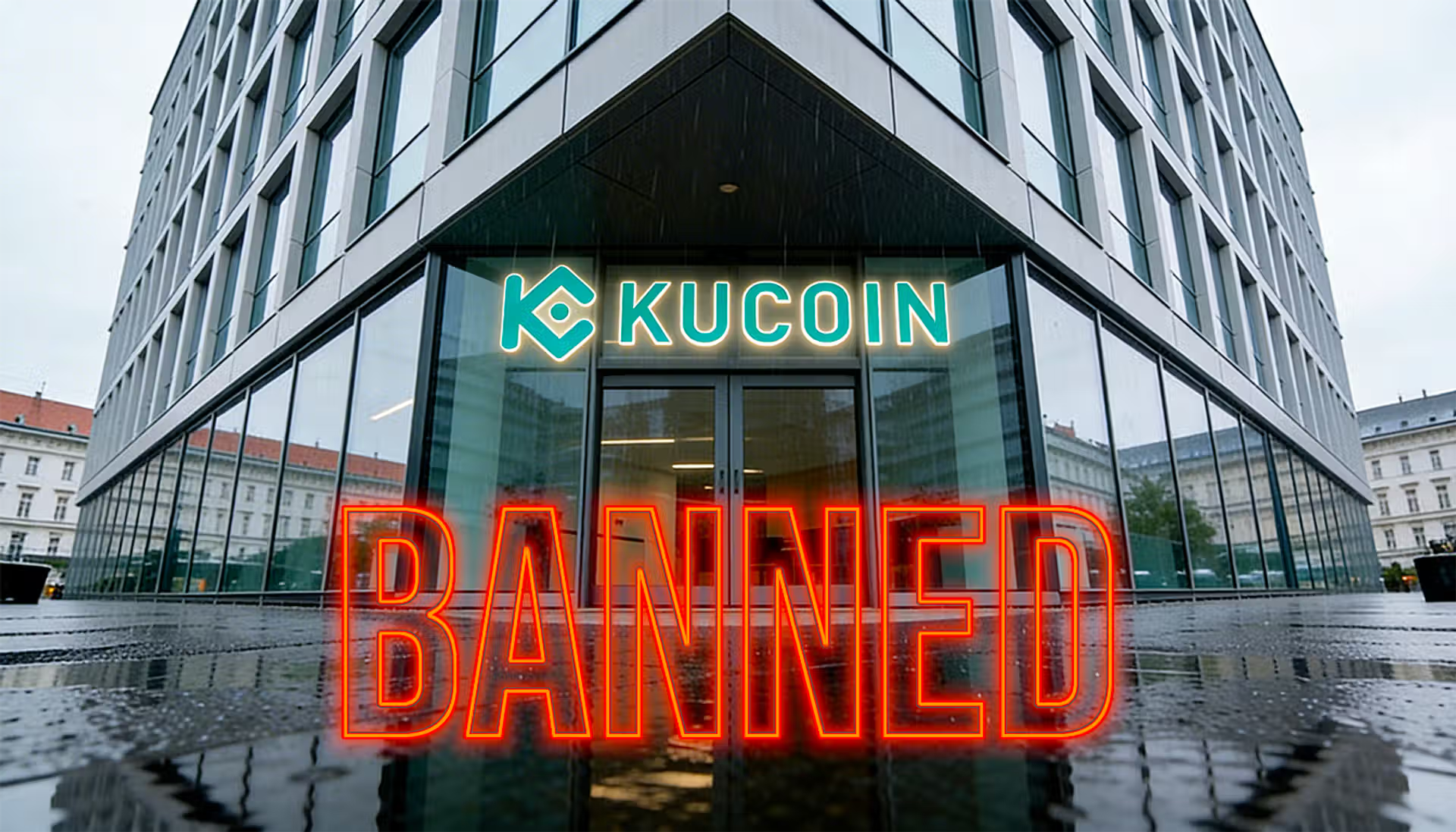
The Financial Market Authority of Austria recently issued a significant administrative decision against KuCoin EU Exchange GmbH due to severe lapses in its internal organizational structure. This regulatory action effectively prohibits the cryptocurrency service provider from engaging with new customers or launching new products after it failed to maintain mandatory oversight roles. The regulator identified that the company no longer possesses the required personnel to manage risks associated with illicit financial flows and international sanctions. Such a move highlights the rigorous expectations placed on digital asset firms operating within the European Union legal framework. This enforcement highlights the critical nature of maintaining functional leadership in departments tasked with monitoring and reporting suspicious financial activities.
Table of Contents


Crypto Asset Service Provider Compliance Requirements
The recent intervention by the Austrian Financial Market Authority against KuCoin EU Exchange GmbH serves as a stark reminder of the non-negotiable nature of administrative standards in the modern financial landscape. When the firm originally received its authorization to operate as a crypto asset service provider in late 2025, it appeared to meet all the necessary criteria established under the Markets in Crypto Assets Regulation and the Financial Markets Anti-Money Laundering Act. These laws require every registered entity to maintain a robust internal defense system designed to identify and mitigate the risks of illicit transactions. Central to this defense system is the appointment of specific key function holders who are responsible for overseeing the daily adherence to legal obligations. These roles include the dedicated officer for monitoring suspicious activities and their deputy, as well as a sanctions compliance officer and their respective deputy. Without these individuals in place, a financial institution essentially operates without a pilot, leaving the gateway open for potential abuse by criminal elements or entities looking to bypass global trade restrictions. The regulator discovered that these essential positions were no longer filled by suitable or active personnel, which fundamentally compromised the integrity of the firm’s operations. Consequently, the authority took the preemptive step of halting all new business activities until the company can prove it has restored its internal oversight capabilities to a legally compliant level.



Regulatory Consequences for Internal Oversight Lapses
The prohibition of conducting new business is a powerful tool used by regulators to protect the broader financial ecosystem from potential contagion or exploitation. In the case of KuCoin EU Exchange GmbH, the loss of its key compliance personnel meant that the firm could no longer guarantee the performance of due diligence on its clients. In the world of digital assets, where transactions move with high velocity and can often involve complex layers of anonymity, the presence of a qualified officer is the primary line of defense. The Austrian regulator specifically pointed to the lack of an active officer and deputy for the prevention of illicit wealth transfers as a primary cause for the administrative order. This failure extends beyond mere paperwork; it represents a collapse of the internal control environment that is supposed to flag high-risk transactions and ensure that the firm does not interact with sanctioned individuals or jurisdictions. By issuing a formal administrative decision, the authority has mandated that the entity establish legal compliance without delay. This means the firm must not only find qualified individuals for these roles but also ensure they possess the necessary expertise and authority to function effectively. Until these positions are appropriately filled and vetted by the regulator, the exchange is legally barred from expanding its footprint or entering into any new contractual obligations with the public. Global Scrutiny and Canadian Enforcement Actions
The struggles of the exchange operator extend beyond the borders of the European Union, as evidenced by major enforcement actions in North America. In July 2025, the Financial Transactions and Reports Analysis Centre of Canada, known as FINTRAC, imposed a massive administrative monetary penalty of 19,552,000 dollars on Peken Global Limited, the entity operating the platform. This penalty was the result of a comprehensive investigation that revealed the firm had failed to register as a foreign money services business while actively serving the Canadian market. Furthermore, the Canadian regulator identified nearly 3,000 instances where the platform failed to report large virtual currency transactions exceeding 10,000 dollars. More critically, the agency found 33 specific cases where the firm failed to submit suspicious transaction reports despite having reasonable grounds to suspect links to money laundering or terrorist financing. These transactions reportedly involved dark web marketplaces and entities associated with the distribution of illicit precursor chemicals. The scale of this fine, which was record-breaking at the time of its issuance, signals a coordinated global effort to hold digital asset platforms accountable for systemic failures in their compliance regimes.
The Role of MiCAR and National AML Frameworks
The oversight of cryptocurrency exchanges in Europe has entered a new era with the implementation of the Markets in Crypto Assets Regulation, commonly known as MiCAR. This framework, combined with national laws like the Financial Markets Anti Money Laundering Act in Austria, creates a comprehensive net designed to catch financial criminals. For an entity like KuCoin EU Exchange GmbH to maintain its license, it must continuously demonstrate that its organizational structure is capable of supporting these high standards. The recent findings by the Austrian authorities suggest that maintaining these standards is a continuous obligation rather than a one-time hurdle to be cleared during the initial registration phase. The specific focus on sanctions compliance also reflects the heightened global sensitivity toward ensuring that digital asset platforms are not used to undermine international geopolitical measures. When a firm loses its sanctions compliance officer, it loses the technical ability to screen its user base against international watchlists provided by the European Union and other global bodies. This vulnerability is unacceptable to modern regulators who view digital asset service providers as integral parts of the formal financial system. The enforcement action taken in Vienna serves as a case study for other firms in the sector, illustrating that the absence of key personnel will result in immediate and restrictive operational consequences.
Strengthening Financial Integrity Through Enforcement
The decision to freeze new business for a registered provider is an indicator of the proactive stance being taken by European regulators to ensure that the crypto industry does not become a weak link in the global financial chain. While the administrative decision against the exchange is not yet legally final, its immediate effect ensures that no further risk is introduced to the market while the company attempts to rectify its internal staffing issues. This approach prioritizes market integrity and the prevention of financial crime over the commercial interests of the service provider. For the company to resume normal operations, it will likely need to undergo a rigorous review process to prove that its new appointments are not just placeholders but are truly suitable and capable of managing the complex risks inherent in the crypto space. This includes the ability to perform deep dives into customer backgrounds, monitor transaction patterns for signs of layering or integration, and maintain a direct line of communication with national law enforcement agencies. The case underscores the fact that in the current regulatory climate, the technical aspects of a crypto platform are only as good as the human oversight that governs them. Without the right people in the right roles, even the most advanced exchange cannot be trusted to operate within the boundaries of the law.
Key Points
- The Austrian Financial Market Authority stopped all new business for KuCoin EU Exchange GmbH after the firm lost its mandatory compliance officers.
- The company failed to maintain active roles for the prevention of money laundering and the oversight of financial sanctions as required by law.
- Regulatory standards under MiCAR and the Austrian Financial Market Anti Money Laundering Act require constant and effective staffing of key oversight positions.
- The exchange is prohibited from signing new contracts or offering new products until it restores its internal organizational compliance.
- This enforcement action highlights the priority of administrative integrity and the role of qualified personnel in protecting the financial system from illicit activity.
Related Links
- Financial Market Authority Austria
- Markets in Crypto Assets Regulation Official Text
- Financial Markets Anti Money Laundering Act FM GwG
- FATF Guidance for a Risk-Based Approach to Virtual Assets
- European Banking Authority AML and CFT Supervision
Other FinCrime Central Articles About KuCoin
- KuCoin’s Latest CAD 19M Penalty from FINTRAC and Its AML Legacy
- KuCoin’s Mandatory KYC Triggers Massive Bitcoin Flight
- India Fines Non-Compliant Crypto Platforms Amid Privacy Coin Ban
Source: FMA
Some of FinCrime Central’s articles may have been enriched or edited with the help of AI tools. It may contain unintentional errors.
Want to promote your brand, or need some help selecting the right solution or the right advisory firm? Email us at info@fincrimecentral.com; we probably have the right contact for you.