An exclusive article by Yair Samban
In recent years, it has become a staple of many conversations (where I’m present, at least…) to comment that geopolitical developments have a critical effect on financial crime trends. This is related to both the criminal activity side, whereby criminals, terrorist organizations, and other bad actors adapt their behaviour based on the threats and opportunities in front of them, as well as on the prevention, detection, and enforcement side, which are understandably affected by the evolution of law enforcement and regulations.
Table of Contents


America First and Finance at the heart of the 2025 National Security Strategy (NSS)
In November 2025, the Trump administration published it’s National Security Strategy (NSS) document. The publication of a National Security Strategy (NSS) is a legal requirement, but in practice, presidents have not always produced it on time or every single year. The latest NSS is a clear product of the Trump administration and its priorities: while previous NSS emphasized counterterrorism or support for democracy, the 2025 NSS centers on the “America First’ principle, and mentions economic security, and the use of U.S. financial and industrial strength as levers of geopolitical influence. It is not a perfect document by far, reading it gives the feeling of a sketch that aspires to be a deeper study – compare it, for example, to the UK NS,S which I have analyzed here https://www.linkedin.com/in/yair-samban-31a69113/.
The NSS defines U.S. financial and capital markets, and the dollar’s reserve status, as strategic assets (p. 6). These assets give Washington leverage over any state seeking access to American liquidity and investment. It couples this with a promise to preserve and grow U.S. financial dominance through maintaining a dynamic free market (probably this means deregulation), digital finance innovation, and making U.S. markets the most “dynamic, liquid, and secure” in the world. In practice, that means more room for using sanctions, market access, and regulatory restrictions as tools to reward alignment and punish adversaries.
While the NSS captures the Trump administration’s political priorities, it struggles to articulate a coherent long-term vision that is aligned with global security realities, which are more complex and interdependent than in any other period in history. Instead of outlining how U.S. power interacts with a complex, multipolar world, the document often offers assertions of American exceptionalism in place of detailed pathways for engagement or reform.
Perhaps the most problematic aspect of the new NSS is its treatment of U.S. allies, particularly in Europe and the Indo-Pacific. The text frames alliances less as enduring partnerships and more as transactional arrangements. The US will invest in its alliances, according to this strategy, based on immediate economic or security returns to Washington. This “conditional alliance” model risks diminishing trust at a time when allied collaboration on sanctions, digital regulation, and technology innovation has never been more essential. By placing allies in front of a critical, uncertain framework that requires them to invest heavily into their ‘usefulness’, rather than rely on shared values, the NSS undermines one of America’s greatest strategic advantages — its network of democratic, economically advanced partners.
Importantly, I’m not setting to agree or disagree with the tone or the scope of the NSS as such, but to offer some critique coming from my unique perspective in this newsletter – does the strategy, as outlined in the document, reflect an investment (or lack thereof) in fighting financial crime, and is this strategy, as laid out in the NSS, facing any notable challenges?
Economic security and financial crime
The strategy explicitly links economic security to national security. Thus, trade imbalances, predatory trade practices, are mentioned alongside drugs, human trafficking, and espionage as core threats. Border security and the fight against cartels, narco‑terrorists, and transnational criminal organizations in the Western Hemisphere are framed as central to national survival. The overall takeaway from this positioning is that while the NSS doesn’t scream ‘FINANCIAL CRIME IS IMPORTANT’, it is clear from the priorities made explicit in the document that preventing financial crime is a key pillar of meeting the main priorities embedded in the NSS. It is clear that the NSS follows a framing that has become common with strategists globally, that elevates financial crime, especially money laundering and trade‑based schemes that feed cartels and hostile states, from a regulatory concern to a strategic battleground – I’ve written about this in the past https://www.riskinfo.ai/post/geopolitics-financial-crime-and-the-ai-revolution-the-new-battlefield-for-financial-services.
Crypto, sanctions evasion, and national security
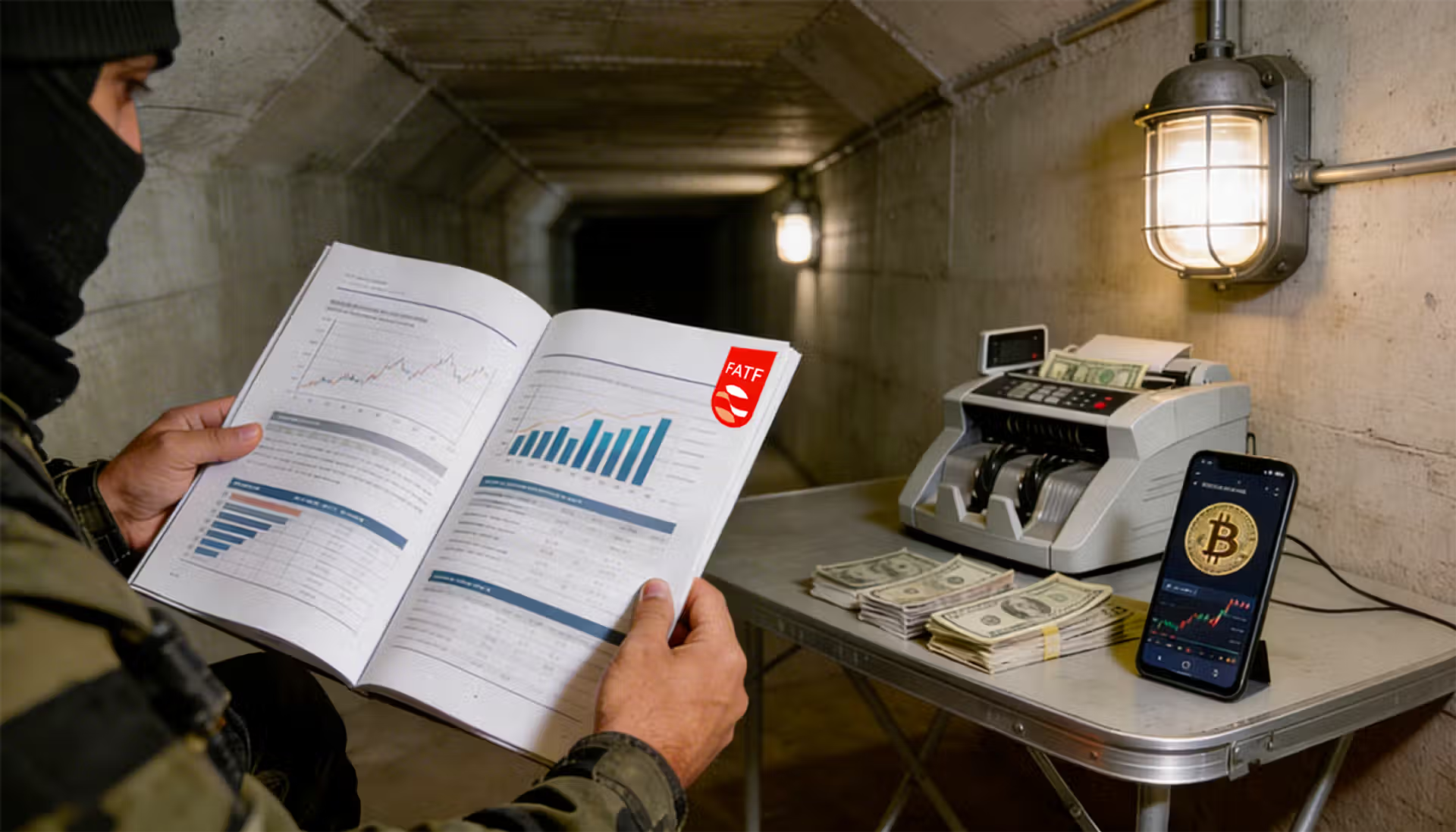
The digital assets economy (aka Web 3.0 or ‘crypto’ in shorthand) emerges as a prime arena where the NSS’s focus on the risks emanating from hostile states, cartels, and sanctions evasion intersects with the clear ambition to grow the US economy by focusing on its key assets, one of them being ‘leadership in digital finance’. In this context, US and allied Western authorities have recently increased their operations targeting exchanges and stablecoin ecosystems linked to sanctioned actors, ransomware, and complex fraud cases, while FATF and EU rulebooks push for tighter compliance and licensing of virtual‑asset providers. This global convergence on crypto controls underscores the NSS’s emphasis on preserving U.S. financial dominance and shutting down foreign “predatory” channels. By clearing the ‘mainstream’ digital channels from economic crime, the US and its allies, operating according to the principles embedded in the NSS, will be increasing the attractiveness of crypto as a means of investment and (hopefully) expand economic activity and investment. At the same time, the push toward regulation and enforcement also incentivizes illicit actors to migrate into more opaque, offshore, or non‑dollar infrastructures designed from the ground up to evade U.S. reach.
A harsher, more fragmented financial battlefield
The NSS’s call to preserve and expand U.S. financial dominance emerges in an environment that is already harsher and more fragmented, with concrete flashpoints in multiple jurisdictions. Since Russia’s full‑scale invasion of Ukraine in 2022, successive EU, UK, and U.S. sanctions packages have frozen hundreds of billions in Russian assets and pushed Moscow to reroute trade through Turkey, the UAE, India, and parts of Central Asia, accelerating experiments with non‑dollar settlement and shadow payment chains. U.S. and European takedowns of crypto platforms used for ransomware, hacks linked to North Korea, and sanctions evasion have shown how quickly illicit capital migrates to new technologies when pressure rises on the formal system, deepening the divide between tightly policed US/Western channels and a proliferating ecosystem of alternative pipes where financial crime can operate more freely.
Thus, financial crime is increasingly influenced by geopolitics; the US National Security Strategy highlights two contradicting efforts: deregulation and acceleration of economic growth, and expression of US leadership in stark economic terms, which brings to the fore the need to counter fraud, sanctions evasion, and other criminal practices that have a prominent economic dimension.
Can ‘America First’ be an inclusive strategy?
As ambitious and stern as the NSS may seem in aligning financial power with national security, its practical execution will face deep challenges because of its transactional approach to allies in Europe, the UK, and beyond. Achieving the stated U.S. agenda of financial and technological supremacy demands strong, interoperable regulatory and security frameworks with those very allies. Collaboration with the UK and EU, for example, can reinforce the resilience of global financial markets by harmonizing sanctions enforcement, advancing anti–money laundering intelligence, and co‑developing digital finance rules that keep Western financial systems both secure and competitive. It should be an aspiration of Washington to create as much harmony as possible between the US, UK, and EU, so as to achieve economies of scale of regulations, sanctions, and the eradication of economic crime. Investing in joint initiatives in cybersecurity, AI governance, and critical infrastructure protection would amplify U.S. influence and accelerate this process. An inclusive “America First” strategy that sees allied strength as an extension of U.S. strength would be creating a new version of previous American engagements in creating a democratic, free economy across the globe – an economy that would end up benefiting American citizens as well as many other nations.
In the next few months, the US and its allies will be busy putting into practice strategies and enforcement actions that seek to counter the influence of organized crime, terrorism, and hostile nation-states on the ambitious ‘America First’ and centricity of financial services agenda of the NSS.
Key Points
- The 2025 U.S. National Security Strategy positions financial power, sanctions, and market access as core national-security tools influencing global AML dynamics
- The strategy links economic security, border threats, drug cartels, and transnational criminal organizations to financial crime risks
- Growing emphasis on crypto-related enforcement highlights concerns around sanctions evasion, ransomware, and hostile-state financing
- Geopolitical fragmentation—Russia sanctions, non-dollar trade routes, alternative payment rails—intensifies exposure to money-laundering pipelines
- The NSS’s transactional approach to alliances risks weakening joint AML, sanctions, and intelligence cooperation with Europe and Indo-Pacific partners
Related Links
- OFAC – Russia-Related Sanctions and Guidance
- U.S. Department of the Treasury – National Security Strategy Overview
- U.S. Department of State – Sanctions and Illicit Finance Briefings
- FATF – Geopolitical Impact on Financial-Crime Risk Assessments
- U.S. Department of Justice – Sanctions and National-Security Enforcement Actions
Other FinCrime Central Articles Written By Yair Samban
Some of FinCrime Central’s articles may have been enriched or edited with the help of AI tools. It may contain unintentional errors.
Want to promote your brand, or need some help selecting the right solution or the right advisory firm? Email us at info@fincrimecentral.com; we probably have the right contact for you.