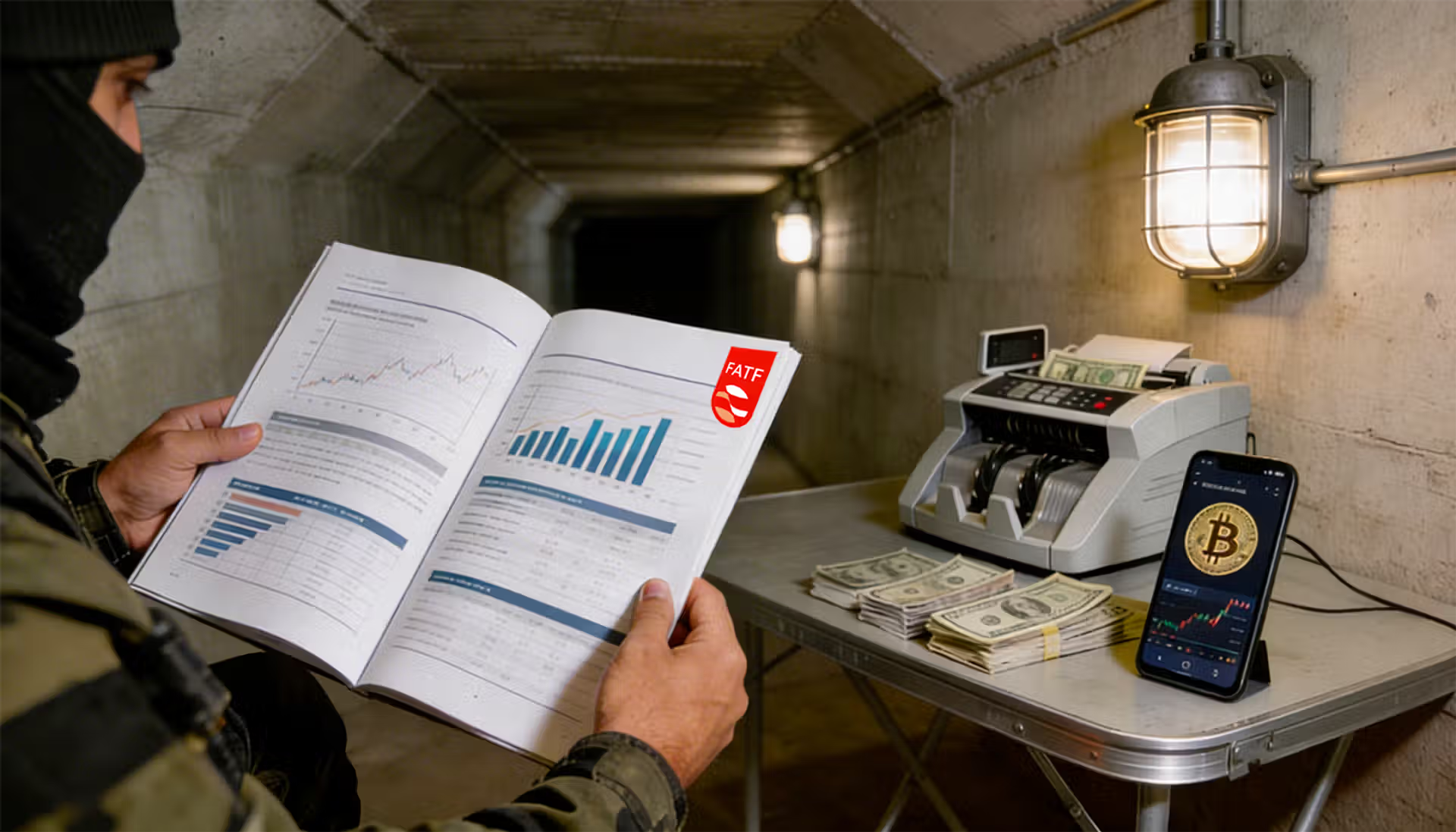
The Financial Action Task Force has released a significant paper highlighting the exponential growth of fraudulent activities facilitated by rapid digital transformation. This global body emphasizes that cyber-enabled fraud now constitutes a major portion of criminal activity across numerous jurisdictions and presents severe challenges for international financial stability. By exploiting instant payment systems and emerging technologies, criminal organizations are moving illicit proceeds with unprecedented speed and complexity. The following analysis explores the strategic frameworks and regulatory guidelines proposed to mitigate these evolving money laundering and terrorist financing threats.
Table of Contents


Mitigating Cyber-Enabled Fraud Risks Through Global AML Standards
The rapid evolution of digital finance has created a fertile ground for cyber-enabled fraud to flourish on a global scale. Recent data indicates that approximately ninety percent of jurisdictions assessed by international monitors now identify fraud as a primary driver for money laundering activities. In specific regions, the prevalence of these crimes is staggering, with some nations reporting that fraud accounts for nearly half of all recorded criminal activity. This surge is not merely a localized issue but a systemic threat that leverages the efficiency of modern banking to obscure the movement of stolen funds. The Financial Action Task Force notes that the adoption of digital innovations during the global pandemic accelerated the speed at which funds can be transferred, often outpacing the ability of law enforcement to intervene. Consequently, the integration of anti-money laundering and counter-terrorist financing standards is more critical than ever to disrupt the financial infrastructure that supports these illicit operations.
Criminal networks have transitioned from simple phishing attempts to highly sophisticated social engineering schemes that utilize artificial intelligence and deepfake technology. These advanced tools allow fraudsters to impersonate trusted entities with high levels of realism, making it increasingly difficult for individuals and businesses to detect deception. Furthermore, the rise of specialized scam centers has professionalized the execution of these crimes, creating a convergence between fraud and other serious offenses such as human trafficking and drug smuggling. To combat this, authorities are being urged to implement more robust verification processes and enhance their monitoring of virtual asset service providers. The goal is to create a seamless defensive perimeter that identifies suspicious patterns before the illicit proceeds are laundered through complex digital ecosystems.
Effective implementation of global standards requires a multifaceted approach that includes unmasking the beneficial ownership of corporate vehicles used to hide criminal wealth. Fraudsters frequently employ shell companies and nominee accounts to layer their transactions and evade detection by financial intelligence units. By requiring countries to adopt risk-based strategies for collecting beneficial ownership information, regulators aim to remove the veil of anonymity that currently protects high-level criminal actors. This transparency is vital for ensuring that the global financial system remains resilient against the manipulative tactics of transnational organized crime groups.



Strategic Enhancements in Asset Recovery and Payment Transparency
A core component of the updated strategy against digital financial crime involves the significant strengthening of asset recovery frameworks. The ability to freeze and seize illicit proceeds in real time is essential for preventing the permanent loss of funds to victims and disrupting the profit motives of criminal syndicates. Revised standards now require jurisdictions to establish rapid payment suspension mechanisms that can be triggered immediately upon the detection of fraudulent activity. This proactive stance is necessary because the window for successful intervention has narrowed significantly due to the prevalence of instant and cross-border payment channels. Without these rapid response tools, the proceeds of cyber-enabled fraud are often converted into virtual assets or moved through multiple jurisdictions within minutes, making recovery nearly impossible.
In addition to faster freezing mechanisms, there is a growing emphasis on improving payment transparency through the implementation of confirmation of payee systems. These technical solutions verify that the recipient of a fund transfer matches the intended party, thereby reducing the success rate of many social engineering and redirection scams. Enhanced transparency also aids in the traceability of fraud proceeds, allowing investigators to map out the entire lifecycle of a criminal transaction. This data-driven approach is further supported by the use of machine learning models and risk-scoring systems that flag high-risk payments in real time. By leveraging advanced technology, financial institutions can move away from manual, reactive processes and toward automated, predictive monitoring.
International cooperation remains a cornerstone of successful asset recovery efforts, particularly when dealing with transnational fraud networks. Competent authorities must navigate diverse legal and jurisdictional constraints while criminals operate without regard for borders. To address this, the current global framework encourages faster and more effective informal coordination between law enforcement agencies and financial intelligence units. Sharing information quickly across borders allows for the synchronized freezing of accounts, which is often the only way to catch professional money laundering services that facilitate the global movement of fraud proceeds.
The Role of Technological Innovation in Detecting Illicit Finance
While technology has served as a powerful enabler for fraudsters, it also provides the necessary tools for defenders to scale their response. National authorities are increasingly investing in sophisticated transaction monitoring systems that utilize artificial intelligence to identify anomalies that would be invisible to human analysts. These systems can process vast datasets at incredible speeds, matching transaction attributes against known fraud patterns and emerging typologies. By deploying these models, banks and fintech platforms can create a dynamic defense that evolves alongside the tactics used by criminal organizations. This technological arms race requires constant investment and the willingness of the private sector to collaborate closely with public regulators.
The regulation of virtual assets and their associated service providers is another critical area where technology and policy must intersect. As criminals increasingly request payments in cryptocurrencies or convert fiat proceeds into digital assets to evade recovery, the need for consistent global regulation becomes paramount. Current standards require virtual asset service providers to implement stringent customer identification and transaction tracing requirements, effectively bringing them into the same regulatory fold as traditional financial institutions. Ensuring that these standards are applied uniformly across all jurisdictions prevents criminals from exploiting regulatory gaps in countries with weaker oversight.
Furthermore, public-private partnerships are proving to be indispensable in the fight against cyber-enabled fraud. These collaborations facilitate the timely exchange of information regarding new scam techniques and money laundering trends. When financial institutions share their front-line observations with government agencies, it allows for the rapid development of defensive strategies that can be disseminated throughout the global financial network. This collective intelligence approach ensures that a discovery made in one region can help protect victims in another, effectively shrinking the space in which fraudsters can operate with impunity.
Sustaining International Resolve Against Evolving Digital Threats
The effort against cyber-enabled fraud is a long-term commitment that requires the sustained mobilization of the entire global financial community. As digital platforms and instant payment systems continue to transform the world economy, the opportunities for criminal exploitation will only increase. Therefore, it is essential that the international community remains vigilant and continues to adapt its regulatory toolkit to meet these challenges. The focus must remain on strengthening the implementation of existing standards while simultaneously looking ahead to identify emerging risks associated with new financial products and services.
Mobilizing the full range of anti-money laundering tools involves not only legal and technical updates but also a cultural shift toward greater transparency and cooperation. Countries must prioritize the protection of their financial systems from the influx of fraudulent proceeds, recognizing that these crimes fund broader criminal enterprises that threaten public safety and human rights. By intensifying collective action and fostering a culture of compliance, the global network of over two hundred jurisdictions can create an environment where fraud is significantly more difficult to perpetrate and much easier to prosecute.
Looking forward, the integration of advanced analytics and global information-sharing networks will be the primary defense against the professionalized fraud hubs currently operating around the world. The goal is to create a global financial ecosystem that is inherently hostile to criminal activity, where the speed of detection matches the speed of the transaction. Through continued innovation and unyielding international cooperation, the threat posed by cyber-enabled fraud can be effectively managed, ensuring that the benefits of digitalization are not overshadowed by the risks of illicit finance.
Key Points
- Cyber-enabled fraud is now recognized as a major money laundering risk by ninety percent of assessed global jurisdictions.
- Advanced technologies like artificial intelligence and deepfakes are being used by transnational criminal groups to scale fraudulent operations.
- Global standards have been updated to require rapid payment suspension and stronger beneficial ownership transparency to disrupt criminal financial flows.
- The regulation of virtual asset service providers is essential to prevent fraudsters from using digital currencies to hide and move illicit proceeds.
Related Links
- Egmont Report on Cyber-Enabled Fraud and Illicit Financial Flows
- FATF 2025 Guidance on Asset Recovery and Best Practices
- Singapore Annual Scams and Cybercrime Brief
- Financial Action Task Force Official Website
Other FinCrime Central Articles About the FATF
- The Bare Reality Behind the 2024-2025 FATF Report
- FATF Strengthens the Shield Against Illicit Financial Flows
- Dangerous Illusion of Strength Behind FATF Consolidated Assessment Ratings
Source: FATF
Some of FinCrime Central’s articles may have been enriched or edited with the help of AI tools. It may contain unintentional errors.
Want to promote your brand, or need some help selecting the right solution or the right advisory firm? Email us at info@fincrimecentral.com; we probably have the right contact for you.