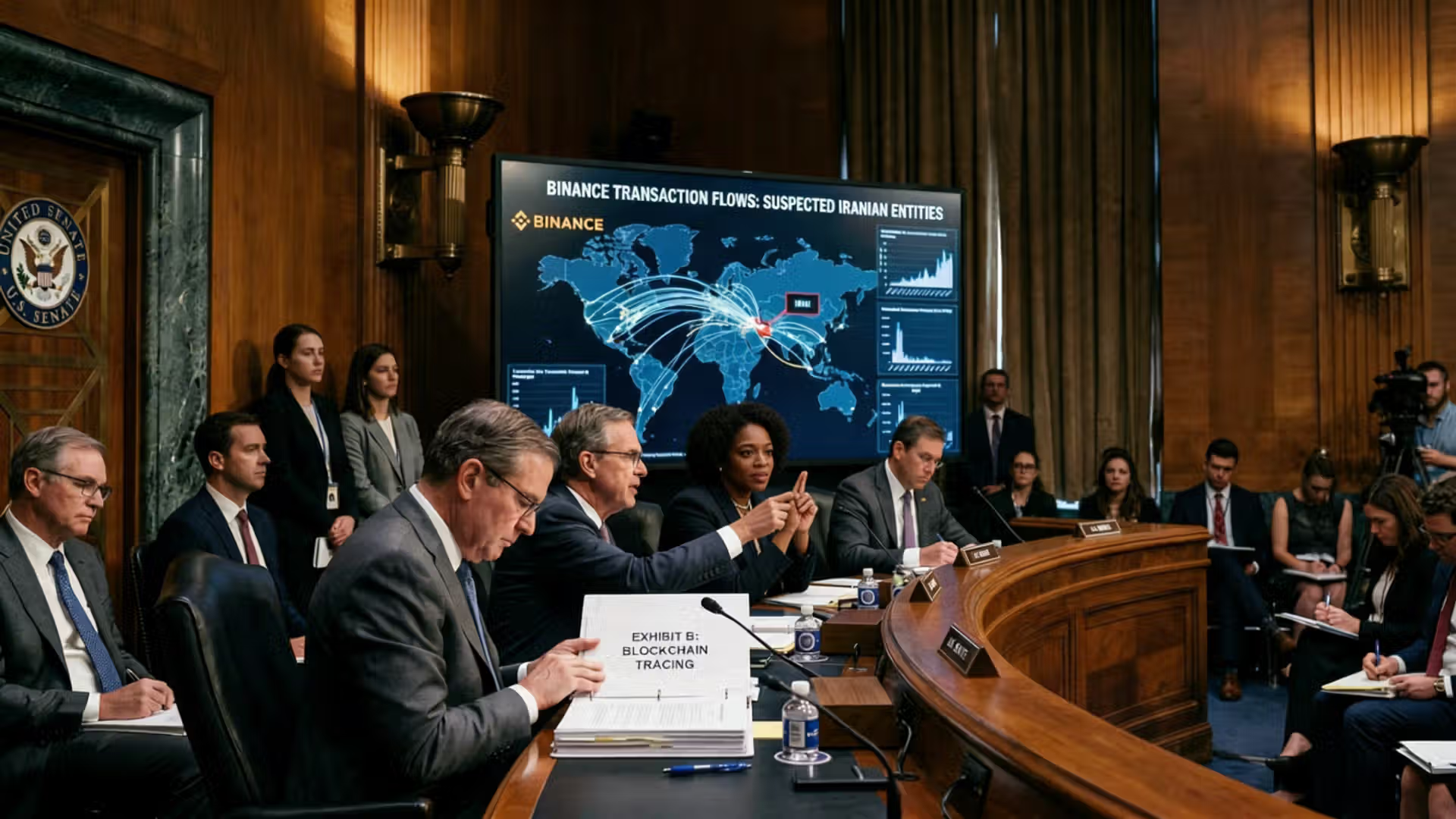
The Department of the Treasury has proposed a significant regulatory framework that mandates a maximum civil penalty of 100,000 dollars per day for permitted payment stablecoin issuers that fail to maintain effective sanctions compliance. This joint proposal from the Financial Crimes Enforcement Network and the Office of Foreign Assets Control seeks to integrate these digital asset entities into the existing anti-money laundering infrastructure of the United States. Under the Guiding and Establishing National Innovation for U.S. Stablecoins Act, these issuers will be formally categorized as financial institutions, subjecting them to the same rigorous oversight as traditional banking organizations. The regulation emphasizes that both material and knowing violations will incur substantial financial consequences to ensure the integrity of the stablecoin ecosystem. By establishing these clear standards, the government aims to mitigate the risks of illicit finance while fostering technological advancement within the domestic financial sector.
Table of Contents



Permitted Payment Stablecoin Issuers Compliance Standards
The emergence of stablecoins has transformed the landscape of digital finance, prompting a necessary response from federal regulators to protect the national security and economic interests of the United States. Permitted payment stablecoin issuers are now at the center of a comprehensive oversight strategy designed to prevent money laundering and the financing of terrorism. The proposed rules require these entities to establish and maintain a written program that addresses specific risks associated with their unique business models and technological infrastructures. Each issuer must designate a dedicated officer responsible for day-to-day coordination and monitoring of the compliance program, ensuring that the organization remains aligned with federal expectations. This structural requirement is intended to create a culture of accountability where compliance is integrated into the core operations of the stablecoin issuance process. Furthermore, the regulation mandates that every program must be approved by the board of directors or an equivalent senior management body to guarantee high-level oversight. This approval process ensures that the leadership of a stablecoin issuer is fully aware of the risks and the measures in place to mitigate them. The internal policies must be reasonably designed to assure and monitor compliance with the Bank Secrecy Act and its implementing regulations. By formalizing these requirements, the government provides a clear roadmap for issuers to operate within the legal framework of the domestic financial system. This proactive approach is essential for maintaining public trust in digital assets as they become more integrated into the broader economy.
To achieve a high standard of operational integrity, issuers must ensure that their compliance programs are not merely static documents but active, evolving frameworks. This involves a commitment to resource allocation, ensuring that the compliance department has the necessary tools, staffing, and authority to function effectively. The proposal highlights that the complexity of the program should be commensurate with the risk profile of the issuer, meaning that larger or more interconnected entities will face greater scrutiny. There is an expectation that these programs will include internal controls designed to prevent the issuer from being used as a conduit for money laundering or other financial crimes. Regular updates to these controls are necessary as new threats emerge in the decentralized finance space. By embedding these practices into the corporate structure, the Treasury seeks to harmonize the digital asset industry with the standards expected of traditional depository institutions. The focus on a designated officer and board-level oversight ensures that there is a clear chain of responsibility for any failures that might occur. This alignment is critical for the long-term stability of the digital dollar ecosystem and its role in international trade and domestic payments.




Risk Assessment and Customer Due Diligence Protocols
Central to the effectiveness of the new regulatory framework is the requirement for issuers to conduct thorough and ongoing risk assessments. These assessments must evaluate the money laundering and terrorist financing risks associated with the specific products, services, and geographic locations in which the issuer operates. The proposal highlights that these processes should not be perfunctory but rather deep evaluations of how illicit actors might exploit the stablecoin platform. Issuers are expected to update these assessments promptly whenever there is a significant change in their risk profile or business operations. This dynamic approach ensures that the compliance program evolves alongside the rapidly changing landscape of the digital asset market. In addition to risk assessments, issuers must implement robust customer due diligence protocols to identify and verify the identities of their users. This includes understanding the nature and purpose of customer relationships and developing a profile that allows for the detection of suspicious activity. For legal entity customers, issuers are required to identify beneficial owners to prevent the use of shell companies for illicit purposes. Ongoing monitoring of transactions is mandatory, with a specific focus on high-value transfers and activity that appears inconsistent with a customer’s known profile. By maintaining these rigorous standards, issuers can act as a critical line of defense against financial crime, providing law enforcement with the information needed to investigate and prosecute illicit actors.
The depth of customer due diligence required under this proposal represents a significant shift for many entities currently operating in the crypto space. It is no longer sufficient to simply collect a name and address; rather, issuers must verify the information using reliable, independent source documents or data. This verification process is intended to ensure that the issuer has a reasonable belief that it knows the true identity of each customer. Furthermore, the requirement to identify beneficial owners addresses a major vulnerability in the global financial system where anonymous actors hide behind complex corporate structures. By pulling back the curtain on these arrangements, the Treasury aims to make it much more difficult for sanctioned individuals or criminal syndicates to move funds through the stablecoin market. Transaction monitoring must be sophisticated enough to identify patterns of behavior that suggest structuring, where users attempt to keep individual transactions below reporting thresholds. These monitoring systems should be automated where possible, but must always involve human oversight to interpret complex or unusual activity. The integration of these protocols ensures that permitted payment stablecoin issuers operate with a high degree of transparency, which is essential for their continued participation in the regulated financial system.

Enforcement Policies and Supervisory Delegations
The Department of the Treasury has outlined a clear enforcement and supervision policy to ensure that permitted payment stablecoin issuers adhere to the new mandates. The Financial Crimes Enforcement Network will have the authority to take formal or informal actions to penalize or remedy noncompliance with the Bank Secrecy Act. Significant supervisory actions may be taken if an issuer demonstrates a systemic failure to implement an effective program or if material deficiencies are identified during examinations. To facilitate efficient oversight, the proposal includes the delegation of examination authority to primary federal payment stablecoin regulators, such as the Office of the Comptroller of the Currency and the Federal Reserve. This collaborative approach leverages the expertise of existing financial regulators to ensure comprehensive coverage across the industry. Issuers must also be prepared for independent testing of their compliance programs, which provides an objective evaluation of their effectiveness. This testing should be conducted by qualified internal or external parties who are independent of the compliance functions being reviewed. The results of these audits must be documented and shared with senior management to facilitate necessary enhancements and corrections. Furthermore, the regulation requires the maintenance of comprehensive records for at least ten years, ensuring that historical data is available for regulatory review or law enforcement inquiries. These enforcement and supervisory measures are designed to create a transparent and resilient stablecoin market that operates with the same level of integrity as traditional financial sectors.
The multi-agency approach to supervision reflects the complexity of the stablecoin market and the need for specialized knowledge in both banking and digital assets. By delegating examination authority, the Treasury ensures that issuers are reviewed by agencies that understand the nuances of payment systems and liquidity management. This reduces the risk of regulatory gaps where an issuer might fall between different jurisdictions. The independent testing requirement serves as a secondary layer of protection, identifying weaknesses that may have been missed by internal compliance teams. These tests should cover all aspects of the anti-money laundering and sanctions programs, including the efficacy of the software used for transaction monitoring and the adequacy of employee training. If deficiencies are found, the issuer is expected to create a remedial plan with clear timelines for resolution. The threat of a 100,000 dollar daily fine serves as a powerful deterrent against negligence or deliberate evasion of these rules. Moreover, the ten-year recordkeeping requirement is significantly longer than the five-year standard for many other financial activities, highlighting the high priority the government places on the ability to trace transactions over long periods. This archival depth is crucial for complex investigations that may take years to unfold, providing a trail of evidence that can withstand legal scrutiny.
Enhancing National Security Through Stablecoin Regulation
The ultimate goal of the proposed joint rule is to safeguard the United States financial system from being used as a conduit for illicit activity. By requiring permitted payment stablecoin issuers to maintain effective sanctions compliance and anti-money laundering programs, the government is closing potential loopholes that could be exploited by foreign adversaries or criminal organizations. The stability and liquidity of payment stablecoins make them attractive for legitimate commerce, but these same features can be misused if proper safeguards are not in place. This regulation ensures that, as digital assets grow in popularity, they do not become a tool for bypassing economic sanctions or laundering the proceeds of crime. The integration of stablecoins into the federal regulatory perimeter is a vital step in modernizing the financial system for the twenty-first century. As the industry matures, the cooperation between the public and private sectors will be essential for identifying and mitigating emerging threats. The proposal encourages issuers to evaluate and implement innovative technologies that can enhance their ability to detect and prevent financial crime. By fostering a regulatory environment that values both innovation and security, the United States can maintain its leadership in global finance while protecting its citizens. The transition to this new framework will require significant effort from issuers, but the long-term benefits of a secure and transparent market far outweigh the initial costs. Through consistent application of these rules, the financial system will remain a robust and reliable engine for economic growth.
The geopolitical implications of these regulations cannot be understated, as stablecoins increasingly serve as a bridge between the traditional dollar-based system and the emerging digital economy. Ensuring that these bridges are secure is a matter of national defense. If a stablecoin issuer were to allow sanctioned entities to move significant capital, it could undermine the effectiveness of U.S. foreign policy and global security initiatives. Therefore, the requirement for a sanctions compliance program is just as critical as the anti-money laundering component. This program must include screening processes that check customers and transactions against lists provided by the Office of Foreign Assets Control. Any hits on these lists must be investigated and, if confirmed, result in the blocking of the assets and reporting to the authorities. The proposal also notes that the rapidly evolving nature of technology means that regulators must remain flexible, allowing for the adoption of new screening tools that use artificial intelligence or advanced blockchain analytics. This collaborative spirit between regulators and innovators is intended to create a system that is both highly secure and capable of supporting high-speed global transactions. By providing a clear legal status for permitted payment stablecoin issuers, the government is essentially legitimizing a new asset class while simultaneously surrounding it with the necessary guardrails. This balance is the cornerstone of the Treasury’s strategy to promote American financial leadership in a digital age.
Key Points
- The Treasury Department proposes a civil penalty of up to 100,000 dollars per day for stablecoin issuers failing to meet sanctions compliance standards.
- Permitted payment stablecoin issuers will be officially classified as financial institutions under the Bank Secrecy Act and the GENIUS Act.
- Compliance programs must include a designated officer, board approval, ongoing employee training, and independent testing.
- Issuers are required to perform comprehensive risk assessments and maintain detailed customer due diligence records for at least ten years.
- The Financial Crimes Enforcement Network and the Office of Foreign Assets Control will share supervisory and enforcement responsibilities.
Related Links
- OFAC Sanctions Compliance Guidelines
- Federal Register Joint Rulemaking Document
- GENIUS Act Legislative Text
- Treasury Department Press Release on Digital Asset Innovation
Other FinCrime Central Articles About Stablecoin Frameworks
- How Does Canada’s Proposed Stablecoin Measure Up Against FATF’s Recommendations on Stablecoins?
- Digital Assets Face Stricter Oversight as FATF Targets Stablecoin Risks
- UK Lawmakers Demand Revised Regulatory Framework for Stablecoin Stability
Source: FinCEN (PDF)
Some of FinCrime Central’s articles may have been enriched or edited with the help of AI tools. It may contain unintentional errors.
Want to promote your brand, or need some help selecting the right solution or the right advisory firm? Email us at info@fincrimecentral.com; we probably have the right contact for you.