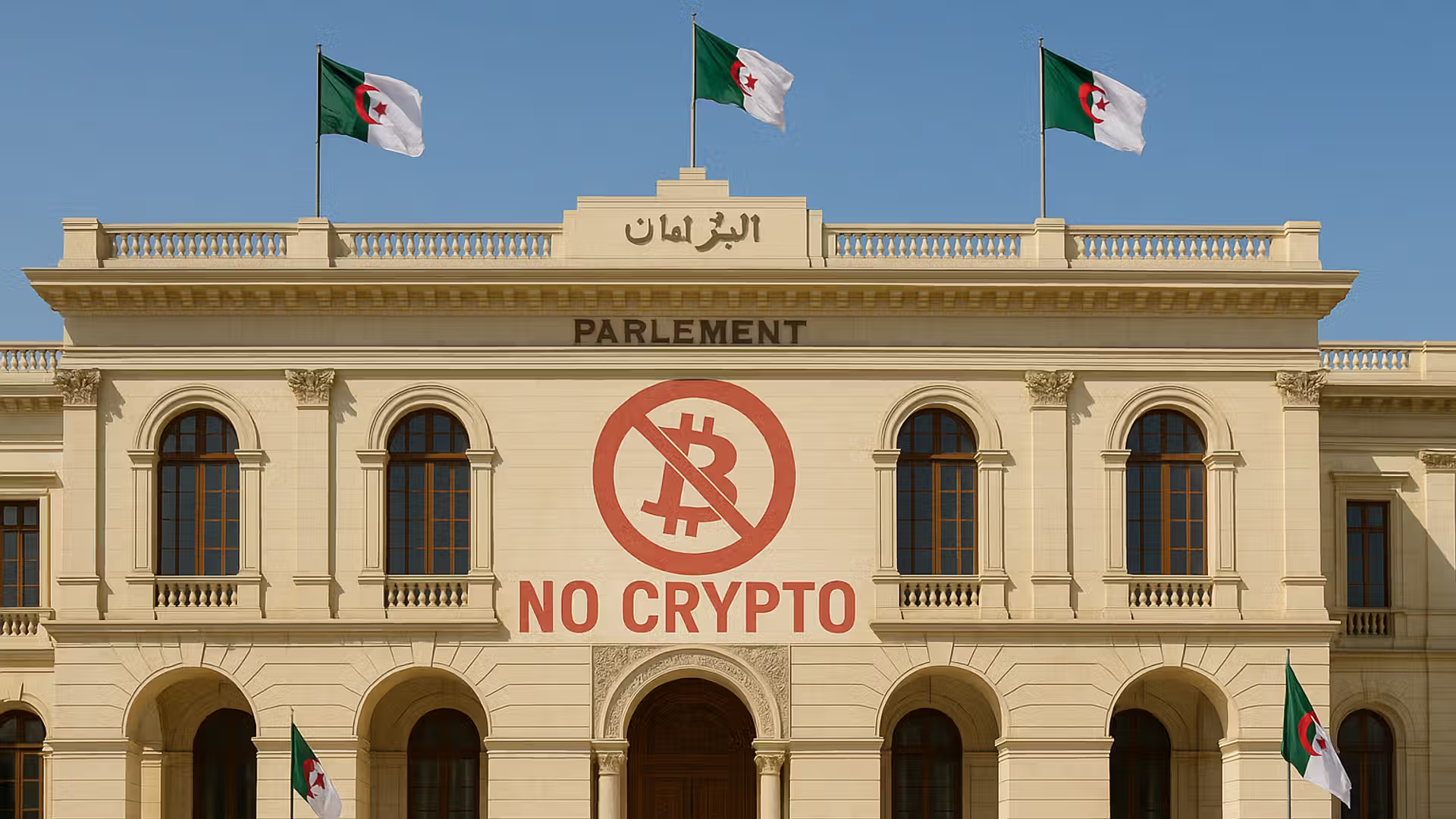
Algeria’s enactment of Law No. 25-10 marks a turning point in its approach to digital assets, as the country has shifted from a loosely defined prohibition to a detailed criminalization of all cryptocurrency activity. This legislation explicitly prohibits holding, trading, mining, storing, or promoting cryptocurrencies. It extends to operating exchanges or wallet services, whether online or in person, within the country or through offshore channels accessible to Algerian residents.
From an AML and CFT perspective, the decision to treat all cryptocurrency activity as inherently linked to financial crime risk represents a fundamental reclassification. Digital assets are now considered financial property, income, or funds, which means they fall squarely within Algeria’s anti-money laundering laws. This shift does not simply discourage crypto use, it embeds it within the legal framework used to combat money laundering, terrorist financing, tax evasion, and illicit capital flight.
Table of Contents


Crypto Regulation in Algeria: AML Compliance Nightmare
For compliance teams, this creates an environment in which any detected crypto involvement, whether direct or indirect, must be flagged as suspicious. Traditional customer due diligence processes will now need additional layers of screening to identify indicators of crypto activity, even if the client claims non-financial use such as education or software testing. Financial institutions will also have to establish new escalation procedures for cases where crypto references are found in client communications, transfers, or external dealings.
The AML integration of cryptocurrency offenses brings Algeria into alignment with certain conservative jurisdictions, yet it goes further by closing all possible operational pathways. Where other countries focus on regulating exchanges or applying KYC rules to crypto services, Algeria has removed the regulatory option entirely, preferring a criminal framework that treats digital asset use as illicit by default.
Legal Scope and Criminal Penalties for Crypto Abuse
The law is broad in scope, with provisions that criminalize the issuance, purchase, sale, possession, promotion, and mining of cryptocurrency. It also covers the provision of any services that facilitate crypto transactions, from hosting blockchain nodes to operating payment gateways linked to crypto assets. This means a person running a blog with affiliate links to foreign crypto platforms could face prosecution, as could a software developer who builds blockchain-based tools accessible from within Algeria.
Penalties under Law No. 25-10 range from two months to one year of imprisonment, accompanied by fines between 200,000 and 1,000,000 Algerian dinars, roughly equivalent to USD 1,540–7,700. In aggravated cases, such as when the offense is committed by an organized group, involves large sums, or is tied to money laundering or other financial crimes, courts may impose both prison sentences and the maximum fine.
The law’s wording provides little room for interpretation. By including activities like promotion and facilitation, it casts a wide net over individuals who may never have owned cryptocurrency but have engaged in its ecosystem in indirect ways. Educational seminars, online content creation, and even social media commentary could, in certain contexts, be construed as promotion.
From a compliance standpoint, this level of breadth means institutions must adopt conservative interpretations when assessing client behavior. Banks, fintech firms, and even non-financial businesses in regulated sectors will have to review not just financial transactions, but also marketing material, partnerships, and third-party affiliations to ensure they do not inadvertently provide a platform for crypto engagement.
The penalty structure also raises a strategic compliance concern. The relatively low maximum prison term could encourage enforcement bodies to opt for administrative efficiency by focusing on financial penalties, which could be applied broadly and frequently. This has implications for corporate budgeting, as firms may need to factor in the risk of significant fines in their operational cost models.
Enforcement Challenges and Institutional Compliance
The implementation of such a sweeping prohibition will likely require coordination between multiple agencies. The Bank of Algeria, the Ministry of Finance, the Financial Intelligence Unit, telecom regulators, and law enforcement bodies will all need to share data and investigative capabilities. On the technical side, authorities may use network monitoring tools to detect access to cryptocurrency exchanges, blockchain explorers, and wallet interfaces.
Virtual private network (VPN) usage is expected to be a focal point, as Algerians attempting to bypass geo-blocking to access foreign platforms may be detected through traffic analysis. This introduces privacy and cybersecurity considerations, since monitoring network activity at this scale demands advanced digital forensics capacity.
For compliance officers, the challenge lies in the fact that the prohibition covers not only direct transactions but also indirect involvement. For example, if a bank detects incoming wire transfers from a jurisdiction known for crypto-friendly regulation, and these transfers coincide with patterns typical of exchange payouts, the institution may need to treat the transaction as suspicious and escalate it under AML reporting requirements.
Another enforcement complication is the existence of decentralized finance (DeFi) and peer-to-peer trading. These operate without central intermediaries, making it harder to trace counterparties. Even with robust blockchain analytics tools, identifying beneficial owners can be difficult, particularly if mixers, privacy coins, or cross-chain bridges are used.
The law’s absence of transitional provisions or amnesty mechanisms compounds these challenges. Individuals who already hold crypto have no legal pathway to divest their assets domestically, potentially forcing them to choose between self-incrimination or silent retention. This is a stark departure from the gradual regulatory rollouts seen in other countries, where transitional compliance windows are provided.
Disruption to Fintech Innovation and Financial Inclusion
Algeria’s zero-tolerance approach will have ripple effects on the country’s fintech and digital innovation landscape. Blockchain technology offers applications far beyond cryptocurrency, including supply chain tracking, identity verification, and secure voting systems. By criminalizing all interaction with crypto, Algeria risks stifling these innovations, as the development and testing of blockchain solutions often involve token use on public or test networks.
From a financial inclusion standpoint, the prohibition could disproportionately affect unbanked and underbanked citizens. Cryptocurrencies have been used in some regions to facilitate cross-border remittances, enable micro-payments, and provide inflation hedges. In Algeria, where traditional banking penetration remains limited in rural areas, removing crypto as an alternative could widen the gap between those with and without access to formal financial services.
The policy also risks accelerating talent migration. Developers, entrepreneurs, and compliance professionals specializing in digital assets may relocate to jurisdictions with more open regulatory environments. This brain drain can have a long-term economic cost, reducing Algeria’s competitiveness in the digital economy.
Moreover, the prohibition may not eliminate crypto activity entirely. Instead, it could drive it further underground, where it becomes harder to monitor and regulate. This creates the paradox that a policy intended to combat money laundering and illicit finance could inadvertently increase the opacity of such activities.
Final Thoughts on Algeria’s Crypto Regulation Shock
Algeria’s legislative choice is clear: eliminate the crypto sector entirely in order to remove perceived risks to financial stability and AML/CFT compliance. The country’s regulatory stance now stands among the strictest in the world, offering no legal space for experimentation, controlled adoption, or compliant innovation.
The immediate consequence is a compliance environment where any crypto signal, however faint, must be treated as a red flag. Financial institutions will need to invest in detection technologies, staff training, and updated procedures to ensure no exposure to prohibited activity.
However, the broader implications extend beyond compliance. The policy sends a message to the global investment community that Algeria is willing to sacrifice potential digital economy gains to ensure strict control over capital flows. Whether this approach will prove effective in curbing illicit finance, or whether it will create a resilient shadow economy, remains to be seen. The long-term success of the ban will depend not only on enforcement capacity but also on whether the public perceives it as legitimate and necessary.
Related Links
- Law No. 25-10, Official Journal of the Republic of Algeria (July 24, 2025)
- Bank of Algeria official communications on cryptocurrency prohibition
- FATF Recommendations on Virtual Assets and Virtual Asset Service Providers
- United Nations Office on Drugs and Crime guidance on cryptocurrency and AML/CFT
Other FinCrime Central Articles About Algeria
- Algeria Added to EU High-Risk List Over AML and CFT Weakness
- Power Struggle Over EU Blacklist Sparks Uncertainty in Money Laundering Controls
Source: Fibladi News
Some of FinCrime Central’s articles may have been enriched or edited with the help of AI tools. It may contain unintentional errors.
Want to promote your brand, or need some help selecting the right solution or the right advisory firm? Email us at info@fincrimecentral.com; we probably have the right contact for you.