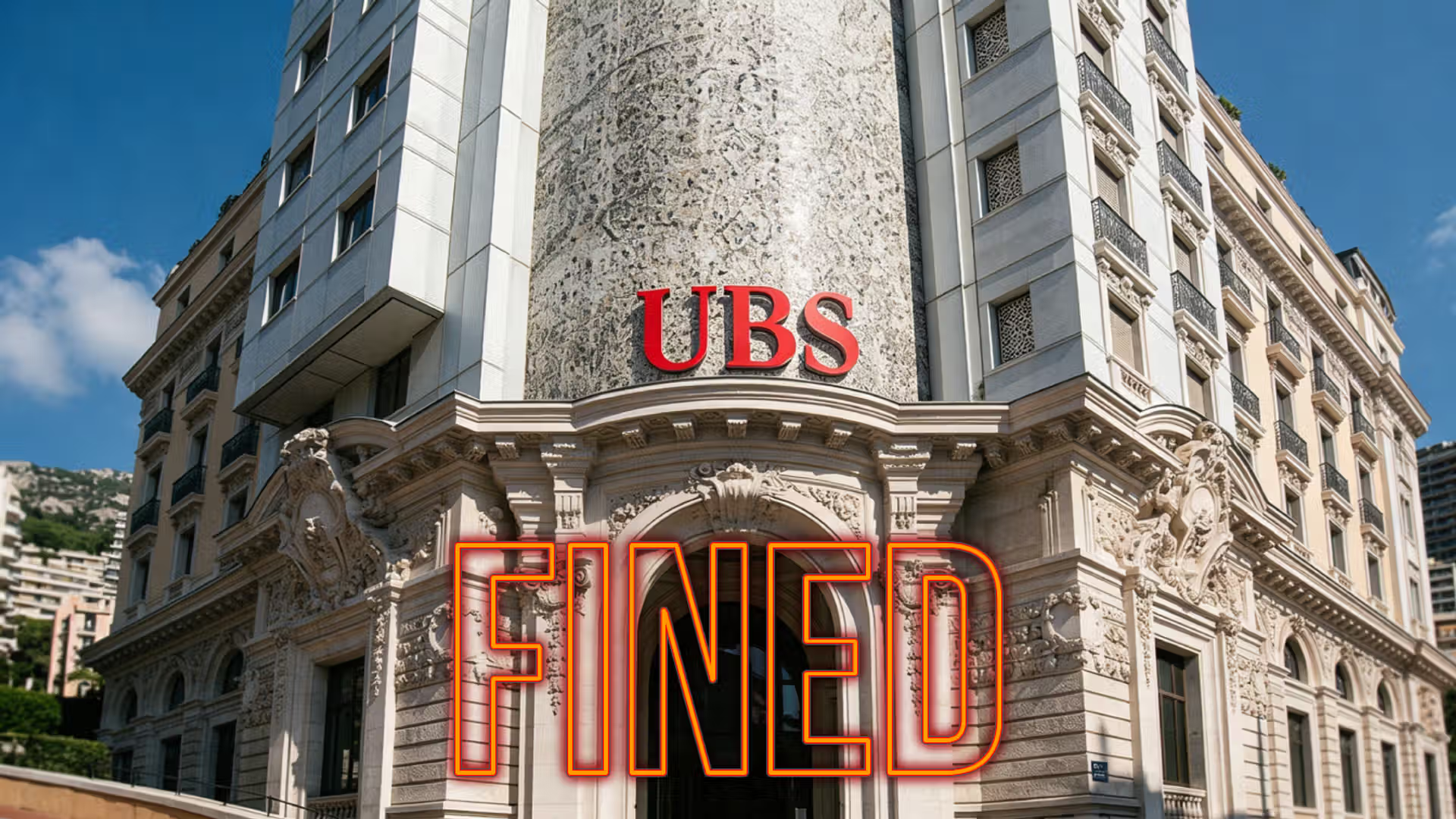
The Monegasque financial regulator recently imposed a significant 6 million euro penalty on the local subsidiary of UBS following a lengthy investigation into its internal controls. This substantial fine stems from repeated oversights regarding the monitoring of high-risk transactions and the onboarding of politically exposed persons between 2018 and 2023. Authorities identified a systemic failure to verify the origin of funds and the purpose of large international transfers involving sensitive jurisdictions. The decision highlights a period of administrative negligence that the bank has only recently begun to address through leadership changes in its compliance department. Such a public sanction serves as a critical warning to the financial sector within the principality regarding the strict enforcement of international transparency standards.
Table of Contents



Serious Anti-Money Laundering Failures
The administrative sanction issued by the Autorité Monégasque de Securité Financière represents one of the most significant enforcement actions in the recent history of the Mediterranean principality. Investigators focused on a five-year window where the bank allowed substantial sums of capital to flow through its accounts without conducting the necessary due diligence required by law. The primary concern for regulators was the lack of scrutiny applied to individuals holding political office or those with close ties to government entities. These individuals, categorized as politically exposed persons, require an enhanced level of monitoring because their positions provide opportunities for the misappropriation of public funds or the acceptance of bribes. By failing to document the nature and purpose of these financial movements, the institution effectively left the door open for illicit capital to enter the legitimate financial system. The 77-page verdict delivered by the watchdog outlines a culture of non-compliance where remote onboarding processes were utilized to bypass the physical presence requirements that often act as a secondary layer of security. This approach allowed wealthy clients to establish banking relationships from afar, often without the bank ever meeting the beneficial owners of the assets in question.
One specific instance highlighted in the official findings involved a series of transactions totaling more than 800,000 dollars. These funds moved through various financial institutions located in Lebanon and Saudi Arabia, ostensibly linked to real estate ventures within the Middle East. However, when pressed for details, the bank was unable to provide a precise explanation regarding the exact finality or nature of these transfers. The absence of documentation is a major red flag in the world of financial intelligence, as it suggests that the bank prioritized the acquisition of high-net-worth clients over its legal obligations to prevent financial crime. The fine of 6 million euros is accompanied by a naming and shaming penalty, ensuring that the decision remains publicly associated with the bank for a period of five years. This dual approach of financial and reputational punishment is designed to deter other institutions from adopting similar shortcuts in their compliance frameworks. The legal basis for this action is rooted in the 2009 legislation of Monaco, which addresses the laundering of capital, the financing of terrorism, and the proliferation of weapons of mass destruction.




Regulatory Scrutiny of Politically Exposed Persons and Offshore Accounts
The failures identified in the principality illustrate a broader challenge facing international wealth management hubs where the desire for privacy often conflicts with modern transparency mandates. The regulator found that the bank did not just fail on a single occasion but demonstrated a pattern of deficiencies in its transaction monitoring systems. For several years, the institution facilitated the movement of wealth for clients whose backgrounds should have triggered immediate alarms. Politically exposed persons are not inherently criminal, yet the risk profile they carry necessitates a deep dive into the source of their wealth. In the case of the UBS subsidiary, this deep dive was frequently substituted with a superficial glance. The watchdog noted that the bank could not justify the economic logic behind several large-scale transfers, which is a fundamental requirement under global standards. When a bank accepts hundreds of thousands of dollars from jurisdictions known for higher levels of corruption risk without asking for proof of the underlying contract or business deal, it becomes a conduit for potential financial crimes.
This case also brings to light the risks associated with remote onboarding. While digital transformation is a goal for many modern banks, the implementation of remote services must be backed by robust verification tools. In Monaco, the bank used these methods to cater to a global elite that preferred to remain at a distance. The lack of face-to-face interaction, combined with a failure to perform adequate background checks, created a blind spot that lasted for half a decade. The regulator specifically pointed to the inability of the bank to provide details on the nature of business relationships, which suggests that the internal audit and compliance functions were either understaffed or lacked the authority to challenge the front office. The 2023 shift in leadership, including the appointment of a new chief compliance officer, indicates that the bank recognized these structural weaknesses, but the changes came too late to avoid the wrath of the AMSF. The detailed list of findings in the verdict serves as a roadmap of what not to do for other private banking entities operating in similar jurisdictions.


Concluding Oversight Improvements and the Future of Compliance in Monaco
The resolution of this case marks a turning point for the financial reputation of Monaco as it seeks to align itself more closely with the Financial Action Task Force standards. The heavy fine and the public disclosure of the bank’s identity signify that the era of quiet, unregulated wealth management is coming to an end. For the bank, the path forward involves a complete overhaul of how it handles high-risk accounts and a commitment to transparency that was previously lacking. The institution has already begun the process of upgrading its compliance team and refining its monitoring software to catch the types of transactions that previously slipped through the cracks. However, the damage to its reputation in a small, interconnected market like the one on the French Riviera may take years to mend. The case proves that even the most prestigious names in global banking are not immune to local enforcement if they fail to uphold the global fight against financial crime.
Ultimately, the focus on money laundering and the financing of terrorism is no longer a peripheral concern for private banks but a core operational necessity. The 6 million euro penalty is a fraction of the total assets managed by such an entity, yet the administrative and legal costs, combined with the loss of trust from regulators, create a heavy burden. The principality has demonstrated that it is willing to take aggressive action against domestic and foreign subsidiaries alike to prove its commitment to the integrity of its markets. As the bank decides whether to exercise its right to appeal, the industry at large is already taking note of the specific failures mentioned in the verdict. The requirement to maintain the publication of this decision for five years ensures that the lesson remains fresh in the minds of stakeholders. Compliance is no longer a checkbox exercise but a continuous process of verification and vigilance that must start at the top of the organization.
Typologies for Compliance Professionals in Private Banking
Financial crime specialists should analyze the following behaviors and patterns to mitigate risks associated with high-net-worth individuals and cross-border transactions. The following indicators are essential for identifying potential illicit activity in a private banking environment.
- Remote Onboarding without Enhanced Verification: Establishing a business relationship with high-net-worth individuals or politically exposed persons without a physical meeting or the use of multi-layered identity verification technology.
- Inexplicable Third Country Transfers: Facilitating large movements of capital between accounts in the local jurisdiction and banks in high-risk or non-cooperative territories without clear economic justification.
- Lack of Source of Wealth Documentation: Accepting significant deposits or transfers from clients whose declared income or known business activities do not align with the volume of funds being moved.
- Ambiguous Real Estate Transactions: Processing payments for property deals in foreign jurisdictions where the underlying contracts, appraisals, or legal entities involved are not clearly defined or verified.
- Failure to Update Client Risk Profiles: Maintaining business relationships over several years without re-evaluating the political status or business interests of the client, leading to outdated risk assessments.
Key Points
- The financial regulator of Monaco imposed a 6 million euro fine on the UBS subsidiary for systemic anti-money laundering failures identified between 2018 and 2023.
- The bank demonstrated a consistent lack of due diligence when onboarding politically exposed persons and monitoring their international financial transactions.
- Specific failures included the inability to verify the purpose of 800,000 dollars in transfers involving Saudi Arabia and Lebanon linked to vague real estate activities.
- The penalty includes a naming and shaming provision where the details of the non-compliance will be publicly available on the regulator’s website for five years.
- The case highlights the risks of remote onboarding and the necessity of a robust source of wealth verification in jurisdictions catering to high-net-worth individuals.
Related Links
- Autorite Monegasque de Securite Financiere Official Sanctions
- Financial Action Task Force Mutual Evaluation of Monaco
- Journal de Monaco Official Government Publication
- Basel Institute on Governance AML Index
- European Banking Authority Anti Money Laundering Guidelines
Other FinCrime Central Articles About Monaco
- Former Monaco bankers convicted for laundering Italian money
- Monaco focuses on combating money laundering and being taken off the grey list
- EU Push to Grey List Monaco Triggers Unprecedented Scrutiny for Investors
Source: Inside Paradeplatz, by Lukas Hässig
Some of FinCrime Central’s articles may have been enriched or edited with the help of AI tools. It may contain unintentional errors.
Want to promote your brand, or need some help selecting the right solution or the right advisory firm? Email us at info@fincrimecentral.com; we probably have the right contact for you.