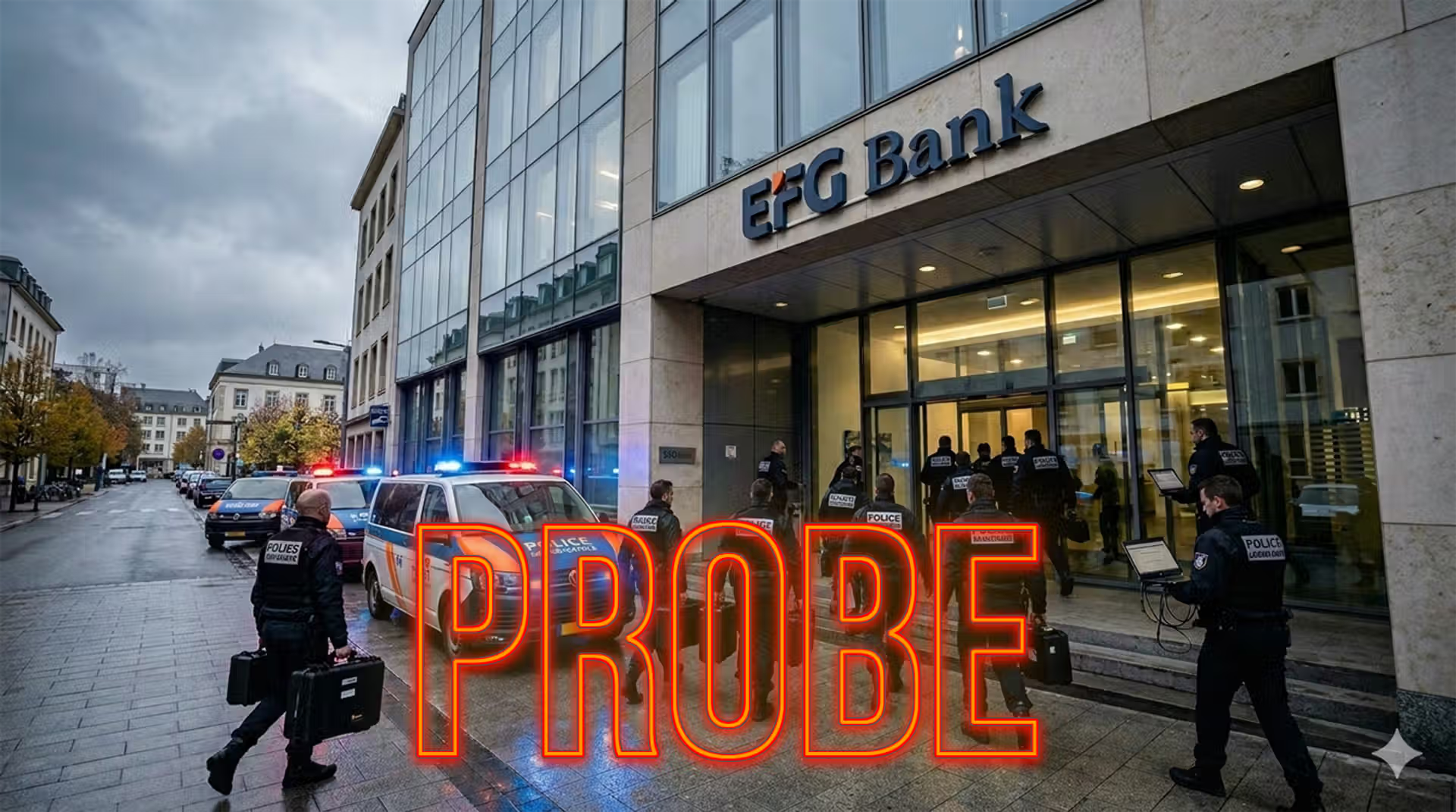
Turkish authorities are examining how a licensed electronic money institution and an insurance company allegedly allowed criminal proceeds from illegal betting activity to enter the financial system. The case focuses on corporate entities owned by fintech entrepreneur Ozan Özerk, whose wider network includes firms previously linked to payment flows tied to a global online fraud scheme uncovered by investigative reporters. Authorities in Istanbul have seized assets, detained employees, and appointed a trustee to take control of one entity. The corporate structures and transaction flows under scrutiny illustrate how non-bank financial institutions may be misused for laundering, even when they operate as regulated businesses. This article focuses on the money laundering dimension of the Turkish probe and the factual record already confirmed by publicly available sources.
Table of Contents


Alleged misuse of a licensed institution for illicit financial flows
The Istanbul Chief Public Prosecutor’s Office announced that Ozan Elektronik Para A.Ş., an electronic money institution, was allegedly used to introduce criminal assets derived from illegal betting into Turkey’s financial system. Prosecutors reported that suspicious transaction patterns indicated placement and layering activities consistent with money laundering typologies observed in high-risk payment environments. These patterns included rapid movement of funds, large-value inflows inconsistent with customer profiles, and commercial transactions that lacked clear economic rationale. Asset seizures of approximately 72 million Turkish lira, along with detention orders for multiple employees, were executed as part of the investigation according to official statements. A prior enforcement action a week earlier resulted in the seizure of roughly 9.6 million dollars and the arrest of several executives linked to the same institution.
Ozan Elektronik Para A.Ş. publicly confirmed that a trustee had been appointed under a court decision issued on 31 October, a measure intended to safeguard operations during the investigation. This development reflects concerns that governance and compliance frameworks may not have sufficiently prevented misuse of its platform. The institution stated that customer and merchant funds would be returned once compliance checks and legal procedures permitted. The appointment of an external trustee is a significant regulatory intervention and remains rare within the sector, reflecting the seriousness with which the authorities viewed the alleged laundering channels.
Investigators also noted that foreign-based transactions connected to illegal betting networks were introduced into accounts associated with the institution, reinforcing suspicions that the platform was used as an entry point for proceeds of crime. Although public statements have not identified the beneficial owners as direct subjects of the investigation, the enforcement actions underscore the sensitivity of electronic money institutions to exploitation when monitoring, due diligence, or governance controls fail to prevent incoming high-risk flows.
Another dimension of the case relates to Aveon Global Sigorta A.Ş., a majority-owned insurance company within the same corporate network. Prosecutors alleged that the company was used to disguise criminal proceeds as insurance premiums, enabling further integration of illicit funds. Insurance premium laundering represents a documented typology where fraudulent premium payments or reimbursement flows serve as conduits for integrating proceeds of crime, particularly where beneficial ownership oversight is limited or data sharing between affiliated companies is insufficient. The allegations indicate that funds may have been cycled through the insurance entity to create a legitimate-looking financial trail. Aveon Global Sigorta A.Ş. did not publicly comment on the claims.
The case demonstrates how electronic money institutions and insurance firms, when operating under shared ownership, can unknowingly become nodes in laundering networks when controls are inadequate. The layering of financial products within related entities can obscure fund origins, making detection more difficult for both compliance teams and regulators. The actions taken by Turkish authorities highlight the importance of segmented oversight, independent governance structures, and strict beneficial ownership monitoring in reducing cross-entity AML vulnerabilities.
Payment processors linked to online fraud flows exposed earlier
Earlier in the year, an investigative project known as Scam Empire, published by an international consortium of journalists including OCCRP, revealed that two additional companies owned by the same entrepreneur processed payments tied to a massive global online fraud scheme. Investigations showed that the fraud involved call centers persuading thousands of victims to make payments that totaled hundreds of millions of dollars. These payments were routed through numerous companies worldwide, including payment institutions and banks registered in Europe. Records showed that companies within the same ownership network had processed a portion of these payment flows.
One payment services firm in the network appeared in leaked data showing more than two million euros moving through an account linked to suspected fraudulent online investment platforms. The institution confirmed at the time that it monitored transactions for red flags and asserted that preventative controls were in place, while noting that fraud attempts persist across the industry despite screening measures. Its communications emphasized that the ultimate beneficial owner did not participate in management or oversight roles and that operational teams maintained autonomy in control decisions.
A separate financial institution within the network, a small European bank, stated that it could not discuss client transactions due to legal confidentiality obligations, while acknowledging awareness of the Turkish investigation. The bank classified the situation as a reputational risk requiring internal responses aligned with regulatory obligations. Public statements clarified that the bank did not consider itself part of the Turkish probe and maintained that the allegations pertained solely to the electronic money institution under investigation in Turkey.
Although none of the institutions were accused of knowingly facilitating fraud or money laundering, the involvement of their payment rails highlighted systemic exposure to illicit flows when controls are evaded or overwhelmed. Investigative reporting demonstrated how fraudulent schemes rely on global payment channels to distribute funds across jurisdictions, mixing victim inflows with legitimate transactions to obscure origin. Such findings underscore the need for payment firms to deploy enhanced monitoring when servicing customers or counterparties located in high-fraud sectors or jurisdictions.
The intersection of the Scam Empire revelations and the Turkish investigation is rooted in the complexity of ownership networks. Corporate structures that span multiple payment services, insurance firms, banks, and jurisdictions create environments where proceeds of crime can be moved through legitimate channels when oversight is not harmonized. Regulators in multiple jurisdictions increasingly examine such networks for control gaps that enable criminals to exploit regulated institutions even in the absence of direct complicity.
Red flags and typologies evidenced in the Turkish investigation
The publicly known facts from the case align with long-established money laundering typologies documented by regulators and intergovernmental bodies. Patterns associated with illegal betting proceeds often involve high-velocity transactions, rapid conversion of funds, and usage of intermediaries to disguise the true origin. Electronic money institutions provide convenient rails for such flows when integration with merchants, payment gateways, or insurance frameworks offers multiple opportunities for layering.
Investigators pointed to the introduction of criminal proceeds into accounts under the guise of commercial payments unrelated to genuine economic activity. Rapid accumulation of funds followed by transfers or withdrawals is consistent with placement and early layering phases. These flows often exploit weaknesses in monitoring systems that are calibrated for typical consumer or merchant profiles but fail to detect anomalies linked to betting or cross-border fraud.
Insurance entities within the same ownership network represent another typology. Premium payments, reimbursements, and contractual payouts can all be used to disguise origins. Criminal networks may move funds into insurance products to create a paper trail that implies legitimacy. When an insurance company receives inflows inconsistent with customer risk profiles or lacking clear underwriting justification, AML systems must respond with enhanced review. The allegations about the insurance entity illustrate how criminals may exploit differences between financial-sector AML regimes and insurance-sector AML regimes, especially where insurers rely on manual due diligence rather than real-time monitoring.
Cross-sector movement of funds between related entities can further complicate detection. Beneficial ownership transparency failures allow criminals to shift funds among companies that appear unrelated at first glance. The case highlights why regulators examine corporate networks holistically, rather than assessing entities in isolation. Ownership structures that span fintech, insurance, and banking create opportunities for laundering across business lines, reducing visibility for compliance teams working within individual institutions.
Law enforcement actions such as asset seizure and trustee appointment signal that the scale and structure of the alleged laundering channels reached a level requiring immediate intervention to prevent further misuse. These measures are typically reserved for cases where authorities believe ongoing criminal exploitation may continue in the absence of external control. The appointment of trustees in particular reflects concerns that internal management may lack the capacity or independence to rectify compliance failures without oversight.
Broader relevance for AML oversight and sectoral risk management
The Turkish case provides a clear illustration of how modern financial crime risks migrate to non-bank institutions that operate sophisticated payment-processing infrastructures. Electronic money institutions offer agility and customer reach, but their speed and scale also present enforcement challenges. Regulators may find that firms expand faster than their compliance frameworks, creating vulnerabilities that criminal networks rapidly exploit.
Insurance companies connected to payment networks through beneficial ownership or related-party structures must maintain equal vigilance. Differences between regulatory frameworks can create blind spots, especially when funds originating from payment channels are re-characterized as insurance inflows. Insurance AML obligations generally require monitoring of premium flows, identification of unusual payment patterns, and close scrutiny of high-risk customers. When an insurer receives payments that align suspiciously with flows entering a related payment institution, the risk of cross-sector laundering rises sharply.
Firms operating across multiple jurisdictions face additional responsibilities. Regulated entities may comply with local AML rules while operating in broader ownership networks where risks originate outside their direct purview. Regulators increasingly expect firms to demonstrate group-wide AML governance, including risk sharing, transaction monitoring correlation, and consolidated reporting. This is particularly relevant when ownership structures include payment processors in one jurisdiction, insurers in another, and financial institutions in a third.
For AML professionals, the core lessons relate to early identification of red flags, cross-entity monitoring, high-quality customer due diligence, and governance mechanisms that segregate functions to prevent internal blind spots. Payment flows tied to illegal betting networks, online investment fraud schemes, or unverified commercial activity require heightened scrutiny. Firms that process high-risk merchant activity must implement controls that block high-risk transactions, detect anomalous patterns, and escalate unusual activity promptly.
The Turkish probe illustrates how public investigations reinforce the need for consistency, transparency, and governance rigor. Regardless of whether institutions knowingly facilitated illicit flows, the reputational and operational consequences of exposure to laundering activity can be severe. Regulators may impose extraordinary oversight measures such as trustee appointments or asset freezes to prevent ongoing harm. The case is a reminder that financial institutions must treat AML as a central strategic priority, not merely a compliance requirement.
Key Points
- Turkish prosecutors alleged that an electronic money institution was used to introduce proceeds of illegal betting into the financial system.
- Asset seizures and trustee appointment indicate significant regulatory concern about laundering risk.
- An affiliated insurance company was accused of disguising criminal proceeds as premium inflows.
- Earlier investigative reporting connected other companies in the same ownership network to payment flows linked to global fraud.
- The case underscores cross-sector AML vulnerabilities within payment, insurance, and fintech corporate structures.
Related Links
- Istanbul Chief Public Prosecutor’s Office official announcements
- Financial Action Task Force reports on money laundering typologies
- European Central Bank material on payment institution supervision
- OECD analysis of insurance-sector money laundering risks
Other FinCrime Central Articles About Turkey
- Turkey Empowers Watchdog to Freeze Crypto Accounts in AML Push
- US Crackdown on Hamas Virtual Currency Reveals Turkey’s Role in Terrorism Financing
- Turkey’s Bold Crypto AML Rules for 2025
Source: OCCRP, by Turgut Denizgil
Some of FinCrime Central’s articles may have been enriched or edited with the help of AI tools. It may contain unintentional errors.
Want to promote your brand, or need some help selecting the right solution or the right advisory firm? Email us at info@fincrimecentral.com; we probably have the right contact for you.