An exclusive article by Fred Kahn
Modern financial systems face a staggering challenge as illicit actors exploit the vast complexities of international commerce to move trillions of dollars across borders undetected. This systemic failure persists despite decades of warnings from the Financial Action Task Force and various national regulators regarding the vulnerabilities of open markets. Trade-based money laundering (TBML) represents the most sophisticated and difficult to detect method of moving criminal proceeds because it disguises illicit value within the massive volume of legitimate global transactions. The fundamental structure of international shipping and invoicing creates a perfect environment for concealment, rendering traditional anti-money laundering controls largely ineffective.
Table of Contents


Why Trade-Based Money Laundering Continues to Evade Detection
The sheer scale of global trade provides an expansive veil for criminal organizations to manipulate invoices and shipping documents without triggering red flags. Most customs agencies focus primarily on prohibited goods or tax evasion rather than the financial integrity of the transaction itself, creating a massive gap where over-invoicing and under-invoicing become standard tools for transferring value between jurisdictions. Financial institutions often lack the necessary visibility into the physical movement of goods, relying instead on paper or digital documents that are easily forged or altered by professional money laundering syndicates. Because banks are not physically present at the ports of entry, they cannot verify if the quality, quantity, or even the existence of the goods matches what is described on the letter of credit. This disconnect between the physical world and the financial ledger ensures that trade-based money laundering remains the path of least resistance for sophisticated cartels and state-sponsored actors. Furthermore, the reliance on manual document checks in an increasingly digital world means that inconsistencies are rarely identified in real time, allowing funds to be cleared and integrated before any suspicion is raised.
The structural failure of pricing transparency for a vast majority of traded commodities and finished products represents one of the most significant hurdles in the fight against trade-based financial crime. There is no global database that can tell a compliance officer exactly how much a specific type of industrial machinery or a shipment of raw textiles should cost at any given moment, allowing criminals to exploit this ambiguity with ease. Even when authorities suspect foul play, the data sharing required to prove a crime is often blocked by strict privacy laws or a lack of international cooperation between customs and financial regulators. Financial institutions are left to monitor transactions in a vacuum, seeing only the flow of funds without the context of the physical shipment, which ensures that even obvious red flags go unnoticed. This fragmentation of information ensures that illicit value can be moved across borders by simply adjusting a decimal point on a shipping manifest or an invoice. As long as the market for these goods remains decentralized and opaque, the ability of regulators to identify value manipulation will remain severely limited.




Examining the Complex Typologies and Strategic Vulnerabilities
To understand why this problem is so difficult to solve, one must examine the diverse typologies employed by professional money launderers to circumvent standard banking and customs controls. The most common method involves the manipulation of quantity and quality, where a criminal enterprise ships a small amount of low-quality goods while invoicing for a large shipment of high-quality items. This allows the buyer to pay a significantly higher price than the goods are worth, effectively transferring the excess value to the seller in another jurisdiction without triggering capital flight alerts. Beyond basic misinvoicing, the Black Market Peso Exchange remains a dominant typology, particularly in the Western Hemisphere, where brokers purchase drug proceeds in a destination country and use them to pay for legitimate commercial goods. This creates a circular flow of value that never touches the traditional banking system in a way that triggers standard thresholds, making it nearly invisible to financial investigators.
Another prevalent typology is the use of multiple invoicing, where a single shipment of legitimate goods is used to justify multiple payments across different banks or financial institutions. By the time a regulator might notice the duplication, the funds have already been moved and integrated into other accounts or assets, leaving a cold trail for law enforcement. Short shipping and over shipping are also frequently utilized, where the physical quantity of goods does not match the documentation, allowing for the silent transfer of value through the delta in the reported versus actual cargo. More advanced schemes involve phantom shipping, where no goods move at all, but a series of forged bills of lading and customs declarations are created to justify a large cross-border wire transfer. These methods are often combined with the use of shell companies and front businesses that have no real commercial purpose other than to facilitate the movement of illicit funds. The variety and adaptability of these typologies mean that static rules-based systems are almost always one step behind the criminals.
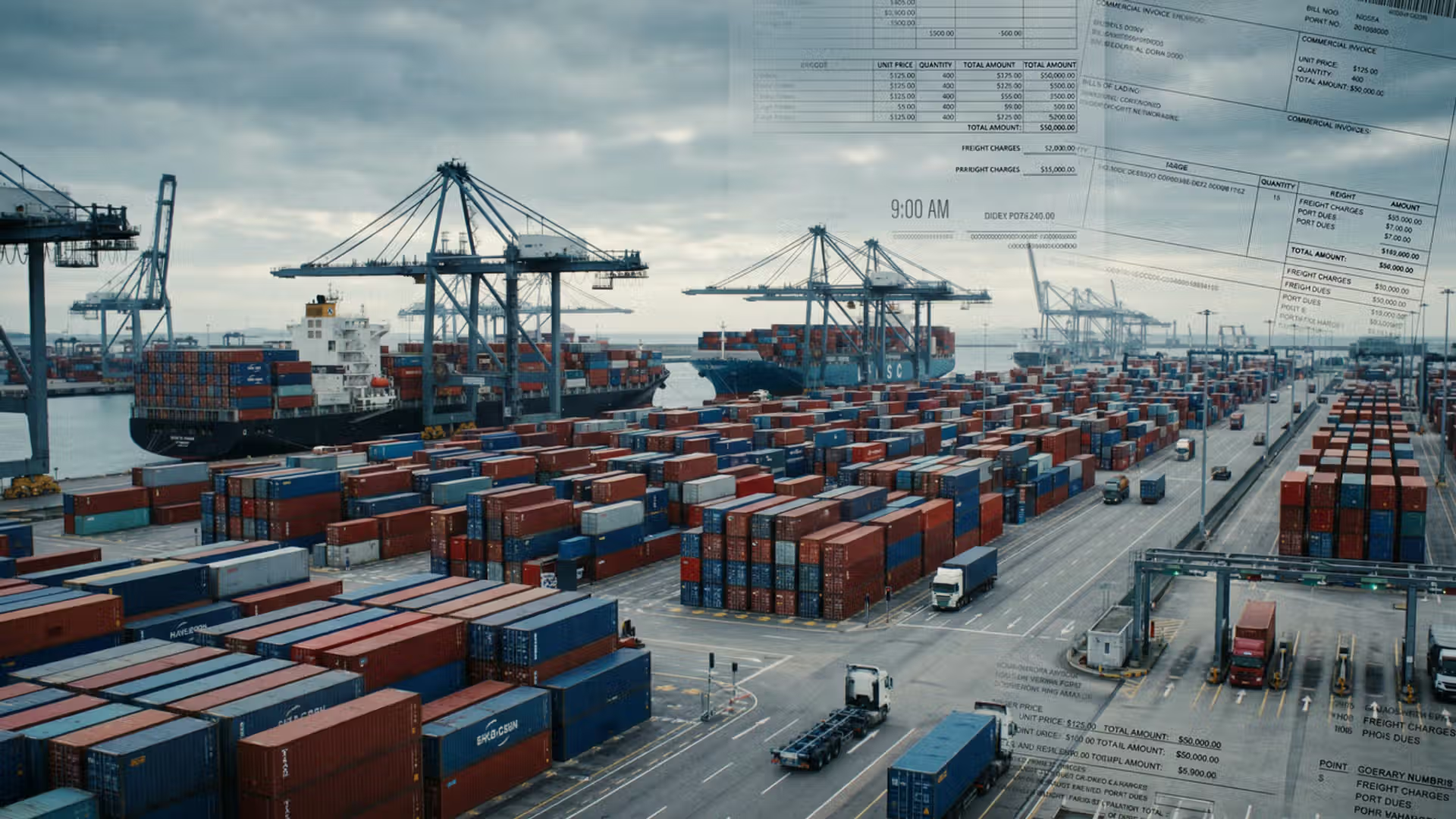
The maritime sector serves as the backbone of global trade, but it is also the primary theater for large-scale trade-based money laundering operations due to its inherent lack of real-time oversight. Modern shipping relies on a high-speed turnover of goods, where any delay at a port can result in massive financial losses for shipping lines and terminal operators, creating pressure to bypass thorough documentation checks. Criminal syndicates take advantage of this by using complex shipping routes that involve transshipment through multiple ports in different jurisdictions, each stop providing an opportunity to alter manifests. The lack of a centralized tracking system that links a specific container to its corresponding financial payment means that once a shipment leaves its port of origin, it effectively enters a black hole of accountability. Despite advances in satellite tracking and port security, the financial data associated with these movements remains siloed within individual banks and corporate ledgers, leaving investigators with an incomplete picture. This structural disconnect is precisely what allows trade-based laundering to remain the most effective method for high-volume value transfer globally.

Regulatory Fragmentation and the Inevitable Policing Gap
The global response to trade-based money laundering is hampered by a patchwork of inconsistent regulations and varying levels of enforcement priority across different countries and jurisdictions. While some developed nations have invested in advanced trade transparency units, many emerging markets remain vulnerable due to a lack of resources or political will to challenge powerful commercial interests. This regulatory fragmentation creates a system where illicit flows naturally migrate toward the path of least resistance, moving through ports and financial centers with the weakest oversight. Furthermore, the incentives of the private sector are often at odds with the goals of law enforcement, as excessive scrutiny represents a high cost and a potential delay in revenue. There is a constant tension between the need for efficient global trade and the requirement for rigorous anti-money laundering checks, which usually results in the former being prioritized over the latter. As long as the global economy prioritizes the frictionless movement of capital, trade-based money laundering will remain an unavoidable feature of international commerce.
The use of anonymous shell companies and complex corporate structures is a cornerstone of trade-based money laundering, providing a layer of separation between the criminal actors and the illicit transactions. These entities are often registered in jurisdictions with weak corporate transparency laws, making it nearly impossible for banks to identify the true beneficial owners behind a massive trade contract. In many cases, a single criminal organization will control both the importing and exporting companies, allowing them to manipulate invoices with total freedom and no external pushback. Third-party intermediaries, such as freight forwarders and customs brokers, are also frequently drawn into these schemes, sometimes as active participants who provide the necessary documentation for a fee. These intermediaries add another layer of complexity to the transaction, making it even harder for investigators to trace the original source of the funds or the ultimate destination of the value. The involvement of multiple parties across several countries ensures that no single regulator has a complete view of the entire transaction, allowing the launderers to hide in the cracks.
Global compliance professionals face an uphill battle when attempting to reconcile the vast amount of data generated by modern trade with the limited tools available for forensic analysis. Most anti-money laundering systems are designed to flag suspicious wire transfers based on amount or frequency, but they are ill-equipped to analyze the underlying commercial logic of a trade deal. For example, a bank may see a payment for ten thousand tons of steel but have no way of knowing if the price per ton is inflated by fifty percent. Without integrated systems that pull in customs data, shipping logs, and real-time commodity pricing, the banking sector remains largely blind to the most common forms of trade manipulation. This information gap is not a temporary technical hurdle but a structural reality of how global commerce is currently organized and governed. As a result, the burden of detection falls on a small number of specialized investigators who are overwhelmed by the sheer volume of suspicious activity reports that lack the necessary context to pursue.
The Structural Reality of Unpoliced Global Commerce
We must confront the provocative reality that trade-based money laundering may be simply too big to police effectively under our current economic and political model. The sheer volume of transactions, combined with the infinite ways in which trade documents can be manipulated, makes total oversight an impossible goal for even the most well-funded agencies. Even with the introduction of artificial intelligence and machine learning to flag suspicious patterns, the human resources required to investigate every red flag would be astronomical and likely cost-prohibitive. Moreover, the transition to a more transparent system would require a level of global cooperation that is currently nonexistent, as countries compete to attract trade volume by offering lower regulatory burdens. The complexity of modern trade is not a bug in the system but a feature that allows for the speed and efficiency we demand, and that same complexity provides the perfect cover for criminal activity.
Until there is a fundamental shift in how international trade is documented and verified, we must accept that the current system is winning, and trade-based money laundering will continue to flourish. The misalignment of incentives between customs, banks, and corporates ensures that the path of least resistance will always be available to those with the resources to exploit it. While small victories are occasionally achieved through targeted investigations, the overall trend is one of expansion and increasing sophistication on the part of money launderers. The reality is that the global economy is built on a foundation of trust and speed that is incompatible with the level of scrutiny required to stop professional value transfer. Acknowledging this structural failure is the first step toward a more honest conversation about the limitations of financial crime enforcement in a globalized world. Without a radical overhaul of the maritime and trade documentation system, the shadow economy will continue to thrive in the containers and invoices that cross our borders every day.
Key Points
- Trade-based money laundering exploits the gap between physical goods movement and financial transaction reporting.
- Criminals utilize diverse typologies such as over-invoicing and multiple invoicing to transfer value undetected.
- The lack of global pricing transparency for commodities makes it nearly impossible to identify fraudulent trade documents.
- Regulatory fragmentation allows illicit funds to bypass strict controls by moving through jurisdictions with weak oversight.
- The structural complexity of international supply chains makes meaningful enforcement of trade-based money laundering almost impossible.
Related Links
- FATF Guidance on Trade Based Money Laundering Risk Indicators
- United Nations Office on Drugs and Crime Trade Based Laundering Portal
- U.S. Immigration and Customs Enforcement Trade Transparency Units
- World Trade Organization Trade Monitoring and Compliance Reports
- Wolfsberg Group Guidance on Trade Finance Principles
Other FinCrime Central Articles About TBML
- Analyzing Trade Misinvoicing and Illicit Financial Flows in Developing Nations
- How Supply Chains Are Used to Launder Funds in the Food and Retail Sector
- Next-Level AML Monitoring Can Be Achieved with Connected Supply Chains
Some of FinCrime Central’s articles may have been enriched or edited with the help of AI tools. It may contain unintentional errors.
Want to promote your brand, or need some help selecting the right solution or the right advisory firm? Email us at info@fincrimecentral.com; we probably have the right contact for you.