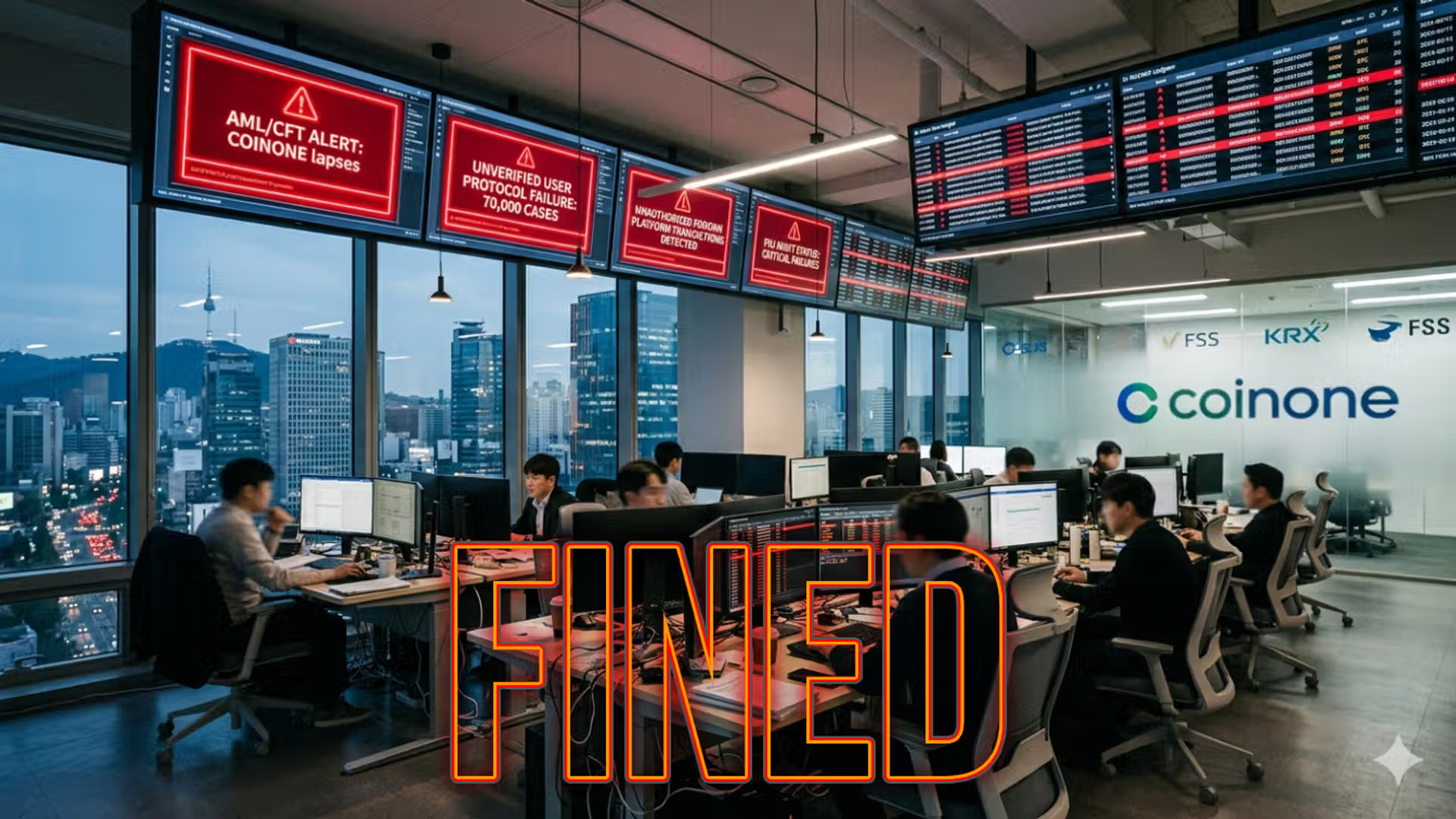
South Korean financial regulators have issued a 5.2 billion won penalty and a three-month business suspension against Coinone following a probe into systemic anti-money laundering failures. The Financial Intelligence Unit conducted a rigorous investigation that revealed approximately 70,000 instances where the exchange failed to verify user identities according to national legal standards. These findings suggest a significant breakdown in the internal compliance frameworks designed to prevent illicit financial flows within the domestic digital asset market. The regulatory body emphasized that the exchange allegedly ignored multiple official warnings while processing a high volume of transactions with unregistered foreign entities. Consequently, the firm now faces a partial freeze on its operations that prevents the onboarding of new customers or the movement of certain funds until the administrative restriction expires.
Table of Contents



South Korean Cryptocurrency Compliance Enforcement
The enforcement action against Coinone centers on extensive failures to adhere to the Act on Reporting and Using Specified Financial Transaction Information, which serves as the cornerstone of the local regulatory framework. Investigators from the Financial Intelligence Unit determined that the exchange failed to conduct proper customer due diligence on a massive scale, specifically highlighting seventy thousand cases of unverified user profiles. This lapse is not merely a clerical error but represents a fundamental vulnerability in the infrastructure meant to deter financial crimes. By allowing unverified individuals to access the platform, the exchange effectively bypassed the gatekeeping mechanisms that ensure transparency in the digital asset sector. The regulatory probe also uncovered that the firm marked customer profiles as complete even when essential identity data was missing, showing a pattern of administrative negligence. This systemic disregard for identity verification protocols allowed unverified users to continue trading without the necessary oversight, creating an environment where suspicious activity could go undetected for extended periods.
Beyond the failures in identity verification, the investigation revealed that the exchange processed over ten thousand unauthorized transactions involving sixteen unregistered foreign platforms. This activity occurred despite the exchange receiving multiple prior warnings from authorities regarding the risks associated with these entities. In the global financial system, interacting with unregistered or non-compliant platforms is a high-risk behavior that often triggers red flags for potential illicit activity. The decision to maintain these connections suggests a prioritization of transaction volume over the rigorous application of anti-money laundering standards. The Financial Intelligence Unit noted that these actions undermined the integrity of the broader financial system, as they facilitated the movement of assets through channels that do not meet the legal requirements for transparency and reporting. The multi-billion-won fine serves as a punitive measure to address these specific violations and as a corrective tool to ensure future compliance with cross-border transaction rules.




Operational Consequences and Industry Precedents
The administrative penalties imposed on the exchange are among the most severe seen in the local market recently, reflecting a tightening of the regulatory environment. The 5.2 billion won fine, roughly equivalent to 3.5 million dollars, is accompanied by a three-month partial business suspension that significantly hampers the operational capacity of the firm. During this period, the exchange is prohibited from registering new users or allowing them to move funds, which is a measure intended to prevent further compliance gaps while the internal systems are remediated. The CEO of the company received an official reprimand, signaling that leadership is held accountable for the failure to implement effective oversight mechanisms. While these actions are administrative rather than criminal, they carry heavy weight in the industry and serve as a warning to other participants. The move follows a similar case involving Bithumb, another major platform that faced even larger fines and longer suspensions for comparable lapses, indicating a broad and consistent push by the government to clean up the virtual asset industry.

Regulatory Transformation of the Digital Asset Sector
This recent enforcement action is part of a larger trend of regulatory transformation within the South Korean financial landscape. The Bank of Korea and the Financial Intelligence Unit are actively working to introduce stricter standards for cryptocurrency platforms, moving away from a period of relatively light oversight toward a highly controlled environment. One of the most significant changes involves the requirement for platforms to reconcile their internal records with actual physical asset holdings every five minutes. This replaces a previous twenty-four-hour cycle, which regulators argued was insufficient for identifying discrepancies or preventing the mishandling of customer funds. The shift to real-time or near-real-time auditing is a direct response to high-profile errors and liquidity concerns that have plagued the industry in recent years. By enforcing such frequent reconciliation, authorities aim to ensure that exchanges maintain the necessary reserves and that their ledger systems are accurate, thereby protecting investors from systemic risks.
Furthermore, the central bank is advocating for legislative changes that would grant exchanges the power to freeze trading during periods of extreme volatility or when suspicious activity is detected. This proposal reflects a desire to move beyond reactive enforcement toward proactive market stability. If adopted, these trading curbs would allow for a temporary pause in market activity to investigate unusual fluctuations, potentially preventing the type of flash crashes or mass liquidations that can destabilize the financial ecosystem. The push for these powers suggests that the government views cryptocurrency not just as a niche asset class but as a potential source of systemic risk that requires the same level of sophisticated intervention as traditional stock markets. The ongoing dialogue between lawmakers and financial authorities indicates that more comprehensive legislation is likely on the horizon, focusing on consumer protection and the prevention of market manipulation through advanced monitoring tools.
Structural Integrity of Financial Compliance Frameworks
The core of the case against Coinone lies in the structural integrity of its internal compliance frameworks and the failure of those systems to act as a barrier against potential money laundering. Effective anti-money laundering programs rely on a continuous cycle of identification, verification, and monitoring, none of which can function if the initial onboarding process is flawed. When tens of thousands of users are permitted to trade without verified identities, the entire chain of accountability is broken. This creates a blind spot for regulators and law enforcement, as the origin and destination of funds become obscured. The investigation highlights that the exchange did not just fail to collect data but actively marked incomplete profiles as ready for trading, which points to a conscious decision to bypass safety protocols. Such actions erode the trust between financial institutions and the regulators who oversee them, leading to the severe administrative consequences observed in this case.
Correcting these systemic failures requires more than just paying a fine; it necessitates a complete overhaul of the corporate culture regarding risk management. The three-month suspension provides a window for the exchange to rebuild its verification engines and ensure that its systems can handle the rigorous requirements of the law. This involves integrating more robust identity software and potentially re-verifying the entire existing user base to clear any lingering discrepancies. For the industry at large, this case underscores that technical innovation cannot be used as an excuse for ignoring established legal obligations. The financial sector is built on the principle of transparency, and digital asset platforms are increasingly being held to the same standards as commercial banks. As the legal landscape continues to evolve, the ability to demonstrate a proactive and transparent compliance posture will be the primary factor that determines which platforms survive the increasing scrutiny of global financial authorities.
Key Points
- South Korean authorities imposed a 5.2 billion won fine on Coinone for failing to verify approximately 70,000 user identities.
- The Financial Intelligence Unit documented over 10,000 unauthorized transactions with 16 unregistered foreign platforms despite prior warnings.
- The exchange faces a three-month partial business suspension, prohibiting the onboarding of new clients and certain fund movements.
- New regulatory standards in the region now require asset reconciliation every five minutes to ensure ledger accuracy and prevent discrepancies.
Related Links
- Financial Intelligence Unit Korea Official Press Releases
- Bank of Korea Reports on Virtual Asset Oversight
- Financial Services Commission Guidance on Digital Asset AML
- FATF Mutual Evaluation Report South Korea
- Act on Reporting and Using Specified Financial Transaction Information
Other FinCrime Central Articles About KoFIU’s Actions
- South Korea Imposes 20 Percent Ownership Cap on Crypto Exchanges to Curb AML Risk
- South Korean Authorities Bust Crypto Laundering Ring Worth 102M$
- Major Blow to Crypto Market as Korea’s FIU (KOFIU) Imposes Heavy Penalties on Exchanges
Source: Digital Today, by Sangyup Oh
Some of FinCrime Central’s articles may have been enriched or edited with the help of AI tools. It may contain unintentional errors.
Want to promote your brand, or need some help selecting the right solution or the right advisory firm? Email us at info@fincrimecentral.com; we probably have the right contact for you.