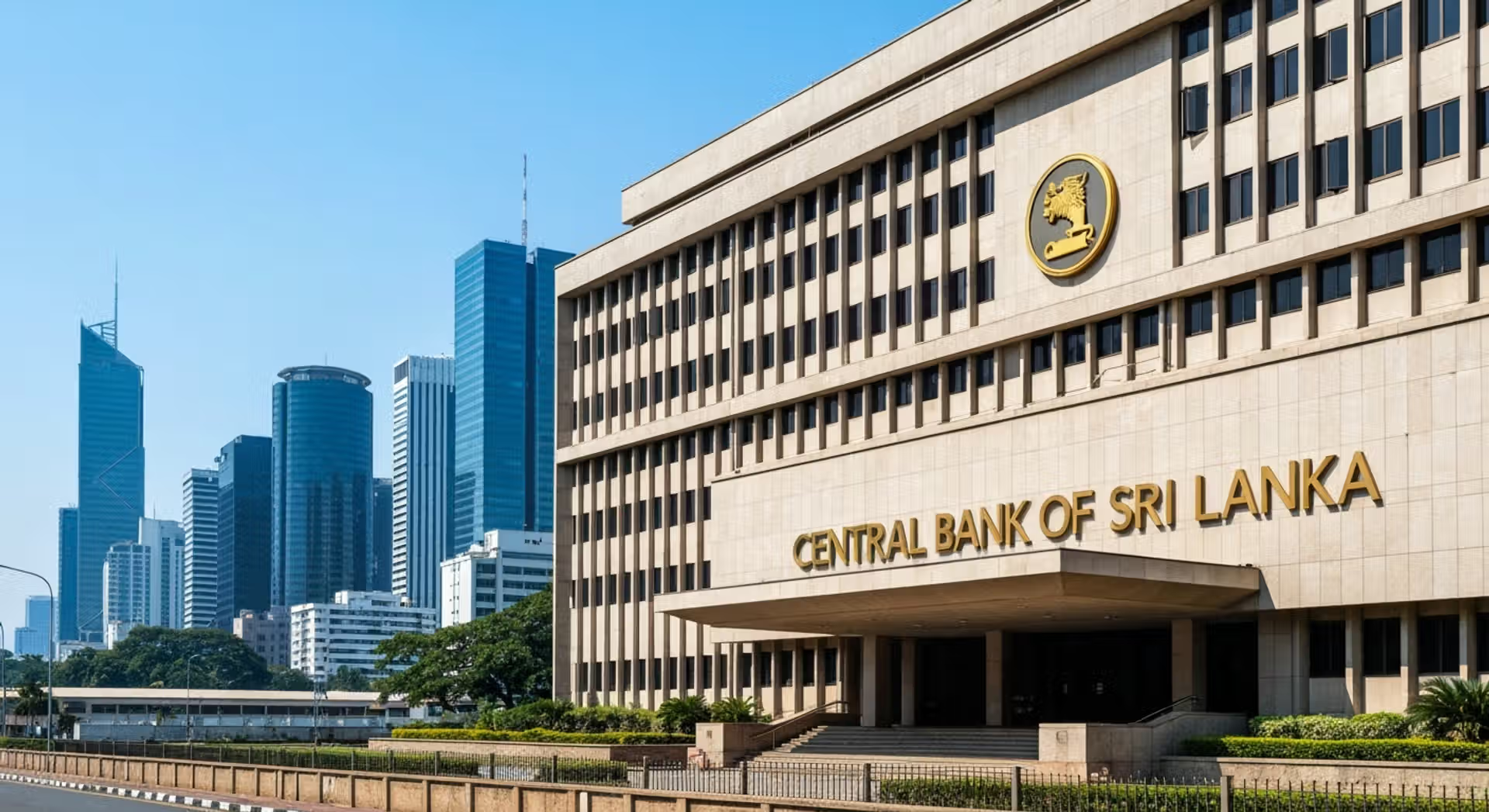
Money laundering remains one of the most corrosive threats to financial stability and governance. When a country’s AML regime is under global scrutiny, the implications reach far beyond domestic policy. Sri Lanka, after two previous mutual evaluations, is preparing for its third FATF assessment in 2026. The new methodology will place greater emphasis on tangible enforcement outcomes rather than the mere existence of legal frameworks. This evaluation will test not only Sri Lanka’s legal infrastructure but also its institutional capacity to prevent, detect, and prosecute laundering schemes effectively.
The case provides a window into how a nation’s efforts to curb illicit finance collide with entrenched criminal networks, institutional weaknesses, and global compliance expectations. It is an opportunity to assess the country’s progress and expose how systemic gaps allow laundering patterns to persist despite legislative reform.
Table of Contents


Historical and Legal Foundations of the Sri Lanka AML Case
Sri Lanka’s legal framework against money laundering is anchored in the Prevention of Money Laundering Act (PMLA) of 2006. The Act criminalizes the acquisition, possession, or transfer of property derived from illegal activity when the actor knows, or has reasonable grounds to believe, that its origin is unlawful. Later amendments introduced stronger freezing powers, asset forfeiture mechanisms, and cross-border cooperation. The objective is to align the national framework with the 40 Recommendations of the Financial Action Task Force (FATF).
The PMLA targets all three stages of laundering—placement, layering, and integration—but enforcement has often lagged behind the legislative ambition. The Act allows imprisonment between five and twenty years, with fines up to three times the value of the laundered property. It also places a burden of proof on defendants to justify the legality of their assets, reflecting a strong stance against unexplained wealth.
Despite these provisions, deficiencies remain. The absence of explicit conspiracy clauses limits prosecutors’ ability to charge networks acting in coordination. Predicate crimes such as drug trafficking, corruption, and trade-based manipulation generate significant illicit proceeds, yet tracing the funds and linking them to offenders remains challenging.
Past FATF evaluations exposed “strategic deficiencies” in Sri Lanka’s AML/CFT regime, leading to grey listing in 2017 and subsequent blacklisting by the European Union. Removal from these lists came only after extensive remedial work by the Financial Intelligence Unit (FIU) and the Central Bank. The upcoming 2026 evaluation, under the new FATF methodology, will prioritize effectiveness—focusing on proven results such as convictions, confiscations, and cross-agency cooperation.
The Sri Lanka AML case therefore represents a crucial test of whether years of reform have translated into operational success rather than theoretical compliance.
Anatomy of a Money Laundering Scheme in Sri Lanka
A typical money laundering scheme in Sri Lanka follows familiar patterns found across developing economies but shaped by local nuances. The most common sources of illicit proceeds are narcotics trafficking, corruption, trade fraud, and public sector embezzlement. These proceeds are often injected into the financial system through front companies, casinos, and high-value goods.
The placement stage involves converting cash into bank deposits, foreign exchange, or movable assets. Sri Lankan casinos and exchange houses have frequently been flagged for weak controls during this initial phase.
The layering stage then conceals the money’s origins through a series of transfers, offshore accounts, and fictitious trade invoices. Investigations have revealed cases where funds were wired to shell companies abroad, masked as consultancy or procurement payments. Others use real estate acquisitions under relatives’ names to disguise beneficial ownership. The absence of an accessible beneficial ownership register until recently made these tactics particularly effective.
The integration stage allows criminals to reintroduce funds into the legitimate economy through real estate, luxury vehicles, or shareholdings in legitimate businesses. Investigators have found that the layering process frequently involves the use of multiple domestic and regional financial institutions.
One notable example involves alleged laundering through aviation contracts, where funds were disguised as payments related to aircraft procurement. Another involves public bond transactions manipulated through insider networks, where excessive profits were allegedly recycled through investment entities. These cases reveal the vulnerability of public finance structures and the ease with which insiders can conceal illicit enrichment.
A pattern of politically exposed persons (PEPs) using family members or intermediaries to own assets adds another layer of complexity. Weak PEP monitoring, insufficient data-sharing between regulators, and limited asset declaration verification have historically hindered detection.
The country’s FIU, despite improvements, faces the ongoing challenge of integrating parallel financial investigations with predicate crime enforcement. Without synchronized tracking of money trails alongside criminal prosecutions, deterrence remains limited.
Challenges, Institutional Weaknesses, and AML Enforcement
Sri Lanka’s AML enforcement apparatus faces institutional and operational difficulties. Staff retention within compliance and investigative units remains problematic, leading to skill erosion and fragmented continuity. Some agencies continue to perceive AML compliance as an administrative burden rather than a national security imperative.
The lack of a fully functional beneficial ownership register is another weakness. FATF’s revised Recommendation 24 requires that authorities have access to accurate, up-to-date ownership data. Although the Companies Act was amended to require corporate beneficial ownership records, practical implementation remains incomplete.
Virtual assets introduce further complexity. FATF Recommendation 15 demands regulation of virtual asset service providers (VASPs), but Sri Lanka remains only partially compliant. Cryptocurrencies provide new avenues for layering and cross-border concealment, yet national legislation has not caught up with technological reality.
Coordination remains a perennial challenge. Predicate crime investigations often proceed without financial follow-up, allowing offenders to retain their proceeds. Successful jurisdictions ensure that financial and criminal probes operate in tandem, depriving criminals of both liberty and profit.
Judicial capacity also affects enforcement outcomes. Many judges and prosecutors lack specialized training in tracing complex transactions, resulting in lengthy proceedings and low conviction rates. While the number of convictions has increased—rising from one in 2015 to over a dozen recently—the figure remains modest relative to the scale of illicit financial activity.
Economic consequences compound these structural weaknesses. Grey listing leads to higher transaction costs, stricter correspondent banking oversight, and reduced foreign investment. The Central Bank has acknowledged that maintaining global banking relationships depends heavily on staying compliant with FATF expectations.
The Proceeds of Crime Act, passed in 2024, marks progress by empowering authorities to freeze and manage confiscated assets. Yet implementation capacity remains uncertain. Asset management requires transparent governance, valuation mechanisms, and inter-agency cooperation—all areas that will be closely examined in the next evaluation.
The Stakes of Effective AML in the Sri Lanka AML Case
The outcome of the upcoming evaluation will shape Sri Lanka’s global financial reputation. Failure to meet the FATF’s expectations could trigger renewed grey listing, limit access to international markets, and drive up sovereign borrowing costs. These macroeconomic repercussions underline why AML effectiveness is not simply a regulatory issue—it is an economic survival challenge.
Weak enforcement perpetuates a cycle of impunity. When proceeds of corruption and organized crime remain untouched, the criminal incentive structure stays intact. Financial system integrity cannot coexist with unchecked laundering.
A functioning AML regime is also a prerequisite for stable foreign direct investment. Investors demand assurance that their funds will not be co-mingled with illicit flows. Transparency and accountability therefore serve as competitive advantages for emerging economies.
Sri Lanka’s strategic location amplifies the importance of its AML performance. Positioned at the crossroads of major shipping routes, it risks exploitation by transnational networks seeking to layer and transit funds across borders. Effective AML controls are not only about compliance but also about shielding the broader region from spillover risks.
The FATF’s current methodology measures success through eleven immediate outcomes, focusing on practical results rather than formal compliance. Sri Lanka’s capacity to demonstrate such results—through prosecutions, confiscations, and cross-agency cooperation—will determine whether it maintains credibility or faces another round of sanctions.
Lessons from the Sri Lanka AML Case
The Sri Lanka AML case illustrates that combating money laundering demands more than legislative compliance. It requires synchronized enforcement, technological modernization, and cultural change within institutions. Compliance must evolve from a regulatory checkbox to a core governance function.
Reforms such as the beneficial ownership registry and the Proceeds of Crime Act are steps in the right direction but must be paired with visible outcomes. Transparent enforcement, cross-border intelligence sharing, and judicial specialization remain critical.
Ultimately, the credibility of an AML regime lies in its ability to confiscate criminal proceeds and disrupt financial channels that sustain organized crime. Sri Lanka’s experience provides a global lesson: effectiveness, not formalism, defines resilience. The coming evaluation will determine whether the country has turned legislative ambition into operational reality—or remains trapped in a cycle of partial compliance and reputational risk.
Related Links
- Sri Lanka Financial Intelligence Unit – National Risk Assessment documents
- FATF / Asia Pacific Group mutual evaluation on Sri Lanka
- Sri Lanka Prevention of Money Laundering Act text/amendments
- Sri Lanka Proceeds of Crime Act legislation
Other FinCrime Central News About Sri Lanka
- Sri Lanka FIU fines Casinos: Bally’s, Bellagio, and NSB penalized
- Strengthening Sri Lanka’s AML/CFT Framework for the Mutual Evaluation
- Sri Lanka’s Central Bank’s New MOU on Money Laundering
Source: The Sunday Times, by Namini Wijedasa
Some of FinCrime Central’s articles may have been enriched or edited with the help of AI tools. It may contain unintentional errors.
Want to promote your brand, or need some help selecting the right solution or the right advisory firm? Email us at info@fincrimecentral.com; we probably have the right contact for you.