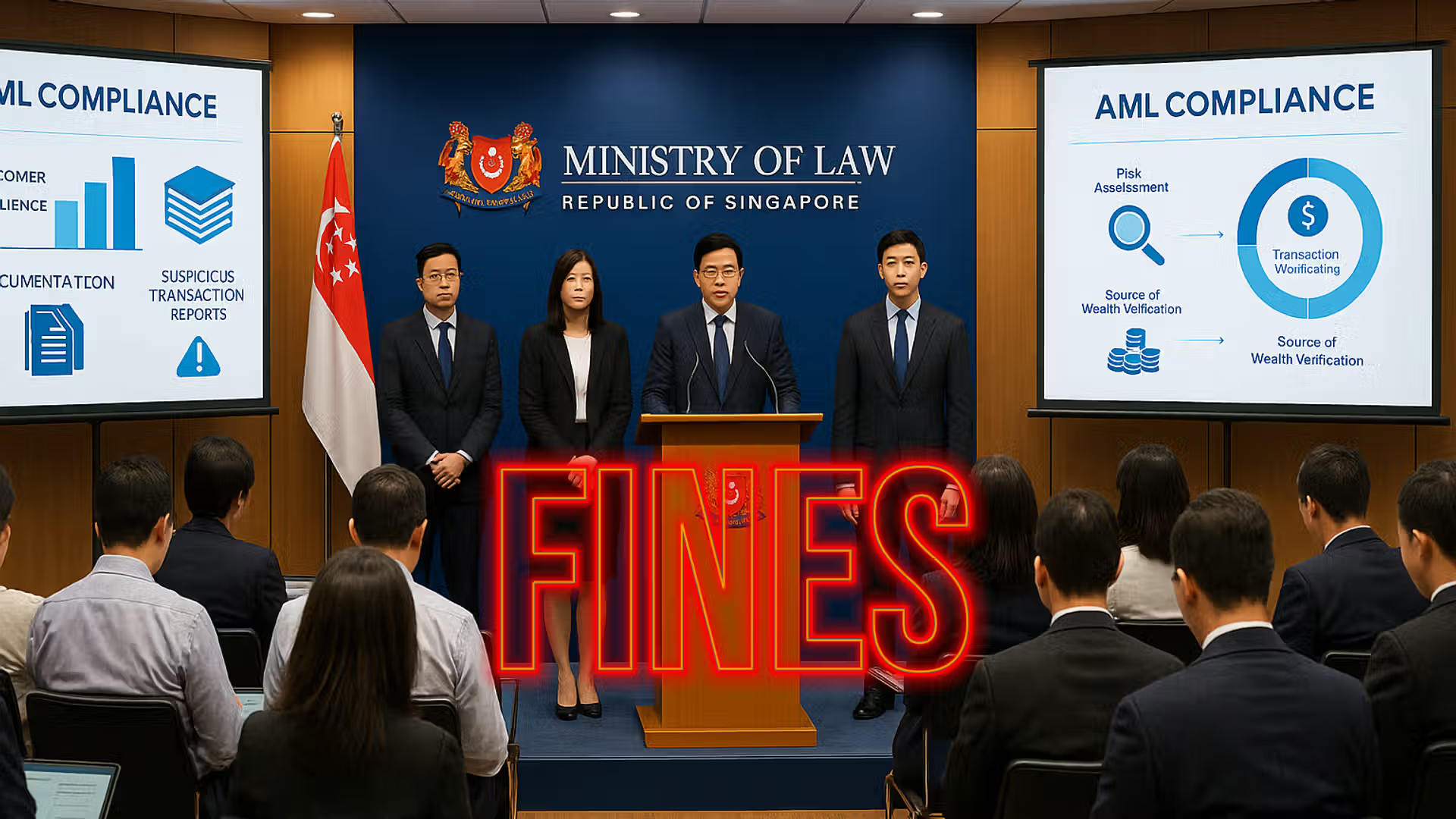
Singapore’s legal sector is under heightened scrutiny following aggressive enforcement actions by the Ministry of Law, guided by the Director of Legal Services (DLS). These measures stem from a sprawling money-laundering investigation launched in August 2023. So far, inquiries into 24 law practices have been in motion, and as of August 2025, thirteen of those have reached enforcement conclusions. Four firms now face combined penalties nearing $200 000, alongside reprimands and referrals for lawyer disciplinary proceedings. Investigations into the remaining eleven are ongoing.
Table of Contents


AML enforcement in law firms
The Legal Profession (Prevention of Money Laundering, Financing of Terrorism and Proliferation Financing) Rules were updated effective July 1, 2025 to shore up AML obligations in the legal sector. All legal entities and practitioners are bound by the Legal Profession Act 1966, which mandates robust customer due diligence (CDD), documentation, and filing of suspicious transaction reports (STRs) where necessary. This wave of enforcement underscores the regulator’s determination to elevate compliance standards within law practices.
Regulatory framework reinforcing Singapore legal compliance
Singapore’s anti-money-laundering regime is anchored in established laws and rules designed to uphold the integrity of its legal sector. Under the Legal Profession Act 1966, law practices and individual lawyers must: assess money-laundering risks per client, conduct CDD proportionate to risk level, file STRs when suspicion arises, document decisions to continue representation notwithstanding red flags, and maintain internal policies and controls. The Legal Profession (Prevention of Money Laundering, Financing of Terrorism and Proliferation Financing) Rules 2015—renamed and refined as of July 1, 2025—provide clarity on measures such as client risk assessment, source-of-wealth verification, and transaction monitoring. Enforcement authority rests with the DLS, who may impose financial penalties, issue reprimands, or refer lawyers to the Law Society of Singapore for disciplinary action. Lawyers face proceedings that could result in fines, suspension, or disbarment—depending on the severity of their breaches. These standards echo international AML/CFT (anti-money-laundering/combating the financing of terrorism) expectations and underscore the need for constant vigilance amid evolving financial crime typologies.
Enforcement breakdown — what occurred with the four penalized law firms
The DLS’s recent actions highlight a spectrum of compliance failures across multiple law firms, each tied to property transactions involving seized assets from the August 2023 money-laundering probe.
- Anthony Law Corporation (ALC) received the heaviest individual penalty of USD 100 000. The firm handled conveyancing for nine clients across 25 properties valued at around USD 135 million. It failed to conduct adequate risk-based scrutiny, neglected to corroborate unusual third-party funding explanations, lacked documentation justifying its decision to proceed after filing STRs, and lacked proper record-keeping.<br>
- Legal Solutions LLC (LS) was fined USD 70 000 for insufficient documentation in its analysis of clients’ money-laundering risks, and for failing to document internal deliberations when it retained clients following STR filings. LS facilitated two clients in conveying 20 properties worth approximately USD 117 million.<br>
- Fortis Law Corporation (FLC) incurred a USD 30 000 fine. FLC neglected to verify client claims that payments derived from legitimate remittance sources. It handled 16 clients and 55 property conveyances valued at around USD 398.7 million.<br>
- Malkin & Maxwell LLP (M&M) was issued a reprimand only, with no financial penalty. The firm relied too heavily on third-party assumptions in vetting source of funds rather than conducting its own independent checks. It acted for a single client in one transaction valued at roughly USD 40 million.<br>
Additionally, two more firms—William Poh & Louis Lim (now Louis Lim & Partners) and Templars Law LLC—were reprimanded for inadequacies in customer due diligence, risk mitigation, and documentation oversight. The managing partner involved in these transactions transferred between firms midstream, heightening concerns about continuity and accountability. Fees collected across all firms in question ranged from USD 15 000 to USD 170 000. Lawyers connected to these cases have been referred to the Law Society for possible disciplinary action. These enforcement outcomes signal the DLS’s intent to apply proportional penalties and to ensure remediation through enhanced compliance measures.
Implications for the legal profession and strengthening AML culture
These enforcement steps carry significant consequences and serve as a wake-up call for the legal community:
- Firm-wide compliance upgrades are essential. Law practices must formalize and regularly test AML policies, including CDD protocols, STR procedures, client risk oversight, and documentation norms.
- Training and accountability are critical. Lawyers must receive updated instruction on AML standards, red-flag indicators, and documentation obligations, with clear internal accountability for lapses.
- Risk-based vigilance must be realigned. Law firms should adopt tiered risk frameworks calibrated to transaction complexity and client profile, and apply enhanced due diligence where warranted.
- Record-keeping discipline matters. Every decision—especially those to proceed despite suspicious indicators—must be fully documented to withstand regulatory scrutiny.
- Ethical alignment should be reinforced. Law professionals must internalize AML/CFT responsibilities as core to their professional duty, not as regulatory burdens.
- Deterrence through enforcement sends a message: non-compliance carries consequences. This will likely prompt the legal sector to adopt more proactive and preventive measures.
Overall, these developments are likely to catalyse a shift toward a more risk-aware legal practice landscape in Singapore.
Enforcement reflects Singapore’s resilience in financial crime prevention
Singapore is renowned for its robust anti-money-laundering system, but global typologies continue to evolve. The 2023 real-estate-focused money-laundering case exploited legal channels—making legal professionals frontline defenders. The DLS’s enforcement activity not only addresses past breaches but also sets a forward-looking tone: enforcement and prevention go hand in hand. Strengthened rules as of July 1, 2025, reinforce the legal sector’s mandate to stay ahead of emerging risks, such as cryptocurrencies, complex trust structures, and global real-estate concealment. Cooperation among regulators—including MAS (Monetary Authority of Singapore), police, and legal oversight bodies—contributes to a cohesive defense against financial crime. The sector-wide impact is clear: internal systems must evolve, professional conduct must align with public interest, and Singapore must remain an AML-resilient jurisdiction.
Closing thoughts on regulatory momentum
Singapore’s bold enforcement against law firms in the context of a high-value money-laundering case underscores its unwavering commitment to financial crime prevention. Penalties approaching USD 200 000, alongside firm reprimands and lawyer referrals, send an unmistakable signal: legal professionals must embed AML resilience into their practice. Investments in policy, training, documentation, and governance are no longer optional—they are imperative. As the remaining 11 investigations unfold, continued transparency and accountability will be vital to maintaining public trust and preserving Singapore’s reputation as a secure, compliant global legal hub.
Related Links
- Ministry of Law Singapore
- Ministry of Law: Update on enforcement actions in the legal sector arising from the 2023 case – Singapore Government
- Legal Profession (Prevention of Money Laundering, Financing of Terrorism and Proliferation Financing) Rules – Singapore Statutes
- Legal Profession Act 1966 – Singapore Statutes
Other FinCrime Central Articles About Crackdown on Law Firms
- UK Lawyer Fined and Banned After Compliance Failures in Azerbaijani Property Deal
- Small Law Firm Faces Heavy AML Penalties for Regulatory Failures
- Simpson Thacher & Barlett, a Prestigious US Law firm, hit with £300K AML Fine for Serious Compliance Shortcomings
Source: Legal World, by Nimitt Dixit
Some of FinCrime Central’s articles may have been enriched or edited with the help of AI tools. It may contain unintentional errors.
Want to promote your brand, or need some help selecting the right solution or the right advisory firm? Email us at info@fincrimecentral.com; we probably have the right contact for you.