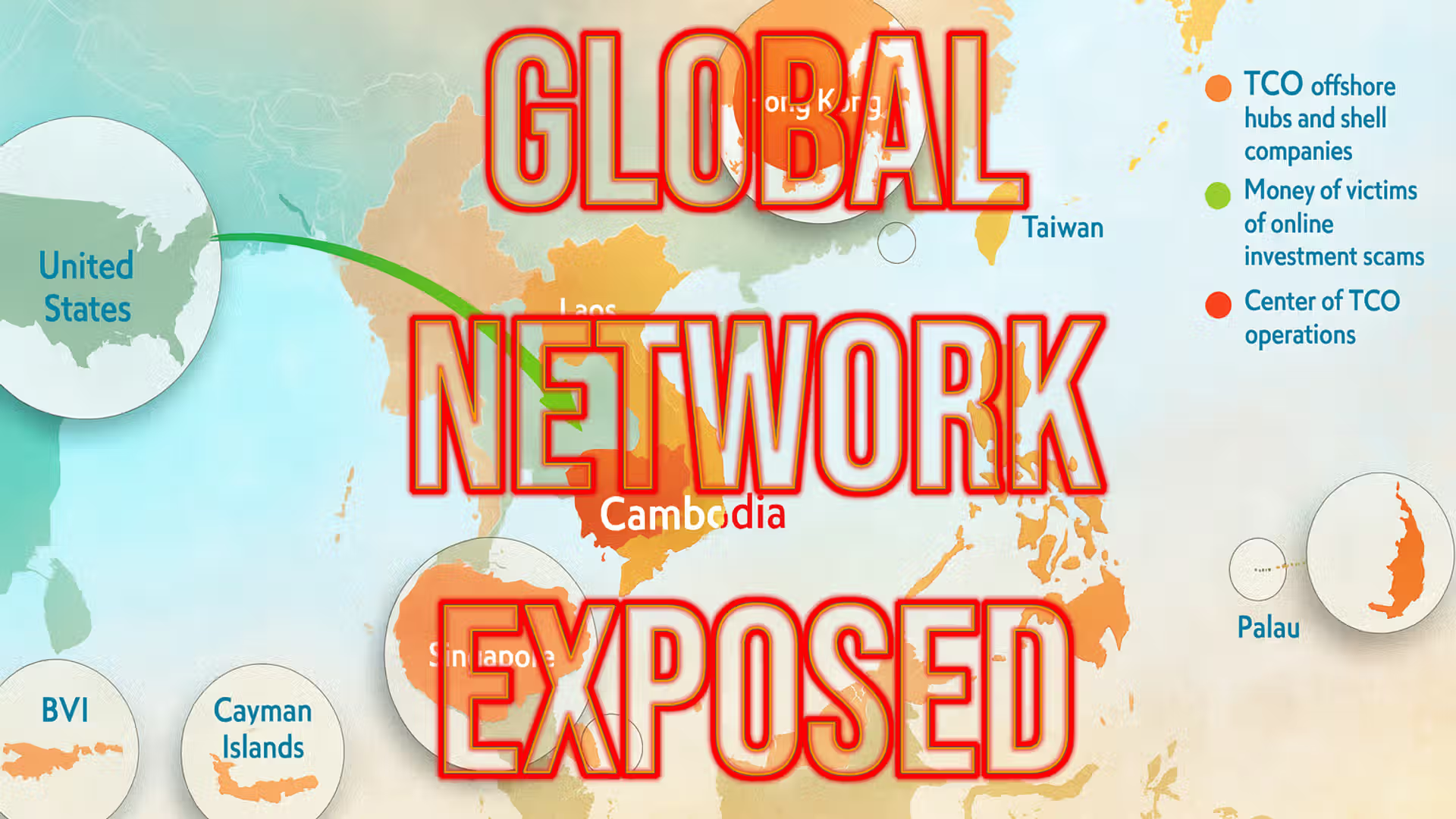
Prince Group TCO represents one of the most structurally complex and aggressively concealed money laundering systems in modern Southeast Asia. The network, headquartered in Phnom Penh under the control of Chen Zhi, is a masterclass in financial engineering built to obscure criminal proceeds behind an illusion of corporate legitimacy. The group’s operations extend across Cambodia, Laos, Singapore, Taiwan, Hong Kong, the British Virgin Islands, the Cayman Islands, and Palau, forming an offshore web of shell entities that act as both conduits and containers for illicit flows.
Table of Contents


The Prince Group TCO Money Laundering Network
At its core, the scheme transforms proceeds of online investment fraud and human exploitation into what appears to be foreign direct investment and legitimate business expansion. Victims—primarily in the United States—are lured through long-term online relationships, convinced to invest in fraudulent trading platforms, and ultimately drained of their savings. The stolen funds are converted into digital assets, shuffled through over-the-counter crypto brokers in Southeast Asia, and then reintegrated into the financial system through Prince Group-controlled companies.
The scale of the operation is staggering. U.S. authorities estimate more than $16 billion lost globally to online investment scams in recent years, with a substantial portion connected to Prince Group TCO and similar Cambodia-based syndicates. The organization’s laundering model leverages the global reach of virtual currency, using exchanges in Hong Kong and Singapore to layer transactions and exchange illicit crypto into stablecoins or fiat currency. These funds are then quietly redirected into offshore jurisdictions where shell companies are registered under innocuous names, often with nominee directors and no apparent economic purpose.
Prince Group’s integration strategy completes the laundering cycle. The funds are reintroduced into Cambodia through large investments in real estate, casinos, luxury hotels, and banking operations. Prince Bank Plc., one of the group’s cornerstone entities, serves as the primary reintegration mechanism, handling deposits, loans, and corporate investments funded with the same money that originated from global scams. This deliberate blending of illicit and legitimate cash flows creates a financial fog that renders traditional detection tools ineffective.
The result is a transnational network that not only conceals billions but actively recycles criminal capital into infrastructure projects, commercial ventures, and tourism assets that further expand the group’s legitimate footprint. The laundering process thus becomes self-sustaining: the more the organization invests, the cleaner its public profile appears, and the more capacity it gains to launder additional proceeds.
Offshore Shells and Digital Disguises
The structural design of Prince Group TCO’s laundering network relies heavily on shell companies across multiple secrecy jurisdictions. Over 100 such entities are linked to the conglomerate, many incorporated in the British Virgin Islands, the Cayman Islands, Singapore, and Mauritius. Each entity performs a narrow function within the wider scheme: ownership layering, asset holding, or transaction routing.
Funds from online investment scams are often converted to virtual currency before being moved through crypto exchanges that offer limited Know Your Customer enforcement. Once digital assets enter the system, they are sent through layering chains that mix legitimate trading activity with illicit transfers. These funds then pass through corporate wallets controlled by Prince Group subsidiaries under the guise of payments for consulting, technology services, or property development.
Forensic analysis of known wallets associated with Prince Group-linked addresses indicates typical laundering behavior: high-volume, low-value transactions across multiple chains, short holding periods, and consolidation into wallets connected to over-the-counter traders. Once liquidity is achieved, fiat currency enters offshore accounts of holding companies such as Prince Huan Yu Real Estate Cambodia Group or Jin Bei Group Co. Ltd. These entities, on paper, conduct normal business in hospitality and construction. In practice, they act as repositories for commingled funds.
The Prince Group network also integrates digital mining as a pseudo-legitimate source of income. Warp Data Technology Lao Sole Co., the group’s bitcoin mining subsidiary in Laos, provides an ideal smokescreen for inflows and outflows of cryptocurrency. Mining revenue and illicit proceeds become indistinguishable once they pass through the same wallets. From there, funds are transferred to regional financial hubs like Hong Kong or Singapore before being reinvested into Cambodia as foreign capital.
A particularly sophisticated layer of concealment comes from the group’s use of “mirror companies.” Entities established in one jurisdiction mirror the name and ownership of companies in another, creating a chain that can be used to justify cross-border wire transfers. When auditors trace payments, they encounter a legitimate-sounding transaction between entities that appear to share the same owners, thereby avoiding immediate suspicion.
The cumulative effect of these practices is to distance criminal proceeds from their origins by several transactional layers and jurisdictional barriers. For every dollar stolen from victims, that dollar may pass through five or more intermediaries before reappearing as an equity injection, land purchase, or construction payment in Cambodia. Each stage benefits from gaps in AML supervision, especially in jurisdictions where corporate beneficial ownership remains opaque or poorly enforced.
Human Exploitation and Financial Engineering
Prince Group TCO’s laundering operations are not merely financial in nature—they are intertwined with severe human rights violations that double as revenue sources. The group’s scam compounds in Cambodia, operating under subsidiaries such as Jin Bei Group and Golden Fortune Resorts World, function as both criminal enterprises and captive labor facilities. The proceeds from these operations directly fuel the laundering cycle.
Victims of trafficking are forced to work in online scam operations that generate cryptocurrency inflows used in the group’s money laundering system. These workers are coerced into perpetrating fraudulent investment schemes, sending instructions to victims abroad on how to transfer funds into digital wallets controlled by the organization. Once collected, the funds are routed to Prince Group-controlled financial institutions and converted into real-world assets.
The relationship between exploitation and laundering is symbiotic. Forced labor reduces operational costs, maximizing profit margins that are later legitimized through the group’s investment portfolio. Every new project—whether a condominium, a casino, or a resort—serves as both a repository for criminal proceeds and a generator of fresh laundering capacity.
The integration of criminal revenue into legitimate real estate also provides collateral for bank loans, allowing the group to multiply its influence across the Cambodian economy. These projects attract local partners, foreign investors, and government connections, further embedding laundered funds within the national financial fabric. The economic footprint of Prince Group TCO has become so substantial that its removal would likely destabilize multiple sectors of Cambodia’s economy, illustrating how successful laundering can entrench criminal power.
An equally important component of the scheme involves financial professionals within the network. Accountants and wealth managers coordinate complex transfers, ensuring compliance with banking documentation requirements while concealing the source of funds. They draft legitimate-looking contracts, manage escrow accounts, and create false invoices to justify cross-border payments. This internal ecosystem of compliance mimicry allows the organization to evade scrutiny even from well-trained AML officers in counterpart banks.
The Palau connection provides a clear example of this model expanding into new frontiers. By acquiring a 99-year lease to an island and developing a luxury resort through Grand Legend International Asset Management, Prince Group extended its laundering reach into the Pacific. Investments in Palau are marketed as tourism development but serve as offshore storage for criminal proceeds. These operations also enable the group to access U.S.-dollar transactions through local banks connected to the international payment system, giving the illusion of legitimate foreign investment flows.
This hybridization of crime, coercion, and capital makes the Prince Group TCO model uniquely dangerous. It transforms human suffering into financial growth, reinvested through legal structures that disguise the underlying exploitation. It also reveals how money laundering cannot be addressed in isolation: it thrives in environments where corruption, weak corporate oversight, and unregulated virtual assets coexist.
A Systemic AML Breakdown
The Prince Group TCO case highlights deep vulnerabilities in regional and global AML frameworks. Despite existing international standards under the Financial Action Task Force and national laws mirroring its recommendations, enforcement gaps persist across multiple nodes of the network.
Cambodia’s financial sector, although formally compliant with key AML conventions, suffers from weak beneficial ownership transparency and limited coordination between regulators and law enforcement. The dominance of conglomerates like Prince Group, whose legitimate entities employ thousands and contribute to GDP, creates a conflict of interest for regulators dependent on private investment.
Offshore jurisdictions such as the British Virgin Islands and the Cayman Islands provide another layer of opacity. While these territories have improved beneficial ownership regimes on paper, enforcement remains inconsistent, and corporate service providers still facilitate rapid company formation with minimal due diligence. The absence of centralized, public registries allows groups like Prince TCO to hide controlling interests behind nominee directors or trust arrangements.
Virtual assets further complicate enforcement. Many of the laundering techniques employed by Prince Group exploit the slow regulatory response to crypto transactions. Decentralized exchanges, privacy coins, and cross-chain swaps make it difficult to trace assets once they leave regulated platforms. Even when blockchain analytics tools identify suspicious patterns, the international nature of the transactions frustrates prosecution.
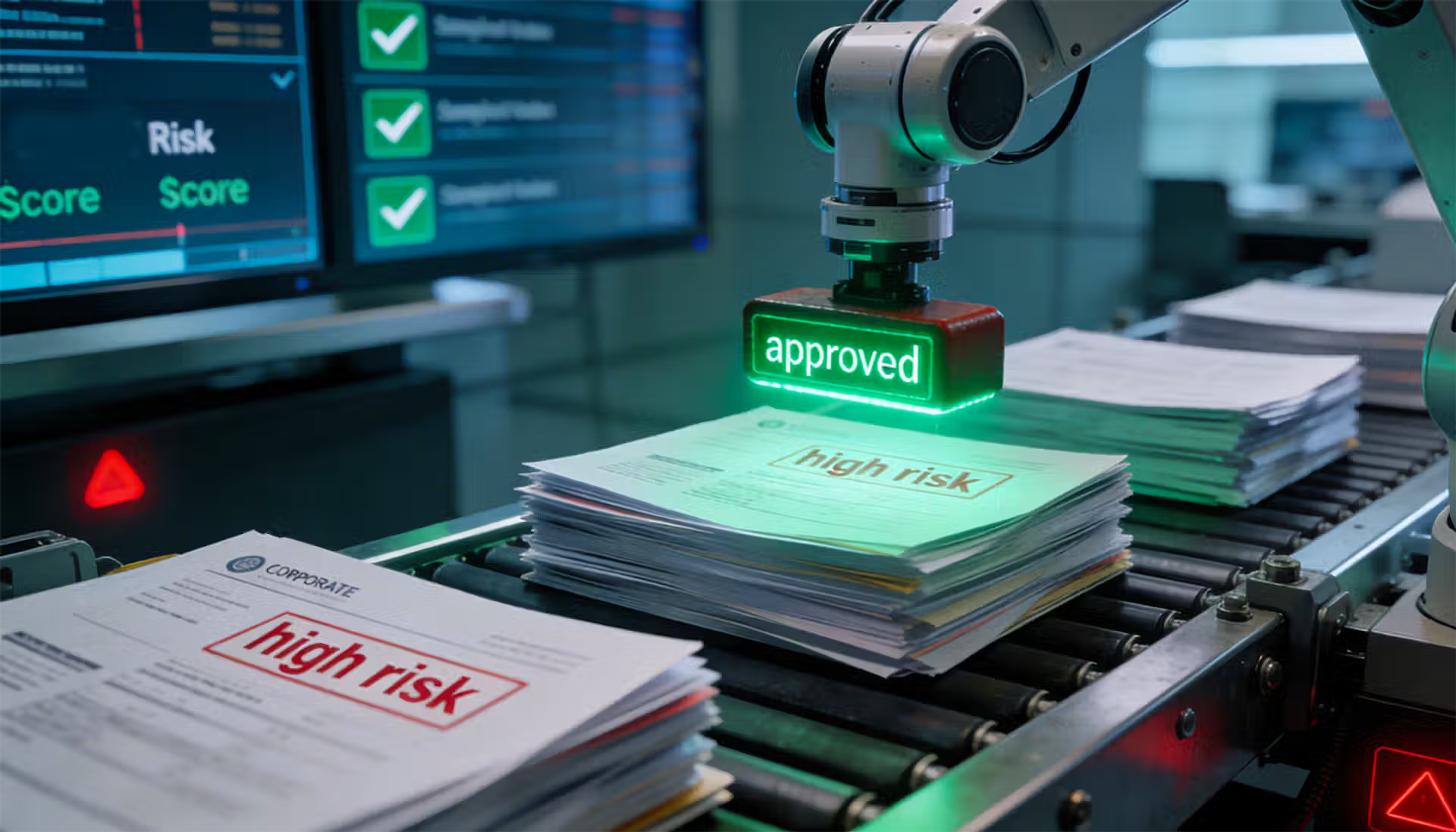
The integration stage—where illicit funds enter legitimate financial institutions—reveals a separate failure. Banks often rely on standard transaction monitoring rules, which are ineffective against structured deposits from shell companies that appear legitimate. The group’s ability to maintain accounts in regulated banks suggests that Know Your Customer processes are limited by what clients choose to disclose and by the banks’ willingness to verify ultimate beneficial ownership beyond documentation.
Global cooperation remains the Achilles’ heel of AML enforcement. Prince Group’s operations span jurisdictions that have vastly different capacities and political will to pursue financial crime. While the United States and the United Kingdom have imposed sanctions, those measures alone cannot dismantle the underlying network. As long as the group can operate freely in Cambodia, Singapore, or Palau, it can reroute its financial architecture and continue laundering billions under new corporate identities.
This systemic breakdown underscores a growing reality: AML regimes are only as strong as their weakest link. Transnational criminal organizations thrive by exploiting jurisdictional mismatches and delays in information sharing. Prince Group’s survival, despite multiple rounds of international sanctions, proves that without synchronized enforcement and real-time data exchange, even the most elaborate AML frameworks remain vulnerable.
Lessons from a Criminal Empire
Prince Group TCO illustrates how financial crime evolves faster than the systems designed to contain it. The organization’s laundering strategy is not built around a single method but around perpetual adaptation. Every regulation, sanction, or compliance reform triggers a structural shift within the network. When one offshore jurisdiction tightens oversight, another becomes the new hub. When banks introduce stricter due diligence, virtual assets fill the gap.
The group’s persistence raises critical questions for the future of AML enforcement. First, should virtual asset transactions be treated with the same reporting and beneficial ownership standards as traditional bank transfers? Second, how can regulators dismantle networks that are both criminal and economically embedded in their host countries? And third, how can global sanctions frameworks prevent designated entities from simply reincorporating under new names and jurisdictions?
Policy responses must evolve beyond static compliance rules. They require proactive intelligence sharing, integration of blockchain forensics with traditional banking data, and international pressure on jurisdictions that act as safe harbors. Financial institutions must also rethink their approach to risk. Instead of focusing solely on customer-level compliance, they should map entire networks of related parties, identifying patterns of cross-ownership and shared management indicative of layering structures.
The Prince Group TCO case should serve as a warning to financial centers and regulators alike. It demonstrates that modern laundering operations are not isolated flows but dynamic ecosystems, powered by both technology and human exploitation. The combination of virtual currency, offshore shell networks, and state-level economic entanglement makes these entities resilient against conventional disruption.
True financial integrity will depend on whether global institutions can treat cases like Prince Group not as anomalies but as the new template for organized financial crime. Only through coordinated action—linking law enforcement, regulators, and private-sector compliance officers—can the systemic vulnerabilities exposed by this case begin to close.
Related Links
- U.S. Department of the Treasury – OFAC Sanctions Programs
- FinCEN – Section 311 Special Measures
- U.K. Foreign, Commonwealth & Development Office – Sanctions List
- Financial Action Task Force – Recommendations
- OFAC Visual Reference – sb0278-img1.png (Prince Group TCO Global Reach)
Other FinCrime Central News About Crypto Crackdowns in Asia
- How Huione Group Laundered $4 Billion Through Crypto Loopholes
- Philippines SEC Launches Major Crackdown on Illegal Crypto Platforms
- Inside Huione Group’s $4B Financial Crime Marketplace Exposed by FinCEN
Source: US Treasury
Some of FinCrime Central’s articles may have been enriched or edited with the help of AI tools. It may contain unintentional errors.
Want to promote your brand, or need some help selecting the right solution or the right advisory firm? Email us at info@fincrimecentral.com; we probably have the right contact for you.