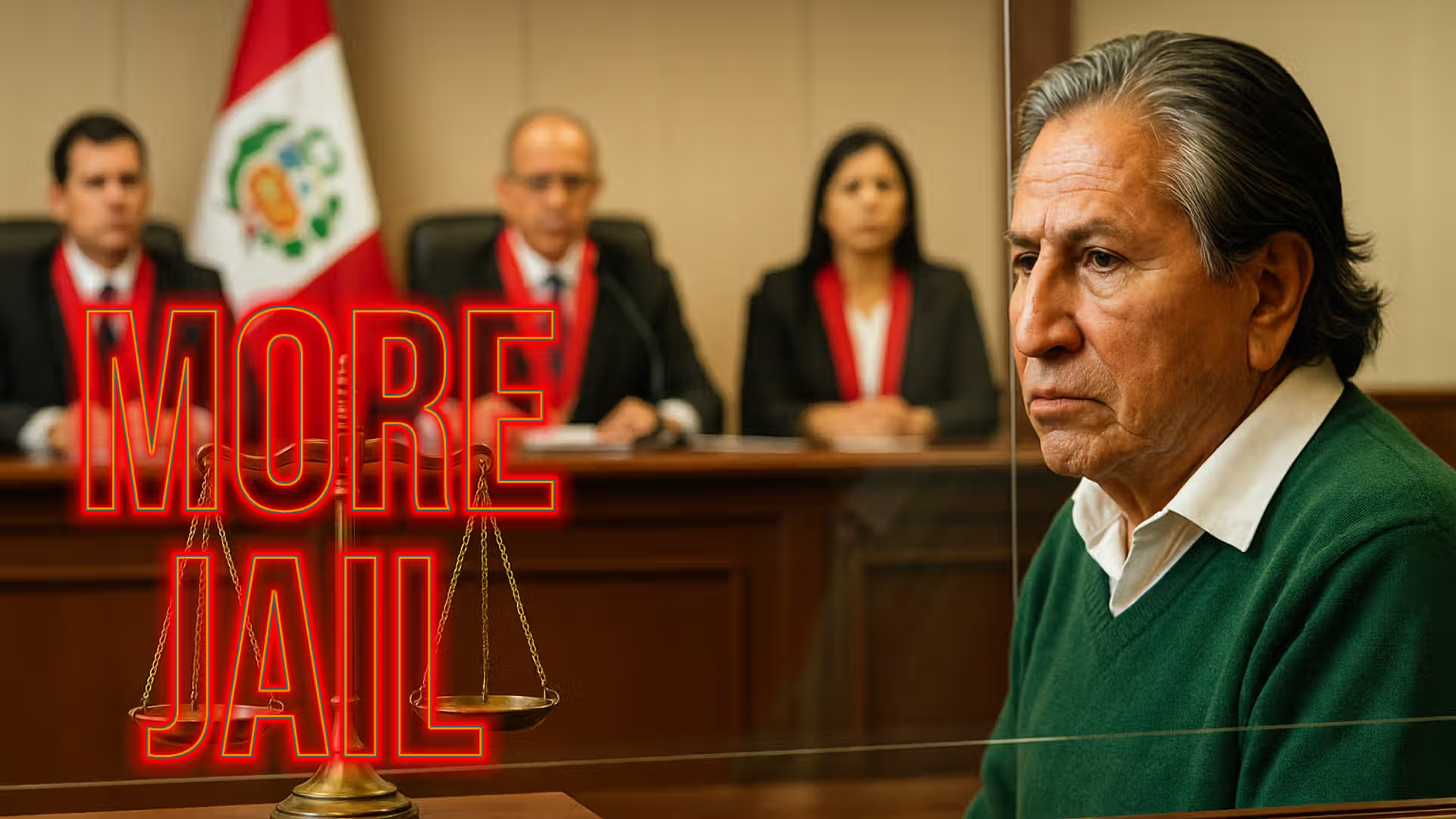
The downfall of former President of Peru Alejandro Toledo cannot be separated from the Odebrecht scandal, a continent-spanning corruption and financial crime scheme. Toledo, who governed Peru between 2001 and 2006, was convicted of accepting millions of dollars in bribes from the Brazilian construction conglomerate Odebrecht in exchange for granting contracts for the Interoceanic Highway. These bribes were not simply hidden under a mattress, they were strategically laundered through offshore structures, family networks, and real estate investments to make the money appear legitimate.
Table of Contents


Money laundering blueprint in high-level corruption
In 2025, a Peruvian court sentenced Toledo to 13 years and four months for aggravated money laundering, in addition to the 20-year prison term he had already received for corruption. His case stands as a powerful example of how political corruption evolves into complex laundering operations that exploit weaknesses in compliance, cross-border monitoring, and institutional independence.
The laundering design involved all three phases recognized in AML practice: placement through offshore deposits, layering through complex transfers across jurisdictions, and integration via property purchases and mortgage repayments. Each phase was deliberately constructed to obscure Odebrecht’s fingerprints on the bribe money and present Toledo as a legitimate property investor rather than a corrupt politician.
Mechanisms of illicit fund movement and AML evasion
Odebrecht’s system of payments was carefully designed to feed corruption across Latin America. Its so-called Division of Structured Operations specialized in clandestine financial flows, distributing millions in bribes using shell companies, coded transactions, and offshore accounts. Toledo’s case represents one of the clearest examples of how those illicit funds were laundered.
The placement phase began when Odebrecht funneled bribe money through intermediaries and into Ecoteva Consulting Group, a Costa Rican offshore shell company controlled on paper by Toledo’s mother-in-law. This maneuver instantly added distance between the origin of the money and its ultimate beneficiary. By situating the funds offshore, Toledo also placed them outside the immediate reach of Peruvian banking scrutiny.
The layering phase relied on international wiring. Ecoteva transferred money across several accounts in Costa Rica and Panama before sending it back into Peru. These transfers were disguised as corporate or family financial activity. Instead of obvious lump-sum property purchases, the funds were used to repay mortgages on luxury properties in Lima. Mortgage repayment laundering was particularly effective because it appeared to settle legitimate debts rather than inject suspicious new money.
Integration followed through the acquisition of high-value real estate in Peru’s capital. Properties in exclusive neighborhoods were paid off or purchased outright using Ecoteva’s funds. Once the real estate was secured, Toledo’s family presented it as part of their asset portfolio, reintroducing Odebrecht’s tainted money into the legitimate economy.
Several laundering techniques stood out. Nominee ownership shielded Toledo by placing company control in his mother-in-law’s name. Offshore incorporation in Costa Rica provided secrecy and delayed investigators. Mortgage repayment laundering disguised bribes as ordinary debt settlement. Family layering added credibility by making transactions look like household financial activity. Multi-jurisdictional transfers created complexity that delayed regulatory inquiries.
Every one of these steps mirrored practices seen across other Odebrecht cases. The conglomerate’s structured bribery and laundering system provided a ready-made playbook for corrupt leaders to emulate. Toledo simply adapted it to his own family and financial network.
Legal frameworks invoked and compliance gaps
The conviction of Alejandro Toledo was based on Peruvian statutes that criminalize aggravated money laundering. Prosecutors successfully demonstrated the illicit origin of the funds, their concealment through offshore conduits, and their reintegration into the economy through real estate. Because the bribes originated in Odebrecht corruption, a predicate offense under Peruvian law, the laundering charges carried heavier penalties.
Yet the fact that Toledo managed to carry out these operations for years demonstrates serious compliance failures. Banks did not flag suspicious incoming wires from Ecoteva despite obvious risk indicators: a shell company sending large sums to repay mortgages linked to a politically exposed family. Real estate intermediaries did not question offshore funds arriving to settle luxury property purchases. Enhanced due diligence, which should have been triggered by Toledo’s status as a former president, was neglected.
Cross-border cooperation was also lacking. Funds moved freely between Peru, Panama, and Costa Rica without timely detection. Requests for mutual legal assistance took years, undermining investigators. Odebrecht’s reach across multiple jurisdictions exposed how fragile regional AML frameworks were in practice.
The eventual conviction came only after forensic audits reconstructed the financial trail, linking offshore transfers to mortgage repayments and property acquisitions. By then, years had passed and the laundering had already achieved its objective of embedding illicit wealth into the legitimate economy.
Institutional lessons and AML strengthening avenues
The Toledo conviction provides enduring lessons for AML practitioners. First, it confirms that real estate remains one of the most attractive vehicles for laundering political bribes. Properties retain value, generate prestige, and historically lacked strong AML controls. Mortgage repayment laundering, in particular, requires greater monitoring by banks and regulators.
Second, offshore shell companies remain critical enablers of corruption. Ecoteva Consulting Group, like countless others used by Odebrecht, provided secrecy and plausible deniability. Global beneficial ownership registries are essential to stop such structures from hiding politically exposed beneficiaries.
Third, politically exposed persons should always be monitored alongside their relatives and associates. Toledo’s reliance on his mother-in-law and spouse was a calculated attempt to distance himself, a strategy repeated in many other Odebrecht-related prosecutions. Enhanced due diligence must encompass family networks.
Fourth, international cooperation must be accelerated. Odebrecht demonstrated that corruption and laundering are inherently transnational. Financial intelligence units need real-time data-sharing mechanisms. Without them, multi-jurisdictional layering will continue to succeed.
Finally, Peru’s broader political system reveals the dangers of systemic corruption. Four of its last six presidents have been implicated in Odebrecht or related scandals. This pattern underscores that AML is not only about tracing funds but also about strengthening institutions, insulating compliance officers from political pressure, and embedding integrity at every level of governance.
Final AML reflections on the Toledo case
The Alejandro Toledo case is a microcosm of the Odebrecht scandal’s legacy. Odebrecht’s Division of Structured Operations created a machinery of bribery that operated across Latin America, and Toledo’s laundering methods show how seamlessly those bribes could be converted into legitimate-looking assets. Offshore companies, nominee owners, mortgage repayments, and high-value real estate formed the backbone of this laundering system.
For AML professionals, the Toledo case reinforces the importance of vigilance in high-risk sectors and the necessity of treating political corruption as a direct precursor to money laundering. Real estate oversight, beneficial ownership transparency, and cross-border cooperation remain the frontline defenses against such schemes.
The Odebrecht scandal may have brought down presidents, ministers, and executives across the continent, but its real legacy lies in the lessons for AML. Unless those lessons are institutionalized and enforced, similar laundering schemes will inevitably repeat themselves, eroding both financial integrity and public trust.
Related Links
- Peru Government Portal – AML legislation
- Financial Intelligence Unit of Peru
- FATF Peru country evaluation
- Inter-American Development Bank AML resources
- United Nations Convention Against Corruption
Other FinCrime Central Articles About the Odebrecht Case
Source: OCCRP
Some of FinCrime Central’s articles may have been enriched or edited with the help of AI tools. It may contain unintentional errors.
Want to promote your brand, or need some help selecting the right solution or the right advisory firm? Email us at info@fincrimecentral.com; we probably have the right contact for you.