Financial institutions are expanding traditional onboarding processes into full lifecycle oversight models, and this shift is creating significant pressure on compliance teams. Perpetual monitoring introduces rapid changes in operational rhythms, forcing teams to adapt to a constant stream of customer risk signals. Many institutions underestimated the complexity of rolling review cycles, which generate far more investigative work than periodic refreshes. Automated workflows, new data integration methods, and intelligent case routing are now essential to sustain these programs, yet many firms still struggle to implement them effectively. As supervisory expectations rise, the risks for institutions that deploy perpetual monitoring without strong governance become more pronounced.
Table of Contents


Perpetual KYC Transformation And Its Growing Burden
Financial institutions once relied on onboarding reviews scheduled at fixed intervals, which allowed teams to distribute risk assessments across predictable cycles. Perpetual monitoring replaces those cycles with continuous oversight of customer data, behavior, and external signals. Instead of scheduling a full review every few years, institutions must now update profiles whenever new information becomes available. This includes changes in ownership, geographic exposure, adverse media findings, or transaction risk patterns. Each update can generate multiple follow-up tasks for analysts, and when multiplied across large customer portfolios, the workload rises sharply.
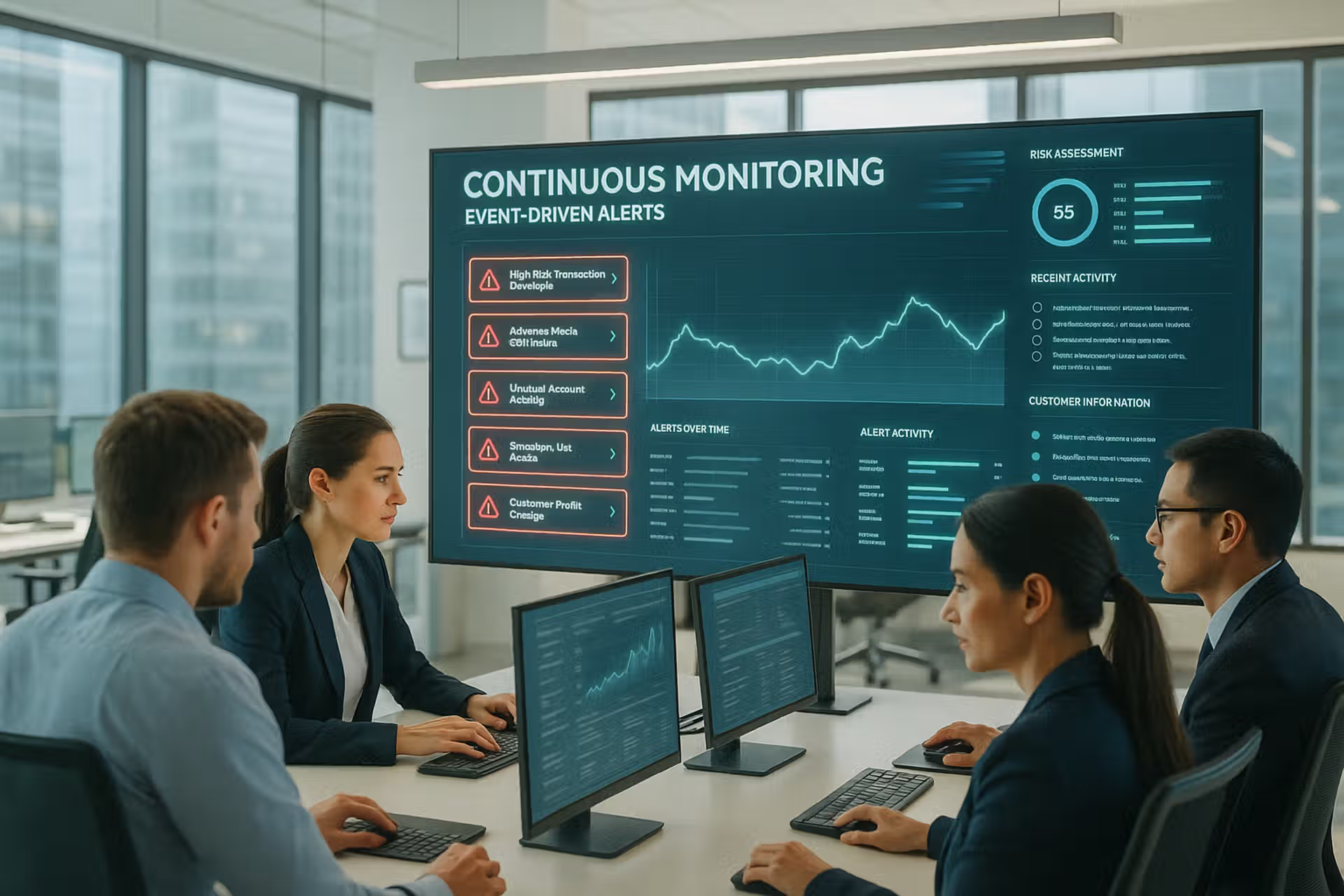
The change also affects how institutions structure investigative processes. Under periodic onboarding, analysts could complete reviews in batches, moving through steps that were familiar and relatively stable. Perpetual oversight breaks these batches into event-driven reviews. A customer who updates a document may trigger identity verification, sanctions screening, politically exposed person checks, adverse media searches, and transaction risk recalibration. When this happens frequently, teams feel overwhelmed by the constant flow of micro reviews that demand immediate attention.
Institutions that adopt perpetual monitoring often encounter data fragmentation during the early stages. Customer risk information may reside in isolated systems, making it difficult to reconcile changes quickly. If onboarding, sanctions, screening, and transaction monitoring platforms are not unified, each update triggers separate actions that are not always synchronized. This inconsistency creates more investigative work, as analysts must navigate multiple systems to confirm the accuracy of customer information. It also increases the likelihood of mismatches between risk ratings and transaction monitoring thresholds.
Many institutions underestimated the scale of alert generation. A profile update that would previously wait until the next refresh now produces immediate triggers across all monitoring layers. Analysts must assess each signal promptly, and the cumulative effect becomes substantial. Even small institutions report significant increases in workload after implementing event-driven controls. Larger firms with multiple lines of business encounter even more complex challenges, as they must coordinate reviews across diverse products and customer segments.
Perpetual monitoring also forces teams to adjust how they prioritize investigations. Traditional onboarding reviews offered clear visibility into portfolios because analysts knew when refresh cycles would occur. Continuous models require more dynamic planning because alerts arise at any time. Cases that appear minor can disrupt workflows if they require extensive verification or produce secondary alerts. Teams must balance this unpredictability while ensuring compliance with regulatory requirements for timely review. When institutions do not establish robust triage procedures, backlogs form quickly and erode the effectiveness of the program.
The strain becomes more visible when teams operate across multiple jurisdictions. Regulatory expectations vary, and perpetual models must accommodate each framework. Institutions must manage event-driven requirements in markets where supervisory bodies expect detailed risk documentation, while also meeting simplified expectations in lower risk jurisdictions. This creates operational complexity that many institutions were not prepared to handle. Without well-defined governance, perpetual monitoring can exceed available resources and create compliance vulnerabilities.
The Automation Gap And Struggles With Intelligent Workflows
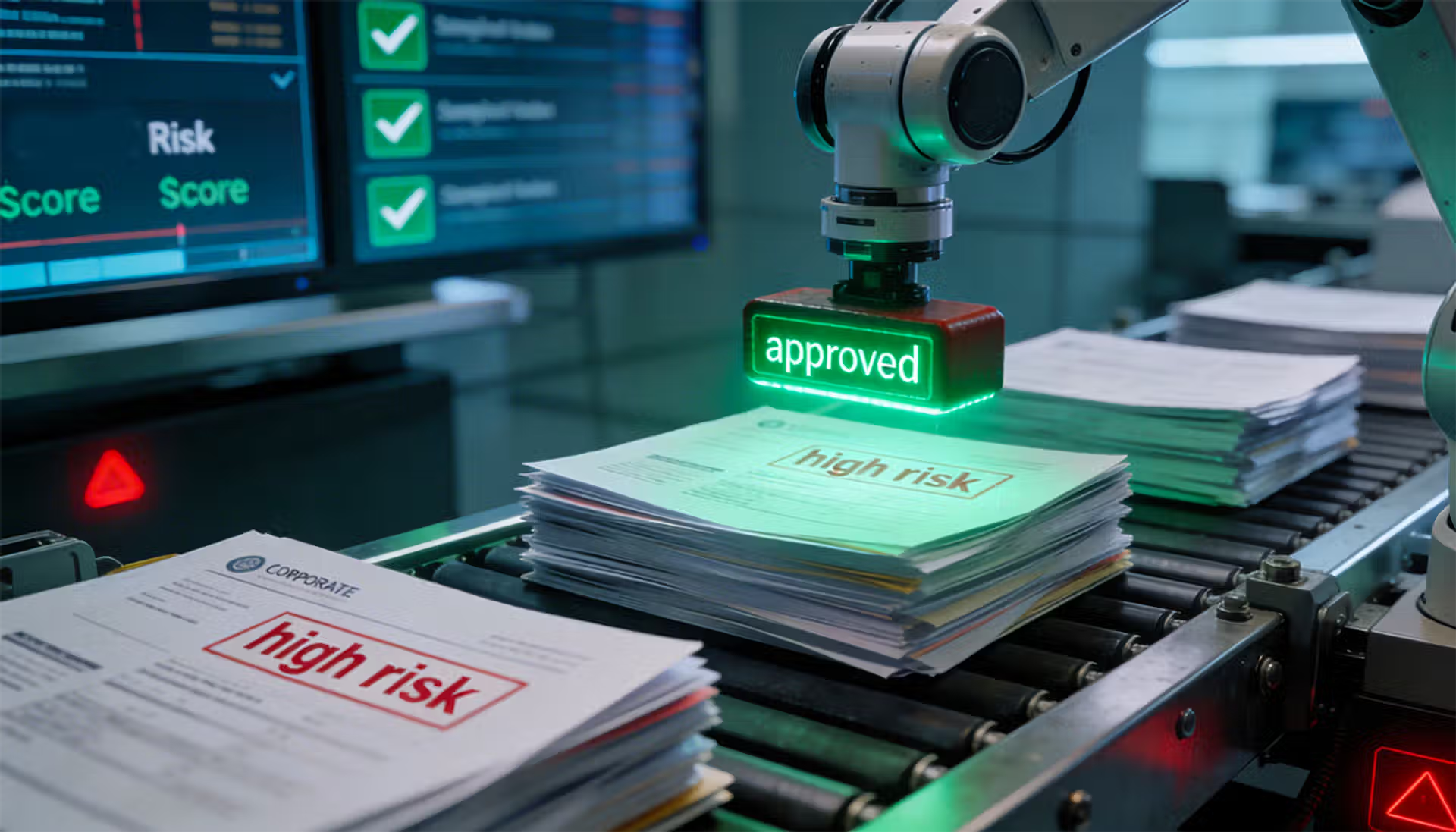
Automation is often presented as the solution to perpetual monitoring challenges, yet many firms lack the foundational capabilities required to support it. Continuous oversight depends heavily on the quality and consistency of customer data. When information is missing, outdated, or stored across multiple systems, automated workflows cannot function correctly. Perpetual models magnify these weaknesses because every new event requires immediate processing. Instead of improving efficiency, poorly structured automation can produce unnecessary alerts and inconsistent outcomes.
Institutions adopting advanced workflow platforms often discover that integration is more complex than expected. Automation engines require standardized data formats and consistent logic across the monitoring framework. Legacy systems do not always support real-time updates or seamless routing, and this creates friction in the review process. When automation does not perform reliably, analysts must intervene more frequently to validate information or correct errors. These interventions reduce the efficiency gains that perpetual monitoring was meant to provide.
Another challenge lies in the sequencing of automated tasks. Perpetual monitoring creates an environment where multiple actions must occur in a specific order. For example, identity verification must be completed before sanctions screening, which must occur before adverse media checks. If workflows do not consider these dependencies, teams receive alerts out of sequence, leading to confusion and unnecessary work. Analysts must reconcile discrepancies manually, which slows the entire process and increases operational costs.
Automation governance plays a critical role in maintaining reliability. Institutions must establish clear ownership for maintaining rule sets, calibrating workflows, and validating data sources. Continuous models require frequent adjustments because new customer information is processed constantly. If governance is weak, workflows become outdated and fail to identify emerging risks. Analysts spend more time investigating inconsistent results, and the institution loses confidence in its systems. This undermines the purpose of perpetual monitoring, which relies on timely, accurate information.
Skill gaps also contribute to implementation challenges. Analysts accustomed to periodic reviews may struggle to manage automated workflows or interpret machine-generated outputs. Perpetual monitoring requires staff who understand both technology and regulatory requirements. Without adequate training, teams may misinterpret alerts or escalate low-risk cases, adding to operational pressure. Institutions must invest in skill development to ensure that analysts can work effectively with automation rather than resisting or bypassing it.
Finally, institutions adopting perpetual models must consider scalability. As customer bases grow, event-driven reviews become more frequent, and the volume of automated tasks increases. Systems that operate smoothly under small workloads may fail under heavy demand. Institutions must evaluate whether their technology infrastructure can support continuous monitoring across all business lines. If systems cannot scale effectively, backlogs and delays become inevitable, creating compliance risks and operational inefficiencies.
Regulatory Expectations And The Risks Of Poor Execution
Supervisory bodies across major markets have made continuous monitoring a core part of risk-based frameworks. Authorities expect institutions to maintain current customer risk profiles and respond promptly to new information. Perpetual oversight aligns with these expectations by updating risk ratings as soon as new data is processed. However, regulators also scrutinize how institutions implement these models, and poor execution can lead to significant compliance concerns.
A key regulatory expectation involves the timely review of event-driven alerts. Supervisors examine whether institutions investigate profile changes promptly and maintain accurate audit trails. When perpetual monitoring generates large volumes, teams may struggle to keep pace, resulting in backlogs that undermine the program. Regulators treat backlogs as indicators of inadequate staffing, weak governance, or flawed technology design. Institutions that cannot manage perpetual workflows face heightened scrutiny during examinations.
Another regulatory concern relates to consistency across monitoring components. Customer risk profiles, sanctions screening, transaction monitoring, and adverse media processes must operate in harmony. If one system updates customer information in real time while others refresh data periodically, inconsistencies arise. These discrepancies can produce false alerts or prevent teams from identifying meaningful risk signals. Regulators expect institutions to maintain alignment across all systems to ensure that monitoring activities are accurate and complete.
Documentation quality is also a major supervisory priority. Perpetual monitoring introduces frequent changes to customer records, which must be documented clearly. Supervisors expect institutions to maintain comprehensive records that explain why each alert occurred, what steps analysts took, and how the final decision was made. Weak documentation exposes institutions to compliance findings because it becomes difficult to demonstrate that reviews were conducted properly.
Regulators also pay attention to the escalation process. When perpetual monitoring identifies risk changes, institutions must determine whether customers require enhanced due diligence. Failure to escalate appropriately is treated as a serious oversight. Supervisory bodies expect institutions to adjust customer classifications promptly when new information emerges. Delays or inconsistent escalation practices indicate deficiencies in governance or workflow design.
Model governance remains a central regulatory focus. Perpetual models often rely on data enrichment from external sources, which must be validated regularly. Supervisors expect institutions to test the reliability and completeness of these data sources, as well as the logic governing event triggers. If institutions rely on inaccurate or outdated data, customer risk assessments may be compromised. Regulators treat this as a weakness in the overall program because it undermines the institution’s ability to detect suspicious activity.
Institutions that deploy perpetual monitoring without adequate controls face heightened compliance risks. Supervisors expect these programs to enhance risk detection, not create new vulnerabilities. Poor execution can result in findings related to governance, staffing, technology controls, documentation, or escalation processes. Institutions must ensure that perpetual monitoring supports regulatory expectations by maintaining structured controls and consistent oversight.
A Path Forward Through Coordinated Transformation
Perpetual monitoring represents a shift in how institutions manage customer risk across the entire customer lifecycle. The transition requires careful planning, coordinated execution, and ongoing refinement. Institutions that approach perpetual monitoring as a simple extension of onboarding routines often underestimate its operational impact. The model introduces complexity across every component of the compliance function, from data management to workflow design to regulatory documentation.
A successful transition requires strong governance and well-defined operating models. Institutions must establish clear accountability for each stage of the monitoring process. Governance teams must oversee the calibration of event triggers, validate data sources, and monitor system performance. Clear processes help ensure that alerts are consistent, workflows produce accurate results, and documentation meets supervisory expectations. Without strong governance, perpetual monitoring becomes difficult to manage and may produce inconsistent outcomes.
Data quality is a foundational requirement for effective perpetual monitoring. Institutions must maintain accurate customer records to support automated workflows and ensure that event triggers reflect real risk changes. Data remediation efforts often accompany perpetual monitoring initiatives because inconsistencies disrupt review processes. By strengthening data management practices, institutions can support the reliability of their monitoring models and reduce the frequency of manual corrections.
Automation must be integrated with workflow logic that reflects real-world compliance requirements. Institutions should design workflows that sequence tasks effectively, route cases to appropriate analysts, and track the status of each review. Intelligent routing ensures that high-risk alerts receive prompt attention while lower-risk tasks are handled efficiently. Automation should support analysts by reducing repetitive work, not creating additional steps that increase their workload.
Training and capability building are essential. Perpetual monitoring requires analysts who understand both the technical and regulatory dimensions of continuous oversight. Institutions must invest in training that helps staff interpret automated outputs, navigate workflow systems, and document decisions effectively. Skilled analysts are critical to sustaining perpetual monitoring programs and maintaining compliance with supervisory expectations.
Scalability should remain a central design consideration. Institutions must ensure that their systems can handle increased volumes as customer bases grow or regulatory expectations evolve. Perpetual monitoring requires infrastructure that can support constant data flows and rapid processing of alerts. Scalable systems help institutions maintain consistent performance even as workload demands rise.
Perpetual monitoring offers meaningful advantages for institutions that implement it effectively. It provides real-time visibility into customer risk, supports a dynamic understanding of customer behavior, and strengthens the ability to detect suspicious activity. However, these benefits require coordinated investment across governance, data, automation, and staffing. Institutions that commit to structured transformation can build sustainable perpetual monitoring programs that enhance risk management and meet supervisory expectations.
Key points
• Perpetual monitoring increases alert volume and investigative workload
• Automation gaps create operational strain and reduce efficiency
• Regulators expect timely reviews and strong alignment across systems
• Weak governance and poor data quality undermine program effectiveness
• Scalable workflows and trained analysts are essential for sustainability
Related Links
- FATF Customer Due Diligence Guidance
- FATF Risk Based Approach Guidance
- European Banking Authority AML Guidelines
- US FFIEC BSA AML Examination Manual
- UK Financial Conduct Authority Financial Crime Guide
Other FinCrime Central Articles About Compliance Challenges
- The Hidden Operational Cost of PEP List Failures
- Black Box vs Glass Box in AML Monitoring and the Money Laundering Risks
- Digital Onboarding Pitfalls and How Banks Can Win
Some of FinCrime Central’s articles may have been enriched or edited with the help of AI tools. It may contain unintentional errors.
Want to promote your brand, or need some help selecting the right solution or the right advisory firm? Email us at info@fincrimecentral.com; we probably have the right contact for you.