An exclusive article by John Christmas
My name is John Christmas. I am the exiled whistleblower from the collapse of the largest bank in Latvia. In 2004, I was employed by Parex Bank. I learned of large insider loans made to notorious oligarchs which had been booked in fraudulent ways. I gave the information to the auditors and ratings agencies and they chose to ignore it. Then in 2005, I gave the information to Latvian officials and got warnings from various sources that I would be prosecuted or killed, so I left Latvia and never returned.
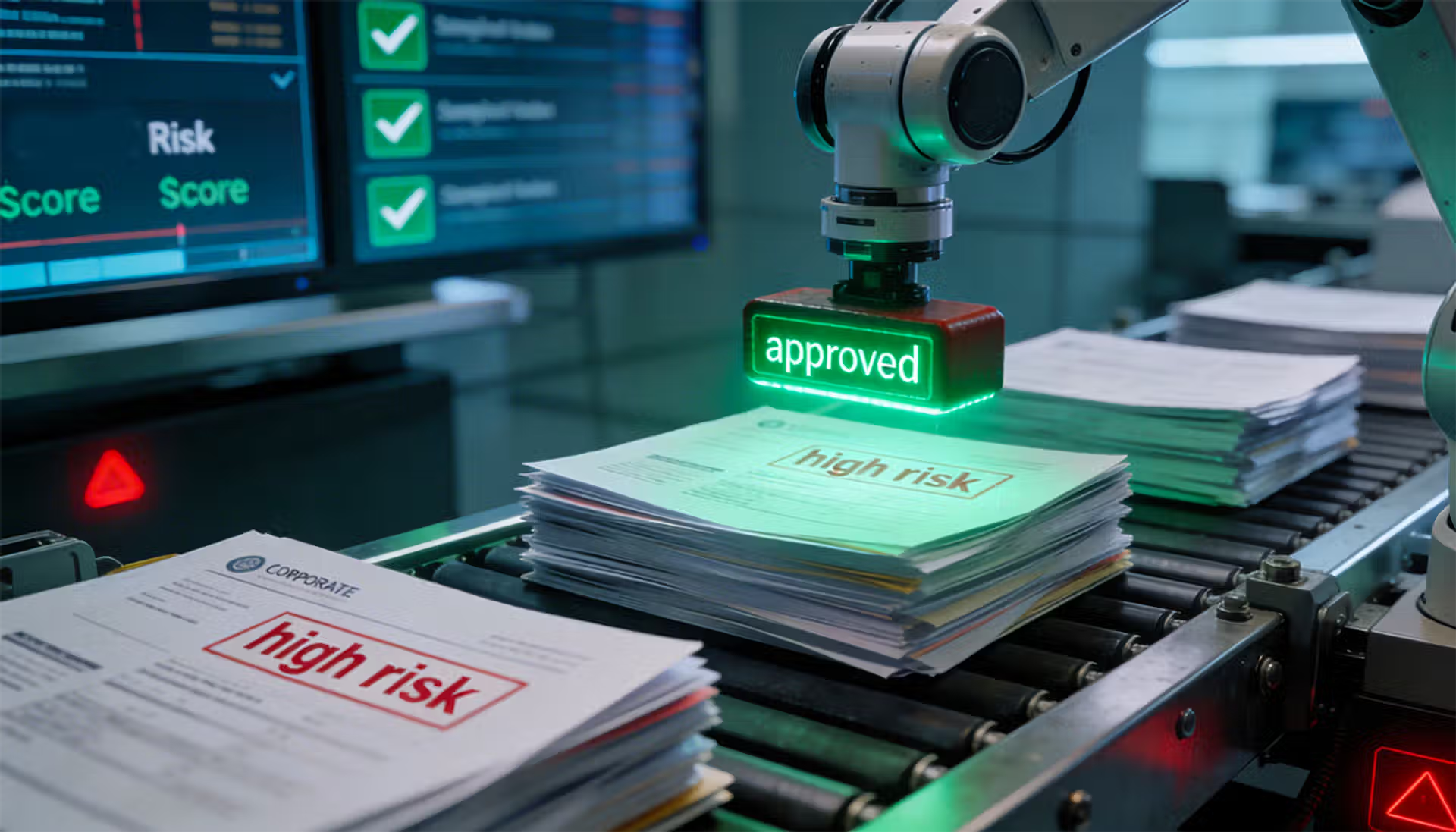
In 2008, Latvia nationalized Parex Bank which for many years had been the largest bank in Latvia. In 2009, Latvia announced the privatization of a Parex stake to the European Bank for Reconstruction and Development ‘EBRD’ as a way to make Latvians feel confident that Parex assets were sound. Then for several years information was gradually released that all was not well at Parex because a large part of Parex assets were overvalued and the privatization was not what it seemed. This culminated in the 2014 revelation that the 2009 privatization had to be reversed because Latvia had a secret obligation to re-purchase the stake at higher price. Accounting standards dictate that if there is a two-part transaction (A pays to B and B pays to A) then both parts of this must be disclosed, however Latvia and the EBRD only disclosed the first part and didn’t disclose the second part. This cover-up is highly disturbing because Westerners, especially Latvians, lost a lot of money and Parex had connections with Russian President Vladimir Putin.The EBRD is based in London and funded by 76 countries including the United States, United Kingdom, and all of the European Union member states to foster democracy.
Some documents referenced below, although not written by myself, are posted on my own website www.LawlessLatvia.com. These documents contain useful details and to the best of my knowledge aren’t posted anywhere else. It’s not necessary to confirm the authenticity of these documents since other sources below, including the Latvian parliament and Eurostat, evidence the same cover-up.
One source for information is the Parex Bank article on Wikipedia (Wikipedia, 2024) which includes contradictory information from multiple contributors however at least establishes dates and references. I authored one of the articles which someone put in the references however I wasn’t a contributor for the main article. Readers will see there is an information war going on.
Table of Contents
The Collapse of Parex Bank
In 2008, Latvia nationalized Parex. This included a large government loan to Parex which funded movement of deposits from Parex to ABLV Bank. ABLV Bank will be a future article in this series. The government claimed that Parex assets were good and therefore the bailout loan would be repaid with interest. According to the government, the bailout was necessary because of the International Financial Crisis caused by the United States.
In 2009, there was a riot at the Parex headquarters. Many people thought the government was lying about Parex and the bailout was motivated by corruption. The national economy had collapsed overnight when the bailout was announced, and the government was borrowing from other countries and the IMF to bail itself out. This riot is the subject of many videos on Youtube including a video by state-owned broadcaster LTV. LTV doesn’t mention the name ‘Parex’ and attributes the riot to hooliganism against the parliament, however the rioters in the video are in front of the Parex headquarters (LTV, 2011).
Following the riot, Latvia invited the EBRD to conduct due diligence on Parex. I offered details of fake assets to the EBRD but my offer was declined. Somehow the EBRD conducted due diligence without the information. The EBRD announced that Parex was valuable and paid the Latvian government 84 million euros for a 25% stake. The EBRD claims that the deal not only restored confidence but also saved money for Latvia (EBRD, 2024).
Later, news emerged that certain Parex assets were big losses, including the ones from my 2004 whistleblowing although my whistleblowing has been mostly censored from the Latvian media. The media downplayed the riot and at first supported the government story that the United States caused all of the problems. However soon the politicians and media switched the story as it became publicly known that many assets were bad. The new story was that first the national economy collapsed and then Parex collapsed, switching the order in which things really happened. And, the reason the national economy collapsed was because Sweden created an asset bubble in Latvia and now the bubble burst . This didn’t make any sense since the bad assets being discovered at Parex were linked to Russian organized crime. Luckily for my credibility, the former prime minister of Sweden, Carl Bildt, made a statement that the Latvian government was lying. He publicly announced, ‘the Latvia Crisis was caused by Parex not Sweden’ in 2011 at a time when Latvian Prime Minister Valdis Dombrovskis was making speeches blaming Sweden. (Bildt, 2011).
The bad assets were mostly loans to insider oligarchs which appeared sometimes purposefully documented so that Parex could not collect back the money. The people on the Parex credit committee who approved the bad loans and the oligarchs who received the bad loans weren’t prosecuted. Also, no action was taken against the auditors even though I had given them a list of the bad loans a few years earlier.
Only one person went to jail as Latvia lost several billion euros. Folk singer Ansis Ataols Berzins who participated in the riot by throwing a stone at the Latvian Parliament was prosecuted (Ir.lv, 2018). He had to do hard time in prison even though he didn’t steal anything or hurt anyone. There was a civil court process against the founding shareholders of Parex to recover a small part of the money they had lent to themselves. The decision by the government to use civil court instead of criminal court against the oligarchs meant the government might as well have done nothing at all. These oligarchs didn’t pay the judgements, and they still reside in the European Union enjoying lifestyles like princes.
It is true that many people were duped and therefore gained confidence because of this deceptive EBRD deal, however it is not true that Latvia saved money as the EBRD claimed. Latvia had no obligation to fully bail out all of the Parex creditors, especially institutional creditors and tens of thousands of shell-company depositors many of which had balances over the deposit protection scheme limit, but chose to do that anyway.
Discovery that Latvia Secretly Paid the EBRD to Invest
In 2010, a leaked report purportedly prepared by the government’s consultant Nomura indicated that Parex was insolvent and the government knew this, a large part of the assets needed to be written off, and the sale of the stake to the EBRD was not what it seemed. Latvia had an obligation to reverse the sale later at a guaranteed profit to the EBRD. What should have happened at this time is that Nomura should have been prosecuted as it was in Italy in a similar case, where it was involved with a fake transaction between Deutsche Bank and Banca Monte dei Paschi di Siena to make the latter appear solvent when really it was not (Martinuzzi, 2019). Also, ratings agencies should have cancelled their ratings for Latvian and EBRD bonds and all these bonds should have been delisted. However, the Nomura report was indicated to be a ‘state secret’ and the journalist who leaked it, Lato Lapsa of www.Kargins.com, was detained by police and forced to take down his website. I kept pictures of the key pages from this document and posted them to make sure they remained online (Nomura, 2010). Even though the government never confirmed if this report is real, the same cover-up was repeatedly evidenced from more sources. Latvia’s state secret law specifies that the law cannot be used to falsify the national debt, however that’s exactly what the government did.
In 2014, I finally had full success at confirming that the EBRD-Parex deal was fake. I convinced Dutch MP Pieter Omtzigt to ask the Dutch parliament to investigate if the EBRD-Latvia-Parex deal of 2009 was secretly reversible (Wellens, 2016). The Dutch parliament confirmed that it was. Omtzigt then wrote to Eurostat explaining that Latvia must correct its accounting. Eurostat replied that Latvia had asked Eurostat to keep the Parex reversion ‘confidential’ and Eurostat had agreed (Omtzigt, 2014). There were articles about this in the media in the Netherlands where journalists noted my whistleblowing and Putin connections (925.nl now down, Bendle.nl now down, and The Post Online still up (Koster, 2014)). There were also articles in the Latvian media which were different because they did not mention me or Putin. For example the Latvian Public Broadcasting article (LSM, 2014) on the subject expressed curiosity as to why the Dutch investigated this Latvian issue, as if the people at LSM weren’t aware that I asked the Dutch to investigate. It’s useful that, at least, LSM specified Latvians weren’t previously aware of this tricky accounting which is one of my complaints: it was wrong for Latvia to hide this from voters and bond investors for years. Since Eurostat decided it was ok for Latvia to keep its national debt ‘confidential’ the cover-up was allowed to continue even though it was already revealed. I notified many institutions in many countries that I had evidence the EBRD and Latvia organized a fraud to protect Putin’s bankers however nobody took action to stop it. The Western governments continued to pour money into the EBRD while ignoring clear evidence that the EBRD was using fraud and doing the opposite of its mission.
Another opinion, similar to my opinion, about the revelation that Latvia had to secretly pay to reverse the EBRD investment in Parex came from Latvian opposition parliamentarian Igors Pimenovs. He made the statement below, translated automatically, on 5 March 2015 in parliament (Pimenovs, 2015). Please keep in mind this original accounting deception which started in 2009 and reversed in 2014 only was revealed to him and his opposition party in 2014-2015, implying the ruling party led by Dombrovskis cheated in all the elections from 2009 to 2014 with help from the EBRD which has a mission of fostering democracy. This deception still continues now in 2025 with the EBRD and Parex successor Citadele Bank, as I will explain later in this series.
Members of our faction had prepared a letter at the end of the previous year with a request… to understand what is happening and whether the news we received in the press about the fact that the sale of Parex banka’s shares to the EBRD was not a successful sale or privatization, but rather about Latvia’s borrowing from the EBRD… And as confirmed by the Ministry of Economy, in response to our question, the EBRD’s investments in the equity capital of “Citadeles” bank and joint-stock company “Reverta”… there were 93 million euros of investments in the equity capital… it was universal right of the EBRD to sell its shares in the Privatization Agency. In total, Latvia – according to the option agreement with the EBRD – has to pay 114 million euros in addition to all payments already made for the takeover of Parex banka. So, in addition to the 750 million lats that Latvia paid for the takeover of Parex banka, we still add this amount – 114 million euros. It will not be paid by the shareholders, but by the aunt from Bauska and the uncle from Vecpiebalga – that is, the people of Latvia. It should be noted that in fact the agency has already made an advance payment of 1.26 million euros and that the EBRD retains its shares, which are approximately 24 million euros, and also agreed to refinance the issued subordinated loan to “Citadeles” bank in the amount of 11 million euros. The total cash payment is 77 million euros. Note that this amount is… not small! One must also consider what the fiscal impact will be on the overall government budget. The Ministry of Economy confirmed that this amount was reflected in the previous year’s budget. But this was done in secret, because no one had been told that such an option contract existed. Therefore, in my opinion, this whole story… this whole agreement was made quite opaquely and secretly from the Saeima and, therefore, from the people. – Pimenovs
Parex Bank Connections with Vladimir Putin
Clear evidence linking Parex to Putin was made public in the Spanish prosecution of the Tambovskaya Mafia in 2015. This Mafia, run out of St Petersburg, was involved with trafficking narcotics, sex slaves, and weapons on a large and international scale. The prosecutor, Jose Grinda Gonzales, famously described Russia as a ‘Mafia State’ since the investigation revealed connections between the Mafia and top people in Putin’s government. Both of the main money launderers identified in the prosecution, Sergey Kuzmin and Michael Rebo, were using platform money laundering accounts at Parex. These accounts are set up to receive and send many transfers such that it’s impossible for investigators to determine the paths of any particular flows of money.
Kuzmin’s prosecution was never completed because he managed to flee back to Russia. However, Rebo confessed to his crimes and received a prison sentence. He was using the Parex branch in Berlin, where his wife Tatjana was working. Another Parex person appears in the prosecution document (Mellado, 2015). He is Grigory Rabinovich. Back in Latvia, it was discovered that Parex gave money to him by making large loans to a company which was already bankrupt, so the money disappeared and the loans weren’t paid back. Spain managed to record a conversation he had on the phone with Alexander Torshin who was a top Putin money launderer. Torshin was giving money laundering instructions to Rabinovich.
Please keep in mind that the Latvia-EBRD deal was protecting all of these people, while Latvian politicians continued to blame the United States and Sweden for making Parex crash. The US and Sweden both provide funding to Latvia and the EBRD. I’ve been sending letters to American and Swedish officials for years to alert them what Latvia and the EBRD are doing, however there is no response.
Then in 2018, the US Treasury released its ‘Putin Warning List’ which wasn’t a sanctions list but anyway alerted the public of the identities of Putin’s inner circle. Two more recipients of fraudulent Parex loans, both named in my whistleblowing, came up on that list. They, like the Parex founders, also live freely in Europe, unbothered by law enforcement and enjoying vast wealth.
And, to top this off came a discovery in 2022. Putin’s superyacht ‘Scheherazade’ was seized in Italy and the front owner for the yacht was a Russian citizen named Eduard Khudainatov (Balmer and Parodi, 2022). He was also recipient of a large loan from Parex (Stack, 2012). The loan had no collateral, Khudainatov didn’t pay it back, and the loss was put to European taxpayers in an intransparent manner implying that European taxpayers may have paid for Putin’s yacht.
Valdis Dombrovskis unifies EU AML
Valdis Dombrovskis, as Prime Minister of Latvia in 2009, signed the Parex-EBRD privatization which was later confirmed to have been a fake privatization protecting criminals and increasing losses to taxpayers. He won several elections after that, while falsifying Latvia’s national debt through that EBRD deal. He always wins in Latvia because the media publishes articles that he rescued Latvia from Sweden without mentioning the truth of the EBRD deal. If that wasn’t enough, Spanish police say that he accepted a bribe in exchange for making a post to encourage Catalonian separatists (Interviu.es, 2016). Given theories that the Kremlin was trying to start a civil war in Spain, I’d think the connection with Dombrovskis would make him less popular. However, the media rarely mentions what happened in Spain as if it’s not important.
Since 2019, Dombrovskis has been European Commission Executive Vice President. When he was selected and confirmed, there was no discussion that the Parex-EBRD deal was fake. Also, government and media downplayed or didn’t mention his action in Catalonia.
In 2020, Dombrovskis was the person who announced ‘A new single EU Anti-Money Laundering System’ as he made strong statements about the importance to stopping money laundering (European Commission, 2021). For the first stage of this project, he selected Latvian citizen and former EBRD employee Mihails Kozlovs to audit the existing AML frameworks of the EU member states.
In 2024, the EU’s Anti-Money Laundering Authority or AMLA was launched and its headquarters will be in Frankfurt. Does this mean the EU will finally crack down on money laundering? Or does this mean the Putin Regime now controls Europe’s central AML institution? Open discussion about what Dombrovskis and the EBRD have been doing would be helpful in determining what is really going on.
This article exclusively reflects the views of its author.
More to come in ‘Cover-Up’ series: Ukio Bank Lithuania, ABLV Bank Latvia, Citadele Bank Latvia, Danske Bank Estonia, and Bank of Cyprus

References
Balmer, C. and Parodi, E. (2022) Italy impounds luxury yacht linked to Russian president. London: Reuters https://www.reuters.com/world/europe/italy-orders-seizure-yacht-linked-by-media-russian-president-2022-05-06/
Bildt, Carl (2011) Two articles which are offline have his quote in the title. These should be archived on the Wayback Machine.
http://www.vipi.lv/vip/pasaule/idn43860/zviedrija-latviju-krize-iedzina-parex-nevis-zviedru-banku-nauda/
http://financenet.tvnet.lv/viedokli/362662-latviju_krize_iedzina_parex_nevis_zviedru_nauda
EBRD (2024) Latvia. London: EBRD.
https://www.ebrd.com/downloads/research/economics/latvia.pdf
European Commission (2021) Beating Financial Crime. Brussels: European Commission. https://ec.europa.eu/commission/presscorner/detail/en/ip_21_3690
Interviu.es (2016) Six million for buying the prime minister of Latvia. Spain: Interviu.es.
http://www.interviu.es/reportajes/articulos/seis-millones-para-comprar-al-primer-ministro-de-letonia
https://www.bolsamania.com/noticias/politica/el-primer-ministros-de-letonia-recibio-seis-millones-de-euros-por-apoyar-la-independencia-de-cataluna–1017405.html
Ir.lv (2018) Riga central prison interview Ansis Ataols Berzins. Latvia: Ir.lv.
https://ir.lv/2018/06/21/video-ir-rigas-centralcietuma-interve-ansi-ataolu-berzinu
Koster, M. (2014) Eurostat werkt mee aan boekhoudfraude bij Letland. Netherlands: The Post Online. http://politiek.thepostonline.nl/2014/08/26/eurostat-werkt-mee-aan-boekhoudfraude-bij-letland/
LSM.lv (2014) EBRD stake in Parex included ‘put option’. Latvia: LSM.lv.
https://eng.lsm.lv/article/economy/economy/ebrd-stake-in-parex-included-put-option.a91151/
LTV Zinu dienests (2011) 13. janvara gadadiena. Latvia: LTV.
https://www.youtube.com/watch?v=MsijPvdOWPo
Martinuzzi, E. (2019) How a $450 Million Loss Was Made to Disappear. New York: Bloomberg. https://www.bloomberg.com/news/videos/2019-12-13/how-a-450-million-loss-was-made-to-disappear-video
Mellado, J. C. and Gonzalez, J. G. (2015) Al Juzgado. Madrid: Fiscalia Especial Contra la Corrupcion y la Criminalidad Organizada. https://lawlesslatvia.com/wp-content/uploads/2016/07/AL-JUZGADO.pdf
Nomura (2010) Surviving Pages of Nomura Leak. Internet: LawlessLatvia.
https://lawlesslatvia.com/surviving-pages-of-nomura-leak/
Omtzigt, P. (2014) Letter from Omtzigt to Eurostat and Reply. Internet: LawlessLatvia.
https://lawlesslatvia.com/eurostat-confirms-dombrovskis-fraud/
Pimenovs, I. (2015) Latvijas Republikas 12. Saeimas ziemas sesijas astota sede 2015. gada 5. marta. Latvia: Saeima (Parliament). https://www.saeima.lv/lv/transcripts/view/289
Stack, G. (2012) Rosneft boss linked to bust oil firm chased by Latvia’s Parex Bank. Berlin: BNE Intellinews. https://www.intellinews.com/rosneft-boss-linked-to-bust-oil-firm-chased-by-latvia-s-parex-bank-500016096/?archive=bne
Wellens, A. (2016) In 2009 Breken Er In De Letse. Netherlands: www.925.nl. This website has been taken down however a 925 video of Omtzigt and myself is still available on the journalist’s Facebook page. https://www.facebook.com/arno.wellens/videos/1016193505083069/
Wikipedia (2024) Parex Bank. Internet: Wikipedia.
https://en.wikipedia.org/wiki/Parex_Bank
More FinCrime Central Cover-up Stories by John Christmas:
- Cover-Up #2: Ukio Bank Lithuania, Siauliu Bank Lithuania, and the EBRD
- Cover-up #3: ABLV Bank, the Latvian government, FinCEN and the EBRD
- Cover-Up #4: Citadele Bank Latvia, Parex Bank’s successor, and the EBRD’s involvement
- Cover-Up #5: Danske Bank’s Estonian branch, successful whistleblowing, but the wrong people got punished
- Cover-Up #6: Bank of Cyprus, the EBRD, and the Blessing of Putin and Trump