A former senior oil trader received a sentence of fifteen months in prison and a fine of $300,000 for his participation in an extensive, nearly eight-year-long scheme involving the bribery of Brazilian government officials and subsequent money laundering to secure lucrative business for the commodity companies where he was employed. The actions of the trader, Glenn Oztemel, who worked for Arcadia Fuels Ltd. and later Freepoint Commodities LLC, represent a significant failure in adhering to international anti-corruption and financial crime prevention standards. This high-profile prosecution serves as a stark warning regarding the severe penalties for individuals and corporations that utilize illicit means to gain a competitive advantage in the global market.
Table of Contents


The Mechanism of International Money Laundering
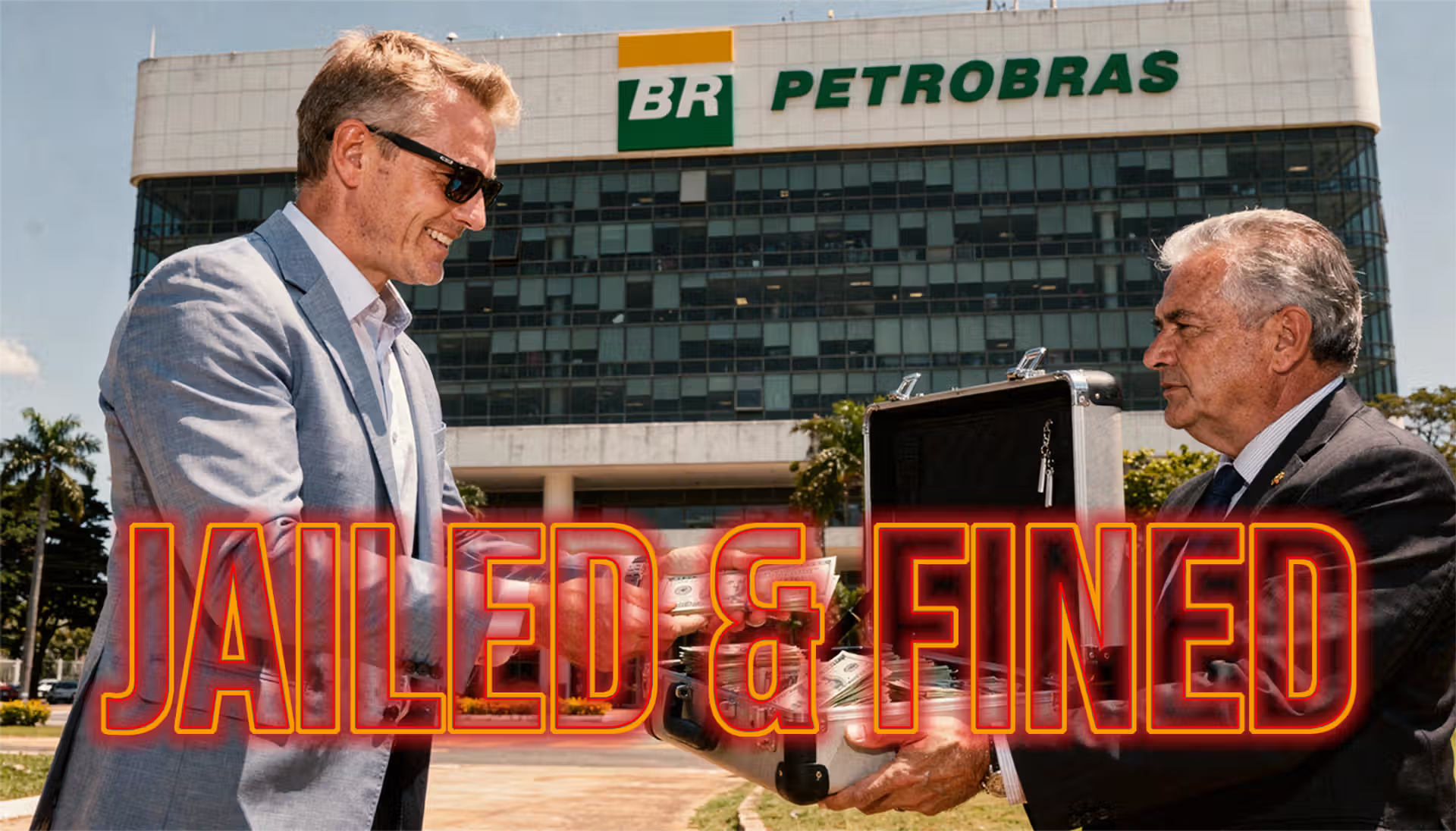
The extensive evidence presented during the trial revealed that Mr. Oztemel engaged in paying over $1 million in corrupt funds to officials at Petróleo Brasileiro S.A., known as Petrobras, the Brazilian state-owned oil and gas company. These payments were not merely bribes; they were part of a sophisticated money laundering operation designed to integrate the illicit funds into the legitimate financial systems of the involved companies. In exchange for the bribes, Mr. Oztemel received highly confidential insider information from Petrobras, including data on competitor bids and proprietary pricing details from other United States companies. This illegally obtained information was critical in granting Arcadia and Freepoint an unfair edge in securing high-value fuel oil contracts from the Brazilian firm, demonstrating how corruption directly fuels financial crime.
The scheme utilized classic layering techniques to obscure the true nature of the transactions. Mr. Oztemel and his co-conspirators orchestrated for Arcadia and Freepoint to transfer corrupt payments to a third-party intermediary and agent, Eduardo Innecco. These transfers were deceitfully recorded in company books as legitimate expenses, specifically designated as purported consulting fees and commissions. The conspirators understood that Mr. Innecco would then distribute a portion of these funds onward to the implicated Brazilian officials, including Rodrigo Berkowitz, a Petrobras trader based in Houston. The process of converting the bribe payment into a false business expense and then moving it through an intermediary before reaching the final recipient is a quintessential example of the layering stage in the money laundering cycle, aiming to distance the source of the illicit funds from their destination.
Deception and Concealment: Tradecraft of Financial Crime
The sophistication of the illicit network was further demonstrated by the elaborate concealment methods employed by Mr. Oztemel and his associates. To avoid detection by compliance officers and law enforcement, they deliberately used coded language when discussing the corrupt payments and transactions. Phrases such as “breakfast” and “freight deviation” were applied in communications to refer obliquely to the bribes and kickbacks being exchanged. This use of jargon is a common tactic in criminal operations to create a veneer of legitimacy over inherently corrupt activities, thereby attempting to bypass keyword and transaction monitoring systems that might be in place at financial institutions.
The conspirators further shielded their activities by strategically avoiding official company communication channels. They relied instead on personal email accounts, encrypted messaging applications, and disposable phones for their correspondence. This deliberate migration to non-monitored channels shows a clear intent to circumvent corporate oversight and regulatory scrutiny. Furthermore, the use of fictitious names, such as “Spencer Kazisnaf” and “Nikita Maksimov,” provided an additional layer of anonymity and complexity to the illicit communication network. These actions were not simply attempts to cover up bribery; they constituted affirmative steps toward the conspiracy to commit money laundering by attempting to make the communication trail untraceable, thereby protecting the subsequent flow of illicit funds from detection.
In a related and critical development, Freepoint Commodities LLC acknowledged its role in the bribery of Brazilian officials, admitting to violations of the anti-bribery provisions found within the Foreign Corrupt Practices Act (FCPA). Freepoint entered into a deferred prosecution agreement with the U.S. Department of Justice’s Criminal Division’s Fraud Section and the U.S. Attorney’s Office for the District of Connecticut. As part of this comprehensive resolution, the company agreed to pay a substantial sum, exceeding $98 million, encompassing both criminal penalties and forfeiture. This corporate resolution underscores the legal principle that corporate entities are strictly liable for the criminal acts of their employees committed in furtherance of the business, even as the individual co-conspirators are prosecuted separately for their distinct roles in the bribery and money laundering conspiracy.
The Role of International Cooperation in AML Enforcement
The successful investigation and prosecution of this intricate case highlight the absolute necessity of international cooperation in combating transnational financial crime. The activities of the oil trader and his associates spanned multiple jurisdictions, involving financial movements and communications across different continents. To effectively track the flow of corrupt payments and gather irrefutable evidence, the Federal Bureau of Investigation’s (FBI) Los Angeles Field Office’s International Corruption Squad, which led the investigation, required significant assistance from numerous foreign governments.
The Justice Department’s Office of International Affairs played a pivotal role in coordinating the collection of evidence and testimony from foreign authorities. Specifically, regulatory bodies and law enforcement agencies in Brazil, Latvia, Switzerland, and Uruguay provided critical support and evidence crucial to securing the conviction. These jurisdictions are key nodes in the global financial system, making their collaboration essential for untangling the complex web of cross-border financial transactions used in the money laundering scheme. The involvement of these diverse nations emphasizes that financial crime compliance and enforcement are now inherently global responsibilities, requiring seamless information sharing under mutual legal assistance treaties and other cooperative frameworks to trace illicit assets and successfully prosecute offenders. The coordinated international legal action against both the individual trader and the corporate entity demonstrates a unified global commitment to upholding the integrity of the international financial and commercial system, reinforcing the mandate that no entity or individual is above the law when it comes to corruption and its associated financial crimes.
Implications for Global Commodity Trading Compliance
The conviction of Glenn Oztemel in September 2024, which included charges for conspiracy to violate the FCPA, conspiracy to commit money laundering, multiple counts of violating the FCPA, and multiple counts of money laundering, sends an unmistakable message across the global commodity trading sector. The case profoundly illustrates that regulatory bodies are fully capable of piercing the veil of sophisticated layering techniques, complex corporate structures, and coded communication intended to obscure illicit financial flows. This successful prosecution underscores the need for commodity trading firms to implement robust, risk-based anti-money laundering (AML) and anti-bribery compliance programs that extend beyond simple paperwork checks.
Specifically, commodity firms must enhance their due diligence processes for third-party intermediaries, agents, and consultants, which are frequently exploited as conduits for corrupt payments, as demonstrated by the role of the agent in this case. Monitoring systems must be sophisticated enough to detect anomalies not only in large wire transfers but also in subtle patterns of communication and the use of unusual payment references, such as the coded language observed here. Furthermore, employees in high-risk roles, such as senior traders operating in foreign markets, require enhanced training on FCPA and AML obligations, particularly concerning the appropriate use of communication channels. The fact that the individual trader was successfully prosecuted under the federal money laundering statutes in addition to the FCPA violations highlights the critical nexus between corruption and money laundering. This legal coupling means that any act of foreign bribery that utilizes the US financial system automatically triggers severe penalties under both sets of laws, significantly raising the risk profile for individuals and corporations that choose to engage in corrupt practices to facilitate trade. The enduring takeaway is that only an absolute commitment to transparent and ethical business practices, supported by a comprehensive AML compliance infrastructure, can protect global trading firms from devastating financial penalties and reputational damage.
Key Points
- A former oil trader was sentenced to fifteen months for his role in a scheme that combined international bribery and money laundering to gain an illicit advantage in the Brazilian oil market.
- Over $1 million in corrupt payments were disguised as consulting fees and commissions and routed through a third-party intermediary, a classic layering technique used in money laundering.
- Conspirators used sophisticated deception tactics, including coded language like “breakfast” and “freight deviation,” along with encrypted messaging, to conceal the bribe payments.
- The commodity company, Freepoint Commodities LLC, separately admitted to FCPA violations and agreed to pay over $98 million in criminal penalties and forfeiture in connection with the same underlying scheme.
- The prosecution was secured through extensive international cooperation involving authorities from Brazil, Latvia, Switzerland, and Uruguay, demonstrating the global nature of effective anti-money laundering enforcement.
Related Links
- U.S. Department of Justice Foreign Corrupt Practices Act Enforcement Policy
- Financial Action Task Force (FATF) Guidance on Trade-Based Money Laundering
- Money Laundering and Organized Crime Control Act (United States Code)
- FBI International Corruption Unit Money Laundering Investigations Overview
- Securities and Exchange Commission FCPA Whistleblower Program Information
Other FinCrime Central Articles About Bankers Who Didn’t Bother
- Ex-Cop-Turned-Banker Arrested in Brazil’s Biggest Money Laundering Scandal
- Banca Privada d’Andorra Sees CEO Jailed Seven Years in €70 Million Laundering Case
- Former Credit Suisse VP and 2 MDs Banned for Life From Working in any UK Regulated Financial Service Activity
Source: US DOJ
Some of FinCrime Central’s articles may have been enriched or edited with the help of AI tools. It may contain unintentional errors.
Want to promote your brand, or need some help selecting the right solution or the right advisory firm? Email us at info@fincrimecentral.com; we probably have the right contact for you.