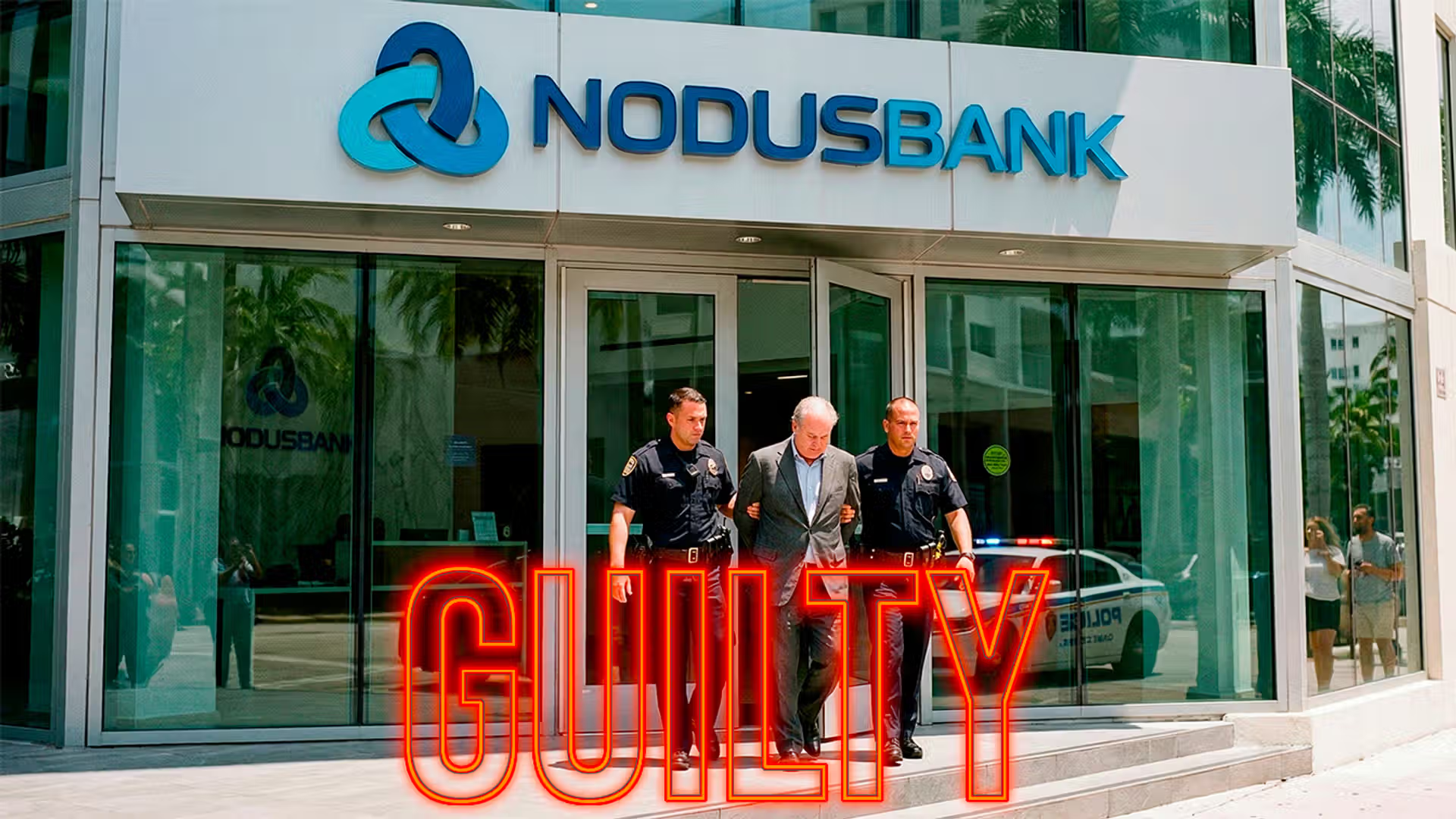
Taesung Terry Kim received a 63-month prison sentence for his central role in a massive 24.4 million dollar money laundering and healthcare fraud conspiracy. The federal court also mandated that Kim pay 24.4 million dollars in restitution and forfeit 6 million dollars in illicitly gained assets. This criminal enterprise involved the systematic exploitation of Medicare and Medicaid through various New York retail pharmacies. Law enforcement officials emphasized that such schemes treat public health funds like a personal bank account while endangering the integrity of federal benefit programs. Kim and his associates utilized a complex web of shell companies and trading entities to conceal the origins of their illegal proceeds.
Table of Contents



Pharmacy Fraud Money Laundering Schemes
The criminal activities orchestrated by Taesung Terry Kim represent a significant case study in how retail pharmacy operations can be transformed into engines for large-scale money laundering. Between the years of 2015 and 2022, Kim operated several pharmacies in the Brooklyn and Queens areas of New York, which served as the primary vehicles for generating fraudulent claims. The core of the operation relied on the submission of approximately 24.4 million dollars in claims to Medicare for prescription medications that were not medically necessary. To facilitate this volume of fraudulent billing, Kim engaged in a systematic program of bribery and kickbacks aimed at both medical providers and individual patients. These bribes were often disguised as legitimate business expenses, such as paying for the office rent and staffing costs of medical professionals who agreed to direct prescriptions toward Kim’s specific pharmacy locations. By corrupting the referral process, the conspirators ensured a steady stream of high-value prescriptions that could be billed to federal programs regardless of patient need.
The conversion of these fraudulent billings into spendable wealth required a sophisticated laundering infrastructure to bypass standard financial monitoring. Kim and his co-conspirators utilized various trading companies to move funds through the financial system under the guise of legitimate commercial transactions. These entities acted as intermediaries, allowing the group to distribute profits among pharmacy owners while simultaneously funding the ongoing bribery and kickback payments. By mixing the illegal proceeds with what appeared to be standard business cash flow, the defendants attempted to evade the scrutiny of anti-money laundering controls within the banking sector. The use of trading companies is a classic laundering technique designed to provide a layer of separation between the predicate crime, which in this case was healthcare fraud, and the eventual personal enrichment of the criminals. This specific financial architecture allowed the participants to extract value from the government programs while maintaining a facade of normal economic activity.




Financial Sophistication in Healthcare Kickback Networks
The structural complexity of the Kim case highlights the evolving nature of financial crimes within the healthcare sector. Unlike simple theft, this scheme required the active participation of multiple parties, including pharmacy owners, medical providers, and even the patients themselves. To incentivize patients to participate in the fraud, Kim provided supermarket gift certificates and direct cash payments, effectively turning beneficiaries into accomplices for a small fraction of the total claim value. This grassroots level of corruption created a massive volume of individual transactions that, when viewed in isolation, might not have triggered immediate red flags. However, the cumulative effect was the extraction of tens of millions of dollars from the public treasury. The sentencing of Kim to more than five years in prison serves as a stern warning to those who attempt to weaponize retail businesses for the purpose of financial crime. The investigative process revealed that the defendant was not merely a passive participant but the primary architect of a system designed to exploit the trust placed in healthcare professionals.
Furthermore, the legal consequences extended beyond incarceration to include significant financial recovery efforts by the Department of Justice. The forfeiture of 6 million dollars, which included bank accounts and real estate holdings, demonstrates the government’s commitment to stripping criminals of their ill-gotten gains. The prosecution of Kim’s partner, Feng Jeff Jiang, who received a 15-month sentence, further illustrates the comprehensive approach taken by the FBI and the Department of Health and Human Services Office of Inspector General. By dismantling the entire network of collaborators, authorities aimed to disrupt the specific laundering channels used by this group. The reliance on trading companies as a front for distributing illegal profits shows that even seemingly legitimate commercial sectors can be infiltrated by organized fraud rings seeking to wash large sums of money. The long duration of the scheme suggests that the conspirators felt emboldened by their ability to manipulate financial records and professional relationships over a period of seven years.

Long-Term Impacts on Anti-Money Laundering Enforcement
This case has provided critical insights for the newly established National Fraud Enforcement Division and the broader federal task force aimed at eliminating waste and abuse. The persistent nature of the fraud, which lasted for seven years, suggests that traditional auditing processes may sometimes overlook the subtle signs of layered money laundering. The use of office rent payments as a bribe is a particularly deceptive tactic, as it mimics a standard commercial lease agreement. AML professionals must therefore look beyond the surface-level documentation to understand the underlying economic reality of business relationships. When a pharmacy consistently pays the overhead for a nearby medical clinic, it creates a red flag for potential quid pro quo arrangements that facilitate money laundering through fraudulent billing. The financial investigators tasked with unravelling these knots must be adept at recognizing when commercial transactions lack economic substance or serve primarily to move value between colluding parties.
The resolution of this case also underscores the importance of interagency cooperation in tracing the flow of illicit funds. The collaboration between the FBI and HHS OIG allowed investigators to connect the clinical aspects of the healthcare fraud with the financial maneuvers used to hide the money. The sentencing of Taesung Kim represents a victory for taxpayers and a reinforcement of the safeguards surrounding Medicare and Medicaid. As federal authorities continue to prioritize the prosecution of fraud against public programs, the lessons learned from the Kim conspiracy will inform future strategies for identifying and preventing the laundering of healthcare proceeds. The requirement for Kim to pay full restitution ensures that the financial damage to the government is addressed, even as he serves his time in federal prison. This case serves as a benchmark for how modern financial investigations can effectively target the intersection of professional services and organized laundering. The scale of the restitution also serves as a deterrent, highlighting that the ultimate cost of such crimes often exceeds the initial illicit gains.
AML Typologies and Red Flags
Anti-money laundering professionals should remain vigilant for specific patterns that mirror the activities found in the Kim pharmacy fraud case. One primary typology is the use of shell or shelf trading companies to facilitate kickbacks. In these scenarios, funds are transferred from a primary business to a third-party entity under the guise of consulting fees, inventory purchases, or service agreements. These funds are then used to pay bribes to individuals who provide the illegal source of revenue. Professionals should scrutinize businesses that have high volumes of outgoing payments to entities that do not appear to provide a clear or necessary service to the core operation. Another critical typology involves the commingling of legitimate pharmacy revenue with funds derived from medically unnecessary prescriptions. This makes it difficult for automated systems to distinguish between legal sales and fraudulent claims. It is often necessary to conduct deep dive audits into the relationship between billing spikes and the actual delivery of medical goods.
Suspicious activity reports should be considered when a retail business suddenly exhibits a massive increase in federal program reimbursements without a corresponding increase in physical infrastructure or legitimate patient volume. Furthermore, the practice of paying for the operational costs of other businesses, such as a pharmacy paying the rent for a physician’s office, should be treated as a high-risk indicator for a kickback conspiracy. AML investigations should also look for frequent, low-value cash withdrawals or the purchase of large quantities of gift cards, which are often used to pay off individual patients in healthcare schemes. Monitoring the lifestyle and asset acquisition of business owners is also essential, as the rapid accumulation of real estate and high-value bank balances can signal the successful laundering of fraud proceeds. By understanding these specific typologies, financial institutions can better detect the early stages of a laundering operation before it reaches the scale of the Kim conspiracy. The use of non-traditional financial instruments like gift cards highlights the need for a broad view of what constitutes a laundering tool in the modern era.
Key Points
- Taesung Terry Kim received a 63-month prison sentence for laundering 24.4 million dollars in healthcare fraud proceeds.
- The conspiracy involved bribing medical providers and patients to generate fraudulent Medicare and Medicaid claims through New York pharmacies.
- Illicit funds were laundered through various trading companies to disguise kickbacks and distribute profits among the conspirators.
- The court ordered a total of 24.4 million dollars in restitution and the forfeiture of 6 million dollars in assets, including real property.
Related Links
- United States Department of Justice Office of Public Affairs
- Federal Bureau of Investigation New York Field Office
- Department of Health and Human Services Office of Inspector General
- Financial Action Task Force Recommendations on Money Laundering
- Medicare Fraud Strike Force Enforcement Actions
Other FinCrime Central Articles About Healthcare-Related Money Laundering
- FinCEN Targets Massive Health Care Fraud and Related Money Laundering
- Russian National Charged in 1.2 Million Dollar Medicare Laundering Case
- Kuwait Enforces Sanctions on Eight Lebanese Hospitals for Terrorism Financing
Source: US DOJ
Some of FinCrime Central’s articles may have been enriched or edited with the help of AI tools. It may contain unintentional errors.
Want to promote your brand, or need some help selecting the right solution or the right advisory firm? Email us at info@fincrimecentral.com; we probably have the right contact for you.