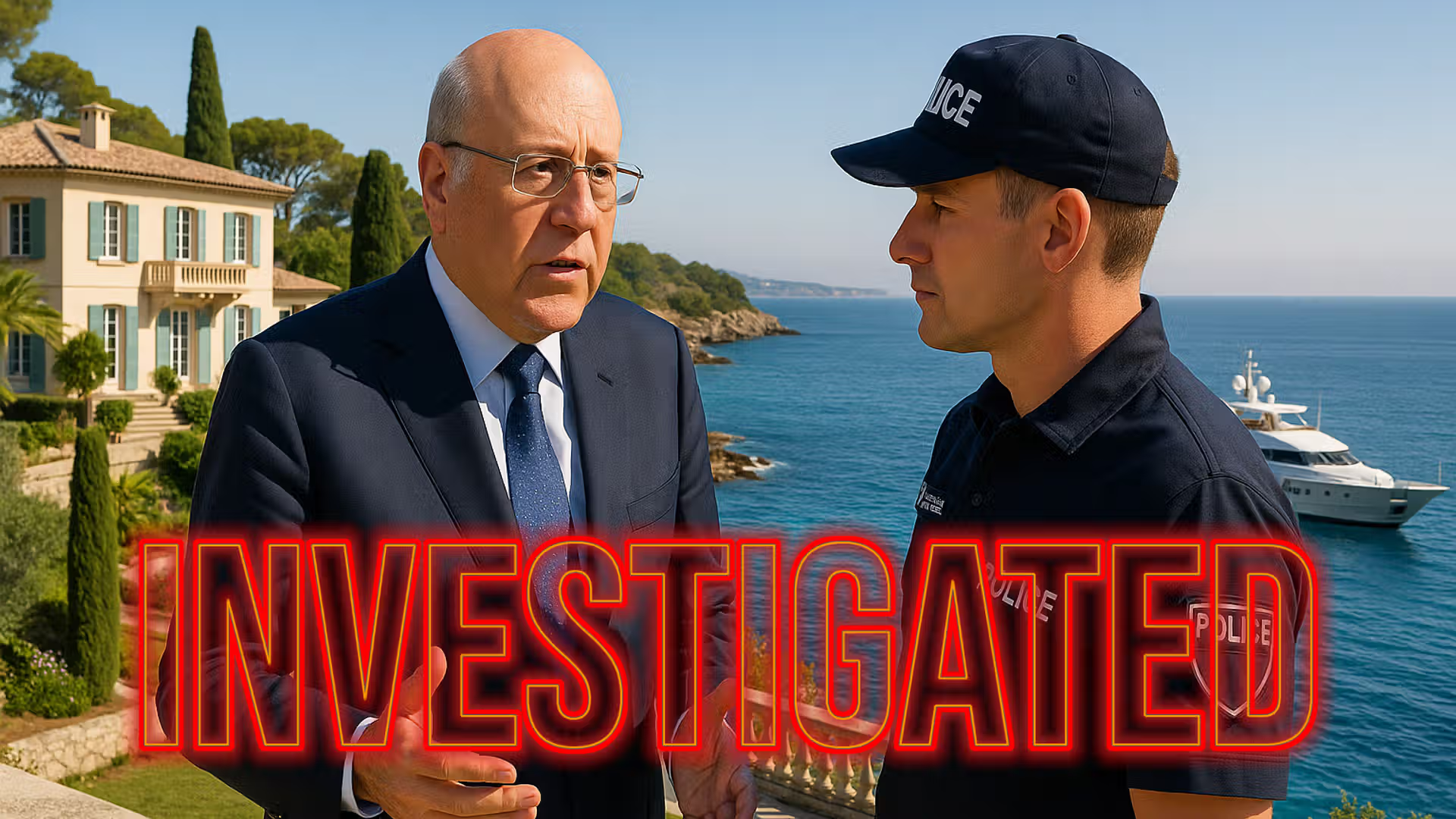
The announcement of a French investigation into Najib Mikati, former Prime Minister of Lebanon, represents a striking development in the global fight against illicit financial flows. The complaint filed by anti-corruption associations accuses Mikati, his brother Taha, and other members of their family of accumulating vast wealth through suspicious channels that allegedly disguise unlawful gains. The allegations revolve around the acquisition of luxury assets in France and abroad, funded through complex structures involving offshore companies and financial layering. At the core of the case lies the question of whether this network constitutes an organised laundering scheme designed to conceal illicit enrichment and circumvent scrutiny by authorities in both Lebanon and Europe.
The French National Financial Prosecutor’s Office has opened a preliminary investigation into these accusations, focusing on laundering of criminal proceeds, concealment of those proceeds, complicity, and participation in an organised association for unlawful purposes. This investigation is not occurring in isolation. It echoes the broader scrutiny of high-ranking Lebanese officials, such as former central bank governor Riad Salamé, who has also faced French judicial proceedings for suspected illicit wealth accumulation. The pattern is consistent: politically exposed persons using international networks of companies, intermediaries, and luxury markets to channel wealth across borders.
Table of Contents


Money laundering allegations against Najib Mikati
The allegations target a financial empire that extends far beyond Lebanon. Najib Mikati, who built a telecommunications fortune before entering politics, has long been described as one of the wealthiest figures in the Middle East. His brother Taha and their families have maintained significant investments in real estate, aviation, and maritime assets. According to the complaint, their fortunes have not simply been the result of business success but have been augmented through questionable financial flows.
The complaint highlights luxury real estate acquisitions in France, including villas on the Côte d’Azur, as well as yachts, jets, and properties abroad. These assets are said to have been purchased via offshore entities, enabling beneficial ownership to be obscured. The associations argue that these arrangements are not coincidental but represent the deliberate use of shell companies, trusts, and nominee owners, which are hallmarks of money laundering typologies. The layering of funds through multiple jurisdictions allegedly created the appearance of legitimacy, making it difficult for authorities to track the origins of the money.
The accusations also extend to Mikati’s children, described as potential receivers of assets stemming from the laundering network. This suggests an intergenerational dimension, where wealth accumulation and laundering mechanisms are passed along family lines, further complicating investigations. Such practices, if proven, would demonstrate not only laundering but also strategies for long-term concealment of illicit enrichment.
What makes this case particularly significant is the explicit allegation of organised criminal association. French law treats laundering in organised groups as an aggravated offence, carrying harsher penalties and broader investigative powers. By framing the Mikati network as a structured group engaging in coordinated financial crime, prosecutors may be able to pursue stronger charges that go beyond individual acts of laundering.
The French legal framework and prosecutorial approach
French anti-money laundering laws are codified within the Criminal Code and the Monetary and Financial Code. The offences cited in this investigation include money laundering, concealment of assets, complicity, and association of criminals. Each carries significant penalties, and when combined under aggravated circumstances, sentences may reach ten years of imprisonment along with heavy fines calculated as a percentage of the assets involved. Confiscation of assets is a central tool, allowing French courts to seize properties, vehicles, aircraft, or financial accounts linked to laundering.
The opening of a preliminary investigation by the French prosecutor indicates that sufficient evidence was presented by the complainants to justify closer scrutiny. The prosecutor now has the authority to request financial records, examine property registries, seek international judicial cooperation, and call witnesses. Mutual legal assistance treaties between France and Lebanon, as well as other jurisdictions where offshore companies may be incorporated, will be critical in tracing ownership and financial flows.
This legal framework is particularly robust when applied to politically exposed persons. Financial institutions in France are required to conduct enhanced due diligence on PEPs, which includes identifying beneficial owners, monitoring unusual transactions, and filing suspicious transaction reports. If French banks, notaries, or intermediaries were involved in processing the Mikati transactions, investigators will examine whether those institutions complied with their reporting obligations.
The case also raises the question of tax evasion as a predicate offence for laundering. By transferring wealth into offshore structures, the Mikati family may have avoided tax obligations in both Lebanon and France. Tax offences are explicitly recognised under French law as predicates for money laundering, which strengthens the case against the family.
Wider AML implications of the Mikati case
The Mikati investigation carries implications that reach beyond one family. It highlights the persistent vulnerabilities of the global financial system to politically exposed persons who move assets across borders. Offshore jurisdictions continue to provide vehicles for concealing ownership, even as international bodies such as the Financial Action Task Force push for stronger transparency standards.
For France, this case underscores the importance of its role as both a financial hub and a destination for luxury assets. French real estate, yachts docked in Mediterranean ports, and Parisian financial services are highly attractive for those seeking to launder wealth. The Mikati allegations suggest that even in a jurisdiction with strong AML frameworks, individuals with resources and connections can exploit gaps between jurisdictions to accumulate assets with questionable origins.
The involvement of civil society groups in triggering the investigation also deserves attention. NGOs have become an important force in AML enforcement, gathering data, analysing property records, and filing complaints that compel prosecutors to act. In the Mikati case, the associations that filed the complaint argue that these actions are part of a broader struggle against the capture of state institutions in Lebanon by private interests. Their role demonstrates how non-government actors can influence the trajectory of AML cases, especially when local institutions may lack independence or resources.
This case also raises the issue of reputational risk for financial institutions. Banks and intermediaries dealing with the Mikati family risk exposure if they failed to apply enhanced due diligence. A failure to identify suspicious patterns could result in regulatory sanctions or civil liability. The case is likely to prompt renewed scrutiny of how French and European institutions handle high-risk PEPs, especially those from jurisdictions with histories of corruption and political instability.
What this investigation means going forward
The French investigation into Najib Mikati and his family is still in its early stages, but its implications are far-reaching. If prosecutors gather sufficient evidence, the case could proceed to a full judicial inquiry, potentially leading to indictments and trials. For Mikati, who recently held the position of prime minister, the reputational consequences alone are significant. Allegations of laundering and illicit enrichment undermine public trust, both domestically and internationally, and complicate his legacy as a political leader.
The investigation also signals that French authorities are willing to apply their laws extraterritorially, holding foreign officials accountable for laundering that touches French territory. This may deter other high-net-worth individuals from using France as a safe harbour for questionable wealth. Luxury assets such as villas, yachts, and jets are particularly vulnerable to seizure, and French law provides clear mechanisms for freezing and confiscating these assets pending trial outcomes.
For the global AML community, the Mikati case reinforces key lessons. Transparency in beneficial ownership remains essential. Offshore companies and trusts must be scrutinised more aggressively, with stronger international cooperation to prevent them from serving as shields for illicit wealth. Enhanced due diligence for PEPs is not just a regulatory requirement but a vital safeguard against reputational and financial damage. The active role of NGOs demonstrates that AML enforcement is no longer confined to regulators and prosecutors; civil society can exert real pressure and provide valuable intelligence.
Whether or not the Mikati family is ultimately convicted, the case already serves as a reminder that the international community is increasingly unwilling to ignore large-scale laundering schemes tied to political elites. For Lebanese citizens struggling with economic collapse, the pursuit of accountability in foreign courts may represent one of the few avenues for justice. For France, the case is an opportunity to demonstrate the effectiveness of its AML regime, strengthen its reputation as a jurisdiction that does not tolerate illicit enrichment, and showcase how cooperation between prosecutors, civil society, and international partners can deliver results.
Related Links
- French Criminal Code Articles 324-1 to 324-4 on money laundering
- French Monetary and Financial Code provisions on suspicious transaction reporting and due diligence (L. 561-1 et seq.)
- Official French government information on TRACFIN and its AML powers
- EU Directive 2018/843 on anti-money laundering transposed into French law
- Jurisprudence from the Cour de cassation on aggravated money laundering
Other FinCrime Central Articles About Lebanon
- EU Flags Lebanon as High-Risk in Ongoing Fight Against Money Laundering
- FATF’s Blacklist: The Challenging Cases of Russia and Lebanon
- OFAC Hits Hezbollah with Fresh Sanctions Shaking Lebanon’s Banking Sector
Source: L’Express
Some of FinCrime Central’s articles may have been enriched or edited with the help of AI tools. It may contain unintentional errors.
Want to promote your brand, or need some help selecting the right solution or the right advisory firm? Email us at info@fincrimecentral.com; we probably have the right contact for you.