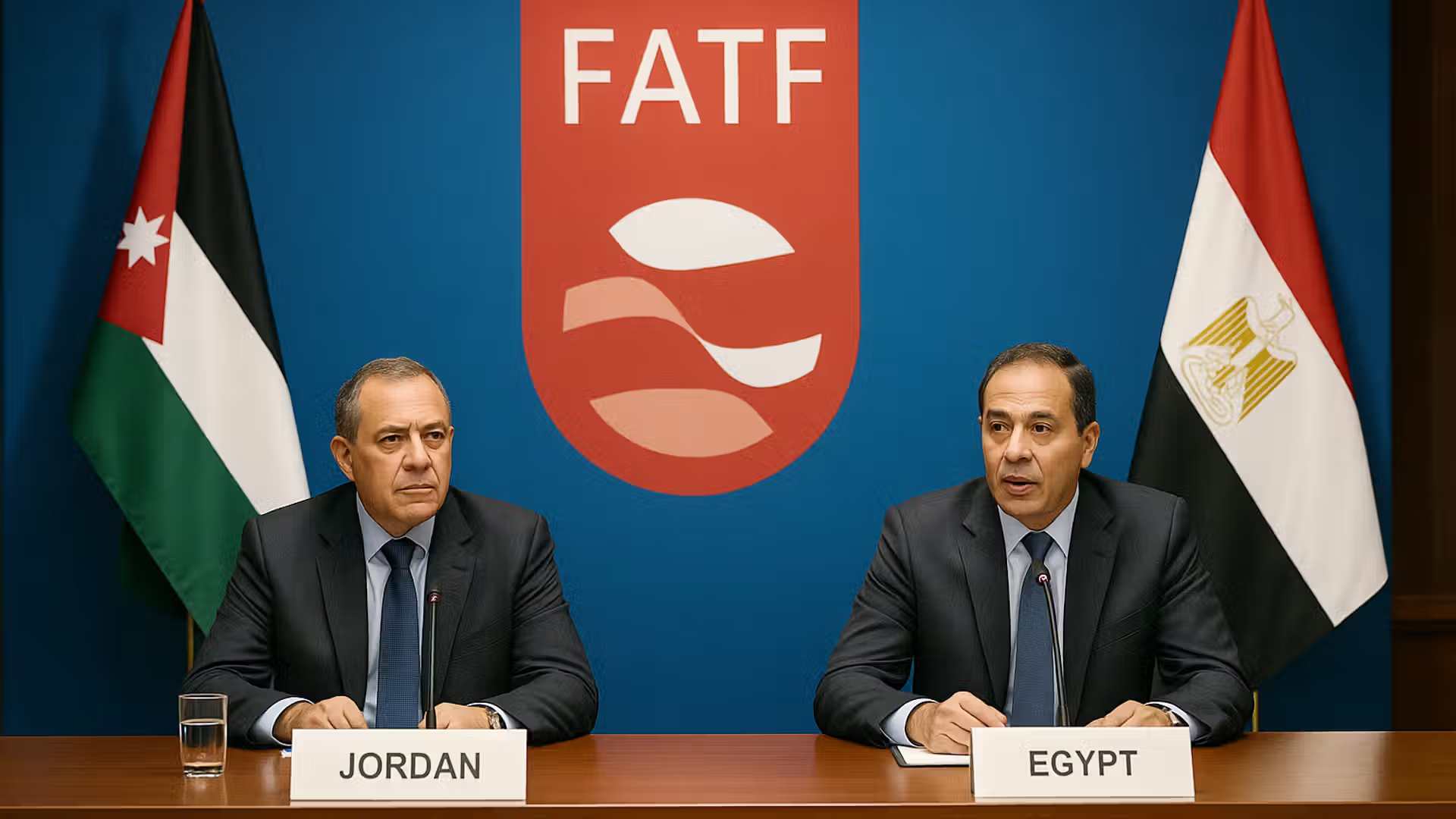
Egypt and Jordan stand at the forefront of the MENAFATF’s 2025 cycle, which marks a turning point for anti-money laundering efforts across the Middle East and North Africa. As regional economies adapt to increasing cross-border financial activity and evolving risk profiles, technical compliance with the FATF’s 40 Recommendations has emerged as a benchmark for regulatory maturity. The latest Enhanced Follow-Up Reports for both countries, published in May 2025, highlight two distinct yet complementary reform paths—one emphasizing institutional governance, the other prioritizing legal precision.
Table of Contents


MENAFATF Findings and the Regional Compliance Landscape
MENAFATF’s enhanced follow-up process subjects member states to periodic reassessment until they demonstrate sustained technical and operational progress. These assessments go beyond box-ticking; they evaluate whether reforms are embedded in domestic systems, whether oversight is risk-based, and whether authorities can cooperate internationally.
Both Jordan and Egypt entered this review period after years of intensified monitoring. Jordan had been under enhanced follow-up since 2019, while Egypt joined the second round of evaluations in 2021. Each country faced unique challenges—Jordan’s centered on supervision of non-financial sectors and transparency of legal arrangements, Egypt’s on the legislative definition of money laundering itself.
Their 2025 results highlight how MENAFATF’s pressure is reshaping compliance culture across the region. Rather than reactive reform, both countries are adopting more integrated approaches linking national strategies, data collection, and feedback loops with reporting entities. This shift mirrors FATF’s 2025 methodology, which prioritizes measurable effectiveness over formal rule alignment.
Jordan’s Expansive Push toward Full Technical Compliance
Jordan’s fifth Enhanced Follow-Up Report, adopted in May 2025, showcases the culmination of a multi-year reform campaign. After its 2019 mutual evaluation placed it under enhanced follow-up, the Hashemite Kingdom undertook a coordinated effort to improve deficiencies across its AML/CFT ecosystem.
MENAFATF’s fifth report reviewed four key recommendations: nonprofit organizations (R.8), transparency of legal arrangements (R.25), regulation of DNFBPs (R.28), and guidance and feedback (R.34). The results demonstrate tangible progress.
For Recommendation 8, Jordan finally addressed the long-standing issue of nonprofit vulnerability to terrorist financing. The authorities completed a risk assessment in 2022, mapping the subset of NPOs that fall under FATF’s definition and identifying those with potential exposure to exploitation. Legislative updates followed, including amendments to Companies Law No. 22 of 1997 and new Social Development and Cybercrime laws that expanded supervisory powers.
Operationally, Jordan established new tools such as the Offsite and Onsite Supervision Guide for NPOs, the NPO governance manual, and a practical guide titled How to Protect Your Organization from Terrorist Financing Risks. The Ministry of Social Development also set up a cross-agency communication committee to enhance coordination among regulators, FIUs, and charitable entities.
Although MENAFATF acknowledged that penalties remain insufficiently deterrent and that international cooperation on NPO inquiries is still limited, the remaining shortcomings were considered minor. The recommendation was upgraded from “Non-Compliant” to “Largely Compliant.”
For Recommendation 25, Jordan tackled one of the most complex AML challenges in the Arab region—the transparency of Waqf (endowment) structures. The Ministry of Awqaf issued “Waqf Transparency Instructions,” mandating trustees to disclose beneficial ownership changes within thirty days and to submit annual audited financial statements. AML Law No. 20 of 2021 reinforced due diligence and recordkeeping obligations, while the Endowment Properties Directorate was empowered to maintain ownership records and cooperate with competent authorities.
These measures bridged most prior gaps but fell short of enabling rapid international cooperation. MENAFATF found no explicit legal mechanism allowing authorities to exchange beneficial ownership information with foreign counterparts. The recommendation was thus upgraded to “Largely Compliant.”
The supervision of DNFBPs under Recommendation 28 was another success story. Article 14 of the 2021 AML/CFT Law defined supervisory authorities across sectors: the Department of Lands and Survey for real estate, the Ministry of Interior for jewelers, and professional associations for lawyers and accountants. Each issued sector-specific guidance between 2021 and 2024, introducing on-site inspections and sanctions.
The only residual weakness lay in the lack of explicit controls to prevent criminals or their associates from indirectly owning DNFBPs. Nevertheless, MENAFATF determined that Jordan had largely met FATF standards, elevating its rating to “Largely Compliant.”
Finally, Recommendation 34 marked Jordan’s transition from reform to maturity. The FIU and Central Bank issued multiple guides on financial fraud indicators and money laundering typologies. Regular workshops and reporting templates for DNFBPs improved suspicious transaction reporting quality. By institutionalizing feedback through manuals and circulars, Jordan met FATF’s expectations for ongoing engagement, earning its first full “Compliant” rating in this area.
By May 2025, Jordan’s compliance portfolio included nine “Compliant,” twenty-seven “Largely Compliant,” and only four remaining partial or noncompliant recommendations. The follow-up process will close in January 2026, positioning Jordan as a regional model of reform ahead of its next full evaluation in 2027.
Egypt’s Precision-Based Legislative Alignment
Egypt’s fourth Enhanced Follow-Up Report, adopted at the same MENAFATF plenary, focused on a single but crucial matter: Recommendation 3 on the criminalization of money laundering. Unlike Jordan’s broad institutional reforms, Egypt’s path centers on legislative refinement and constitutional alignment.
When Egypt’s Mutual Evaluation Report was adopted in 2021, the country was already compliant or largely compliant with most FATF recommendations. However, Recommendation 3 was rated “Partially Compliant” due to ambiguity around the explicit criminalization of organized criminal group participation and the independence of the money laundering offence from the predicate crime.
In 2023, Egypt amended its AML/CFT Bylaws through Cabinet Decision No. 3331, defining “organized criminal group” and adding Article (2 bis) to confirm that money laundering can be prosecuted without prior conviction of the underlying crime. These measures directly addressed MENAFATF’s earlier concerns.
Yet the reforms exposed an institutional dilemma. Under Articles 95 and 170 of the Egyptian Constitution, only Parliament can enact criminal laws. Thus, while the Bylaws clarified the interpretation of existing legislation, they did not carry statutory force. MENAFATF noted that reliance on executive regulations to define criminal offenses conflicts with constitutional principles of legality.
Nevertheless, Egypt’s judiciary has filled this gap through consistent rulings. The Court of Cassation reaffirmed that money laundering is an independent crime, and offenders can be punished separately from those convicted of the predicate offense. The AML Law’s Article 14 imposes imprisonment of up to seven years and fines up to twice the value of laundered assets, ensuring proportionality and deterrence. Legal persons may also face fines up to five million Egyptian pounds and confiscation of illicit proceeds.
MENAFATF acknowledged Egypt’s significant progress, upgrading Recommendation 3 from “Partially Compliant” to “Largely Compliant.” This brought Egypt’s overall technical profile to eleven “Compliant,” twenty-six “Largely Compliant,” and only three “Partially Compliant” recommendations. Egypt remains under enhanced follow-up, with its next review scheduled for 2026.
While the upgrade marks an improvement, Egypt’s challenge lies in translating judicial precedent into explicit statutory law. Codifying organized criminal group participation within the AML framework would resolve the constitutional limitation and secure full compliance. The 2025 outcome demonstrates that legal precision remains Egypt’s primary compliance strategy—methodical, incremental, but anchored in the rule of law.
Shared Lessons and Regional Outlook
The experiences of Jordan and Egypt underscore two complementary dimensions of AML progress—Jordan’s institutional integration and Egypt’s legal refinement. Both approaches respond to MENAFATF’s evolving emphasis on effectiveness and sustainability rather than mere rule adoption.
At a regional level, MENAFATF’s findings show a convergence toward risk-based regulation. Countries are learning to balance FATF compliance with domestic realities such as religious endowments, professional self-regulation, and constitutional limits. The growing use of national risk assessments, feedback loops, and public-private coordination is transforming compliance from a reactive obligation into an active governance process.
For Jordan, the next step will involve operationalizing its reforms through cross-border cooperation and more stringent enforcement of sanctions, particularly within the nonprofit sector. For Egypt, the focus will be legislative consolidation—ensuring all criminal definitions appear in primary law rather than executive bylaws.
The broader takeaway for the region is the shift from technical compliance to demonstrable effectiveness. MENAFATF’s assessments increasingly evaluate whether laws are enforced, data is shared, and institutions collaborate in practice. Jordan’s coordinated framework and Egypt’s judicial independence both point to a new era of accountability-driven compliance across MENA.
Related Links
• MENAFATF Official Publications – Jordan Enhanced Follow-Up Reports
• MENAFATF Official Publications – Egypt Enhanced Follow-Up Reports
• FATF Recommendations – Official FATF Site
• Jordan AML/CFT Law No. 20 of 2021 – Official Text
• Egypt AML Law No. 80 of 2002 – Official Text
Other FinCrime Central News From MENAFATF
- MENAFATF plenary meeting bolsters regional AML CFT collaboration
- MENAFATF Leadership Sets Ambitious Anti-Money Laundering Agenda in Jordan
- Saudi Arabia hosts the 39th MENAFATF Meeting
Source: FATF
Some of FinCrime Central’s articles may have been enriched or edited with the help of AI tools. It may contain unintentional errors.
Want to promote your brand, or need some help selecting the right solution or the right advisory firm? Email us at info@fincrimecentral.com; we probably have the right contact for you.