Bafin imposed a €35000 penalty on Leonteq Securities Europe, while unresolved contradictions across audits, supervisory investigations, public statements, and cross-border oversight raised more questions than the fine itself. The publication accompanying the sanction provided almost no detail, a silence that stands in stark contrast to the severity and breadth of findings in Germany, Switzerland, and France. These earlier findings showed structural AML failures over multiple years, which makes the modest sanction difficult to reconcile with the record. Meanwhile, the firm had previously insisted that internal reviews showed no wrongdoing, even though a SAR was later filed and regulators in different countries reached very different conclusions. These layers of inconsistency have turned the Leonteq case into an emblematic example of fragmented AML oversight and selective transparency.
Table of Contents


Conflicting findings and unresolved questions about Leonteq’s AML governance
The first major inconsistency arose in 2022 when Leonteq publicly responded to media allegations concerning two structured product trades executed through an offshore intermediary. Leonteq asserted that its internal compliance team had thoroughly reviewed the transactions and found no evidence of wrongdoing. The company also commissioned an external review by EY, which concluded that no suspicious activity had occurred and that no SAR was necessary. Leonteq assured stakeholders that all required documents had been reviewed and that the intermediary had met expected standards.
Yet according to reporting by Les Echos, a SAR was filed with Tracfin within six months of EY’s conclusion. This suggests either that new information emerged shortly after the audit or that the internal and external reviews had overlooked relevant indicators. The fact that the transactions in question occurred earlier further complicates the timeline because it indicates that the decision to file the SAR could not have been motivated by genuinely new transactional activity. Instead, the SAR appears to have been triggered by re-evaluation of existing information, casting doubt on the firm’s earlier claim that no suspicion existed. The Financial Times had also reported concerns from former employees, including suggestions that oversight of specific distributors had not been reliable, which adds further tension to the firm’s narrative that all controls were functioning properly.
This inconsistency became more significant as regulatory investigations unfolded. If internal and external reviews declared the system robust, it does not align with the numerous weaknesses regulators subsequently identified. The SAR timing, EY’s conclusion, and the company’s public assurances form the foundation of the first major contradiction that would later be amplified by regulatory scrutiny in multiple countries.
Regulatory actions in Germany, Switzerland, and France reveal deeper contradictions
In 2023, BaFin issued a remediation order requiring Leonteq Europe to correct fundamental deficiencies in its AML framework. Regulators found a lack of adequate internal safeguards, incomplete documentation, insufficient transaction monitoring, and ineffective oversight of higher-risk relationships. These findings implied that essential components of AML compliance were either absent or not functioning as required. BaFin concluded that the failures had persisted until at least the end of 2022, which directly overlaps with the period covered by the EY review that found no suspicious activity.
In Switzerland, FINMA concluded enforcement proceedings in 2024 that revealed structural deficiencies in governance, oversight of distributors, and monitoring of complex transactions. FINMA determined that the firm had failed to apply adequate controls over key distribution partners and required the firm to return profits associated with those relationships. The regulator stated that oversight failures had occurred over multiple years, meaning they preceded the internal and external reviews conducted in 2022. This directly contradicts the company’s public assurances that there were no material findings and raises questions about whether the reviews failed to consider the broader systemic issues later identified by FINMA.
French authorities provided another layer of contradiction. The ACPR reportedly concluded that Leonteq had all the information necessary to detect suspicious activity, even though the firm had previously stated that it lacked enough documentation to file a SAR. The regulator considered the available information adequate to justify escalation and referred possible money laundering and fraud to prosecutors. This stands in direct conflict with Leonteq’s earlier claims, endorsed by EY, that all relevant information had been reviewed and no suspicion was found. The ACPR position also suggests that Leonteq may have misunderstood or misrepresented its own access to information at the time of the initial allegations.
Taken together, the regulatory conclusions from BaFin, FINMA, and the ACPR paint a picture of systemic failings that do not align with the company’s internal account. Each regulator found issues in different parts of the organisation, suggesting that the inconsistencies were widespread rather than isolated. The conflicting statements about whether Leonteq had the necessary documentation to assess the risks call into question the thoroughness or accuracy of the reviews performed in 2022.
A timeline filled with contradictions that remain unresolved
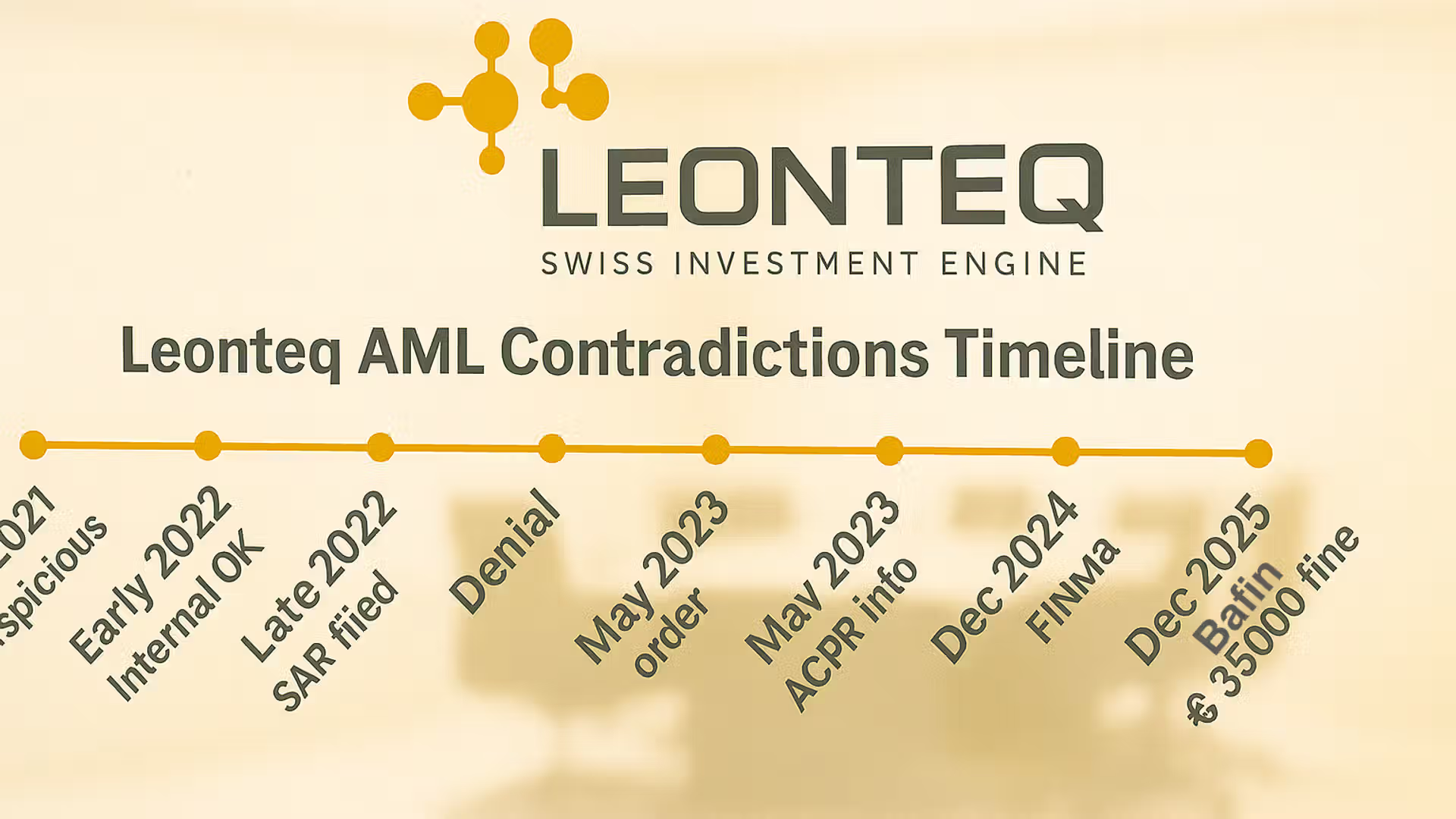
To understand the depth of these inconsistencies, it is helpful to review the sequence of events. Allegations concerning suspicious transactions emerged in late 2021 and early 2022. Leonteq responded by conducting an internal review and commissioning an external investigation by EY. Both reviews reportedly found no evidence of wrongdoing and no reason to submit a SAR. The company stated that all documents were available and that nothing had been identified that would justify escalation.
Yet within months of the finalisation of the EY report, a SAR was reportedly submitted to Tracfin. This conflict alone raises doubts about the completeness of the internal and external reviews. It is unclear whether the SAR was submitted because new information emerged or because the earlier reviews failed to capture the seriousness of certain indicators. The fact that the transactions occurred earlier suggests that the SAR filing was not triggered by new events but by a reassessment of previously available information.
In 2023, BaFin required the firm to implement significant corrective measures, identifying issues that the EY review should have detected if it had thoroughly assessed AML controls. These deficiencies included inadequate internal safeguards, missing documentation, and ineffective monitoring. Meanwhile, in 2024, FINMA concluded that the firm’s governance structures and distribution oversight had major shortcomings over multiple years. This again contradicts the assertion that controls were functioning effectively when EY conducted its audit.
When BaFin issued the €35000 fine in 2025, the accompanying disclosure contained almost no detail about the nature of the breach, whether it concerned incomplete remediation, new failures, or other concerns. The lack of detail is strange, especially given the scale of issues previously uncovered. The small size of the fine appears disproportionate to the severity of the earlier findings, further contributing to suspicion. The opacity of the final publication leaves stakeholders unable to understand what specifically triggered the penalty.
Another inconsistency arises from the company’s public statements. In 2025, Leonteq claimed that regulatory legacy matters were drawing to a close, yet regulators had issued serious enforcement actions in consecutive years. BaFin had required remediation in 2023, FINMA completed enforcement in 2024, and the final penalty in 2025 still lacked clarity. This creates tension between the firm’s messaging and the regulatory trajectory.
The inability to reconcile internal and external audits, SAR timing, supervisory findings, and public statements indicates a deeper challenge in understanding the true scope of the problem. It is possible that internal reviews were constrained or incomplete, or that audits focused narrowly on documentation without considering broader patterns. It is also possible that regulators did not fully disclose their findings for reasons related to confidentiality or ongoing investigations. In any case, the public record provides an incomplete and conflicting narrative.
Potential implications and concerns that the full story remains hidden
The inconsistencies across jurisdictions raise concerns that the full extent of the issues may not have been disclosed. Internal and external reviews concluded that no suspicious activity had occurred, yet regulators found significant deficiencies shortly afterward. BaFin and FINMA both uncovered systemic control failures, and the ACPR referred potential money laundering and fraud to prosecutors. Despite these findings, the final BaFin penalty was modest and accompanied by almost no explanation.
This raises questions about whether regulators have chosen not to disclose certain details. The lack of transparency from BaFin is especially notable. A fine linked to structural failures in AML controls would ordinarily include at least a summary of the issues identified. The decision to withhold detail could suggest that the regulator is attempting to limit public scrutiny or that more serious findings were made but not disclosed.
There is also concern that the minimal disclosure may reflect an effort to draw a line under the matter without fully addressing the problems. The fact that the firm’s public statements about the completeness of documentation were contradicted by the ACPR indicates that communication from the firm may not have been entirely aligned with regulatory expectations. This discrepancy further supports the notion that the full story may not be available to the public.
The possibility that Swiss regulators or perhaps even more so German regulators could be pulling the blanket over a larger scandal cannot be dismissed, given the contradictions in the timeline, the minimal disclosure accompanying the final penalty, and the multiple cross-border findings. Without clear and complete reporting, stakeholders are left to piece together fragmented information that does not form a coherent picture. The risk is that the issues are more extensive than acknowledged and that the current record fails to reflect the full extent of the weaknesses.
Key Points
EY and internal reviews cleared trades in 2022 but a SAR was reportedly filed within six months
BaFin issued a remediation order in 2023 due to significant AML failures
FINMA found structural deficiencies and ordered CHF 9.3 million in profit disgorgement
ACPR reportedly concluded that Leonteq had all the necessary information at the time
A €35000 fine followed in 2025 with minimal detail, raising concerns about transparency
Related Links
- Leonteq December 2025 communication
- FINMA enforcement communication on Leonteq
- BaFin publication of measures regarding Leonteq Securities Europe GmbH
- Leonteq auf dem Prüfstand
- EXCLUSIF Leonteq, le champion suisse des produits structurés, dans le viseur de la justice
- Produits structurés : Leonteq chute en Bourse après la sanction du régulateur suisse
- Leonteq statement on recent media article and business update
- Leonteq – The Wolfsberg Questionnaire
- French banking watchdog flags possible fraud at Leonteq to prosecutors, report says
Other FinCrime Central Articles About the Mysterious Leonteq Saga
- Leonteq, three regulators, and an AML audit trail full of inconsistencies
- Strong Claims, Small Numbers, Are FINMA AML Penalties Enough?
Source: Bafin
Some of FinCrime Central’s articles may have been enriched or edited with the help of AI tools. It may contain unintentional errors.
Want to promote your brand, or need some help selecting the right solution or the right advisory firm? Email us at info@fincrimecentral.com; we probably have the right contact for you.