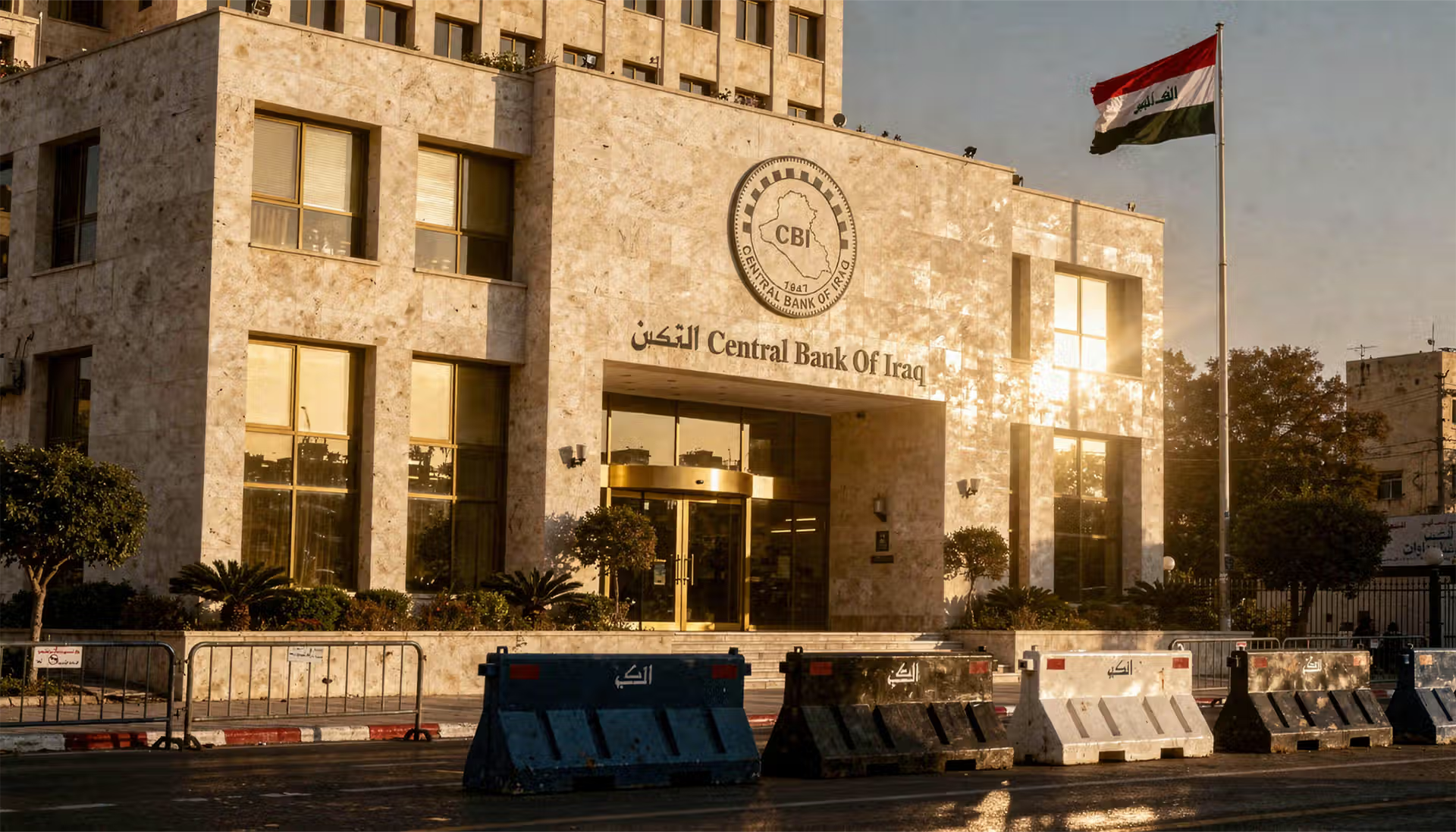
Growing concerns across Iraq’s financial sector point to a rising trend where online personalities become channels for illicit transfers. Public visibility and fast-moving digital engagement offer opportunities for criminal networks to disguise value within seemingly routine promotional activity. Regulators report that certain transaction flows lack commercial justification and involve actors tied to restrictive measures. Banks are now expected to classify these profiles as high risk due to opaque income sources and unexplained financial movements. This case demonstrates how social platforms have created conditions that criminal groups can exploit when institutional controls fall behind emerging behaviours.
Table of Contents


Patterns driving influencer laundering scrutiny
Iraqi authorities highlight the emergence of complex financial behaviours linked to social media activity that present challenges for compliance teams attempting to distinguish genuine income from illicit flows. The Central Bank of Iraq has reported cases where online engagement is used to create a façade of commercial legitimacy, allowing criminal networks to move funds through personalities whose audience reach provides cover for irregular transfers. These concerns relate to both money laundering and terror financing exposure, producing a need for institutions to reassess risk models associated with digital-economy clients.
Regulators cite several key indicators. Sudden follower surges that do not correlate with documented promotional campaigns raise suspicions, as this pattern can be artificially engineered to increase credibility before illicit financial movements begin. Another warning sign involves incoming payments from parties lacking clear business relationships or any connection to normal influencer revenue streams. When these payments appear at volumes or frequencies unrelated to advertising contracts, red flags arise concerning the true purpose of the transactions.
The Central Bank stresses that some influencers have unknowingly accepted promotional offers from entities associated with restrictive measures. These arrangements, while framed as commercial partnerships, have sometimes originated from organisations under sanctions or from intermediaries connected to networks under investigation. When funds pass through these channels, influencers may inadvertently facilitate the movement of value to actors who rely on their public visibility to mask illicit intent.
Rapid acquisition of high-value goods also contributes to regulatory concern. Purchases of luxury items that cannot be matched to declared income demonstrate potential layering behaviour where illicit funds are incorporated into the legitimate economy through lifestyle-driven assets. Compliance teams are urged to consider whether the timing of such purchases aligns with suspicious inflow patterns, as clustering of transactions can provide insight into laundering attempts.
Iraqi authorities also observe frequent use of proxy accounts. Relatives or close associates may hold accounts that receive transfers related to influencer activity, even when these individuals have no involvement in the online business. This practice complicates beneficial ownership assessment and increases the difficulty of identifying the true recipient of funds. The bank’s guidance emphasises that these patterns should trigger enhanced due diligence and deeper analysis to determine whether the arrangement serves to obscure financial trails.
Fragmented transfers represent another risk. Some accounts exhibit repeated small transactions believed to be part of smurfing techniques used to avoid detection thresholds. When these transfers lead to regions associated with conflict or limited oversight, concerns increase regarding potential links to illicit groups. Regulators require banks to examine whether such flows align with ordinary online earnings or demonstrate characteristics consistent with structured movement of funds.
These behaviours collectively illustrate why financial institutions are required to categorise influencers as high-risk customers. Their diverse revenue sources, irregular earnings schedules, and exposure to third-party payments elevate vulnerability when appropriate monitoring is not implemented. Iraq’s authorities therefore instruct institutions to create dedicated review procedures tailored to digital-economy clients, ensuring the detection of anomalies that would be less visible under traditional models based on employment income or corporate activity.
Illicit fundraising through unregistered digital campaigns
A significant portion of regulatory concern focuses on fundraising activities conducted under the guise of charitable missions. Iraqi authorities report that several individuals have leveraged their online platforms to solicit donations from followers while lacking registration with recognised charities or any approved banking structures typically required for legitimate humanitarian campaigns. Funds sent through these informal channels often travel to unidentified recipients, reducing traceability and increasing exposure to diversion.
The Central Bank highlights cases in which emotional appeals on social platforms attracted substantial contributions within short intervals. Without oversight, donors cannot verify whether the funds reached the intended beneficiaries. In several instances examined by regulators, the accounts receiving transfers provided no documentation, accountability, or operational presence. This anonymous structure reflects the types of vulnerabilities that illicit actors exploit when seeking to move value discreetly across borders.
Identity concealment remains central to these risks. Fake profiles and intermediary accounts are frequently used to collect donations, shielding the individuals who ultimately receive the funds. When transfers coincide with regions experiencing instability, the likelihood that funds may support violent groups becomes a concern. These patterns mirror international observations about how digital platforms are used to mobilise resources for extremist networks, often relying on sympathisers who respond to emotionally driven campaigns without verifying credentials.
Payment fragmentation further complicates detection. Donations are sometimes split into multiple micro-transactions designed to evade monitoring thresholds. Regulators note that this mechanism has long been associated with terror financing and remains effective when conducted through online wallets, peer-to-peer systems, or informal financial networks without standardised oversight. Iraq’s supervisory authorities therefore emphasise the need for institutions to track cumulative activity rather than assessing transactions in isolation.
Connections to sanctioned actors add an additional dimension of risk. Instances where promotional or fundraising campaigns are linked to organisations under international scrutiny reveal the potential for influencers to inadvertently support groups targeted by global enforcement frameworks. When funds are routed through entities that appear on sanctions lists, the absence of structured oversight amplifies the chances that value could finance activities prohibited by international law.
Banks are instructed to flag any unregistered fundraising campaigns conducted by influencers and to determine whether the individual can demonstrate legitimate humanitarian partnerships. If supporting documentation is absent, institutions must examine whether the activity aligns with known patterns of illicit fundraising. Funds moving to unidentified individuals, regions with active conflict, or jurisdictions associated with opaque intermediaries require immediate escalation under Iraq’s regulatory guidance.
The sensitivity of this issue increased following recent enforcement measures introduced by Iraqi authorities to curb foreign currency smuggling. Under these measures, outgoing transfers require detailed documentation of overseas purchases or clearly identified legitimate purposes. This policy highlights the broader context in which the Central Bank is attempting to strengthen overall financial transparency while addressing gaps that criminal networks exploit through online engagement.
Banking obligations and risk-based controls for digital-economy clients
Iraqi regulators outline specific expectations for banks serving influencer clients due to the complexity of income flows associated with digital platforms. Institutions must ensure that customer due diligence procedures match the evolving nature of online activity. The Central Bank instructs banks to verify income sources by examining contracts, platform payouts, sponsorship agreements, and any other documentation that explains incoming funds. When transactions appear inconsistent with the customer’s declared business model, banks are required to escalate reviews.
Enhanced due diligence applies to all accounts tied to an influencer, including those belonging to intermediaries or family members. Unknown third-party accounts used to receive earnings represent a significant risk because they obscure the flow of funds and limit visibility over true beneficiaries. Banks must conduct thorough investigations when identifying these arrangements, determining whether they serve legitimate administrative purposes or act as mechanisms to hide financial activity.
Monitoring systems must adapt to detect anomalies specific to the influencer economy. Rapid spikes in income, short-term promotional activity that does not explain large payments, or repeated transfers from unrelated entities must be reviewed. Regulators recommend that banks integrate behavioural indicators into transaction monitoring frameworks, acknowledging that digital earnings follow irregular patterns but still display consistent markers when legitimate.
The Central Bank also directs institutions to scrutinise contracts with businesses that lack verifiable corporate profiles. When influencers receive payments from opaque companies, especially those connected to high-risk jurisdictions, banks must investigate the nature of the partnership and whether it masks concealed sponsorship by entities under sanctions or under investigation. Where uncertainty arises, regulators expect institutions to request further clarification or issue suspicious transaction reports.
The broader regulatory environment reinforces the importance of these controls. Recent sanctions imposed by international authorities on Iraqi banking leaders illustrate the consequences of insufficient oversight. These sanctions were linked to allegations of laundering funds through networks associated with Iran’s Islamic Revolutionary Guard Corps and aligned armed groups. This context shows why Iraq’s Central Bank prioritises stricter monitoring, as lapses in control can create channels that facilitate prohibited financial flows.
Collectively, these obligations reflect a shift within Iraq’s regulatory framework to address vulnerabilities emerging from online economic activity. Banks are expected to implement continuous risk-based assessments, maintain up-to-date customer profiles, and ensure that all transaction patterns align with declared business models. When discrepancies arise, institutions hold responsibility for identifying irregularities before illicit transfers are integrated into the financial system.
Shifting digital-economy risks demand stronger institutional controls
The case presented by Iraqi authorities illustrates how financial crime evolves as digital engagement grows and online personas acquire economic influence. The Central Bank’s warning reflects a broader recognition that influencers, due to their visibility and irregular income flows, can become attractive conduits for laundering networks and groups seeking to route funds for harmful purposes. Irregular income patterns, unregistered fundraising, opaque partnerships, and complex transaction structures contribute to an environment where traditional monitoring approaches can fail without tailored controls.
Banks operating in Iraq must therefore adapt frameworks to address risks unique to social-platform activity. Enhanced due diligence, behavioural monitoring, and strict verification of income sources are essential. When influencers engage in financial activity involving unknown parties, sanctioned entities, or beneficiaries in conflict areas, institutions must interpret these behaviours as high-risk indicators requiring immediate attention.
The regulator’s instructions highlight the economic transformation created by digital ecosystems and the need for compliance functions to mirror this shift. Without proactive oversight, the financial system becomes vulnerable to misuse that undermines both domestic stability and international security objectives. Iraq’s renewed focus on identifying illicit flows through influencer activity underscores the importance of continuous vigilance as criminal groups adapt to new opportunities created by online visibility.
Key Points
- Influencer activity can mask irregular financial flows linked to criminal networks
- Unregistered fundraising campaigns present high risk for terror financing transfers
- Proxy accounts and fragmented transactions obscure true beneficiaries
- Banks must classify influencer clients as high risk and apply enhanced controls
- Partnerships with opaque or sanctioned entities elevate laundering exposure
Related Links
- Central Bank of Iraq Regulatory Circular on High-Risk Customers
- US Treasury Sanctions Information
- FATF High-Risk Jurisdictions Updates
- Iraq Anti-Money Laundering and Counter-Terrorism Financing Office
Other FinCrime Central Articles About Iraq
- Kuwait, India, and Iraq Forge New AML Intelligence Pac
- First Iraqi Bank’s Training Revolution Sets a New Standard for Financial Integrity
Source: The New Region
Some of FinCrime Central’s articles may have been enriched or edited with the help of AI tools. It may contain unintentional errors.
Want to promote your brand, or need some help selecting the right solution or the right advisory firm? Email us at info@fincrimecentral.com; we probably have the right contact for you.