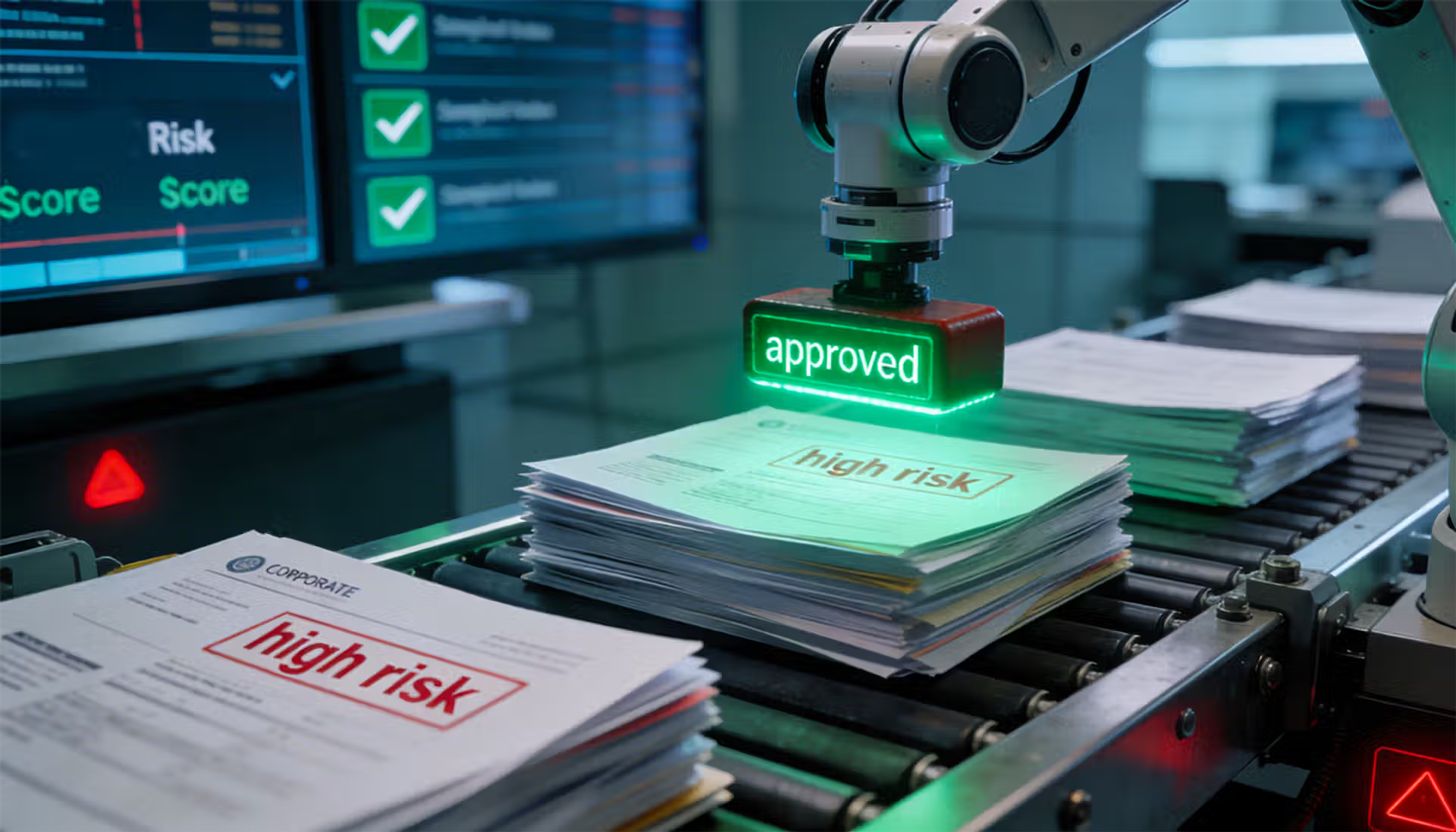
The $125,000 FINRA fine against the firm highlights how significant gaps in reporting to the Trade Reporting and Compliance Engine can undermine market transparency. The penalty also covers the separate issue concerning undisclosed security prices on customer confirmations. FINRA found that the firm inaccurately reported or failed to report more than 12000 transactions over several years. These errors affected fixed income activity across corporate debt and Treasury securities. The scale and duration of the problems demonstrate how reporting obligations can break down when operational controls are not aligned with regulatory requirements.
Table of Contents


TRACE reporting failures
The case centers on persistent inaccuracies in the firm’s reporting of fixed income transactions to the Trade Reporting and Compliance Engine, creating a lengthy period in which market participants and regulators lacked access to essential data. FINRA requires that all TRACE-eligible trades be reported promptly, accurately, and completely, and the system forms a critical part of the fixed income audit trail. The firm’s reporting failures began in July 2018 when it moved to an agency booking model. The operational transition was not communicated correctly to the fixed income desk, which continued to input all trades as principal transactions. As a result, every single report the firm submitted for corporate debt and Treasury securities over a period of more than five years reflected the wrong capacity. Approximately 7450 corporate debt transactions and 440 Treasury transactions were tagged as principal when they should have been identified as agency.
This incorrect capacity reporting distorted the data flowing into TRACE. Capacity codes indicate whether a firm trades on behalf of clients or for its own account, and any misclassification limits the ability of investors and oversight bodies to evaluate market activity accurately. Accuracy in this field is essential because capacity affects execution practices and potential conflicts of interest. Capacity errors also complicate the audit trail by making it difficult to identify the true role of the broker-dealer in the trade sequence.
A separate reporting failure emerged starting in February 2020. Due to human error, the firm stopped submitting TRACE reports for trades with its non-member affiliate. These trades should have been reported under FINRA’s requirement that the member report transactions involving a non-member counterparty. Over 4250 corporate debt transactions and roughly 355 Treasury trades went unreported before the firm corrected its processes in April 2024. These omissions represented half of all reportable corporate debt, and Treasury trades the firm was required to submit in that time period.
The core issue was not the existence of complex trading patterns but the absence of basic controls to ensure that operational changes and system inputs aligned with FINRA Rule 6730. When execution capacity is entered incorrectly and trade reporting is skipped altogether, TRACE cannot perform its intended role in supporting price transparency and early detection of irregularities. Incomplete or incorrect reporting deprives investors of reference data that influences pricing and valuation decisions. FINRA has repeatedly emphasized that TRACE data enables regulators to detect patterns that may indicate market manipulation, layering, spoofing, or conflicts tied to execution quality. Missing or inaccurate reports weaken that supervisory capability.
Market impact of TRACE inaccuracies
Failures in TRACE reporting do not stay contained within a firm’s internal systems. They circulate through the market because transparency tools rely on accurate data to function. A single firm can distort price discovery and comparative analysis simply by misreporting a large volume of trades over multiple years. In this case, the inaccuracies amounted to a complete misclassification of every capacity code for years and a total absence of reporting for thousands of transactions with a non-member affiliate.
The scale of the misreporting raises concerns about the information available to institutional investors during that period. TRACE serves as a public utility for fixed income transparency, and traders monitor disseminated reports to gauge liquidity, spreads, and execution patterns. If transactions that should appear in TRACE are missing, observers see an incomplete picture of market activity. This affects benchmarks, valuation models, and investment decisions. Market participants may unknowingly rely on fragmented data when assessing where securities are trading and how prices evolve across the day.
For regulators, TRACE omissions create gaps in the audit trail. Investigations into market conduct rely on complete reporting to reconstruct sequences of trades, identify outliers, and confirm whether behaviors align with regulatory expectations. When a firm misclassifies capacity, the audit trail loses a key data element that helps determine whether a firm is acting on behalf of clients or itself. When trades are absent altogether, regulators cannot examine whether execution practices deviate from norms.
Although the firm eventually corrected its reporting, the delay in remediation is notable. The capacity issue persisted from 2018 through late 2023 before the firm identified the error in its own internal review. The missing trade reports went unnoticed until FINRA raised the issue in 2024. These timelines indicate that no effective monitoring existed to validate the integrity of TRACE submissions. Such controls are fundamental for any broker-dealer engaged in fixed income trading, given the reliance the market places on accurate reporting.
Operational weaknesses behind the reporting errors
The errors originated from operational breakdowns rather than intentional misconduct. However, this distinction does not reduce their regulatory significance. TRACE reporting requires a firm to maintain operational workflows capable of capturing accurate trade data in real time. Any change in booking structures or account classifications must be accompanied by corresponding updates to reporting instructions, system fields, and desk procedures.
The shift to an agency booking model created a misalignment between front office practices and reporting requirements. A simple failure to communicate the new booking structure to the trading desk meant that every fixed income trade for several years contained inaccurate capacity information. The persistence of the error suggests that no reconciliation process compared internal capacity classifications with TRACE outputs. Such reconciliations are standard in the industry to ensure ongoing data integrity.
Human error explained the missing reports for non-member affiliate transactions, yet the duration of the omissions implies that system validations were insufficient. A well-designed reporting infrastructure includes default checks, exception reports, and automated flags when expected data is absent. Best practices in fixed income reporting involve cross-checks between trading systems, middle office controls, and regulatory reporting modules. When these controls are absent, firms may rely on manual processes that increase the likelihood of mistakes.
Supervisory oversight also plays a significant role. Although this article does not explore the deficiencies related to confirmation disclosures, it is relevant that the overall fine applies to that separate failure as well. The inclusion of supervisory issues in the penalty underscores FINRA’s expectation that firms must proactively identify systemic reporting risks rather than wait for external inquiries. Robust supervision includes testing, periodic reviews, and governance structures that escalate reporting anomalies.
Regulatory lessons and future expectations
The fine and censure remind market participants that TRACE reporting is a central component of market transparency, not a secondary administrative task. Firms engaged in fixed income trading must regularly test the accuracy of their reporting processes. Any operational change must trigger a structured review of how trade data flows through internal systems to FINRA. Capacity fields, trade counterparties, timestamps, and other required components must be validated through both automated and manual controls.
The case also highlights that the absence of malicious intent does not shield a firm from regulatory action when reporting failures persist for long periods. FINRA looks at the market impact, duration of errors, and adequacy of internal controls. When thousands of trades are either misreported or not reported at all, the integrity of TRACE data is compromised. This situation illustrates that even relatively small firms with a limited number of registered representatives can create significant transparency gaps if reporting structures are not rigorously maintained.
The broader lesson is that firms must design their operational models with regulatory reporting at the center rather than treat it as an ancillary function. TRACE reporting should align with booking models, account structures, and trade capture processes. Firms must test their systems whenever structural changes occur. Regular oversight, reconciliation, and validation are essential to prevent long-running inaccuracies. FINRA’s findings serve as a reminder that transparency failures, regardless of origin, carry real consequences.
Key Points
- More than 12000 TRACE-eligible transactions were inaccurately reported or not reported.
- Capacity codes for all corporate debt and Treasury trades were incorrect for years.
- Thousands of trades with a non-member affiliate went unreported due to human error.
- Market transparency and audit trail integrity were impacted across fixed income activity.
- FINRA fined the firm $125000, covering both TRACE reporting failures and a separate disclosure issue.
Related Links
- FINRA TRACE Reporting Overview
- FINRA Rule 6730 Transaction Reporting
- FINRA Regulatory Notices
- SEC Fixed Income Market Structure Resources
- FATF Recommendations
Other FinCrime Central Articles About FINRA’s Actions
- FINRA Fines BMO Capital Markets $300k Over Late Reporting Failures
- $5.5 Billion Under the Radar: How EFG Capital’s AML Failures Sparked a Major FINRA Fine
- FINRA Fines BMO Capital Markets $300k Over Late Reporting Failures
Source: FINRA
Some of FinCrime Central’s articles may have been enriched or edited with the help of AI tools. It may contain unintentional errors.
Want to promote your brand, or need some help selecting the right solution or the right advisory firm? Email us at info@fincrimecentral.com; we probably have the right contact for you.