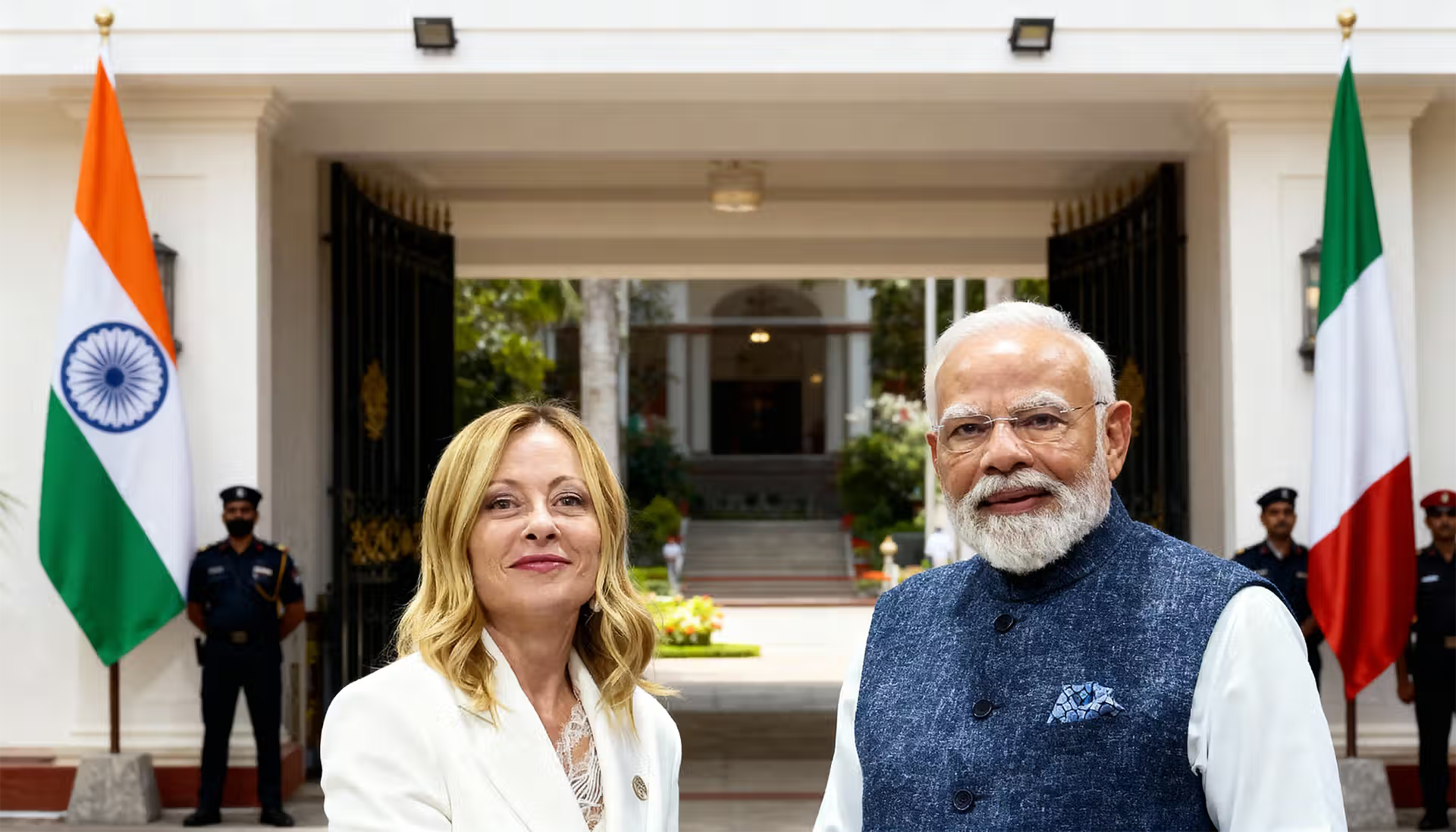
India and Italy pushed their cooperation into an entirely new tier after both governments agreed to intensify joint pressure on global money laundering structures used by violent extremist networks. Their meeting during the G20 in Johannesburg transformed a diplomatic engagement into a coordinated plan that directly targets clandestine financial pipelines. This initiative places Narendra Modi and Giorgia Meloni among the most assertive leaders currently investing political capital into cross border disruption of illicit financing. The recent terror attack in Delhi added urgency, reinforcing why both countries want operational synergy rather than symbolic collaboration.
A shift from high-level declarations to concrete joint activity signals a new phase, one shaped by shared exposure to transnational crime, growing sophistication of laundering structures, and rising pressure on governments to demonstrate measurable results. At the G20, both leaders’ recommitment to this agenda set the tone, confirming that their partnership now intends to track, dismantle and prevent complex flows that sustain violent networks.
Table of Contents


Joint Strategy Against Terror Financing
The first pillar of the plan revolves around structural reforms and operational alignment designed to map and obstruct illicit flows linked to extremist activity. Both governments understand that terror networks rely on fragmented oversight, weak coordination between jurisdictions and misaligned intelligence practices. Addressing these gaps requires joint technical teams, direct communication channels and synchronized review of financial flows that previously moved unnoticed between authorities.
The meeting in Johannesburg produced a common strategy anchored in immediate goals. These include strengthening analytical units that process suspicious transactions, reinforcing scrutiny of cross-border transfers involving high-risk entities, and increasing collaborative assessments of financial conduits used by networks that operate between South Asia, the Middle East and Europe. Analysts in both countries have long identified the same structural threat: fragmented oversight allows terror facilitators to move funds in small amounts through informal networks, front businesses and remittance chains that exploit inconsistencies between jurisdictions.
India has emerged as a critical geography for understanding how these flows evolve, particularly given its exposure to groups that rely on hawala operators, fraudulent trade documentation and layers of intermediaries. Italy, on the other hand, contributes experience acquired through investigations into extremist cells that often rely on charitable fronts, small commercial entities and cash-intensive retail operations to disguise flows. Bringing these strengths together improves the chances of tracking networks that change typologies as enforcement pressures shift.
Both governments also emphasized professional training to reduce uneven knowledge across institutions. Specialist units in Italy have offered to provide insight into complex forensic analysis, while Indian investigators will share their experience in tracking networks that move between formal transfers and informal brokers. Both sides acknowledged that without skilled staff, sophisticated monitoring systems lose their effectiveness.
Coordinated Mapping of Illicit Financial Channels
A second dimension of the partnership focuses on mapping the financial channels that enable terror networks to operate. These structures often rely on movement across multiple continents, exploiting weak oversight and limited analytical capacity. The new cooperation aims to identify overlaps between financial activity detected in India and operational presence noticed in Italy, thereby making it harder for networks to hide in the gaps between jurisdictions.
One priority involves the scrutiny of entities that exhibit patterns consistent with laundering activity. These include inconsistent cash flows, irregular shipments of high-value goods, payments routed through unexpected locations, abrupt changes in transaction volume and financial behavior that deviates from the stated business model. Both countries intend to share typologies linked to front companies that operate with minimal transparency and act as facilitators for extremist groups.
Investigators in India have tracked cases involving funds diverted through shell entities, misuse of charitable donations and exploitation of gaps in regulatory reporting. Italy has confronted networks associated with radicalized individuals who operated small commercial entities as collection points for cash destined for extremist organizations abroad. Some of these businesses acted as informal remittance channels, enabling fluid movement of small payments designed to remain below detection thresholds.
The recent terror attack in Delhi added urgency to this mapping effort. A car explosion near a metro station left multiple victims, prompting renewed scrutiny of domestic and international links that may have enabled the perpetrators to secure support. Italian officials expressed solidarity with India and reaffirmed their commitment to preventing financing flows that ultimately contribute to incidents of this nature. Both governments see the attack as proof that networks evolve rapidly and require constant analytical pressure.
Strengthened Architecture for Intelligence Sharing
Central to the new partnership is the commitment to deepen intelligence exchanges and create an architecture that reduces delays in transmitting actionable information. Cooperation between agencies often depends on slow bureaucratic mechanisms that allow financial flows to continue while institutions wait for clarification. Both leaders insisted on mechanisms that allow their financial intelligence units and law enforcement bodies to communicate without procedural bottlenecks.
An integrated approach will improve the speed at which investigators can freeze assets, block suspicious transfers and identify new transactions linked to extremist actors. Staff in both countries will have access to rapid escalation processes for cases that indicate imminent operational risk. This integrated structure aims to eliminate situations where delays of several days enable networks to move funds through third countries.
Both governments also agreed to intensify collaboration across multilateral platforms that work to combat illicit financial flows. Participation in global bodies offers opportunities to refine joint risk assessments, advance shared policy priorities and coordinate pressure on jurisdictions with systemic weaknesses. Leaders from both countries believe that collective action is essential to closing the gaps exploited by terror networks.
India brings extensive experience in monitoring complex cross-border flows that involve hawala networks and front companies. Italy contributes expertise in identifying extremist financing structures embedded within migrant communities, charitable associations and informal commercial networks. Sharing this knowledge enhances each country’s capacity to detect patterns that may otherwise remain obscure.
Expected Impact on Global Disruption Efforts
The joint framework has a strong international dimension. Both countries understand that networks involved in extremist financing often operate across loosely connected jurisdictions where oversight diverges. Coordinated investigative action between India and Italy strengthens global efforts to track entities involved in laundering funds into regions where extremist groups maintain operational presence.
The new partnership aims to identify threats that arise when facilitators exploit inconsistencies in financial rules. Many networks move funds in small installments, often through apparently legitimate transfers involving businesses that show no overt connection to criminal activity. Detecting these patterns requires comparing transaction data, business structures and behavioral anomalies across borders.
The initiative also positions both countries to influence global policy. Their shared experiences give them the ability to advocate for reforms that strengthen transparency in financial flows. These can include improvements in verifying beneficial ownership, ensuring consistent reporting of suspicious activity and reducing loopholes in trade documentation. Discussions in Johannesburg highlighted the need for such reforms, particularly following repeated cases where facilitators used fraudulent invoicing to disguise the movement of funds.
Economic ties between India and Italy reinforce the strategic relevance of their partnership. Trade valued in billions creates extensive legitimate financial interaction. This environment, while positive for economic growth, can also be exploited by networks seeking to hide illicit flows within legitimate commercial activity. Collaborative monitoring helps reduce this risk, ensuring that expanding trade does not unintentionally create opportunities for extremist financing.
The broader strategic relationship between both leaders continues to deepen. Their coordination at international summits reflects growing mutual trust, and the initiative reflects that this trust now extends to sensitive operational matters. Cooperation across sectors, from defence to technology and skilled workforce development, forms a backdrop to the new push for financial security.
Expanding Network of India’s Counter Financing Partnerships with Egypt, Qatar, Kuwait, and Beyond
India’s recent cooperation with Italy fits into a wider strategy that has taken shape over the past two years, in which New Delhi systematically forges bilateral frameworks aimed at disrupting illicit financial flows linked to extremist activity. Several agreements with key partners in the Middle East and North Africa illustrate how India is consolidating an extended architecture of joint monitoring, intelligence alignment and operational readiness.
India and Egypt strengthened their partnership by integrating structured exchanges on financial intelligence, focusing on the identification of informal transfer routes, misuse of charitable entities and attempts by regional facilitators to send funds through dual use commercial networks. Both governments have assessed that extremist groups operating in North Africa rely on brokers who shift funds between formal transfers and cash based intermediaries, making coordinated scrutiny essential. Their joint work includes deeper risk assessments of remittance corridors, stronger oversight of high risk business sectors and joint training sessions for investigators who monitor suspicious cross border transfers.
India and Qatar have advanced a similar arrangement, concentrating on scrutiny of payment channels vulnerable to exploitation by networks that operate between South Asia and the Gulf. The partnership includes attention to transfers structured below reporting thresholds, front companies used to mask cash intensive activity and trade documentation inconsistencies that signal potential misuse of legitimate commercial flows. Both countries have also expanded technical cooperation, sharing analytical indicators that point to networks attempting to move funds rapidly across multiple jurisdictions.
India and Kuwait have committed to closer coordination as well, with emphasis on preventing the diversion of funds through charitable channels, oversight of non profit organizations and improved detection of high risk transfers that move between migrant communities and intermediaries abroad. Their engagement includes joint assessments of front businesses that operate in sectors prone to financial misuse, wider exchange of typologies involving illicit cross border activity and reinforced protocols for handling urgent financial intelligence alerts involving possible extremist financing.
Alongside these agreements, India continues to strengthen cooperation with several other jurisdictions that face similar risks. These engagements involve aligning investigative techniques, comparing risk profiles across remittance corridors, reviewing vulnerabilities in trade based movement of funds and coordinating responses to emerging typologies. This broader diplomatic effort shows a sustained commitment to building a multi country network capable of constraining facilitators who depend on regulatory inconsistencies and fragmented oversight to move money across borders.
Related Links
- Financial intelligence cooperation guidelines
- Frontex Cross-border crime prevention framework
- Counter terrorism financing risk assessment resources
- International illicit flow monitoring standards
- Global financial transparency principles
Other FinCrime Central Articles About India Extending Its Cooperation
- Kuwait, India, and Iraq Forge New AML Intelligence Pact
- Powerful Unity Drives India and Egypt’s Counterterror Cooperation
- India and Qatar Strengthen Alliance Against Money Laundering
Source: News Karnataka
Some of FinCrime Central’s articles may have been enriched or edited with the help of AI tools. It may contain unintentional errors.
Want to promote your brand, or need some help selecting the right solution or the right advisory firm? Email us at info@fincrimecentral.com; we probably have the right contact for you.