The arrest of a 29-year-old Uzbek national in South Korea has revealed one of the country’s largest-ever terrorist financing and money laundering schemes. The suspect allegedly disguised his fundraising activities as charitable work, channeling virtual assets to internationally designated terrorist groups. The case marks a critical turning point for anti-money laundering and countering the financing of terrorism frameworks, highlighting how digital assets, non-profit misuse, and immigration loopholes can converge to create complex cross-border risks.
Table of Contents


Emerging terrorist financing threats in virtual assets and front charities
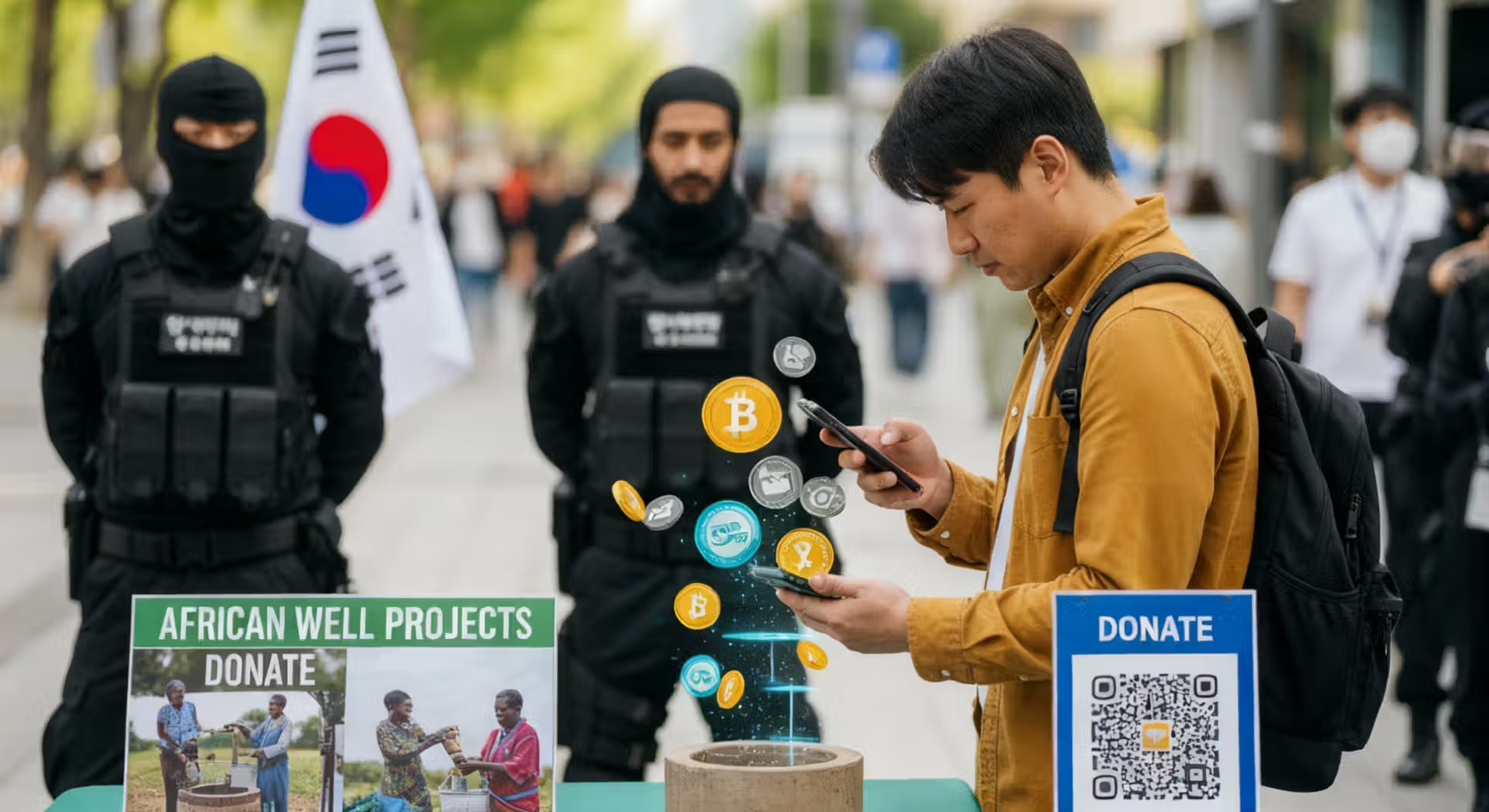
Between June 2022 and October 2025, the suspect raised close to 952 million won (approximately $664,000) through social media appeals and local fundraising events under the pretense of supporting humanitarian projects in Africa. Authorities confirmed that around 27 million won was ultimately transferred to Katibat al-Tawhid wal-Jihad (KTJ), a UN-designated extremist group in Syria, and to virtual wallets linked to Hamas.
The suspect reportedly posed as a charity volunteer and ran an amateur football club in Gyeonggi Province to solicit donations from fellow Uzbek nationals. Investigators discovered that donations were often collected in the stablecoin USDT, allowing rapid conversion and transfer to overseas wallets without traditional banking oversight. The operation demonstrates how the misuse of digital currencies and charitable structures can outpace existing detection mechanisms within AML frameworks.
This incident underscores the need for closer collaboration among financial regulators, virtual asset service providers (VASPs), immigration authorities, and law enforcement agencies. Each stage of the scheme—from fundraising to conversion, transfer, and concealment—exploited systemic weaknesses in monitoring, highlighting how criminal innovation continuously adapts to technological and regulatory blind spots.
The South Korean police described this as the largest terrorist financing case ever uncovered domestically. Beyond the immediate criminal charges, it reveals an urgent need to integrate digital asset surveillance and cross-border intelligence-sharing into AML and counter-terrorism systems to prevent future abuse.
Anatomy of the case: fundraising, transfers and concealment
The operation’s structure reflected a sophisticated layering of fundraising and concealment techniques. Initially, the suspect posed as a humanitarian fundraiser affiliated with a fake charity claiming to build wells in Africa. Using social media, he targeted Uzbek expatriates in Korea, posting emotional content about refugees and providing bank and wallet details for “donations.” These online appeals formed the foundation of his collection network.
He then leveraged local community structures to add legitimacy. The formation of a small football club in Gyeonggi Province allowed him to host events and raise funds under the guise of sports activities. This type of setup is difficult for financial institutions to flag because sports clubs and charities are often classified as low-risk entities.
The second phase involved the conversion of collected funds into virtual assets. Authorities reported that 626,819 units of USDT were raised and held in multiple wallets. At the time, the exchange rate of approximately 1,520 won per USDT translated to nearly one billion won. This conversion into digital form gave the suspect anonymity, mobility, and access to foreign wallet addresses beyond domestic supervision.
A portion of these funds, around 27 million won, was transferred to wallets linked to KTJ and Hamas. Both groups are under sanctions by the United Nations, the European Union, and the United States. By sending digital assets rather than bank transfers, the suspect effectively avoided automatic screening by financial institutions that would have otherwise detected connections to sanctioned entities.
Authorities also uncovered that the suspect had entered Korea in 2018 on a student visa and later filed 11 separate refugee applications to prolong his stay after Uzbekistan invalidated his passport in 2022 following a domestic terrorism financing investigation. His continued presence in Korea allowed him to manage multiple accounts and cryptocurrency wallets without consistent oversight.
The case’s unraveling required close coordination between the Gyeonggi Nambu Provincial Police, South Korea’s National Intelligence Service, the Uzbek Embassy, and the U.S. FBI. Investigators traced transactions across several exchanges and ultimately apprehended the suspect on October 16, 2025. The integration of international intelligence channels proved essential to identifying both the flow of funds and their destination.
For AML specialists, the anatomy of this scheme reveals how each layer—non-profit cover, social media solicitation, digital asset conversion, visa manipulation, and cross-border coordination—forms part of a modern laundering and terror-financing architecture. Every stage contained red flags that could have been detected earlier if more granular monitoring of charities, virtual asset transactions, and refugee-status applicants had been in place.
Money laundering implications and regulatory gaps
This case carries major implications for the global AML and counter-terrorist financing community. It not only exposes vulnerabilities in South Korea’s virtual asset monitoring and non-profit oversight but also illustrates how the boundaries between money laundering and terrorist financing are blurring.
First, the misuse of charitable organizations and sports clubs poses a serious challenge. Traditional AML risk models often classify these entities as low risk. However, when donations originate from high-risk jurisdictions or are converted into cryptocurrencies, the threat level escalates dramatically. Regulators must therefore update their frameworks to include the misuse of local community organizations as conduits for illicit funding.
Second, virtual assets remain the preferred tool for layering and obfuscation. Stablecoins like USDT enable rapid transfer of value without reliance on the formal banking sector. Because exchanges often operate across jurisdictions, tracing these flows demands cooperation among international regulators and law enforcement. VASPs should deploy transaction-monitoring systems capable of identifying large donation-style inflows, recurring wallet patterns, and transfers to sanctioned addresses.
Third, immigration processes can inadvertently provide cover for illicit fundraising. Multiple refugee applications allowed the suspect to remain in the country despite having an invalidated passport and a pending arrest warrant abroad. Enhanced data sharing between immigration services and financial intelligence units would have likely exposed these inconsistencies earlier.
Fourth, diaspora-based fundraising networks require particular scrutiny. The suspect exclusively targeted Uzbek nationals in South Korea, exploiting trust within a small expatriate community. Such networks often escape regulatory attention because they operate within personal circles. AML programs should therefore incorporate diaspora risk indicators, especially for communities with ties to conflict zones or sanctioned regions.
Finally, the case reinforces the importance of sanctions enforcement in the virtual asset domain. While banks regularly screen transactions against sanction lists, many crypto transfers occur peer-to-peer without name-matching or address screening. Regulators should require exchanges to monitor not only wallet identifiers but also transaction behavior that matches patterns associated with sanctioned groups.
The convergence of these vulnerabilities demonstrates that terrorist financing can seamlessly intersect with money laundering. Funds collected under charitable pretexts, layered through digital assets, and transferred to conflict regions meet both criteria—concealment of illicit origins and funding of prohibited activity. To counter this, financial institutions, regulators, and VASPs must align their AML and counter-terrorism frameworks under a unified risk-based approach.
Compliance lessons for financial institutions and VASPs
The South Korean case offers critical lessons for global compliance professionals. First, institutions must strengthen due diligence on non-profit clients and local associations. Every organization soliciting cross-border donations, especially through crypto wallets, should undergo enhanced vetting of its governance, beneficiary network, and use of funds.
Second, transaction monitoring systems must evolve. Traditional indicators such as large wire transfers or multiple cash deposits are insufficient in a world where stablecoin movements occur instantly. Institutions should adopt blockchain analytics tools capable of mapping wallet clusters, flagging suspicious movement patterns, and identifying linkages to known extremist addresses.
Third, risk scoring should include immigration and visa-related intelligence. Banks onboarding foreign students, refugees, or asylum seekers from high-risk jurisdictions should apply enhanced due diligence measures, including validation of passport status, background screening, and cross-checking with foreign authorities where permissible.
Fourth, institutions should collaborate more actively with law enforcement. Information sharing between VASPs, banks, and financial intelligence units can dramatically shorten the detection window for illicit fundraising campaigns. Establishing national typology repositories or shared red-flag libraries for donation-related crimes can improve industry-wide awareness.
Fifth, financial institutions should refine their sanction-screening capabilities. Screening should extend to wallet identifiers, transaction metadata, and behavioral analysis rather than relying solely on name-based searches. Integrating blockchain analytics with traditional sanctions databases can provide a more complete risk picture.
Lastly, compliance frameworks should address the growing use of diaspora communities for illicit fundraising. Culturally informed monitoring, combined with localized outreach programs, can help detect when legitimate community fundraising crosses into prohibited territory. Institutions should flag accounts that exhibit recurring small donations followed by large crypto conversions or transfers abroad.
By incorporating these lessons, financial institutions and VASPs can close many of the gaps that allowed this operation to flourish. The case serves as a warning that AML and CFT compliance must evolve as quickly as the tactics of those who seek to exploit them.
Final considerations and forward-looking actions
This case will likely shape South Korea’s future approach to AML and CFT enforcement. It highlights the need for integrated supervision between financial, virtual asset, and immigration authorities. Virtual assets, when left unmonitored, provide terrorists and money launderers with unprecedented reach and anonymity.
Going forward, regulators should require:
• enhanced due diligence on non-profits accepting digital assets,
• mandatory reporting of large stablecoin donations,
• coordinated monitoring between immigration, FIUs, and law enforcement,
• inclusion of diaspora risk indicators in national risk assessments, and
• clear legal guidance for the freezing of virtual assets linked to terrorist financing.
For global institutions, this case underscores the necessity of updating compliance models to include refugee-status exploitation, digital fundraising, and virtual-asset transfers. Continuous staff training on typologies involving charities, sports clubs, and social media solicitation is essential.
From a strategic standpoint, South Korea’s coordinated response—combining local police, intelligence services, and international partners—provides a model for how jurisdictions can respond effectively to cross-border money laundering and terrorist financing. However, prevention remains the best defense. Institutions must ensure their systems are capable of detecting such schemes before they reach operational maturity.
Ultimately, the Uzbek national’s fundraising network serves as a cautionary tale: terrorist financing can thrive within ordinary community structures when AML vigilance fails. Compliance professionals worldwide must absorb these lessons to protect financial systems from similar infiltration.
Related Links
- United Nations Office of Counter-Terrorism – Virtual assets and donation risks
- FATF Comprehensive Update on Terrorist Financing Risks (2025)
- Egmont Group Report on Abuse of Virtual Assets for Terrorist Financing (2023)
- U.S. Treasury OFAC – Designation of Katibat al-Tawhid wal-Jihad
- U.S. Department of State – Combating Terrorist Financing
Other FinCrime Central Articles About Charities Being Used For Terrorism Financing
- Global Charity Laundering Exposed Khalistani and Islamist Networks Funding Terror
- How Online Fundraising Empowers Terrorism Financing Networks
- OFAC Crackdown Unveils Hidden Millions Flowing to Hamas and FPLP via Sham Charities
Source: Korea JoongAng Daily
Some of FinCrime Central’s articles may have been enriched or edited with the help of AI tools. It may contain unintentional errors.
Want to promote your brand, or need some help selecting the right solution or the right advisory firm? Email us at info@fincrimecentral.com; we probably have the right contact for you.