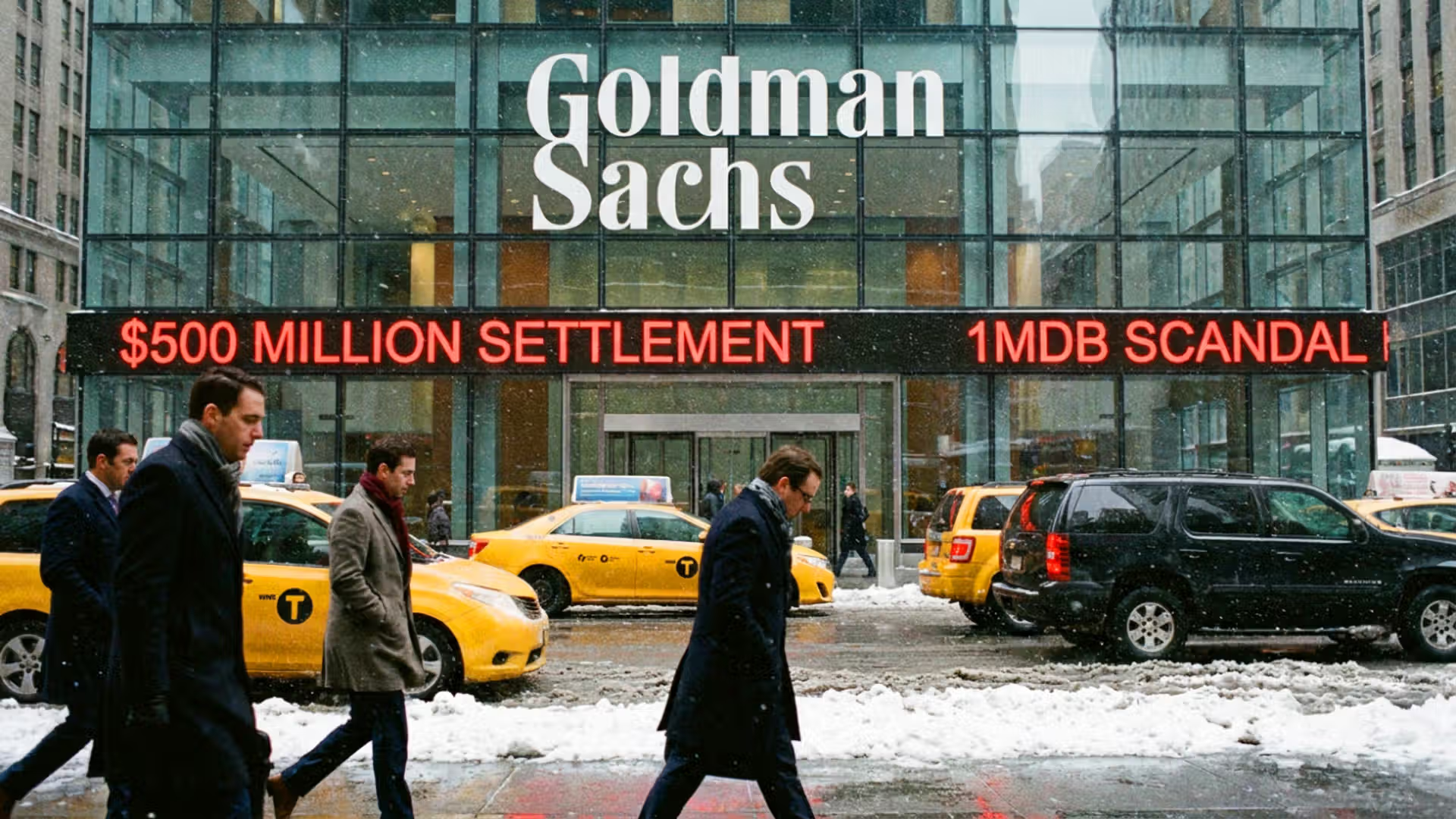
A federal court filing in Manhattan recently revealed that Goldman Sachs has agreed to pay a $500 million penalty to settle a significant class action lawsuit brought forward by institutional investors over the 1MDB scandal. The litigation accused the prominent Wall Street financial institution of misleading its own shareholders regarding its extensive operational involvement with the strategic investment development fund, known traditionally as the Malaysian state wealth vehicle. This major sovereign wealth organization became the centerpiece of one of the most complex international asset diversion and financial crime conspiracies in modern history. The legal action, spearheaded by a major Swedish pension fund alongside other institutional investors, asserted that the financial organization artificially maintained its market valuation by misrepresenting internal risk management frameworks while actively participating in high-value bond offerings.
Table of Contents



Sovereign Wealth Fund Underwriting and the 1MDB Bond Issuances
The historical operational background of this litigation traces back to a series of massive debt originations structured by the global investment bank on behalf of the Malaysian state development entity. Between the years of 2012 and 2013, the financial institution facilitated the issuance of approximately 6.5 billion dollars in sovereign-backed bonds, which were ostensibly intended to fund domestic economic development initiatives, infrastructure projects, and strategic energy investments within the Southeast Asian nation. Instead of achieving these public objectives, global law enforcement agencies and regulatory bodies subsequently discovered that a network of corrupt officials and external facilitators systematically diverted billions of dollars away from the state treasury. This massive siphoning of capital triggered international investigations across multiple jurisdictions as authorities sought to trace the complex web of transactions that allowed public funds to be extracted from the national development treasury. The multi-billion-dollar bond deals were processed with unprecedented speed, raising immediate concerns among external financial observers regarding the adequacy of institutional oversight and the depth of the due diligence performed prior to execution. Despite clear red flags concerning the rapid movement of capital and the unconventional structuring of the accounts, the transaction proceeded without substantial internal intervention, allowing the initial phase of the asset dissipation to occur unhindered. This systemic failure within the operational hierarchy highlights how profit incentives can inadvertently undermine risk mitigation protocols when dealing with high-value state clients.
The orchestrators of this illicit architecture utilized a labyrinthine network of offshore banking institutions, opaque corporate vehicles, and international shell companies to obscure the true origin, ownership, and ultimate destination of the public funds. Throughout this period, the underwriting financial institution collected an estimated 600 million dollars in investment banking fees, a sum that compliance professionals later noted was significantly higher than standard market rates for similar sovereign debt issuances. The sheer volume of these fees, combined with the rapid deployment of the capital into high-risk jurisdictions, should have triggered immediate internal compliance inquiries and enhanced due diligence protocols within the global banking group. Financial investigators later established that the excessive fee structure served as a powerful internal incentive to expedite the transactions, effectively silencing internal critics who raised preliminary questions about the legitimacy of the fund operations. The subsequent distribution of these funds involved intricate layer transactions designed to sever the audit trail, making it exceptionally difficult for standard regulatory reporting mechanisms to detect the ongoing diversion. By routing capital through multiple international jurisdictions with strict bank secrecy laws, the facilitators successfully concealed the integration of public money into private luxury markets.
The failure to properly interrogate the underlying economic substance of these multi-billion-dollar bond transactions ultimately allowed corrupt actors to exploit the global financial system. Shareholder plaintiffs argued that the bank’s senior leadership was fully aware of the heightened compliance risks associated with the Malaysian state fund but chose to prioritize short-term profitability over regulatory adherence. This operational approach allowed the siphoned capital to enter the international banking system, where it was subsequently laundered through high-end real estate acquisitions, luxury asset purchases, and complex corporate structures scattered across multiple continents. Institutional oversight mechanisms failed at several critical junctures, as repeated warnings from regional compliance officers were systematically downplayed or entirely dismissed by senior executives focused on meeting aggressive revenue targets. This structural negligence not only facilitated the immediate theft of public assets but also inflicted severe long-term reputational damage on the financial institution itself, culminating in widespread public condemnation and a profound loss of investor confidence globally. The broad geographic dispersion of the laundered assets required an unprecedented level of international cooperation among law enforcement agencies, demonstrating the immense scale of the defensive actions necessary to counter modern transnational financial crime networks.




Regulatory Sanctions and Criminal Guilt in Financial Institutions
The corporate fallout from the Malaysian state fund conspiracy extended far beyond civil shareholder litigation, resulting in historic criminal penalties and structural regulatory interventions globally. In the year 2020, the parent financial organization entered into a comprehensive corporate resolution with the United States Department of Justice alongside multiple international regulatory authorities, resulting in a total financial penalty exceeding 2.9 billion dollars. As part of this extensive deferred prosecution agreement, a key foreign subsidiary of the Wall Street bank formally entered a guilty plea in a federal court, admitting to criminal wrongdoing regarding its participation in the corrupt bond underwriting scheme. This landmark enforcement action sent a clear signal to the entire global banking sector that turning a blind eye to sovereign corruption would result in unprecedented financial penalties and catastrophic reputational harm. The multi-billion dollar fine represented one of the largest monetary sanctions ever imposed for anti-money laundering compliance failures, underscoring the severity with which regulatory bodies view the facilitation of state-level kleptocracy. Furthermore, the judicial resolution required the implementation of strict independent monitoring to ensure complete transparency in all future sovereign debt transactions.
This structural enforcement action demonstrated that major financial institutions could face severe corporate criminal liability when internal anti-money laundering frameworks fail to prevent large-scale state asset dissipation. Furthermore, the criminal prosecution targeted individual actors within the banking hierarchy, leading to the formal conviction of a former managing director and the guilty plea of another senior investment banker who actively conspired with external network architects to bypass internal compliance controls. These individuals actively subverted the bank’s internal oversight mechanisms, falsified documentation, and provided misleading statements to internal compliance committees to ensure the lucrative bond transactions were successfully closed. The individual prosecutions revealed a deeply troubling pattern of internal collusion, where senior personnel weaponized their intimate knowledge of the bank’s compliance systems to evade detection and suppress internal alerts. This internal sabotage effectively neutralized the institution’s defensive parameters, illustrating that even the most sophisticated monitoring software is entirely ineffective if the human elements responsible for its operation are actively working to undermine its integrity for personal and corporate gain.
The formal conclusion of the three-year deferred prosecution agreement occurred in May of the year 2024, after a federal judge in Brooklyn officially dismissed the criminal charges against the corporate entity following the bank’s compliance with the mandated remediation terms. However, the subsequent 500 million shareholder settlement underscores that the financial and legal repercussions of systemic anti-money laundering failures can persist for years after regulatory authorities conclude their formal criminal investigations. The civil litigation focused heavily on the institutional deception practiced by corporate leadership, who continuously reassured public markets that the bank maintained industry-leading risk management systems while internal documents revealed significant vulnerabilities. This lingering legal liability demonstrates that regulatory clearance does not automatically insulate a financial institution from the wrath of its investors, who possess independent legal avenues to seek redress for the artificial inflation of stock prices. The protracted nature of these concurrent legal battles serves as a stark warning to boards of directors everywhere regarding the compounding costs of compliance failures.


Governance Failures and Long-Term Compliance Remediation
The intersection of state-level corruption, investment banking operations, and shareholder deception highlights a fundamental vulnerability in global corporate governance models. Institutional investors argued that the dramatic decline in the bank market capitalization, which occurred as the full scope of the Malaysian state fund fraud became public, was a direct consequence of the bank’s failure to maintain transparent reporting standards. The discrepancy between the public declarations of pristine risk management and the internal realities of compliance subversion forms the core legal basis of the securities fraud claims that necessitated this massive 500 million dollar settlement. The long-term erosion of shareholder value resulting from these disclosures illustrates how deeply intertwined ethical governance is with sustainable financial performance. When a firm repeatedly misleads the market regarding its exposure to criminal investigations, it violates the foundational trust required for stable capital market operations, inviting aggressive litigation from large-scale institutional asset managers who are legally obligated to protect their beneficiaries.
For anti-money laundering officers and corporate governance experts, this case serves as an enduring case study on the catastrophic risks associated with institutional blind spots driven by fee generation. When a financial entity fails to cultivate a corporate culture that empowers compliance personnel to halt suspicious transactions involving politically exposed persons, the resulting legal liabilities can easily wipe out the profits generated by the underlying business units. The cumulative financial burden borne by the Wall Street institution across criminal fines, regulatory disgorgements, and civil settlements eventually totaled several billion dollars, vastly exceeding the 600 million dollars in fees originally generated by the bond deals. This stark mathematical imbalance completely refutes the short-term business logic that prioritizes transactional volume over rigorous risk assessment. The enduring lesson for the financial services industry is that compliance must never be viewed as an operational cost center to be minimized, but rather as an essential protective shield necessary to preserve the very survival of the corporate entity.
The ongoing process of institutional remediation requires a total overhaul of how global banks assess the integrity of sovereign wealth funds and state-owned enterprises. Modern anti-money laundering frameworks must implement continuous monitoring systems that look past formal government sign-offs to verify the actual beneficial ownership and utilization of capital raised through public debt markets. The resolution of this shareholder lawsuit highlights that the modern investment landscape demands absolute transparency, as sophisticated institutional investors possess the resources and legal standing to hold financial giants accountable for facilitating international financial crimes. True remediation requires a cultural shift where compliance metrics are integrated directly into executive compensation models, thereby aligning personal financial incentives with long-term regulatory adherence. Until financial institutions fundamentally restructure their internal reward systems to penalize compliance subversion, the temptation to facilitate high-value, high-risk state transactions will remain a persistent vulnerability across the global financial landscape.
Anti Money Laundering Typologies for Institutional Financial Crimes
Anti-money laundering compliance professionals must analyze the specific operational methodologies utilized in massive sovereign wealth fund diversions to enhance their internal detection mechanisms. When evaluating high-risk transactions involving state-directed capital or significant bond originations, compliance officers should remain vigilant for specific behavioral patterns and structural anomalies.
- Exploitation of Sovereign Wealth Structures: The utilization of state-owned investment vehicles or public development funds to raise massive tranches of capital that are rapidly transferred to unrelated foreign entities without a clear economic purpose.
- Abnormal Investment Banking Advisory Fees: The payment of unusually high underwriting or advisory fees that deviate significantly from standard regional benchmarks, which may indicate an effort to incentivize institutional non-compliance or look past structural irregularities.
- Opaque Corporate Entities in Secrecy Jurisdictions: The extensive routing of public bond proceeds through shell companies, offshore financial centers, and private banking accounts linked to politically exposed persons or unauthorized third-party intermediaries.
- Subversion of Internal Compliance Gatekeepers: Deliberate actions taken by internal business line executives to mislead compliance committees, falsify background information, or bypass enhanced due diligence protocols regarding high-risk clients.
- Inconsistencies in Capital Utilization Reporting: A profound lack of verifiable documentation or transparent reporting concerning how funds raised through public debt markets are deployed, contrasting sharply with the stated objectives in official offering circulars.
Key Points
- Goldman Sachs has agreed to a 500 million settlement to resolve a long-standing civil class action lawsuit brought by institutional shareholders over the 1MDB sovereign wealth fund scandal.
- The shareholder litigation asserted that the financial institution actively misled public markets regarding the integrity of its risk management systems while facilitating massive fraud.
- The underlying financial crime involved the systematic diversion of 4.5 billion dollars from the Malaysian state fund through a complex global network of shell companies and offshore bank accounts.
- This civil settlement follows a prior 2.9 billion dollar criminal resolution in 2020, where a Malaysian subsidiary of the bank admitted to criminal wrongdoing in connection with the bond issuances.
- Individual accountabilities within the financial organization included the criminal conviction of one senior investment banker and a guilty plea from another for subverting internal compliance controls.
Related Links
- United States Department of Justice Official 2020 Press Release on Goldman Sachs 1MDB Resolution
- Securities and Exchange Commission Enforcement Actions Regarding Sovereign Wealth Fund Fraud
- Federal Reserve Board Orders Against Financial Institutions for Anti-Money Laundering Failures
- Financial Action Task Force Guidance on Inherent Money Laundering Risks in Sovereign Debt
Other FinCrime Central Articles about 1MDB
- Jail Sentence for Tim Leissner in Goldman Sachs 1MDB Case
- Costly 3 Million CHF Lesson for JP Morgan Suisse in 1MDB Ruling
- Standard Chartered Under Fire as $3.4 Billion 1MDB Laundering Lawsuit Hits Singapore
Source: Reuters
Some of FinCrime Central’s articles may have been enriched or edited with the help of AI tools. It may contain unintentional errors.
Want to promote your brand, or need some help selecting the right solution or the right advisory firm? Email us at info@fincrimecentral.com; we probably have the right contact for you.