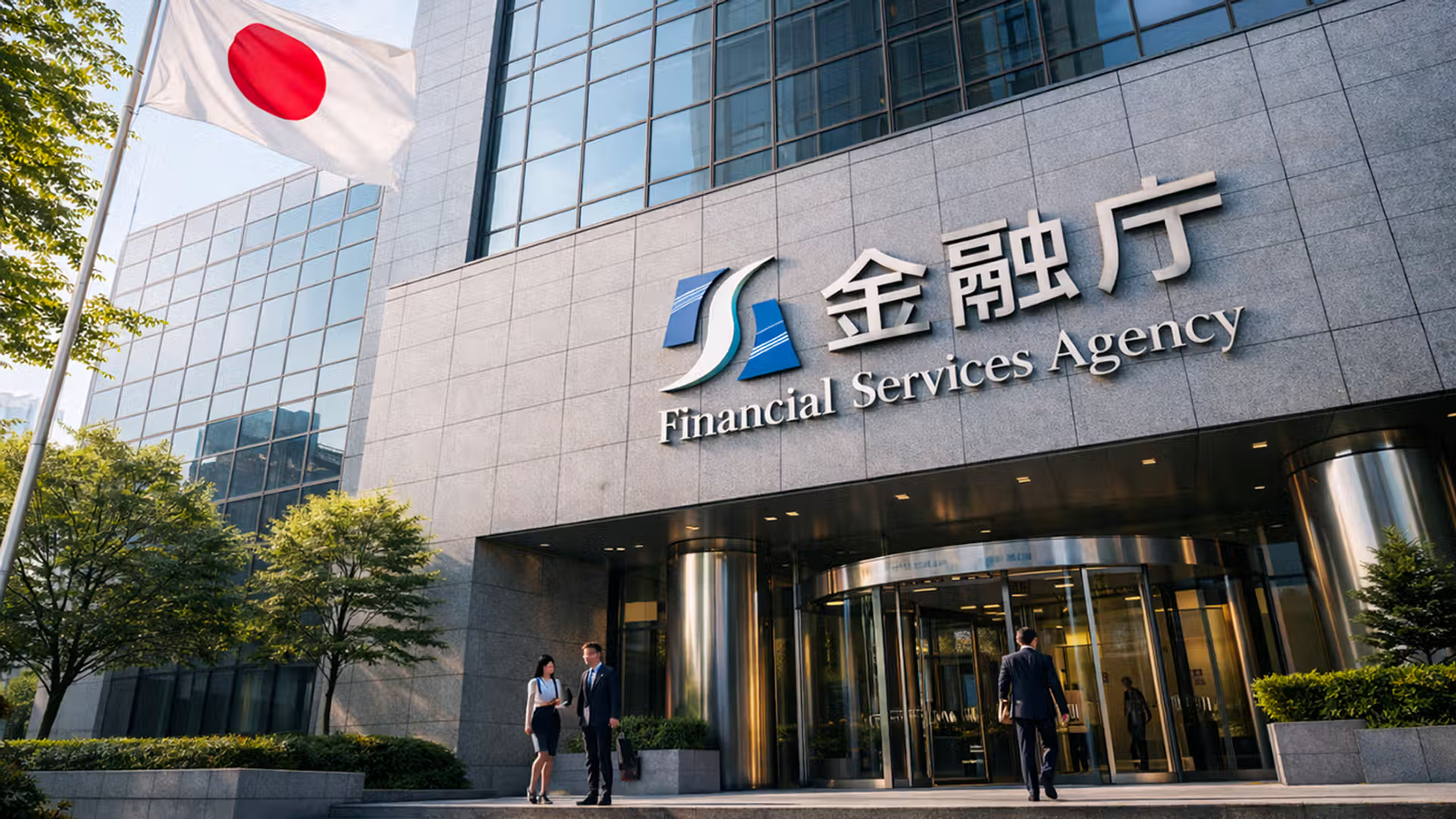
The Financial Services Agency of Japan has released its revised Guidelines for Anti-Money Laundering and Combating the Financing of Terrorism to address evolving risks in the global financial landscape. These updated protocols emphasize a more rigorous risk-based approach that requires financial institutions to proactively identify and mitigate vulnerabilities within their specific operational contexts. By refining the expectations for internal control frameworks, the regulator aims to harmonize domestic practices with international standards established by the Financial Action Task Force. The guidelines serve as a comprehensive roadmap for banks, insurance companies, and other financial entities to enhance their defensive measures against criminal exploitation of the economic system. Through this publication, the Japanese government reaffirms its commitment to maintaining the transparency and integrity of its financial markets in 2026 and beyond.
Table of Contents



Japanese Financial Regulatory Updates and Risk Management
The transition toward a more sophisticated oversight model in Japan is driven by the necessity to protect the national economy from the destabilizing effects of illicit capital. Under the current guidelines, the Financial Services Agency has shifted its focus from a purely rules-based compliance check to a dynamic risk-based assessment process. This requires every financial institution to develop a deep understanding of its own risk profile, taking into account the nature of its clients, the specific products it offers, and the geographic regions in which it operates. For instance, a bank dealing extensively with cross-border trade finance must implement much more stringent controls than a local credit union serving a domestic retail base. The regulator expects firms to document these assessments meticulously and to demonstrate that their mitigation strategies are proportional to the identified threats. This approach ensures that limited compliance resources are directed where they are most needed, rather than being spread thinly across all activities regardless of their actual risk level.
Furthermore, the guidelines clarify the expectations for ongoing monitoring and the periodic review of client relationships. It is no longer sufficient to conduct due diligence only at the time of account opening. Instead, firms must maintain a continuous cycle of oversight, updating client information and risk ratings as circumstances change. This is particularly important for high-net-worth individuals and politically exposed persons who may experience sudden changes in their financial status or influence. The Financial Services Agency emphasizes that the data used for these assessments must be accurate, up to date, and easily accessible for regulatory audits. Failure to maintain high-quality data is viewed as a fundamental weakness in an institution’s defense mechanism. By establishing these clear expectations, the Japanese authorities are pushing the private sector to adopt a more proactive and analytical mindset, moving beyond simple box-ticking exercises to become true partners in the fight against financial crime.




Enhancing Internal Control Systems for Global Integrity
A robust internal control system is the backbone of any effective anti-money laundering program, and the revised guidelines provide a detailed blueprint for its construction. The Financial Services Agency identifies three distinct lines of defense that must be clearly defined and adequately resourced within every organization. The first line consists of the business units themselves, which are responsible for the day-to-day identification of risks and the execution of basic due diligence. The second line is the compliance and risk management department, which provides oversight, develops policies, and monitors the effectiveness of the first line. The third line is the internal audit function, which must remain independent and provide objective verification that the entire system is functioning as intended. This tripartite structure ensures that there are multiple layers of accountability and that no single failure can compromise the integrity of the entire institution.
The regulator also places a heavy emphasis on the role of technology in modern compliance. As transaction volumes increase and criminal methods become more sophisticated, manual monitoring is no longer a viable option for most firms. The guidelines encourage the adoption of advanced transaction monitoring systems that utilize artificial intelligence and machine learning to identify patterns associated with money laundering, such as smurfing or rapid layering of funds. However, the Financial Services Agency cautions that technology is not a panacea. These systems must be regularly tuned and validated by human experts to ensure they are capturing the right risks without overwhelming compliance teams with false positives. The human element remains critical, particularly in the investigation of flagged activities and the ultimate decision to file a suspicious activity report. Training programs must therefore be comprehensive, covering not only the technical aspects of the law but also the practical skills required to spot red flags and conduct deep dive investigations into complex financial structures.

Accountability and the Responsibility of Senior Management
One of the most significant changes in the regulatory landscape is the heightened level of accountability placed on the board of directors and senior executive officers. The Financial Services Agency has made it clear that anti-money laundering compliance is not merely a technical task for the legal department but a core strategic priority that must be championed from the top. Senior management is responsible for fostering a corporate culture that prioritizes ethical conduct and legal compliance over short-term profit. This involves ensuring that the compliance department has a sufficient budget, high-quality staff, and a direct line of communication to the board. In cases where systemic failures are discovered, regulators will look closely at whether the leadership provided adequate resources and whether they were informed of the risks facing the firm.
This top-down approach is intended to prevent the silos that often lead to communication breakdowns in large organizations. When the board is actively engaged in the oversight of risk management, the institution is much more likely to identify and address vulnerabilities before they can be exploited by criminals. The guidelines also require firms to establish clear internal reporting lines that protect whistleblowers and ensure that ethical concerns can be raised without fear of retaliation. By making compliance a matter of personal accountability for senior leaders, the Japanese government is seeking to align the incentives of the private sector with the public goal of financial stability. This shift in focus reflects a global trend toward individual liability for corporate failures, signaling that the era of corporate anonymity in the face of regulatory breaches is coming to an end.
Future Resilience and the Evolving Regulatory Landscape
The Financial Services Agency views these guidelines as a living document that must evolve in tandem with the financial industry itself. As new technologies like decentralized finance and virtual assets become more integrated into the mainstream economy, the regulator will continue to issue updates and clarifications to address the unique risks they present. The current focus on a risk-based approach provides the flexibility necessary to adapt to these changes without the need for constant legislative overhaul. Financial institutions must remain agile, staying informed of emerging threats and adjusting their internal controls accordingly. The regulator has indicated that it will continue to conduct rigorous on-site inspections and off-site monitoring to ensure that the principles outlined in the guidelines are being effectively implemented in practice.
In addition to domestic oversight, Japan remains committed to international cooperation and the sharing of best practices with other global regulators. Money laundering is a transnational crime that knows no borders, and its prevention requires a coordinated global response. By aligning its domestic standards with the latest recommendations from the Financial Action Task Force, Japan ensures that its financial system remains a hostile environment for illicit capital while remaining open and attractive to legitimate global investors. The long term success of these efforts will depend on the continued partnership between the government and the private sector, as well as a shared commitment to the principles of transparency and integrity. As Japan continues to strengthen its defenses, it sets a powerful example for other nations in the region and contributes to the overall stability of the international financial order. The path forward requires constant vigilance, but with a clear strategic framework in place, the Japanese financial sector is well positioned to meet the challenges of the future.
Key Points
- The Japan Financial Services Agency updated its Guidelines for Anti-Money Laundering and Combating the Financing of Terrorism on March 31, 2026.
- These guidelines mandate a sophisticated risk-based approach requiring institutions to perform self-directed risk assessments and mitigation.
- Senior management is held directly accountable for the effectiveness of the internal control frameworks and the accuracy of suspicious activity reporting.
- The revisions are specifically designed to bring Japanese financial oversight into full alignment with the latest FATF international standards.
- Financial institutions must prioritize continuous monitoring and employee training to adapt to evolving techniques used in money laundering and terrorist financing.
Related Links
- Japan Financial Services Agency AML CFT Guidelines 2026
- FATF Recommendations on International AML Standards
- Act on Prevention of Transfer of Criminal Proceeds Japan
- FSA Frequently Asked Questions on AML Guidelines
- Ministry of Finance Japan Financial Integrity Reports
Other FinCrime Central Articles About Japan
- Japan Strategic Compliance Framework for Reporting Suspicious Transactions
- Japan’s FSA Sets the Pace for Foreign Banks Compliance Excellence
- Japan’s FSA Exposes Major AML Failures at AEON Bank
Source: FSA
Some of FinCrime Central’s articles may have been enriched or edited with the help of AI tools. It may contain unintentional errors.
Want to promote your brand, or need some help selecting the right solution or the right advisory firm? Email us at info@fincrimecentral.com; we probably have the right contact for you.