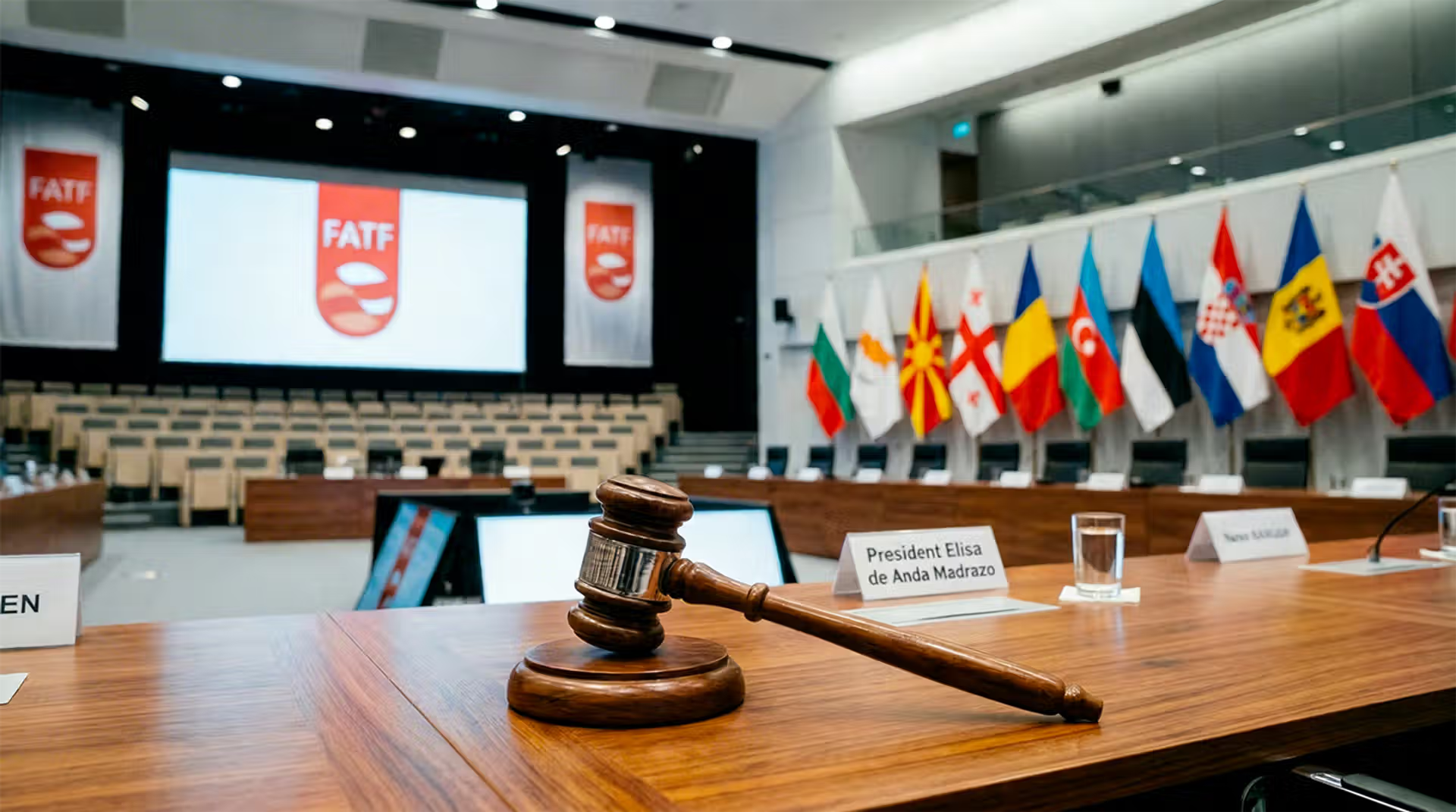
Regulatory bodies within Central Europe have recently undergone a series of rigorous evaluations as the FATF publishes updated 2025 reports detailing the technical compliance of regional financial frameworks. These latest assessments indicate a significant move toward closing legislative gaps that previously allowed for the movement of illicit capital across borders. The reports highlight a collective effort among nations such as Slovakia, Poland, and Hungary to rectify historical deficiencies in beneficial ownership transparency and the supervision of non-financial professions. While many jurisdictions have successfully upgraded their legal statutes to meet global expectations, the practical application of these laws remains a focal point for upcoming effectiveness reviews. The overarching objective is to create a unified front against financial crimes that threaten regional economic stability and the integrity of the global banking system.
Table of Contents


Strengthening Regional Anti-Money Laundering Frameworks
The landscape of financial integrity in Central Europe is undergoing a transformation as nations align their domestic policies with updated international requirements. Slovakia has demonstrated notable progress in its latest assessment, specifically focusing on the regulation of virtual asset service providers and the transparency of legal persons. These advancements are not merely administrative but represent a fundamental shift in how the government perceives and mitigates the risks associated with modern financial crimes. By implementing stricter reporting requirements and enhancing the powers of its financial intelligence unit, Slovakia aims to close loopholes that have previously been exploited by transnational criminal networks. The 2025 updates emphasize that technical compliance is the first step in a longer journey toward demonstrating high levels of effectiveness in preventing the integration of criminal proceeds into the legitimate economy.
In Moldova, the focus of the recent follow-up report centers on the progress made in addressing deficiencies identified in previous rounds of evaluation. The nation has worked extensively to improve its legal framework regarding the freezing of terrorist assets and the oversight of non-profit organizations. These measures are critical for a country situated at a geopolitical crossroads, where the risk of illicit transit remains a constant concern. Moldovan authorities have also bolstered their international cooperation mechanisms, ensuring that information regarding suspicious transactions can be shared more rapidly with foreign counterparts. The report reflects a growing political will to treat financial crime as a top-tier security priority, which is essential for maintaining investor confidence and securing the country’s path toward further economic integration with European markets.



Enhancing Transparency Through Beneficial Ownership Registries
A critical component of the recent legislative updates across the surveyed nations is the enhancement of beneficial ownership transparency. Azerbaijan and Montenegro have made strides in ensuring that information regarding the true controllers of legal entities is accurate, accessible, and verified. The removal of anonymity from corporate structures is widely recognized as one of the most effective tools in the fight against shell company abuse. In Azerbaijan, new protocols for the collection of ownership data have been integrated into the corporate registration process, making it significantly harder for individuals to hide their involvement in suspicious transactions. These registries are now subject to more frequent audits, ensuring that the data provided by companies remains current and useful for law enforcement agencies conducting complex financial investigations.
Montenegro has similarly focused on the real estate sector, which remains a high-pressure point for the laundering of illicit funds derived from foreign criminal activities. The latest report notes that Montenegro has improved its supervision of real estate agents and developers, requiring them to conduct more thorough customer due diligence. By bringing these non-financial sectors into the regulatory fold, the country is reducing the number of safe havens available for criminal proceeds. Furthermore, the authorities have worked to harmonize their criminal code with international standards, particularly concerning the definition of money laundering offenses. This legal alignment ensures that the judicial system can effectively prosecute cases involving the layering of funds through high-value property acquisitions, a common tactic used by organized crime groups in the Mediterranean region.
Sectoral Supervision and Gatekeeper Accountability
The role of the non-financial sector, including lawyers, notaries, and casinos, has been a recurring theme in the reports for Romania and Georgia. These professionals act as gatekeepers to the financial system, and their failure to conduct adequate due diligence can lead to significant vulnerabilities. Romania has introduced more stringent supervisory measures for these designated non-financial businesses and professions, requiring more robust risk assessments and the submission of suspicious activity reports. The Romanian government has also increased the resources available to its supervisory bodies, allowing for more on-site inspections and a higher frequency of thematic reviews. These efforts are designed to ensure that the burden of vigilance is shared across all sectors of the economy, not just within traditional banking institutions.
Georgia has complemented these measures by increasing the penalties for non-compliance, sending a clear message that the lack of internal controls will not be tolerated. The Georgian authorities have focused on the gambling sector, which has grown significantly in recent years and presents unique risks for the laundering of cash. New regulations require casino operators to implement sophisticated monitoring systems to track the origin of funds used by high rollers. Additionally, Georgia has made progress in clarifying the obligations of lawyers and accountants when assisting clients with the formation of legal entities or the management of trust accounts. These reforms are part of a broader strategy to professionalize the compliance culture within the country, ensuring that all gatekeepers are aware of their responsibilities under the national anti-money laundering strategy.
Institutional Reforms and Cross-Border Cooperation
Poland and North Macedonia have focused their recent efforts on institutional capacity building and the strengthening of cross-border cooperation. The ability of a nation to engage in timely and effective information exchange with foreign counterparts is essential for dismantling international money laundering syndicates. Poland has streamlined its procedures for mutual legal assistance, allowing for faster response times when assets need to be frozen or seized at the request of international partners. This improvement is particularly vital given Poland’s geographic and economic position as a gateway between Western Europe and the East. The Polish financial intelligence unit has also increased its analytical capacity, utilizing new software to detect patterns of suspicious behavior across large datasets, which has led to more high-quality leads for law enforcement.
North Macedonia has likewise prioritized the training of its law enforcement agencies, ensuring that investigators have the specialized knowledge required to follow complex money trails across multiple jurisdictions. The recent report highlights the country’s success in improving the coordination between the prosecution service and the financial police. By creating joint task forces for high-profile financial investigations, North Macedonia has been able to reduce the time it takes to move from the detection of a crime to the filing of formal charges. Furthermore, the country has updated its laws regarding the seizure of criminal assets, making it easier for the state to permanently confiscate funds even in the absence of a criminal conviction in certain circumstances. These institutional changes are critical for building a resilient system that can withstand the pressures of corruption and organized crime.
Sustaining Progress in High Risk Jurisdictions
The reports for Cyprus and Bulgaria highlight the ongoing challenges and successes in managing high volumes of foreign direct investment while maintaining a clean financial reputation. Cyprus, once heavily criticized for its past vulnerabilities, has completely overhauled its vetting processes and increased the level of scrutiny applied to high-net-worth individuals. The country is now focusing on ensuring that its banking sector is not used as a transit point for funds linked to sanctioned entities or political corruption. The latest follow-up report notes that Cyprus has significantly improved its compliance with recommendations regarding the transparency of trusts and other legal arrangements. By requiring the registration of trust beneficiaries, the Cypriot authorities have added an extra layer of protection against the misuse of these structures for tax evasion or money laundering.
Bulgaria, while still under close monitoring by international bodies, has demonstrated a renewed political will to implement the necessary structural changes. The coordination between the Bulgarian national bank and the financial intelligence unit has improved, leading to a more synchronized response to emerging threats in the professional services sectors. The report acknowledges that Bulgaria has made progress in its legal framework for targeted financial sanctions, ensuring that it can quickly freeze the assets of individuals and entities listed by international organizations. However, the focus now shifts to the effectiveness of these measures in practice. Bulgarian regulators are working to ensure that banks and other financial institutions have the technical capability to implement these sanctions in real time, preventing any leakage of funds once a listing is announced.
Future Trajectories for Financial Integrity and Compliance
The road ahead for these jurisdictions involves a transition from legislative drafting to the demonstration of measurable impact. The international community is increasingly moving toward an assessment model that values the number of successful prosecutions and the volume of confiscated assets over simple changes in law. For countries like Croatia and Estonia, this means that the next few years will be defined by how well their newly empowered agencies use their tools to disrupt criminal operations. Croatia has focused on improving the quality of its financial investigations, particularly in cases involving public procurement fraud. Estonia, on the other hand, continues to lead in the digital space, refining its oversight of the virtual asset sector to ensure that innovation does not come at the cost of security.
The evolving nature of global finance, including the rise of decentralized finance and privacy-enhancing technologies, will require these frameworks to remain agile. The 2025 reports serve as a baseline for a new era of accountability where the focus is on the resilience of the system against unforeseen shocks. As all twelve nations continue to refine their internal controls, the emphasis must remain on the quality of the data collected and the speed at which it can be turned into actionable intelligence. The collective security of the European financial zone depends on its ability to adapt to new threats, and these updates suggest that the regional links are being reinforced with greater urgency than ever before. Sustained progress will require not only technical expertise but also a continued commitment to transparency and the rule of law at the highest levels of government.
Key Points
- Slovakia and Moldova have upgraded regulations for virtual asset service providers to meet international standards.
- Romania and Georgia have implemented stricter oversight and higher penalties for non-financial gatekeepers like real estate agents and lawyers.
- Poland has improved mutual legal assistance protocols to facilitate faster international asset freezing and seizure.
- Azerbaijan and Montenegro have enhanced beneficial ownership registries to prevent the use of shell companies for illicit activities.
- Estonia remains a leader in digital asset regulation by requiring more frequent audits and stricter licensing for crypto entities.
Related Links
- The FATF Recommendations on International Standards
- United Nations Office on Drugs and Crime Money Laundering portal
- European Commission Anti Money Laundering and Countering the Financing of Terrorism
- Wolfsberg Group Standards for Financial Institutions
- Basel Institute on Governance AML Index
Other FinCrime Central Articles About FATF Reports
- The Bare Reality Behind the 2024-2025 FATF Report
- FATF and Interpol Strategy to Combat the 1.03 Trillion Dollar Fraud Economy
- Dangerous Illusion of Strength Behind FATF Consolidated Assessment Ratings
Source: FATF
- Bulgaria
- Cyprus
- North Macedonia
- Poland
- Georgia
- Romania
- Montenegro
- Azerbaijan
- Estonia
- Croatia
- Moldova
- Slovak Republic
Some of FinCrime Central’s articles may have been enriched or edited with the help of AI tools. It may contain unintentional errors.
Want to promote your brand, or need some help selecting the right solution or the right advisory firm? Email us at info@fincrimecentral.com; we probably have the right contact for you.