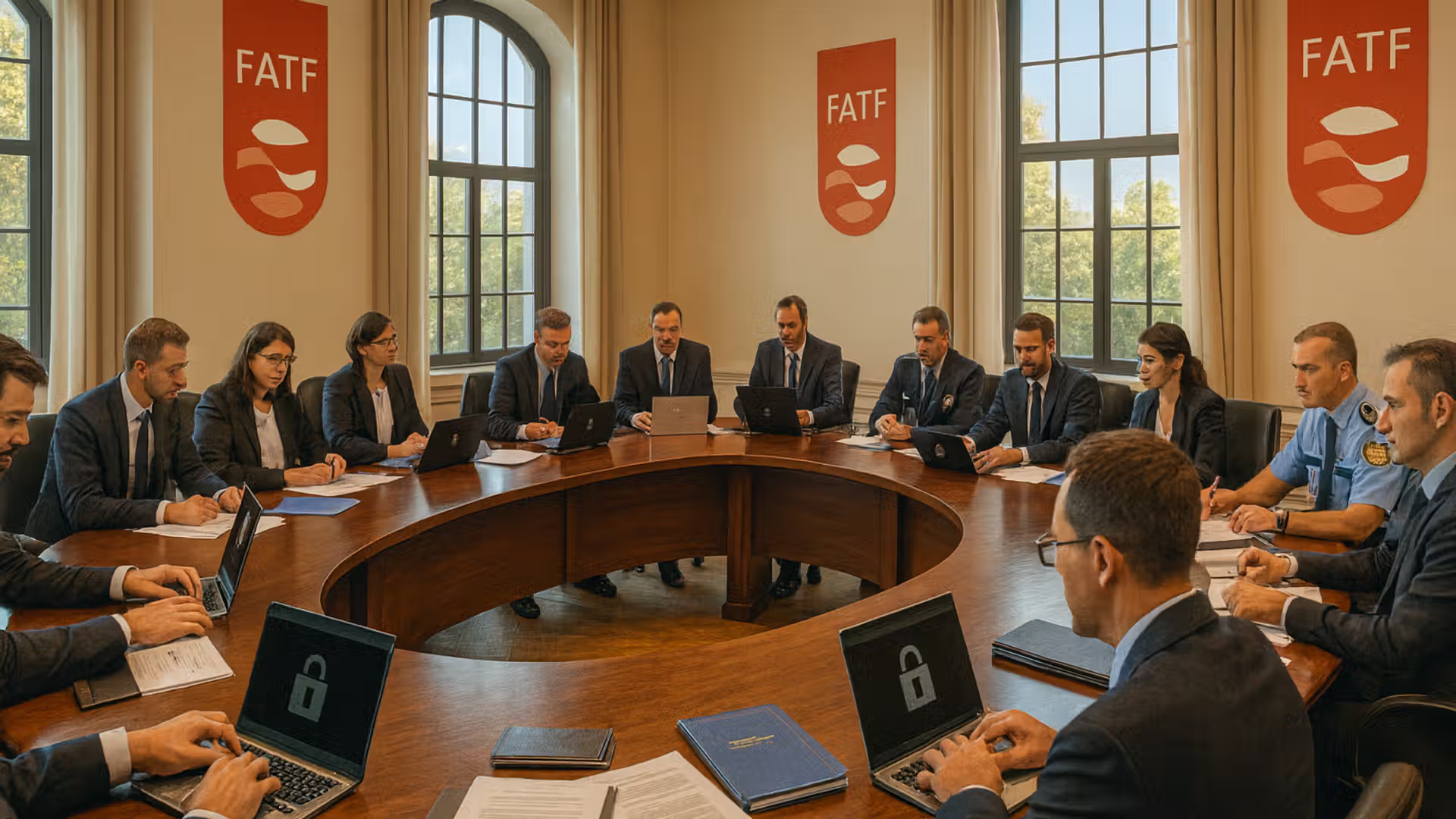
The publication of the International Co-operation on Money Laundering Detection, Investigation, and Prosecution Handbook represents a significant step by FATF, the Egmont Group, INTERPOL, and UNODC to address systemic weaknesses in the global response to illicit finance. Despite decades of progress in building AML frameworks, money laundering remains one of the least effective areas of enforcement worldwide. Criminals thrive on the slow pace of traditional processes, exploiting jurisdictional gaps to shift illicit assets across borders long before investigators can react.
The new guidance directly tackles these challenges. It emphasizes the use of informal cooperation to complement formal procedures, ensuring that intelligence flows quickly and that authorities are better equipped to act before criminal proceeds vanish. By providing specialized brochures for prosecutors, law enforcement agencies, and financial intelligence units, the initiative recognizes the distinct yet interconnected roles each plays in the AML chain.
Table of Contents


Strengthening money laundering cooperation across borders
Money laundering is rarely a domestic issue. Illicit funds generated through drug trafficking, tax fraud, corruption, or wildlife smuggling are routinely layered across multiple jurisdictions to create distance between criminals and their assets. Traditional Mutual Legal Assistance (MLA) frameworks remain essential for securing admissible evidence, but their procedural nature often means delays of weeks or months.
The handbook and its companion brochures present a solution: fast, secure, intelligence-led collaboration that helps authorities anticipate and disrupt schemes before they become entrenched. Rather than waiting for evidentiary requests to filter through central authorities, investigators are urged to use encrypted communication platforms, rapid-response protocols, and joint analysis to act in real time.
The benefits are evident in recent cross-border successes. In Europe, FIUs from Italy, Spain, and the Netherlands exposed a €95 million laundering scheme by pooling intelligence quickly. In Australia, Operation AVARUS-X disrupted billions in illegal transfers through money service businesses with U.S. support. U.S. and Indian cooperation froze USD 150 million in cryptocurrency linked to narcotics trafficking, while INTERPOL-backed coordination helped secure convictions in a wildlife smuggling case involving rhino horns. Each outcome demonstrates how speed and coordination multiply the impact of AML efforts.
Practical guidance for prosecutors, LEAs, and FIUs
The initiative is not merely theoretical. FATF and its partners released three targeted brochures to ensure guidance translates into daily practice:
For prosecutors:
The guide emphasizes how informal exchanges can sharpen MLA requests. By engaging through FIUs or LEAs, prosecutors can access intelligence faster and frame requests with greater precision. The brochure highlights best practices such as narrowly defined requests, feedback mechanisms, and diagonal cooperation. Secure communication and legal awareness are vital to maintaining both confidentiality and efficiencyInformal Int Cooperation Brochu….
For law enforcement agencies:
LEAs are tasked with operational agility. The brochure underscores the importance of early engagement with international partners, using tools such as INTERPOL’s I-24/7, Egmont Secure Web, and Europol’s SIENA. It encourages LEAs to provide partial or preliminary intelligence when full responses are delayed, ensuring that investigations remain active. Joint investigation teams and operational task forces are also promoted as key tools to strengthen prosecutionsInformal Int Cooperation Brochu….
For financial intelligence units:
FIUs are at the center of intelligence-sharing networks. The FIU brochure highlights their unique ability to act pre-emptively by sharing suspicious transaction intelligence and emerging risk data. Cutting-edge tools such as homomorphic encryption, federated learning, and blockchain-based audit trails are recommended to protect confidentiality while enabling broader cooperation. Reciprocity is a recurring theme, reinforcing that FIUs must be willing to both provide and request intelligence under common standardsInformal Int Cooperation Brochu….
Together, these guides form a triangular system of cooperation. Each actor reinforces the other, ensuring intelligence is not lost between silos but instead shared strategically to dismantle networks.
Challenges, innovation, and the road ahead
Despite these advances, major hurdles remain. Legal restrictions in some jurisdictions prevent direct cooperation between prosecutors, requiring diagonal exchanges through FIUs or LEAs. Cultural and institutional barriers also persist, where authorities may hesitate to share information without guaranteed reciprocity. Trust remains the foundation of informal exchanges, and without it, even the most sophisticated systems fail.
Technology offers part of the solution. Secure portals, encrypted messaging, and AI-driven network analysis now allow authorities to detect hidden relationships across vast datasets without breaching privacy. Privacy-enhancing technologies like secure multi-party computation and homomorphic encryption are becoming essential to balance transparency with confidentiality.
At the same time, regular capacity building and participation in international forums ensure that personal and institutional trust continues to grow. Informal cooperation relies not just on technology but on relationships. Knowing counterparts, understanding legal powers, and maintaining open lines of communication remain critical to avoiding duplication and ensuring swift action.
The upcoming 2026 UN Crime Congress in the UAE will serve as a milestone, offering member states an opportunity to showcase the progress made under this framework and recommit to dismantling financial crime infrastructure. Whether measured by asset recovery, conviction rates, or prevention of systemic risks, success will hinge on how deeply these informal practices become embedded in the daily work of FIUs, LEAs, and prosecutors.
A stronger framework for future cooperation
The FATF-led initiative marks a turning point in the global fight against money laundering. It is not a replacement for formal processes but an acknowledgment that intelligence-led agility is indispensable in the modern financial landscape.
By adopting informal cooperation as a daily practice, authorities can anticipate criminal behavior, accelerate investigations, and recover illicit wealth before it disappears. This approach builds resilience in financial systems, protects economies from criminal infiltration, and enhances global stability.
The message is clear: stronger cooperation, faster intelligence exchange, and trust-based networks are no longer optional but essential pillars of AML enforcement. If embraced fully, the handbooks could transform fragmented national efforts into a synchronized global response, leaving fewer safe havens for illicit finance.
Related Links
- FATF – International Cooperation
- Egmont Group – FIU Information Exchange
- INTERPOL – Fighting Financial Crime
- UNODC – Money Laundering
Other FinCrime Central Articles on Latest FATF Initiatives
- FATF Latest Flashcard Guidance From Risk Assessment To Asset Recovery
- FATF Flags $Billions at Risk from Evolving Terrorist Financing Gaps
- What ChatGPT Has To Say About the FATF 2025 Methodology Changes Compared to Previous Versions
Source: FATF
Some of FinCrime Central’s articles may have been enriched or edited with the help of AI tools. It may contain unintentional errors.
Want to promote your brand, or need some help selecting the right solution or the right advisory firm? Email us at info@fincrimecentral.com; we probably have the right contact for you.