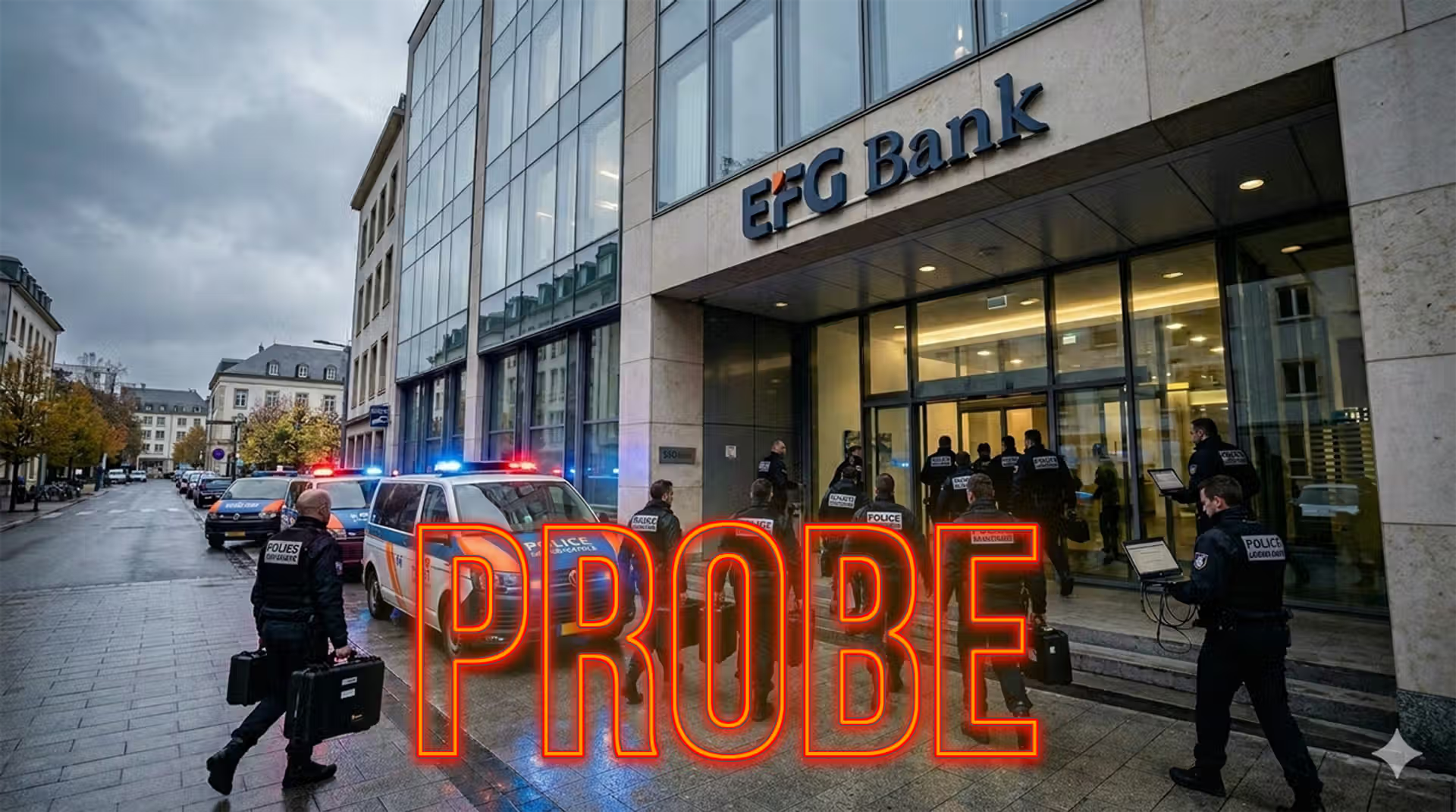
Luxembourg judicial authorities recently conducted a large-scale raid on the premises of EFG Bank to investigate potential criminal activity. This preliminary inquiry focuses on alleged violations of established anti-money laundering protocols and counter terrorism financing regulations within the financial sector. The investigation specifically targets the institutional internal controls and the historical compliance framework maintained by the private banking entity. Security officials and digital forensics experts were deployed to secure evidence during the operational phase of the probe in February 2026. While the legal process remains in its initial stages, the case highlights the increasing scrutiny placed on wealth management firms by European regulators.
Table of Contents


Anti Money Laundering Compliance Failures
The core of the legal challenge facing EFG Bank involves specific allegations regarding its failure to maintain an adequate anti-money laundering compliance environment. According to official reports from the Luxembourg Prosecutor, the investigation was initiated in 2025 following concerns about the bank’s internal organization and its adherence to the Law of 12 November 2004. This specific legislation serves as the cornerstone for financial oversight in the Grand Duchy, mandating that all credit institutions implement robust systems to detect and prevent the flow of illicit funds. The authorities are examining whether the bank neglected its statutory duties to identify suspicious transactions or if it failed to cooperate fully with the relevant financial intelligence units. Such failures are considered severe under modern European banking standards, as they potentially allow criminal syndicates to integrate proceeds from illegal activities into the legitimate financial system. The raid on the bank offices in Luxembourg City involved two dozen members of the Judicial Police, including specialists from the anti-money laundering and new technologies sections, signaling that digital records and transaction histories are central to the ongoing inquiry.
Beyond the immediate tactical execution of the search warrant, the investigation delves into the long-term structural integrity of the firm’s risk management. Compliance within the modern banking sector is not merely a box-ticking exercise; it requires a dynamic and responsive framework capable of identifying evolving patterns of financial crime. The Luxembourg authorities are looking for evidence that the bank’s internal audit functions were either bypassed or intentionally weakened over several years. This includes an analysis of how the bank handled high-risk accounts and whether the beneficial ownership information was verified with the required level of rigor. In the context of global finance, failure to perform these duties is often viewed as a systemic risk to the jurisdiction itself. The current probe aims to determine if the reported lapses were the result of individual negligence or a broader corporate culture that prioritized asset growth over regulatory adherence. If the prosecution finds that the bank ignored repeated internal warnings about its compliance gaps, the legal consequences could extend beyond administrative fines to include criminal liability for the entity and its senior management. Furthermore, the authorities are assessing if the bank historical data reflects a pattern of non compliance that suggests a deliberate circumvention of European Union directives.



Regulatory Oversight and Wealth Management Risks
Wealth management institutions like EFG Bank often face heightened risks due to the complex nature of their international clientele and the high value of the assets under their management. The Luxembourg financial center is a global hub for private banking, making it a primary target for regulatory bodies seeking to enforce strict transparency. In this case, the investigators are looking for evidence of systemic weaknesses in the bank’s customer due diligence processes. This includes the requirement to verify the source of wealth and the source of funds for high-net-worth individuals, particularly those operating across borders. The legal framework requires banks to not only identify their clients but also to understand the underlying economic purpose of their transactions. When a bank fails to perform these duties, it risks becoming an inadvertent conduit for tax evasion, corruption, or organized crime. The current probe into EFG Bank suggests that the authorities may have identified patterns of behavior that do not align with the rigorous standards expected of a subsidiary of a major Swiss financial group. The presence of the anti-money laundering section of the police indicates that the focus is on the structural integrity of the bank’s compliance department rather than isolated incidents of employee misconduct.
The complexity of these investigations often stems from the international nature of the transactions involved. Luxembourgish law is specifically designed to align with European Union directives that demand absolute clarity in the movement of capital. For a bank specializing in wealth management, the challenge lies in monitoring thousands of transactions across multiple jurisdictions simultaneously. Regulators expect that any institution operating in this space possesses the technological infrastructure to flag anomalies in real time. The investigation into EFG Bank will scrutinize whether their software systems were fit for purpose or if they were manually overridden to facilitate specific lucrative relationships. Furthermore, the authorities are interested in the role of the bank compliance officers and whether they were granted the necessary independence to perform their duties without interference from the commercial side of the business. This tension between profit generation and regulatory compliance is a recurring theme in global anti money laundering cases, and this particular inquiry serves as a reminder that the latter must always prevail to ensure the stability of the marketplace. The investigation also touches upon the bank internal whistleblowing mechanisms and whether employees felt empowered to report suspicious activities without fear of professional retaliation.
Judicial Procedures and Institutional Obligations
The legal proceedings in Luxembourg follow a strict path governed by the principles of due process and the presumption of innocence. The preliminary investigation led by the Luxembourg Prosecutor is designed to determine if there is sufficient evidence to bring formal charges against the bank or its executives. During the raid, officials seized documents and digital data to reconstruct the timeline of the alleged compliance lapses. Under the modified law of 2004, financial entities are legally bound to report any suspicions of money laundering to the Financial Intelligence Unit without delay. A failure to report, or a delay in reporting, can result in significant administrative fines and criminal penalties. The investigation also looks at the internal reporting lines and whether the bank management suppressed warnings from its own compliance officers. Institutional obligations extend beyond simple paperwork; they require a proactive culture of risk management where the bank must demonstrate it has taken every reasonable step to prevent its services from being misused. The outcome of this case will likely depend on the quality of the evidence recovered from the bank servers and the ability of the prosecution to prove that the bank demonstrated a reckless disregard for its regulatory duties.
In addition to the immediate criminal investigation, the bank may also face parallel administrative reviews by the Commission de Surveillance du Secteur Financier. This dual track approach ensures that while the police look for criminal intent, the financial regulator assesses the bank’s continued fitness to hold a license. The seizure of computers and physical files during the raid is intended to provide a comprehensive look at the daily operations of the compliance desk. Investigators will be looking for specific instances where know your customer protocols were ignored for politically exposed persons or for clients originating from high-risk jurisdictions. The legal obligation for a bank is to maintain a continuous monitoring cycle, meaning that a client approved five years ago must be constantly re-evaluated against current risk profiles. If the EFG Bank investigation reveals that these re-evaluations were neglected, it will strengthen the case for a finding of systemic failure. The legal burden on the bank is significant, as it must prove that it had an effective organization in place that was capable of detecting the very activities now under investigation. The prosecutor is also examining the bank cooperation during the 2025 phase of the inquiry to see if any evidence was withheld or destroyed prior to the 2026 search operation.
Impact of Enforcement Actions on Financial Stability
The execution of a search warrant at a major banking institution serves as a powerful deterrent to other players in the financial market. It underscores the reality that no institution is above the law when it comes to protecting the integrity of the financial system. For Luxembourg, maintaining a reputation as a clean and well-regulated jurisdiction is vital for its continued success as a financial gateway to Europe. Any perceived leniency toward money laundering could lead to international sanctions or a downgrade by bodies such as the Financial Action Task Force. This investigation into EFG Bank is part of a broader trend of increased enforcement activity across the European Union, where the creation of new anti-money laundering authorities has empowered local prosecutors to take more aggressive action. The bank, as a provider of cross-border services, must navigate a complex web of national and international laws, and any failure in one jurisdiction can have ripple effects throughout its entire corporate structure. The concluding phase of this investigation will determine whether EFG Bank must undergo significant structural reforms or face heavy financial sanctions to remediate its reported internal deficiencies.
Looking forward, the resolution of this case will set a precedent for how Luxembourg handles failures in the wealth management sector. If the investigation leads to a formal indictment, it will signal that the era of light-touch regulation is definitively over. The bank must now cooperate with the prosecutor while simultaneously trying to reassure its global client base that their assets are managed within a secure and compliant framework. The reputational damage from such a high-profile raid is often as significant as the legal penalties themselves. In a world where transparency is the new global standard, banks that cannot prove the cleanliness of their operations will find it increasingly difficult to compete. The ongoing work of the Luxembourg Judicial Police and the Prosecutor’s Office reflects a commitment to upholding these standards, ensuring that the financial sector remains a driver of legitimate economic growth rather than a shield for illicit wealth. As the evidence is processed, the global financial community will be watching closely to see how the Grand Duchy balances the needs of its banking industry with its non-negotiable obligations to international law and financial safety. The meticulous nature of this probe demonstrates that the authorities are prepared to invest significant time and resources into ensuring that high-level banking remains synonymous with high-level compliance.
Key Points
- The Luxembourg Prosecutor launched a preliminary investigation into EFG Bank for suspected money laundering and terrorism financing failures.
- A major police raid involving 24 judicial officers and digital forensics experts took place at the bank Luxembourg headquarters.
- The investigation focuses on potential violations of the Law of 12 November 2004 regarding customer due diligence and internal organization.
- Authorities are examining the bank level of cooperation with financial regulators and its internal systems for reporting suspicious activities.
- No formal convictions or fines have been issued yet as the case remains in the evidentiary gathering phase under the principle of presumption of innocence.
Related Links
- Luxembourg updates its national risk assessment of money laundering
- Financial Intelligence Unit Luxembourg AML Guidelines
- European Banking Authority Regulatory Framework
- Financial Action Task Force Luxembourg Mutual Evaluation Report
- Grand Ducal Police Judicial Section Annual Reports
Other FinCrime Central Articles About Luxembourg
- Luxembourg Authorities Update Requirements for Customer Identity Verification
- CSSF, the Luxembourg Regulator, Fines Rakuten Europe Bank for AML Failures
- Luxembourg’s BIL Bank Caught in $175 Million Azerbaijani Fraud Scandal
Source: PaperJam, by Thierry Labro
Some of FinCrime Central’s articles may have been enriched or edited with the help of AI tools. It may contain unintentional errors.
Want to promote your brand with us or need some help selecting the right solution or the right advisory firm? Email us at info@fincrimecentral.com; we probably have the right contact for you.