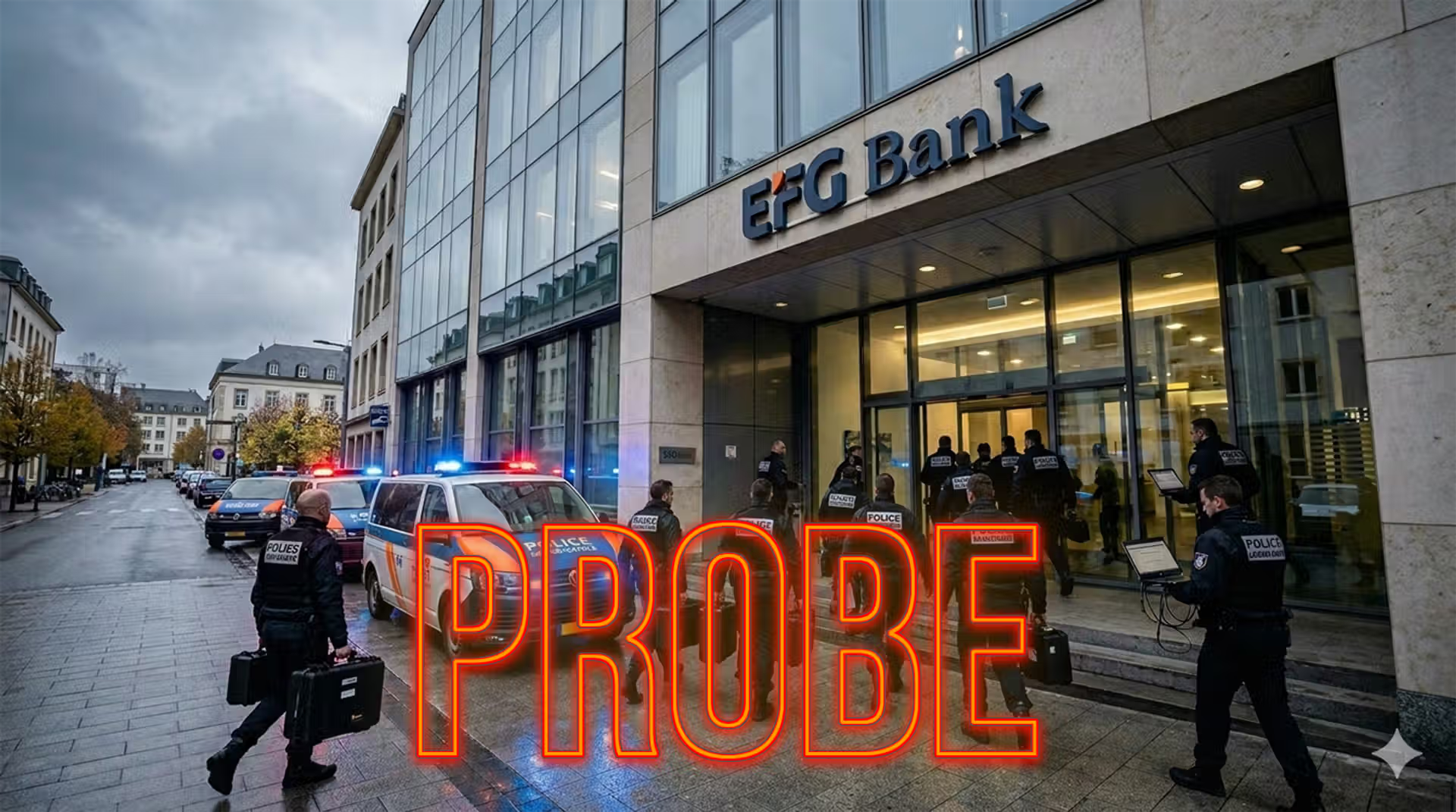
Europol and Eurojust dismantled a cryptomixer laundering service after confirming its role in processing illicit funds, and the case includes a EUR 25 million seizure at the heart of the enforcement action. The takedown of an anonymization platform used for large-scale laundering marked a coordinated effort led by Swiss and German authorities with Europol support. The operation centered on stopping the flow of concealed cryptocurrency transactions linked to serious criminal activity. Officials highlighted the financial scale of the platform while underlining how its mixing features enabled the movement of criminal proceeds. The service had been active for years and its infrastructure allowed offenders to mask the origin of funds across both clear web and dark web channels.
Table of Contents


Laundering Architecture Behind Cryptomixer
The operation targeted a mixing service that pooled digital assets from thousands of customers, then redistributed them after random delays. Law enforcement confirmed that three servers were seized in Switzerland along with the platform’s domain and more than EUR 25 million in Bitcoin. The mixing technology relied on a hybrid setup that allowed users to operate either through traditional browsers or dark web environments, which increased its attractiveness to criminal networks.
Since its launch in 2016, its transaction pool has processed more than EUR 1.3 billion in Bitcoin, and the mixing activity obscured the movement of funds tied to ransomware groups, drug trafficking networks, weapons traffickers, fraudulent payment card operations, and dark web marketplaces.
The architecture made tracing transactions on public blockchains significantly more difficult. Offenders could send deposits that were combined with those from unrelated users for prolonged time periods, and the service redistributed them in random batches to specified wallets. That concealment broke the link between source and destination, effectively laundering illicit proceeds before they reached exchanges or cash-out mechanisms.
The seizure of servers allowed authorities to preserve more than 12 terabytes of data, which may now support forensic blockchain analysis and the identification of the actors behind earlier flows.
The operation exemplifies how financial crime actors use decentralized financial tools to bypass traditional monitoring. Law enforcement agencies pointed out that mixers such as this one operate outside regulated financial channels, allowing criminals to avoid transaction monitoring rules, record-keeping obligations, and customer identification checks. These gaps create opportunities to disguise funds generated through cross-border criminal marketplaces, and the architecture of mixers provides a persistent challenge for AML frameworks.
Cross-Border Coordination and Data Recovery
The action week took place in Zurich through a joint effort of Swiss and German authorities, supported by Europol under the EMPACT framework. Early coordination enabled the confiscation of digital assets, servers and the domain, as well as the recovery of stored information from the infrastructure. Once seized, the platform displayed a law enforcement banner signaling the shutdown, a common measure to prevent further misuse.
Investigators confirmed that the platform was frequently used to reroute funds after ransomware incidents. Criminal groups relied on the service to launder Bitcoin gained through extortion operations, and the randomization process allowed them to move proceeds to fresh wallets free from direct traceability. Blockchain forensic experts now anticipate that data obtained from the servers could reveal transaction flows that were previously masked, which may support future charges against money laundering networks.
The action followed previous efforts by Europol to disrupt anonymous transaction tools, including the 2023 takedown of another service that at the time was the largest in operation. The 2025 case further demonstrates how money laundering typologies evolve as criminals adopt new obfuscation systems. Authorities noted that mixers function as critical layers in laundering chains, especially when offenders seek to remove identifiable transaction patterns.
Criminal Market Reliance on Mixing Services
The case highlights the persistent reliance of dark web operators on mixing infrastructure. Drug traffickers and weapons sellers use these systems to distance their profits from initial sales. Payment card fraud networks have also adopted digital currencies as a settlement method, and mixers provide the intermediary step that cloaks their transfers. As criminal marketplaces continue to embrace cryptocurrencies, laundering via mixers becomes central to sustaining their operations.
Criminal users often route Bitcoin through several mixers before sending funds to exchanges. Once mixed, offenders transfer assets to accounts on regulated trading platforms, where they can convert cleaned cryptocurrency into other assets or cash. Although compliance teams at exchanges monitor for suspicious patterns, the random distribution process breaks the transaction history, presenting limited indicators for automated monitoring systems.
Digital currency users who operate within legitimate purposes rarely need mixing services, and the technology’s main clientele remains criminal actors seeking anonymity. Law enforcement agencies continue to stress the need for cooperation between blockchain analytics firms, AML teams, and investigative units to detect suspicious patterns linked to mixer outputs. The confiscation of structured data in this case could provide benchmarks for improved detection and help regulators define enhanced monitoring requirements for virtual asset service providers.
Enforcement Impact and Forward-Looking Assessment
Authorities described the seizure as a significant disruption to laundering networks that depended on the platform to obscure Bitcoin flows. The shutdown removes a long-standing mechanism that supported laundering across multiple criminal domains, including cybercrime and cross-border trafficking. The confiscated digital assets and stored data create a foundation for retrospective analysis, enabling investigators to map flows that were previously concealed.
Regulators emphasize the importance of continuous adaptation of AML controls as mixers evolve. The case serves as evidence that digital laundering infrastructures require coordinated responses across jurisdictions, particularly when servers and operations span several countries. By removing a key service used by ransomware operators and dark web vendors, enforcement agencies have limited the laundering pathways available and signaled their capability to act against anonymization tools.
Future operations may continue to focus on platforms that offer high levels of concealment without compliance measures, especially where their architecture enables the large-scale anonymization of criminal proceeds.
Key Points
- A mixing service used to hide cryptocurrency transactions was dismantled
- The operation yielded EUR 25 million in seized Bitcoin
- Servers and the domain were confiscated along with 12 terabytes of data
- The platform mixed more than EUR 1.3 billion in Bitcoin since 2016
- Authorities targeted the laundering methods used by cybercrime and trafficking groups
Related Links
- Europol Official Website
- Eurojust Official Website
- Swiss Federal Police
- German Federal Criminal Police Office
- FATF Guidance on Virtual Assets
Other FinCrime Central Articles About Crypto Mixers
- Explosive Tornado Cash Trial Puts Crypto Mixer’s True Purpose Under the Microscope
- Cryptocurrency Mixers and the Fight Against Money Laundering
- 8 Crypto Money Laundering Techniques, 6 Containment Solutions, and 6 Things Regulators Can Change
Source: Europol
Some of FinCrime Central’s articles may have been enriched or edited with the help of AI tools. It may contain unintentional errors.
Want to promote your brand, or need some help selecting the right solution or the right advisory firm? Email us at info@fincrimecentral.com; we probably have the right contact for you.