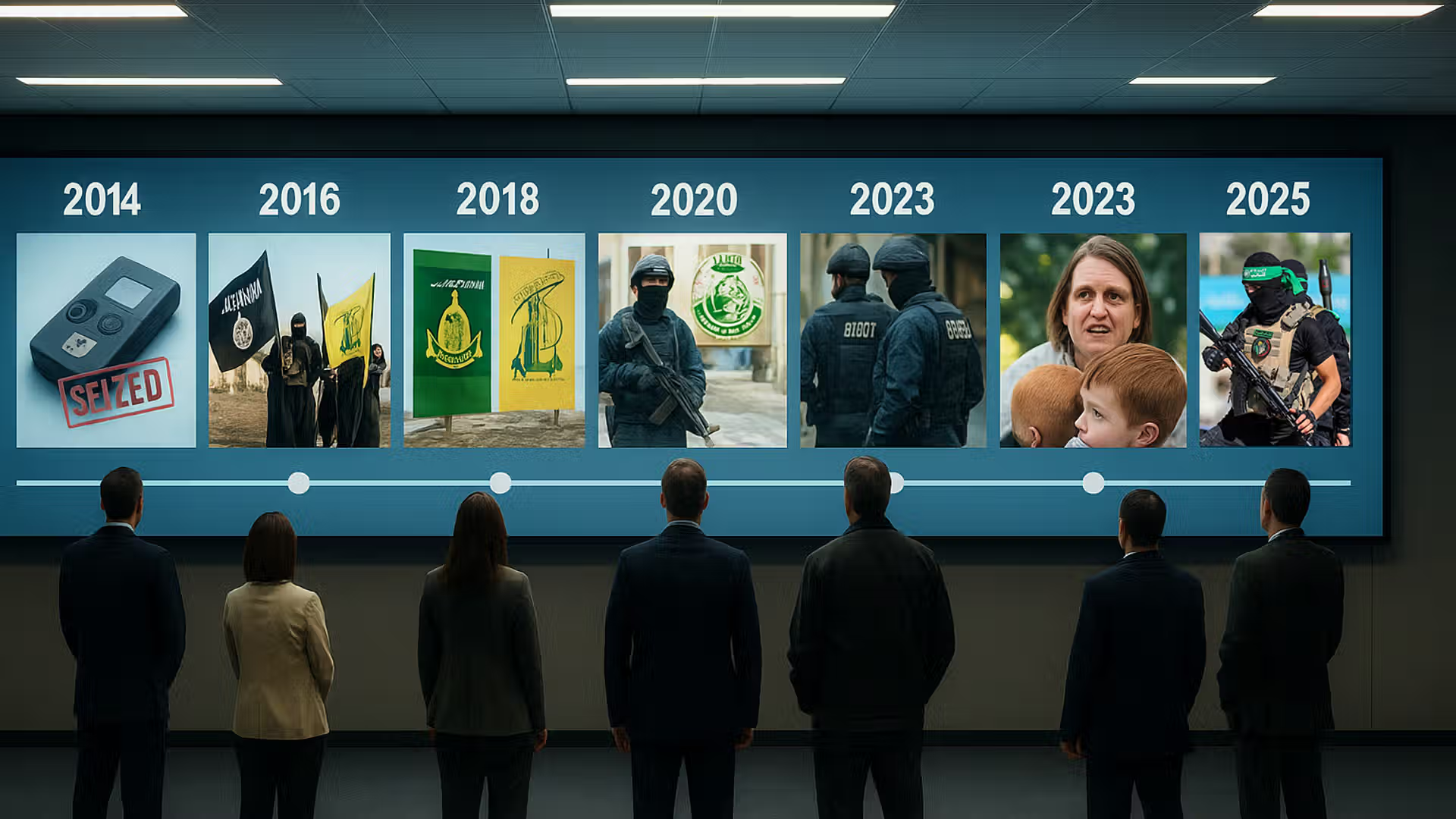
An exclusive article by Fred Kahn
The growing sophistication of extremist fundraising through digital assets is far from a recent development. This article revisits a pivotal case that demonstrated how cryptocurrency was already being exploited for terrorism financing years before the issue entered mainstream debate. The investigation uncovered early patterns of wallet use, platform exploitation, and online propaganda that not only funded violent networks but also foreshadowed the tactics still seen today. By retracing these events, the case offers a clear reminder that the link between blockchain technology and terrorism financing has deep roots and requires a long-term, adaptive response from investigators and compliance professionals alike.
Table of Contents


Terrorist Financing Cryptocurrency Patterns Exposed By Coordinated Seizures
Five years ago, coordinated actions against three intertwined campaigns revealed a repeatable playbook. Public facing donation pages and social channels pitched quick, borderless support. Wallet addresses rotated, sometimes with per donor address generation. Messaging urged privacy tools, along with basic operational tips designed to make funds flow without detection. Despite these tactics, investigators tied donation streams to clusters of addresses, identified administrators, and attributed custodial off ramps that converted digital assets to fiat or goods. More than three hundred accounts were mapped across services. Millions in value were interdicted alongside multiple sites and pages that amplified the solicitation.
The first cluster used donation portals that promised anonymity. The pages generated unique addresses and encouraged users to avoid simple tracebacks. Despite the claims, transactional footprints linked to a set of receiving addresses that fed a central treasury. From there, movement patterns showed common behaviors, including consolidation, test sends, and timed transfers aligned with messaging spikes on social channels. Investigators obtained authority to seize the infrastructure and, for a period, operated a mirror that received inbound funds into controlled wallets, cutting off resources while preserving evidentiary trails.
A second cluster operated from conflict zones and portrayed itself as humanitarian support while signaling a harder edge to insiders. Channels offered detailed instructions, requested specific equipment, and provided price points meant to normalize the ask. Behind the scenes, administrators layered transfers through nested services, cross chain hops, and automated splitting scripts. The layering slowed investigators but did not prevent the identification of wallet clusters and custodial choke points. A third operation mixed classic fraud with extremist facilitation, selling protective equipment during a public health emergency and redirecting proceeds. The storefronts looked legitimate, order flows were processed through mainstream instruments, and back end wallets forwarded value to handlers. Combined, the operations illustrated how digital commerce fronts, donation campaigns, and crypto rails can blur together.
From a controls perspective, the patterns matter more than the names. Points of exposure included static wallets posted on repeat, predictable address reuse, custodial exchange cash outs, bulk gift card purchases, and merchant services with mismatched profiles. The network graph showed reliable artifacts such as peel chains, consolidation wallets, bridge use at specific intervals, and time stamped bursts after propaganda releases. These artifacts enable case building and support seizure orders that cut off access to the funds and the digital property used to solicit them.
Tracing And Tactics Across Wallets And Platforms
Modern tracing relies on careful linkage rather than shortcuts. Investigators build clusters by connecting addresses that spend together, that interact with known service tags, or that share behavioral signatures. Deposit and withdrawal timing, fee selection habits, typical counterparties, and on chain metadata inform the graph. Off chain data, including records from intermediaries and communication captured under lawful process, enriches the picture. The combination reveals administrators, cash out locations, mule networks, and supply procurement nodes that convert digital value into real world capability.
Donation mechanics tend to evolve along familiar lines. Early phases post static addresses that supporters memorize or share. Mid phases rotate to per session or per donor generation, sometimes through a script that pulls an address from a prebuilt pool. Mature phases adopt payment widgets that assign fresh addresses on request and that attempt to detect blockchain analytics crawlers. Across all phases, the goal remains the same, collect value with minimal friction and delay mapping. Yet reuse creeps in. Reuse of infrastructure, reuse of operators, reuse of know your adversary blind spots, and reuse of cash out channels all create compounding signals.
Chain hopping introduces another layer. Operators bounce value from a well watched network into one with thinner monitoring and then back to a liquid network for off ramp. Bridges, mixers, and privacy tools are combined with service accounts that accept small inflows over long periods. The blending changes the appearance of flows, however liquidity needs force a return to high volume venues. That return is where compliance programs, subpoenas, and court orders converge. Case files often show the same patterns, small probes to exchange deposit addresses, scaling deposits after perceived safety, and withdrawals to local payment rails or to goods suppliers.
Undercover engagement supports the technical work. When a donation portal is mirrored under authority, inbound contributions are captured, and the flow of supporters is measured in real time. Communications with administrators expose procurement priorities and price points that align with observed withdrawals. False fronts, controlled deliveries, and test buys with marked funds validate attribution. These techniques mirror classic financial crime work, adapted to platforms that never sleep and to assets that settle within minutes.
For compliance teams, the practical takeaway is twofold. First, behavior centric controls outperform static lists. Second, velocity and context matter. Monitoring that flags rapid address rotation with common withdrawal endpoints, sudden inflows after propaganda events, or repeated small deposits followed by quick bridge hops will outperform rules that only match against previously seen addresses. Case driven typologies should be encoded into models that alert on combination patterns, not just one signal at a time.
Legal Frameworks And Forfeiture Mechanics
Several statutory authorities underpin these actions and provide a pathway to seize digital assets connected to violent groups or to fraud tied to such groups. Civil forfeiture under 18 U.S.C. § 981 allows the United States to forfeit property involved in or traceable to transactions that violate specified money laundering offenses. This provision applies to digital assets when they are part of laundering conduct or when they are the proceeds of certain crimes. When a court finds probable cause and later establishes forfeitability, the property can be seized and condemned, even when no criminal conviction is obtained against a particular individual, provided the statutory requirements are met.
Criminal forfeiture under 18 U.S.C. § 982 operates upon conviction of defined offenses and allows for the forfeiture of property involved in or traceable to the crime. General procedural rules for civil cases appear in 18 U.S.C. § 983. When violent groups are involved, material support statutes such as 18 U.S.C. § 2339B prohibit knowingly providing support or resources to designated organizations. The statute includes extraterritorial jurisdiction for certain conduct and provides significant penalties. When operators use computers unlawfully to further schemes, charges may include unauthorized access and related conduct under 18 U.S.C. § 1030, better known to practitioners as the core computer crime statute. Fraud based storefronts can also implicate wire fraud under 18 U.S.C. § 1343.
Financial institutions often ask how these authorities intersect with their obligations. The Bank Secrecy Act, codified at 31 U.S.C. §§ 5311 to 5336, requires covered entities to maintain programs, keep records, and file reports that help detect and prevent money laundering and financing of violent activity. Program elements, customer identification, risk based monitoring, and suspicious activity reporting form the operational spine. In practice, records collected under this framework support tracing and attribution when lawfully obtained, and they guide enhanced due diligence for higher risk relationships.
Seizure of digital assets proceeds through standard processes adapted to the technical nature of the property. A court authorizes the seizure based on probable cause that the property is subject to forfeiture. Custody is secured by transferring the assets to controlled wallets or by freezing them at a custodian. Notices issue, claimants have an opportunity to contest, and the government bears the burden to establish forfeitability in civil proceedings. When the property is tied to violent activity, recovered funds may be directed, in whole or in part, to statutory funds established to compensate victims, subject to court orders and eligibility criteria.
International aspects become central when wallets, hosts, or operators sit abroad. Mutual legal assistance, informal cooperation, and joint operations with foreign counterparts enable evidence collection and enforcement. Cross border seizures may require local judicial orders or cooperation agreements. The complexity argues for early engagement between investigators and compliance teams to locate service choke points that are reachable under domestic process. When a custodial venue is in scope, speed matters, because administrators often attempt to move value after learning of an investigation.
Institutional Controls And Practical Playbooks
Financial institutions, exchanges, and payment providers can deploy a layered defense that combines intelligence, analytics, and governance. Begin with a current risk assessment that explicitly covers extremist fundraising typologies on digital rails. The assessment should map product exposure, from retail accounts that buy and sell digital assets to merchant services that process sales for stores with unusual inventory, to remittance corridors that interface with peer to peer platforms. Document the risk appetite and control coverage in a way that examiners and auditors can verify.
Next, encode typologies into detection logic. Examples include rapid address churn with common terminal destinations, deposits that align with propaganda event calendars, repeat use of donation address patterns, or network clusters that bridge to thinly monitored chains before re entering liquid venues. Build models that score combinations of weak signals rather than relying on a single indicator. Pair the models with feedback loops from investigations, so that false positives are suppressed and high value alerts are prioritized. Consider staging a sandbox to test new rules against historical data that includes known cases, then deploy to production after back testing and calibration.
KYC controls remain decisive. Where the business model allows, require documentary verification that goes beyond minimum standards, focusing on the authenticity of merchants, beneficial owners, and stated purpose. For institutional relationships, verify that charity clients have filings and governance consistent with their claims, and validate the physical footprint. For marketplaces that list protective gear, electronics, or dual use items, calibrate onboarding questionnaires to surface red flags about source of supply and order patterns. Assign heightened due diligence tiers to segments that present higher risk, and embed clear exit criteria when misrepresentation is discovered.
On the governance side, establish a response playbook. When a typology alert hits, investigators should follow a checklist that includes on chain tracing, off chain record pulls, request for information to counterparties when permissible, and escalation for potential law enforcement coordination. Preserve evidence with hash based integrity checks. Use decision trees so analysts know when to freeze funds subject to applicable contracts and legal authority. Maintain a matrix that maps statutory frameworks to action types, so teams can consult counsel quickly and move in a compliant manner.
Training and tabletop exercises help. Run a quarterly simulation in which a donation portal pops up, a wave of small transactions arrives, and funds bridge to a secondary chain. Track the response end to end, from triage to case memo to external engagement. Measure time to alert, time to attribution, and time to decisive action. Update controls based on lessons learned. Sustain a watchlist of typology features derived from public cases and from your own portfolio. Keep the list short, concrete, and operational, so it actually shapes analyst behavior.
Ongoing Use Of Crypto By Terror Networks Despite Greater Awareness
Greater awareness in the compliance sector has not eliminated the underlying threat posed by cryptocurrency-fueled terrorism financing. Over the past few years, financial institutions, exchanges, and regulators have invested heavily in blockchain analytics, enhanced due diligence procedures, and real-time monitoring systems. Training programs, public advisories, and intelligence-sharing initiatives have improved understanding of how extremist groups operate in the digital realm. Yet, despite these advances, groups such as Hamas and Hezbollah continue to exploit cryptocurrency as a reliable funding mechanism for their operations.
The same traits that initially attracted these organizations to digital assets—fast settlement, borderless transactions, and the perception of anonymity—remain firmly in place. Investigations may temporarily disable specific wallet clusters, merchant accounts, or online donation portals, but replacement infrastructure is often established within days or even hours. In some cases, newer platforms are designed to be more resistant to tracing, using privacy coins, cross-chain swaps, or decentralized protocols that fall outside traditional oversight. This cat-and-mouse cycle keeps compliance teams under constant pressure to adapt their detection models and escalate suspicious activity before funds can be converted into weapons, logistics, or propaganda.
The persistence of this threat underscores that vigilance in the compliance sector cannot be reactive or episodic. Institutions must maintain continuous, intelligence-led monitoring that goes beyond static blacklists and instead focuses on behavioral analysis across multiple transaction rails. Collaboration with law enforcement, industry peers, and technology providers remains critical to closing the gaps exploited by these networks. Ultimately, while awareness has grown, the ongoing use of cryptocurrency by terrorist organizations makes it clear that disruption requires sustained operational focus, innovation in detection, and a willingness to challenge the evolving tactics of adversaries determined to keep their funding lines alive.
Related Links
- Global Disruption of Three Terror Finance Cyber-Enabled Campaigns
- Justice Department Disrupts Hamas Terrorist Financing Scheme Through Seizure of Cryptocurrency
- 18 U.S.C. § 981 Civil Forfeiture
- 18 U.S.C. § 2339B Providing Material Support or Resources to Designated Foreign Terrorist Organizations
- 2022 National Terrorist Financing Risk Assessment
Other FinCrime Central Articles About the Use of Crypto for Terrorism Financing
- How Terrorism Financing Exploits Bitcoin’s Safe-Haven Status in Argentina
- US Crackdown on Hamas Virtual Currency Reveals Turkey’s Role in Terrorism
- How Crypto Deregulation Could Empower Terrorism and Extremism
Source: U.S. DOJ
Some of FinCrime Central’s articles may have been enriched or edited with the help of AI tools. It may contain unintentional errors.
Want to promote your brand, or need some help selecting the right solution or the right advisory firm? Email us at info@fincrimecentral.com; we probably have the right contact for you.